When you think of your earliest memory of reality television, what comes to mind? Is it “The Real World,” “Survivor” or “The Bachelor”? Perhaps it’s other fare like “Project Runway” or one of the “Real Housewives” franchises.
Growing up in the ‘90s and early aughts, my first exposure to reality programming was MTV’s slate of shows like “Real World” and “Road Rules” — thanks to being the youngest of four siblings, I was exposed to shows that were, in hindsight, too risque for me at too young an age. But they left an indelible mark. I saw Irene McGee of “Real World: Seattle” get slapped by her roommate Stephen Williams, a moment that at the time sent shock waves. Genesis Moss, of the Boston cast, was one of my earliest exposures to a gay person on TV. And Melissa Howard of the New Orleans season showed me how you can be 5-foot-2 and unapologetically feisty — as someone with a similar build and demeanor, I took that to heart.
Over the years, I’ve sometimes dismissed reality TV because it felt a little too personal or a little too competitive. I often wonder about the psychological effect on participants as their lives are laid bare for all to see. However, I can’t deny their appeal and why fans have continued to gravitate toward these shows season after season. They make for excellent watercooler talk; in recent weeks, my co-workers and I have spoken endlessly about “The Bachelorette” and Taylor Frankie Paul, and who did or didn’t stay married from Season 10 of “Love Is Blind.”
Few of us knew in the early days what effect reality television would have on the culture or how it would create a new type of star. Reality TV personalities have become influencers, pop culture icons and even political figures. One is the president.
And many shows have not only endured, they’ve spawned universes, international adaptations and spinoffs. Bravo, a TV channel that used to focus on the performing arts, is now an unscripted powerhouse that even has its own convention, BravoCon, where its various universes come together in service of fans.
What does that say about us as viewers? There’s always been a fascination with peering into the lives of others, seeing how they react to everyday problems under the glare of a camera. Perhaps it is a way to deflect from the reality of our own lives, which under the guise of normalcy is straining with the weight of political upheaval and economic turmoil, not to mention personal strife. Seeing someone else onscreen deal with their reality is sometimes the best escape.
So like it or not, reality television is here to stay.
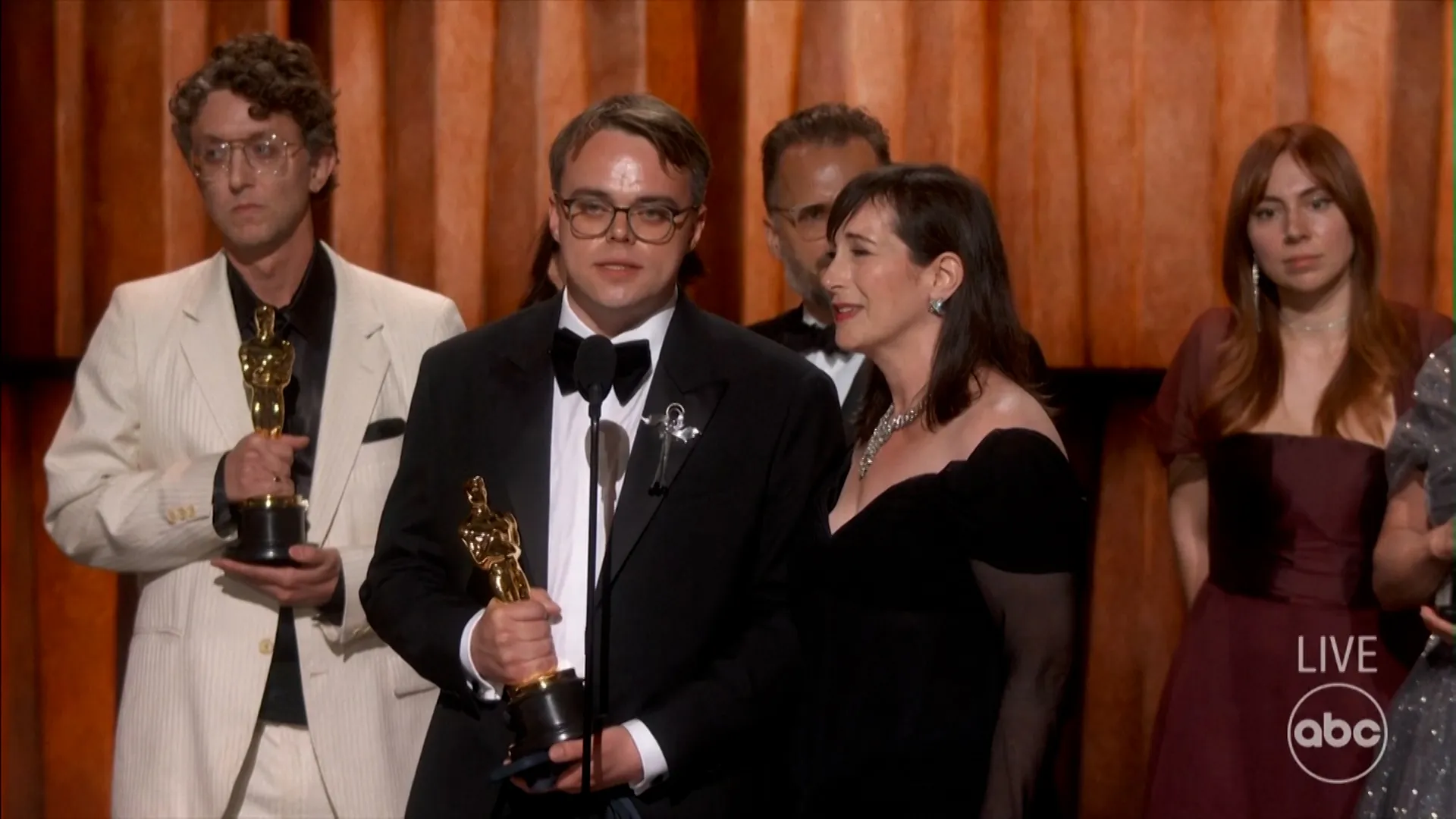
One Battle After Another was the big winner of the 98th Academy Awards, taking home six Oscars.
Paul Thomas Anderson’s black comedy about a has-been revolutionary won Best Picture, Best Director, Best Adapted Screenplay, Best Supporting Actor, Best Film Editing, and Best Casting.
Recommended Stories
list of 1 itemend of list
Sinners, which entered the ceremony with a record 16 nominations, was the second-biggest winner of the night, with four awards.
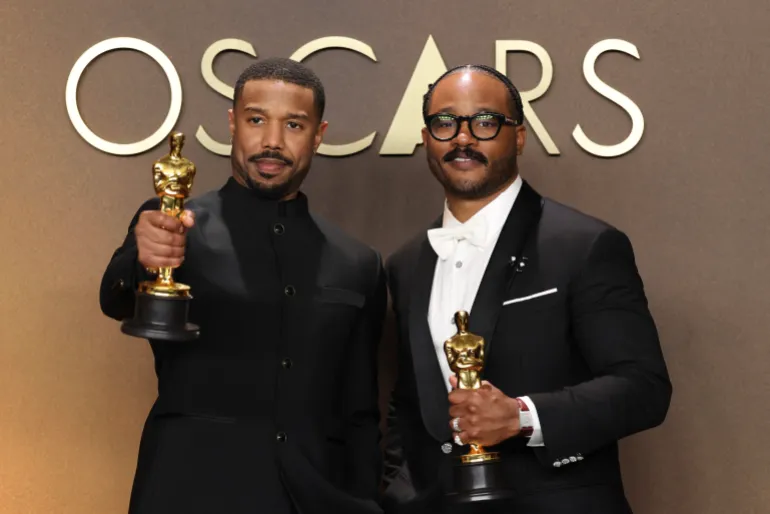
Michael B Jordan earned Best Actor for his leading role, while director Ryan Coogler picked up his first Oscar for Original Screenplay.
In the acting categories, Jessie Buckley won Best Actress for Hamnet, marking her first Academy Award, while Amy Madigan was recognised as Best Supporting Actress for Weapons.
Elsewhere, the South Korean musical fantasy KPop Demon Hunters won two Oscars, while Frankenstein also secured two awards.
Here is the full list of winners:
Best Picture One Battle After Another
Best Actress Jessie Buckley, Hamnet
Best Actor Michael B Jordan, Sinners
Best Supporting Actress Amy Madigan, Weapons
Best Supporting Actor Sean Penn, One Battle After Another
Best director Paul Thomas Anderson, One Battle After Another
Best Original Score Ludwig Göransson, Sinners
Best Animated Film KPop Demon Hunters
Best International Feature Sentimental Value
Best Documentary Feature Mr Nobody Against Putin
Best Casting Cassandra Kulukundis, One Battle After Another
Best Sound Gareth John, Al Nelson, Gwendolyn Yates Whittle, Gary A Rizzo and Juan Peralta, F1
Best Original Screenplay Ryan Coogler, Sinners
Best Adapted Screenplay Paul Thomas Anderson, One Battle After Another
Best Documentary Short All the Empty Rooms
Best Live Action Short Film The Singers and Two People Exchanging Saliva (tie)
Best animated short film The Girl Who Cried Pearls
Best Music (Original Song): EJAE, Mark Sonnenblick, Joong Gyu Kwak, Yu Han Lee, Hee Dong Nam, Jeong Hoon Seo and Teddy Park for Golden, KPop Demon Hunters
Best Film Editing: Andy Jurgensen, One Battle After Another
Best Cinematography: Autumn Durald Arkapaw, Sinners
Best Production Design: Tamara Deverell and Shane Vieau, Frankenstein
Best Costume Design Kate Hawley, Frankenstein
Best Makeup and Hairstyling Mike Hill, Jordan Samuel and Cliona Furey, Frankenstein
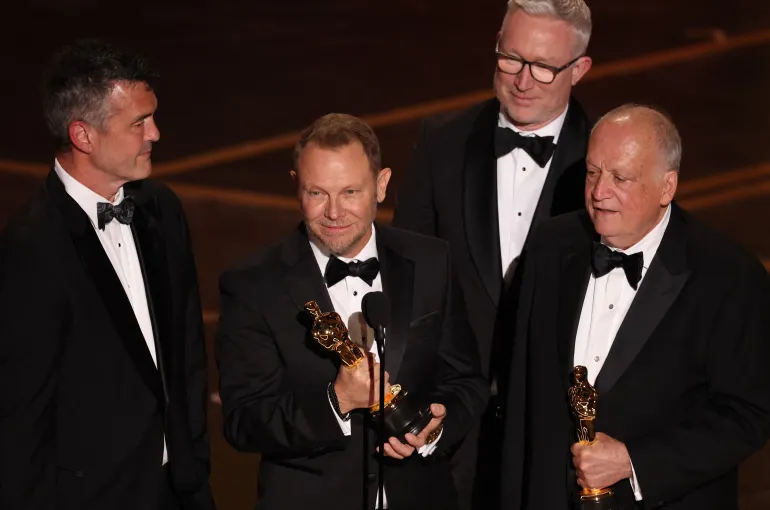
Best Visual Effects Joe Letteri, Richard Baneham, Eric Saindon and Daniel Barrett, Avatar: Fire and Ash
Visual effects supervisor Eric Saindon, visual effects artist Richard Baneham, Daniel Barrett and visual effects supervisor Joe Letteri accept the award for Best Visual Effects for Avatar: Fire and Ash [Patrick T. Fallon/AFP]
As anticipated, it ended up being One Battle After Another’s night at the 98th annual Academy Awards, with the political thriller carting away six Oscars out of a total of 13 nominations.
But while Paul Thomas Anderson’s magnum opus continued its march towards award-season domination, there were moments of genuine surprise and subversion in Sunday’s ceremony.
Recommended Stories
list of 3 itemsend of list
Some of those moments had to do with the current political climate in the United States.
Host Conan O’Brien and his fellow presenters deftly avoided mentioning President Donald Trump by name, but their barbs took direct aim at his policies since returning to office.
Other surprises came from within the filmmaking community itself. For only the seventh time in Oscar history, a tie was announced: Two films had gotten an equal number of votes for Best Live Action Short.
As a result, both the surrealist thriller Two People Exchanging Saliva and the moody bar-room drama The Singers shared the Academy Award.
Here are six key takeaways from the night.
Actor Michael B Jordan holds the Oscar for Best Actor next to director Ryan Coogler, who earned an Oscar for Best Original Screenplay [Valerie Macon/AFP]
A two-horse race between Sinners and One Battle
The vampire film Sinners came into Sunday night’s ceremony with a record 16 Oscar nominations. But the big question of the night was: How many nods could it actually convert into wins?
Its biggest competition was, of course, Anderson’s One Battle After Another, which had the second highest tally of nominations.
Sinners director Ryan Coogler and Anderson were in direct competition in several top categories, including Best Picture and Best Director.
In both cases, Anderson came out ahead, though he acknowledged how fickle such awards can be.
“ I just want to say that, in 1975, the Oscar nominees for Best Picture were Dog Day Afternoon, One Flew Over the Cuckoo’s Nest, Jaws, Nashville and Barry Lyndon,” the four-time Best Director nominee said, listing films now considered to be Hollywood classics.
“There is no best among them. There is just what the mood might be that day.”
In the categories for Best Supporting Actor and Best Film Editing, One Battle After Another also triumphed, as well as for the inaugural award for Best Casting.
But in a sign of how well matched their two films were, both Coogler and Anderson emerged from the night with writing Oscars.
Anderson picked up Best Adapted Screenplay award for his use of the Thomas Pynchon novel Vineland, while Coogler made off with the Best Original Screenplay Oscar for Sinners, a work inspired by his uncle’s love of the blues.
US cinematographer Autumn Durald Arkapaw poses in the press room with her Oscar for Best Cinematography [Valerie Macon/AFP]
Jordan dunks on Chalamet in Best Actor race
Sinners, which won four Academy Awards overall, earned some of the most emotional, nail-biting victories of the night.
In the Best Cinematography category, for instance, Autumn Durald Arkapaw became the first woman to top the field.
It was her first nomination and first win, with Arkapaw besting veteran cinematographers like Marty Supreme’s Darius Khondji and Frankenstein’s Dan Laustsen, both multiple nominees.
Another big win for Sinners came in the form of Michael B Jordan, the actor whom Coogler has cast in every film since his directorial breakout in 2013’s Fruitvale Station.
Jordan, 39, was in a tight race for Best Actor with another young performer, 30-year-old Timothee Chalamet of the 1950s ping-pong drama Marty Supreme.
But Chalamet’s aggressive campaigning may have ultimately sabotaged his prospects. Multiple cracks were taken throughout the night at Chalamet’s recent comments disparaging opera and ballet.
“Nobody cares anymore” about either art form, Chalamet said in an interview last month.
“We can change society through art, through creativity, through theatre and ballet and also cinema,” director Alexandre Singh said pointedly during his acceptance speech for Best Live Action Short.
O’Brien, meanwhile, acknowledged the backlash with a joke about heightened security at the night’s Oscar ceremony.
“I’m told there are concerns about attacks from both the opera and ballet communities,” O’Brien said, before turning to Chalamet. “They’re just mad you left out jazz.”
Irish actress Jessie Buckley celebrates her win during the 98th Annual Academy Awards [AFP]
A conga line of snubs
Given the dominant performances from Sinners and One Battle After Another, plenty of critically acclaimed films left empty-handed, or nearly so.
Guillermo del Toro’s Frankenstein, as expected, earned three wins in technical categories, including Best Production Design, Best Costumes and Best Hairstyling and Makeup.
Netflix’s smash hit KPop Demon Hunters, meanwhile, also fulfilled expectations that it would dominate in its categories, Best Animated Feature and Best Original Song.
But then there were former frontrunners like Hamnet that failed to generate much traction, including for director Chloe Zhao, a past Oscar winner. Out of eight nominations total, it only came away with one win: a Best Actress trophy for Irish performer Jessie Buckley.
Marty Supreme and the Brazilian film The Secret Agent fared worse, however. Despite having nine nominations and being considered an early shoo-in for Best Actor, Marty Supreme scored no wins.
The Secret Agent, which swept the Best Actor and Best Director categories at the 2025 Cannes Film Festival, also earned nothing at this year’s Oscars.
Same was true for the quirky kidnapping drama Bugonia, from Oscar darling Yorgos Lanthimos.
South Korean-US singer Ejae poses with the Oscar for Best Original Song for the film KPop Demon Hunters[Angela Weiss/AFP]
Fears about artificial intelligence
The ceremony, however, did occasionally veer away from the competition between the films to discuss issues facing the film industry and the country as a whole.
Among those was the creeping growth of artificial intelligence (AI) in the creative sector.
In the weeks leading up to the 98th Oscars, an AI-generated video clip had gone viral, appearing to show Hollywood icons Brad Pitt and Tom Cruise in a rooftop brawl worthy of a James Bond movie.
The clip had been generated through AI software developed by the Chinese firm ByteDance, and Hollywood leaders quickly denounced it as a threat to their livelihood, not to mention a copyright infringement.
Those concerns reverberated on the Oscar stage on Sunday, with O’Brien and others addressing the growing use of AI.
“Tonight we are celebrating people, not AI, because animation – it’s more than a prompt,” actor Will Arnett said emphatically as he introduced the animation awards.
O’Brien, meanwhile, joked that, by next year, his hosting gig would be taken by “a Waymo in a tux”.
Host Conan O’Brien performs onstage during the 98th Annual Academy Awards [Patrick T Fallon/AFP]
Trump skewered for threatening free speech
Another concern looming over the night’s Oscar ceremony came in the form of President Donald Trump, who has courted controversy by launching deadly military attacks in Venezuela and Iran, as well as leading a violent immigration crackdown in the US.
At no point was Trump mentioned by name. But his leadership was alluded to throughout the night.
O’Brien, the host, set the tone early on with his oblique jabs at the Republican president in his opening monologue.
“When I hosted last year, Los Angeles was on fire,” the two-time Oscar emcee said in remarks dripping with sarcasm. “But this year, everything’s going great.”
Fellow comedian Jimmy Kimmel was even more direct. Last September, his show was briefly suspended after Trump criticised the comedian.
The head of the Federal Communications Commission, a Trump appointee, subsequently threatened the broadcasting license of the TV channel Kimmel performs on.
“There are some countries whose leaders don’t support free speech. I’m not at liberty to say which. Let’s just leave it at North Korea and CBS,” Kimmel quipped, referring to another channel that cancelled a fellow late-night comedy show.
Several filmmakers honoured at the Oscars likewise waded into the controversies surrounding Trump.
Best Documentary Feature winner David Borenstein, for instance, implied a parallel between his film — an exploration of authoritarianism in Russia — and what is currently happening in the US.
“Mr Nobody against Putin is about how you lose your country,” Borenstein explained.
“What we saw when working with this footage is that you lose it through countless small little acts of complicity: when we act complicit, when a government murders people on the streets of our major cities, when we don’t say anything, when oligarchs take over the media.”
Indian actress Priyanka Chopra and Spanish actor Javier Bardem present the award for Best International Feature Film [Patrick T Fallon/AFP]
Political speeches avoid mention of Iran war
The Oscars come roughly seven months ahead of the pivotal midterm elections in the US, which could see Trump’s Republican Party lose its majorities in Congress.
But while several filmmakers did hint at their anti-Trump stances, few explicitly denounced his policies.
For example, Norway’s Joaquim Trier, the winner of the Best International Feature category, veiled his criticism in a James Baldwin quote about the duty to protect children.
“Let’s not vote for politicians who don’t take this seriously into account,” Trier said.
No artist during the night referenced the US and Israeli war against Iran either, though its effects were felt among the participants of this year’s Oscar crop.
Writer-director Jafar Panahi, whose work was up for two Oscars on Sunday, has already said he plans to return to his native Iran after the awards season concludes.
Meanwhile, Iranian politician Sara Shahverdi — the subject of a nominee in the Best Documentary Short category — was prevented from attending the Oscars at all due to Trump’s ban on visas for 39 countries.
Palestinian actor Motaz Malhees, star of the Oscar nominee The Voice of Hind Rajab, likewise told media outlets he could not be present at the ceremony due to the travel ban.
The most pointed acknowledgements of the US-led and US-backed conflicts in the world were brief. When Spanish actor Javier Barden took the Oscar stage to present an award, he offered up six words, “No to war, and free Palestine!”
Russian filmmaker Pavel Talankin, meanwhile, made a similar appeal to the audience. “In the name of our future, in the name of all of our children, stop all of these wars now,” he said.
But by and large, the Oscar winners and presenters kept their remarks vague, emphasising global unity over political criticism.
“If I can be serious for just a moment, everyone watching right now around the world is all too aware that these are very chaotic, frightening times,” O’Brien told the audience at the outset of the night.
“It is at moments like these that I believe that the Oscars are particularly resonant. Check it out. Thirty-one countries across six continents are represented this evening, and every film we salute is the product of thousands of people speaking different languages.”
Cinema, he and others argued, transcended borders. The talent on stage was not the US’s alone.
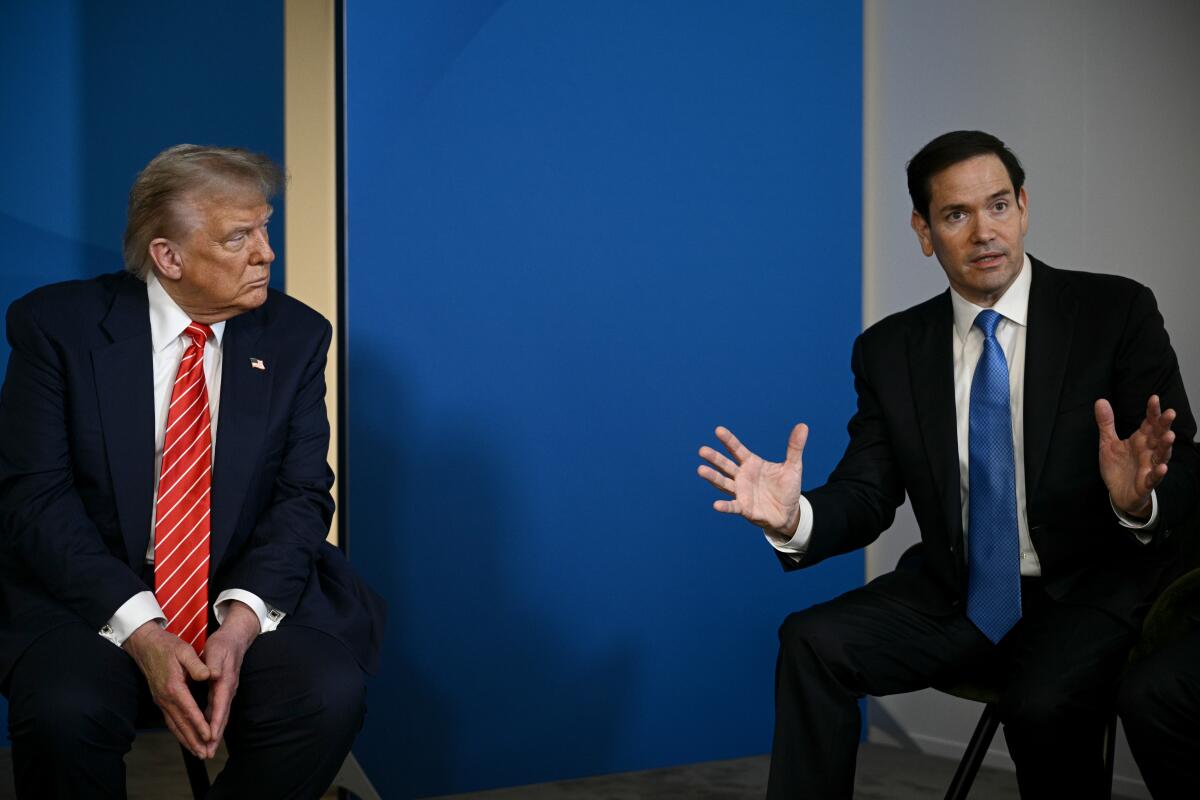
The pet did a neat trick: Before a room filled with heads of state from across Latin America, Little Marco spoke Spanish.
His owner — well, his soul’s owner at least— grinned and joked, “I think he’s better in Spanish” than in English. Following President Trump, it was Pentagon Pete’s turn to tease Little Marco.
“I only speak American,” Secretary of Defense Hegseth cracked. The auditorium stayed quiet save for Secretary of State Marco Rubio, who meekly protested, “I only speak Cuban.”
Trump gave him a pat on the back. Good boy, Marco.
The exchange, which happened over a weekend dominated by the war with Iran, was brief yet said so much about the times Latinos live in. Rubio, the most powerful Latino politician in U.S. history, might as well have been to Trump and Hegseth the Chihuahua that says “Yo quiero Taco Bell.” The man who has played an oversized role in pushing a president who campaigned against costly foreign wars and chaotic regime changes to do both was brought back down to an undignified size.
Little Marco indeed.
Here’s a reminder that no matter how high and mighty you get in Trump’s White House, a Latino is still an exotic “other.”
Tokenizing someone is always an ugly thing — yet Rubio deserves no tears. He has made a career out of wearing his latinidad like a shiny guayabera when convenient, long casting himself as the boy-faced exception to the corrupt, ineffectual Latino politician archetype. That stance has fueled a 27-year career — Florida speaker of the House, U.S. senator, former presidential candidate, secretary of State and national security advisor. That has made many conservatives and more than a few Latinos feel he’s not just capable of a strong White House run but that he could even win were he to do so.
All it cost Rubio was his morals and backbone. All he had to do was roll over.
We Latinos deserve better — and yet we kind of don’t.
The story liberals and conservatives have always told about America’s largest minority is that we would irrevocably change the United States — the former group maintained it would be for the better, the latter insisted we would cause this country’s downfall. Rubio proves that at our worst, Latinos show that in our rush to assimilate and be embraced, we often become the worst kind of Americans.
Secretary of State Marco Rubio speaks as President Trump during a NATO summit in June in the Hague.
(Brendan Smialowski / Pool Photo)
We’re the ones whom the American psyche sees as perpetual invaders, yet we sign up by the thousands for the Border Patrol, Immigration and Customs Enforcement and other agencies in Trump’s deportation Leviathan. Even as Trump slimed Latinos during his first term and his years out of office, an increasing number of us warmed up to him — surely, he was referring to other Latinos — until Trump captured more of our votes in 2024 than any Republican presidential candidate ever.
It takes a certain type of person to go from child of Cuban immigrants — the favorite son of an exile community that transformed Miami from a retiree haven into one of the capitals of Latin America — to tell European leaders last month that they and the United States “opened our doors to an unprecedented wave of mass migration that threatens the cohesion of our societies, the continuity of our culture, and the future of our people.”
It takes the worst kind of Latino.
I called Rubio a vendido in a previous columna after he cheered on the extrajudicial capture of Venezuelan despot Nicolás Maduro. He’s definitely still a sellout — what else to call someone who once fiercely opposed Trump but now sidles up to him like a cockapoo? But the most pathetic part about Rubio’s rise is that his followers see him as the culmination of the long-held dreams of Latinos that things would become better for our ancestral Latin American countries and ourselves once one of us was charge.
Alas, no. He’s living up to a realpolitik maxim attributed to various Latin American caudillos: For my friends, everything; for my enemies, the law.
Strongmen like El Salvador and Argentina presidents Nayib Bukele and Javier Milei get coddled and receive foreign aid; college students on study visas who criticize the Trump administration get nabbed by la migra. Rubio is overseeing a foreign policy that currently has the U.S. dictating how Venezuela will be governed, is bombing Iran like the country was a game of Pachinko and is slowly choking Cuba into collapse. He’s the unholy child of Bush-era neoconservativism and MAGA — and Rubio is just getting started.
That’s how he set himself up to be used as Latino punch line by Trump and Hegseth. The setting: the inaugural meeting at a Trump golf course near Miami of the Shield of the Americas, a coalition of Western Hemisphere countries ostensibly assembled to fight drug cartels. It resembled one of those lesser super-groups in the Marvel Cinematic Universe — you got Costa Rica instead of Mexico, Bolivia instead of Brazil. The group even has a crappy logo. You know how unserious the confab was when Trump’s point person for this is Kristi Noem, whom he literally had just fired as Homeland Security secretary.
After Trump rambled through a short speech, it was Rubio’s time to offer remarks. Here was a chance for the secretary of State, the man the Atlantic recently called “bright and well spoken,” to channel his inner Simón Bolivar or José Martí. The secretary of State thanked everyone present in English, but not before praising Trump for his “bold leadership” and bragging that the president is “one of the most historic figures in American history.”
Then Rubio looked back at his beaming master.
President Trump signs a proclamation committing to countering cartel criminal activity at the Shield of the Americas Summit on Saturday at Trump National Doral Miami in Doral, Fla.
(Rebecca Blackwell / Associated Press)
“You all right if I — “ he began before Trump cut him off with a magnanimous, “Sure. Please.”
That’s when Little Marco spoke in flawless Spanish. Rubio’s comments weren’t much different from what he said in English, save his remark that what they all planned to do by following Trump “will make future generations grateful for the work we are doing today.”
That last statement sums up Rubio. For centuries, Latin America has yearned for prosperity and peace free from American interference. This hope has fueled revolutions, music, film, culture and all the best things the region has produced only to have U.S.-backed tyrants crush those movements.
That’s the torch Rubio now proudly carries.
“All my life I’ve been in a hurry to get to my future,” he wrote in his 2013 memoir, “American Son.” Rubio’s future is now. And our present — not just Latinos, but all Americans — is worse because of it.
At a time when so many forces seem to be dividing us as a nation, it is tragic that President Trump seeks to co-opt or destroy whatever remaining threads unite us.
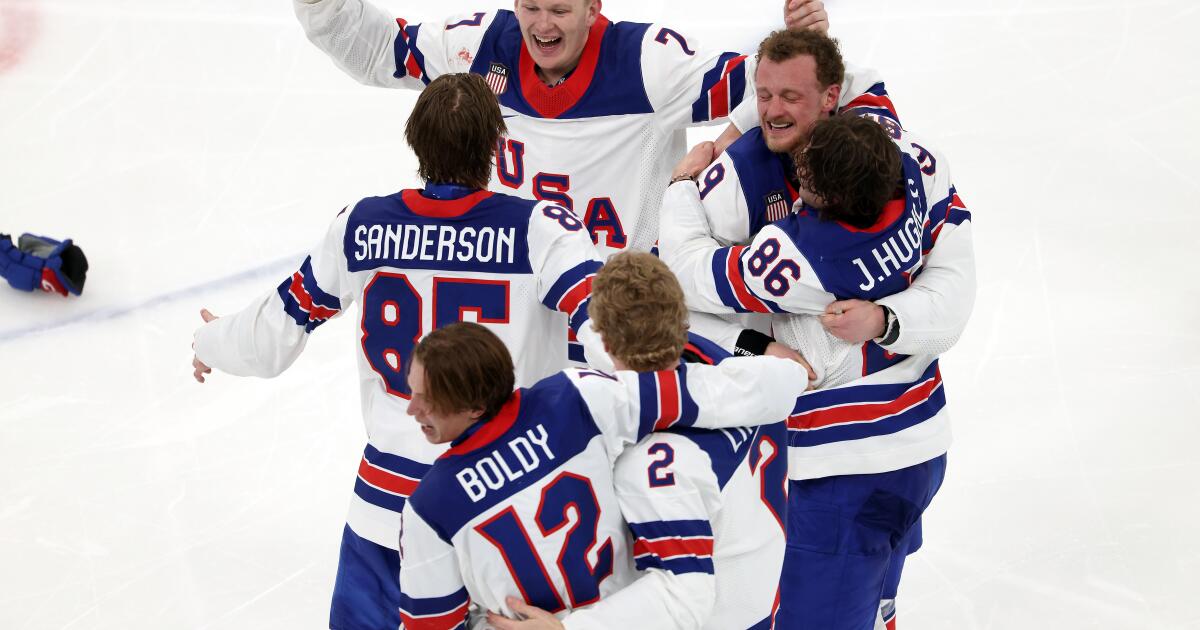
I refer, of course, to the U.S. men’s Olympic hockey team winning gold: the kind of victory that normally causes Americans to forget their differences and instead focus on something wholesome, like chanting “USA” while mispronouncing the names of the European players we defeated before taking on Canada.
This should have been pure civic oxygen. Instead, we got video of Kash Patel pounding beers with the players — which is not illegal, but does make you wonder whether the head of the Federal Bureau of Investigation has a desk somewhere with neglected paperwork that might hold the answers to the D.B. Cooper mystery.
Then came the presidential phone call to the men’s team, during which Trump joked about having to invite the women’s team to the State of the Union, too, or risk impeachment — the sort of sexist humor that lands best if you’re a 79-year-old billionaire and not a 23-year-old athlete wondering whether C-SPAN is recording. (The U.S. women’s hockey team also brought home the gold this year, also after beating Canada. The White House invited the women to the State of the Union, and they declined.)
It’s hard to blame the players on the men’s team who were subjected to Trump’s joke. They didn’t invite this. They’re not Muhammad Ali taking a principled stand against Vietnam, or Tommie Smith and John Carlos raising fists for Black power at the Olympics in 1968, or even Colin Kaepernick protesting police brutality by kneeling during the national anthem. They’re just hockey bros who survived a brutal game and were suddenly confronted with two of the most powerful figures in the federal government — and a cooler full of beer.
When the FBI director wants to hang, you don’t say, “Sorry, sir, we have a team curfew.” And when the president calls, you definitely don’t say, “Can you hold? We’re trying to remain serious, bipartisan and chivalrous.” Under those circumstances, most agreeable young men would salute, smile and try to skate past it.
But symbolism matters. If the team becomes perceived as a partisan mascot, then the victory stops belonging to the country and starts belonging to a faction. That would be bad for everyone, including the team, because politics is the fastest way to turn something fun into something divisive.
And Trump’s meddling with the medal winners didn’t end after his call. It continued during Tuesday night’s State of the Union address, when Trump spent six minutes honoring the team, going so far as to announce that he would award the Presidential Medal of Freedom to goalie Connor Hellebuyck.
To be sure, presidents have always tried to bask in reflected glory. The main difference with Trump, as always, is scale. He doesn’t just associate himself with popular institutions; he absorbs them in the popular mind.
We’ve seen this dynamic play out with evangelical Christianity, law enforcement, the nation of Israel and various cultural symbols. Once something gets labeled as “Trump-adjacent,” millions of Americans are drawn to it. However, millions of other Americans recoil from it, which is not healthy for institutions that are supposed to serve everyone. (And what happens to those institutions when Trump is replaced by someone from the opposing party?)
Meanwhile, our culture keeps splitting into niche markets. Heck, this year’s Super Bowl necessitated two separate halftime shows to accommodate our divided political and cultural worldviews. In the past, this would have been deemed both unnecessary and logistically impossible.
But today, absent a common culture, entertainment companies micro-target via demographics. Many shows code either right or left — rural or urban. The success of the western drama “Yellowstone,” which spawned imitators such as “Ransom Canyon” on Netflix, demonstrates the success of appealing to MAGA-leaning viewers. Meanwhile, most “prestige” TV shows skew leftward. The same cultural divides now exist among comedians and musicians and in almost every aspect of American life.
None of this was caused by Trump — technology (cable news, the internet, the iPhone) made narrowcasting possible — but he weaponized it for politics. And whereas most modern politicians tried to build broad majorities the way broadcast TV once chased ratings — by offending as few people as possible — Trump came not to bring peace but division.
Now, unity isn’t automatically virtuous. North Korea is unified. So is a cult. Americans are supposed to disagree — it’s practically written into the Constitution. Disagreement is baked into our national identity like free speech and complaining about taxes.
But a functioning republic needs a few shared experiences that aren’t immediately sorted into red and blue bins. And when Olympic gold medals get drafted into the culture wars, that’s when you know we’re running out of common ground.
You might think conservatives — traditionally worried about social cohesion and anomie — would lament this erosion of a mainstream national identity. Instead, they keep supporting the political equivalent of a lawn mower aimed at the delicate fabric of our nation.
So here we are. The state of the union is divided. But how long can a house divided against itself stand?