Americans can rest easy – for the moment, at least. The fine folks at the Federal Bureau of Investigation have thwarted a major national security threat.
On October 9, the FBI arrested 35-year-old engineer Abdulrahman Alfozan, a Saudi citizen employed at the California-based artificial intelligence company OpenAI, the maker of the chatbot ChatGPT, and a firm that describes its mission as ensuring that “artificial general intelligence benefits all of humanity”.
A press release from the United States Department of Justice said that Alfozan was accused of installing a “surreptitious audio recording device” in an executive conference room at the OpenAI offices in San Francisco.
The statement quoted Director of National Intelligence Jay Clayton’s assessment that “this serious situation underscores why winning the global super intelligence race is a national security prerogative”. (For those who have not yet got the memo, US President Donald Trump recently decreed that the term “artificial intelligence” be changed to “super intelligence” or “SI.”)
FBI director Kash Patel concurred that “protecting American SI innovation is essential to safeguarding our nation’s economic strength and national security”, and assured everyone that the FBI would continue doing its part “to ensure our country maintains its competitive edge”.
So much for the separation of corporation and state in the world’s self-appointed greatest democracy.
The covert device was reported to have been concealed in toilet paper and attached to the back of a television monitor. The Gizmodo website has noted with amusement that, despite being cast as a “sophisticated” spying apparatus, the device in question can in fact be easily ordered online “for the low low price of $13.99”.
If convicted, Alfozan faces up to five years in jail and a fine of $250,000.
Now, some of you may still be asking what the big deal is – and why the US government is acting like it’s 1950 and the Soviets are stealing our nuclear secrets.
The spectacle becomes all the more curious when we consider that the company up in arms over the alleged attempted theft of its technology owes much of its existence – and massive valuation – to stealing stuff from people.
The day before Alfozan’s arrest, USA Today and several other newspapers sued OpenAI in a Manhattan federal court for copyright infringement and the unauthorised use of hundreds of thousands of news articles and other materials to develop ChatGPT.
And back in July, various US media outlets including the New York Times and the New York Daily News requested that a federal judge impose sanctions on OpenAI for “hiding and destroying evidence showing how ChatGPT was trained on stolen journalism”, as attorney Steven Lieberman put it.
The moral of the story, perhaps, is that when OpenAI steals things it’s to “benefit all of humanity” – but when a 35-year-old Saudi engineer does it, it’s a national security crisis.
In case we were not already bored to tears hearing about national security, US Attorney General Todd Blanche took to X on Tuesday to preach that the “theft of intellectual property involving cutting-edge super intelligence technology poses a serious threat to our national security”, necessitating continued “swift action … to protect American innovation and safeguard our nation”.
Of course, many Americans might wonder why “innovation” gets such special treatment when they themselves are so often on the receiving end of government abuse. The frequency with which US police officers murder unarmed Black people, for instance, would seem to indicate that there are far more literal threats to the nation’s security than a $14 device hidden in toilet paper.
But human security is of no interest to a corporatocracy increasingly dominated by AI, an industry that thrives on putting people out of jobs and that is deeply entwined in a number of sordid developments at home and abroad. Among them is mass surveillance, which combines AI-assisted violations of civil liberties and constitutional protections with good old police state “innovation”.
To that end, a bunch of US cops have taken advantage of new AI-powered technology, such as automated licence plate readers, to stalk their exes. Then there is the matter of the FBI and other government agencies buying up data en masse from tech companies in a bid to keep tabs, Big Brother-style, on everyone’s personal information at all times.
It makes you think twice about the sudden concern for “spying” in the Alfozan case.
As for threats to other people’s national security, OpenAI and like-minded tech companies that do business with the Pentagon have been complicit in recent US aggression – from Venezuela to Iran – as the US pursues its strategy for “Accelerating America’s Military AI Dominance” (concocted before Trump mandated the renaming of AI as SI).
Israel, too, has exploited OpenAI technology, among other US-made goodies, to conduct its contemporary apocalyptic exercises in the Middle East. Last year, the Associated Press news agency (AP) revealed that US tech giants had “quietly empowered Israel to track and kill many more alleged militants more quickly in Gaza and Lebanon through a sharp spike in artificial intelligence and computing services”.
The AP report went on to note that “the number of civilians killed has also soared, fueling fears that these tools are contributing to the deaths of innocent people”.
But while it might be news to the AP, that is unfortunately how a genocide works.
And as the US goes to war for AI dominance while the tech giants bank on a post-human world, one can’t help but feel that the toilet paper was a nice touch, indeed.
The views expressed in this article are the author’s own and do not necessarily reflect Al Jazeera’s editorial stance.
Big Brother viewers were left emotional after one housemate confessed she wanted to leave the ITV2 show
A Big Brother housemate was reduced to tears in the latest episode of the ITV2 reality show(Image: ITV)
A Big Brother housemate has admitted “I want to go home”.
It’s been three weeks since 16 contestants walked into the famous house, hoping to win over the British public and bag the huge cash prize. Among them was teacher Yasmin, who formed close bonds with her co-stars Omar and Rhianna.
But her relationships hit a rough patch earlier this week after she rushed to defend newcomer Twinks. It all started when Twinks admitted she identifies as a witch in a private conversation with three other housemates.
News of Twinks’ spiritual beliefs spread like wildfire across the house and Omar wasn’t impressed by her confession. He later had a heated conversation with Twinks, where he asked her if she has ever ridden a broomstick.
The 21-year-old went on to insist that the word ‘witch’ has negative connotations, but Yasmin begged him to “have some respect”. The fallout from their argument left Yasmin in tears during Monday’s episode (October 5) of the ITV show.
The emotional housemate was shown crying alone in bed as she confessed: “I want to go home.” Pauline was quick to console her and asked: “Why do you feel that way?”
Yasmin replied: “I miss my friends and family. I miss how normal everyone is.” Pauline then offered words of support, saying: “Whatever you need to get some peace in this house, take that time. You’ll be okay, my girl. You will be okay.”
It’s not just her clash with Omar that has left the ITV star heartbroken, she also found out that Rhianna has been “chatting s***” behind her back. Yasmin discovered that Rhianna believed she had a secret crush on Lynx in last night’s episode.
Reflecting on the revelation, she told Big Brother: “It’s not the comment that’s p**** me off. It’s the fact that you sat there chatting s*** about me, and it’s like, are we not friends?
“It just makes me think how much other s*** has been said? And I’m sat there going ‘Love you, sis. Hi, sis. How are you doing?’ And then all I’ve ever done in here is look out for Omar, and I just think it’s just been thrown back in my face.”
Although their friendship has lasted weeks, Yasmin told Big Brother that “there’s no coming back” from their latest argument. “The friendship is dead in the water,” she said.
Viewers at home were left heartbroken as they watched Yasmin break down. One shared online: “Watching Yasmin cry was hard, I’m so p**** with how she gets treated in there.”
Someone else said: “Feel for Yasmin so much right now #bbuk,” while a third added: “Oh bless Yasmin. I feel awful for her.”
And a final defender posted: “Yas has done nothing wrong they’re making fun of a new housemate which is rude as hell and she’s simply defending her what’s wrong with that… #bbuk.”
Fans of Strictly Come Dancing made their thoughts clear after the first dance off of the series sent one emotional couple packing after just two weeks
20:16, 04 Oct 2026Updated 20:16, 04 Oct 2026
The first dance off left one Strictly couple heading for the exit(Image: BBC)
Strictly Come Dancing fans were shocked as the first celebrity was sent packing after Movie Week. Celebrity hairstylist Chris Appleton was emotional after he was cut from the hit BBC competition after losing in a dance off against Jaime Winstone.
The stylist, 43, who has worked with the likes of Kim Kardashian and Jennifer Lopez, was near the bottom of the leaderboard with a score of 33 after two weeks of dancing.
And it was the end of the road for Chris and his pro partner Amy Dowden, who were tearful at the decision They performed their Cha Cha to I’ll Be Ready from Baywatch, before Jaime and Carlos Gu performed their Cha Cha to Oh, Pretty Woman from Pretty Woman.
Jaime was unanimously saved buy the judges and lives to dance another day.
To see more of the stories you love from The Mirror and to find them easily in Google then make us your preferred source. Free and easy-to-do, just click on the link here to find more from The Mirror at the top of your feed.
Viewers took to X to say: “i so wish amy and chris’ partnership could’ve lasted longer 🙁 , a partnership i wanted from the very beginning.”
Another said: “SO sad to see Chris and Amy go. I don’t think they deserved to this week. Imo it should’ve been Melanie and Aljaz. But the public vote how they want to. And honestly I do still think Chris would’ve done MUCH better in a same sex partnership, but it was his choice. #Strictly.”
And a third said: “God I can feel myself crying for Chris and Amy. It’s so unfair.”
It’s the second time in successive series that Amy has been dumped at the first hurdle. She also got the boot alongside The Apprentice’s Thomas Skinner in 2025.
Chris said he had felt a “whirlwind of emotion” and said: “I’m 43 and got good at doing what I did which is hair. So to come into something like this, I felt so out my comfort zone.
“I saw myself in a way I’d never seen myself and challenged myself in ays I never knew I’d be challenged. But I’m very grateful for everyone who’s been involved.”
And he said having a friend in Amy is something he is thrilled with, before saying he wished he could have helped her go further. The professional dancer added she is “heartbroken” but her heart is only breaking because she doesn’t get to dance with Chris any more.
Fans were shocked after Melanie and Aljaz avoided the dreaded dance off despite being rock bottom of the judges’ leaderboard. One user said: “melanie must have got more votes than loads of people to get through over jaime who was much higher on the leaderboard #Strictly.”
The show was a huge success with fans tuning in too. A Strictly spokesperson said: “Strictly’s movie week was the most watched programme of the night, with a peak of 5.6 million viewers. As ever, overnight ratings do not give the full picture of all those who watch in an on-demand world.”
The Good Morning Britain guest opened up about an emotional moment that didn’t make it to air
09:21, 02 Oct 2026Updated 09:23, 02 Oct 2026
Big Brother star Charlotte has opened up about the unseen moment she was reduced to tears on the ITV show(Image: ITV)
A Big Brother star has revealed one of her co-stars reduced her to tears in a scene fans never saw.
Charlotte Nott is a quadruple amputee who entered the famous house earlier this month, and revealed it was always her dream to join the ITV2 competition. But the 18-year-old student “reached her limit” after just 13 days and decided to quit.
She has since been sharing behind-the-scenes truths with viewers, including key moments that didn’t make it to air. Charlotte has now opened up about the unseen moment she ‘broke down crying’ during her appearance on Good Morning Britain.
The programme on Friday, October 1, saw hosts Kate Garraway and Ranvir Singh asking the teenager about her first TV experience. They soon touched on a controversial comment that fellow housemate Rochelle Rackham made about Charlotte’s limb loss.
The 57-year-old told Charlotte, who lost her limbs to meningitis, that she has “a bit of a fear” of people with “no arms”. She went on to admit: “It’s just something that’s always freaked me out a bit.
“And when I saw you I was like ‘Oh my god’. And I feel so ashamed because now I don’t even look at it and to have what you’ve had done is just like unbelievable.”
Charlotte later confided in the other housemates about the comment, claiming: “I’m not, like, offended but obviously it was rude.” Although ITV viewers watched the conversation, they didn’t see the emotional fallout it sparked days later.
On GMB, Charlotte shared: “A few days after that, they didn’t show it, but I did break down crying in the garden. Not that it offended me, but I just felt like I was uncomfortable around her. Because I was like ‘Well, she’s told me she’s scared of me and like I’m, how can I sit across [from] her?'”
The interaction left a mark on the student but she has insisted it wasn’t the sole reason for her early exit, although she confessed: “I think it just kind of added to it maybe a little bit”.
Try ITVX Premium free for a week
This article contains affiliate links, we will receive a commission on any sales we generate from it. Learn more
ITVX Premium offers exclusive ad-free content that can be streamed on-demand and on the go, with everything from Hollywood blockbusters to bingeable British box sets.
An annual plan costs £59.99 – equal to £4.99 per month – after a seven-day free trial.
The former housemate has also posted the story on her TikTok page, explaining: “A few days after the Rochelle comment me and Yas had a heart to heart in the garden one night. I broke down crying saying it did actually bother me and I felt really uncomfortable in the house.”
Kuala Lumpur, Malaysia – The phone hasn’t stopped ringing in recent days. Raf*, a leader of refugees from Myanmar who are living in Malaysia, receives more than 100 calls a day, and they follow a common pattern.
“They are crying, asking me to do something,” Raf told Al Jazeera.
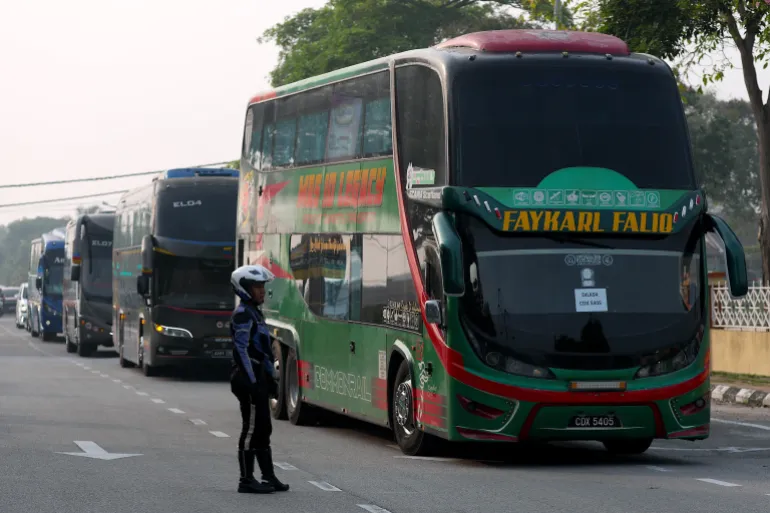
The Malaysian government on Tuesday deported nearly 1,500 refugees, part of its stated plan to send back at least 5,000 refugees as part of a deal with the military government of Myanmar. That move, from a country that had long taken in the refugees, has sparked fear among the tens of thousands of other refugees from Myanmar in the country, who have one question at the top of their minds: Who might be next?
The deportation was carried out during escalating raids on refugee communities by immigration officials, which have led to the detention of more than 50,000 refugees this year alone. Those working with refugees in Malaysia said the frequency of the raids has increased since June when Prime Minister Anwar Ibrahim announced the repatriation agreement with Myanmar.
“[We’ve seen] a sharp increase. Raids are happening every single day. There’s up to 50 raids or more happening every day,” said Heidy Quah, founder and executive director of the Malaysian nonprofit Refuge for the Refugees.
Minister of Home Affairs Saifuddin Nasution told local media that the government has conducted more than 9,700 such operations from the beginning of this year until September 17. That’s an average of 37 operations a day.
There are now more than 10,000 Myanmar nationals in Malaysia’s immigration depots, according to the Ministry of Home Affairs.
In all, Malaysia is home to more than 215,000 refugees, according to the Office of the United Nations High Commissioner for Refugees (UNHCR). Nearly 194,000 are from Myanmar. There are more than 126,000 Rohingya refugees in Malaysia, where they have been the target of widespread hate speech on social media in recent months. Apart from the Rohingya, the Myanmar refugees in Malaysia include nearly 16,000 from the Chin community and 33,000 from other Myanmar communities. The non-Myanmar refugees in Malaysia include small numbers of Pakistanis, Yemenis, Somalis, Afghans, Syrians, Sri Lankans, Palestinians and Iraqis.
The Myanmar refugee community in Malaysia has yet to identify any Rohingya among the first nearly 1,500 people deported on Tuesday, community leaders told Al Jazeera. Instead, many are from Myanmar’s other ethnic minorities, who are more likely to have valid national identification documents, community leaders said.
“The Rohingyas are a problem for deportation because Myanmar denies their citizenship,” Raf said. “So I don’t think that Myanmar will agree and accept all those Rohingyas.”
Myanmar officially treats the Rohingya as Bangladeshi immigrants despite the community’s long roots in Myanmar and their distinct ethnic identity. The Myanmar army has repeatedly cracked down on the Rohingya minority, including a wave of violence in 2017 that many rights groups have described as genocide. It set off a major refugee crisis when hundreds of thousands of Rohingya fled to Bangladesh, Malaysia, India and other neighbouring nations.
Myanmar community leaders also said the raids this year appear to have targeted locations highlighted in anti-refugee videos on social media in which content creators filmed refugee-populated areas, portraying them as hubs of chaos. These videos have been shared thousands of times on platforms such as Threads, TikTok and Facebook.
Al Jazeera contacted the Immigration Department to verify the link between the videos and raids but had not received a response at the time of publication. Accounts that had posted and shared antirefugee sentiment also did not respond to requests for comment.
Decline in resources
The increase in hostilities towards refugees in Malaysia coincides with a sharp decline in the capacity of local and international aid groups to support them, especially since the closure of the United States Agency for International Development in July 2025.
In Malaysia, this severely shrank resources for organisations helping refugees with basic needs, such as healthcare, Quah told Al Jazeera.
“Then slowly, United Nations organisations were being defunded, and even within the UN High Commissioner for Refugees in Malaysia, they lost a lot of staff,” Quah said. The job cuts reflected global retrenchments by UNHCR last year.
The agency continues to struggle with a funding crisis, saying on Tuesday that it faces a $5.79bn funding gap and, as of July, has received 32 percent of the funds it needs this year.
In Malaysia, this has led to even less protection for refugees and higher rates of exploitation, Quah said.
“Even UNHCR cardholders are arrested and remanded for about 14 days [while the] cards are verified,” she said.
For instance, an asylum-seeking woman who had scheduled an appointment to meet UNHCR representatives this month was recently detained, and immigration authorities demanded a letter from the organisation to prove that she was an asylum seeker, Quah said.
Although UNHCR confirmed the woman was seeking asylum, she remains in detention, Quah said.
An initial group of 1,476 people from Myanmar are deported from Malaysia on September 29, 2026, first my bus and then by Myanmar navy ships [Fazry Ismail/EPA]
Ongoing violence in Myanmar
UNHCR and rights groups in Malaysia have urged the Malaysian government to stop the deportations as violence continues in Myanmar.
A day before Malaysia’s deportation of the refugees on Tuesday, an air strike by Myanmar’s military was reported to have killed at least 33 people in Rakhine state, the historical home of the Rohingya. The Arakan Army group said the victims included vendors, shoppers and pedestrians. In June, the UN said Myanmar’s military was responsible for more than 700 civilian deaths over a six-month election period that started in August last year.
The Human Rights Commission of Malaysia (SUHAKAM) said that while Malaysia is not a party to the Refugee Convention of 1951, the principle of nonrefoulement has become part of customary international law and Malaysia, therefore, is bound to abide by it. The principle protects people from being returned to a place where they face a real risk of persecution, torture or other serious harm.
Particular attention should also be given to children, SUHAKAM said, highlighting that Tuesday’s deportation included 27 children, some reportedly as young as eight years old.
“No child should be returned to danger. Their safety, dignity and best interests must come first,” it said.
Myanmar community leaders in Malaysia told Al Jazeera the ships that departed on Tuesday will arrive in Yangon on Sunday.
“After that, we will [learn] whether they are allowed to leave the port safely [or are detained],” said one community leader who requested anonymity due to the increase in violence towards refugees in Malaysia.
Still, even those who are allowed to leave the port may need to spend months or years in Yangon because it is unsafe to travel across the country, the community leader said.
Rohingya refugees face evictions from their homes in Malaysia amid rising local tensions and online misinformation [File: Hasnoor Hussain/Reuters]
Call for independent access
Rights groups further criticised the Malaysian government’s framing of the deportations as “voluntary”, saying individuals should have sufficient information about conditions in their home countries before making such a decision.
“While authorities say the returns are voluntary, those returned had been held in immigration detention. This raises serious questions about whether decisions to return were genuinely free and informed,” UNHCR Assistant High Commissioner for Protection Edem Wosornu said.
The Malaysian government said people were selected for deportation based on a list of names shared by the Myanmar government in an official diplomatic note.
“Such [a] ‘voluntary’ decision must be determined by an independent authority, such as the UNHCR, and not by the Immigration Department,” SUHAKAM said .
UNHCR told Al Jazeera that it was not involved in the latest return process and did not have access to the individuals concerned. “[We were,] therefore, not in a position to independently ascertain the voluntariness of their decisions to return,” it said.
“We continue to encourage the government to ensure that return processes include individual assessments, access to protection procedures and safeguards to ensure that any decision to return is free, informed and genuinely voluntary,” it said.
Malaysian Prime Minister Anwar Ibrahim has long positioned himself as a champion of human rights but now faces criticism for the expulsion of Myanmar refugees [File: Rafiq Maqbool/AP]
Malaysia registering refugees
The deportations come at a time when Malaysia is simultaneously positioning itself as welcoming to refugees and their needs.
In 2015, the Malaysian government launched a Refugee Registration Document (DPP) programme. On paper, it is supposed to help register refugees, giving them official documentation.
Raf welcomed the DPP as long as the registration and documentation of refugees in Malaysia leads to access to work, education and healthcare.
“If these three things are provided, I think that’s a good solution for temporary refugees staying here.”
But the Malaysian branches of Amnesty International and Asylum Access said the latest deportations raise profound concerns about the purpose of the DPP. The programme should not be used to fast-track unlawful deportations, the groups said in a joint statement.
*Name changed to protect the individual’s identity