Crimes Against Humanity

Lebanese girl mourns paramedic father killed in Israeli strike | Crime

NewsFeed

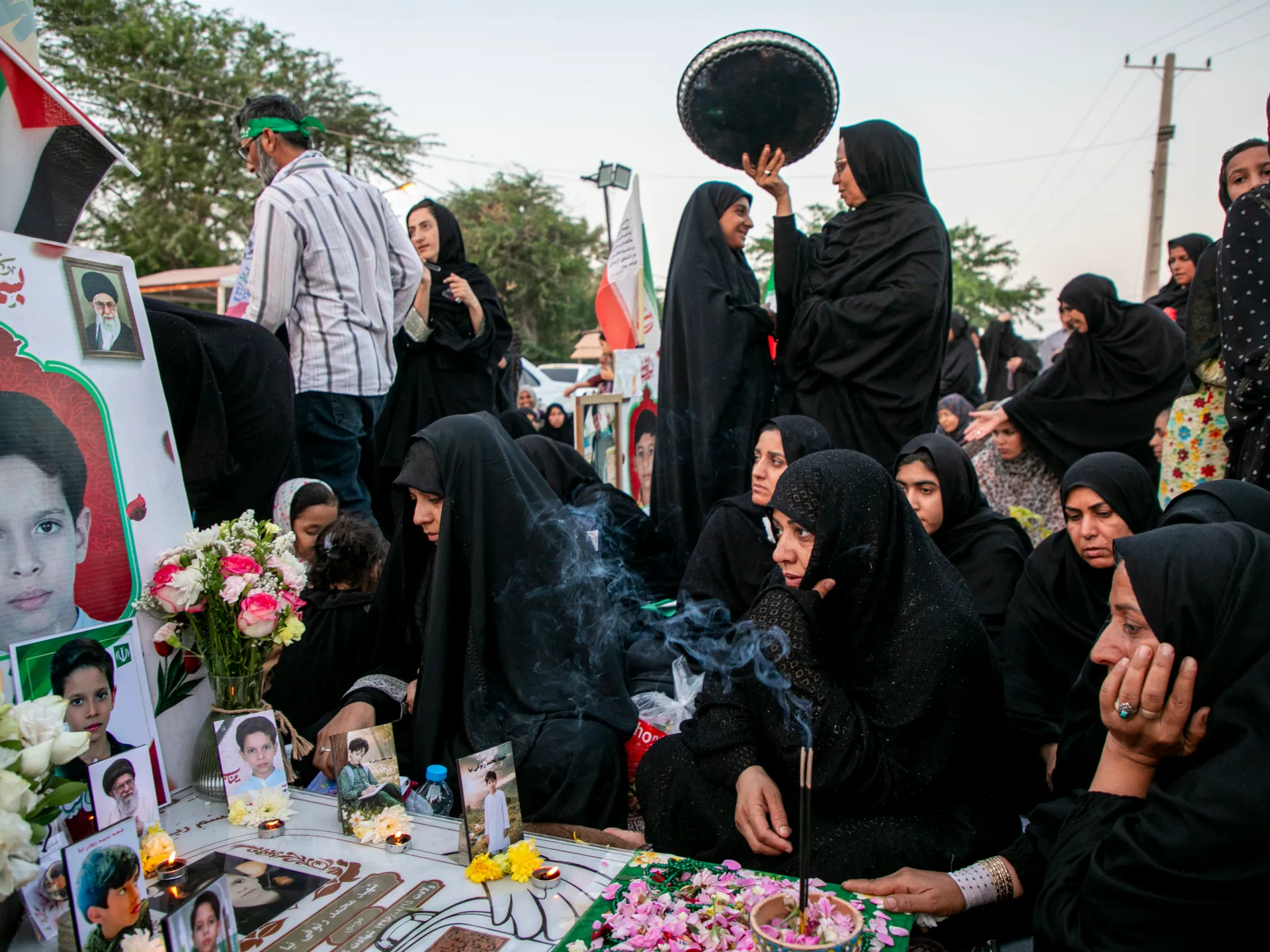
A young girl in southern Lebanon joined hundreds mourning her father, one of three paramedics killed in an Israeli “double-tap” strike during the US-brokered ceasefire. At least 95 emergency responders have been killed in Lebanon, a pattern the UN says may amount to a war crime.

Source link

Israel kills at least 12 Palestinians in Gaza amid ‘ceasefire’ | Israel-Palestine conflict News

Hamas says the Israeli escalation represents the failure of the international community to uphold the truce in Gaza.

Israeli forces have killed 12 Palestinians in attacks throughout Gaza, medical sources in the enclave tell Al Jazeera, as Israel continues its daily violations of the ceasefire struck last year.

An Israeli attack on a police vehicle on Friday killed at least eight people, including three civilian bystanders, in Khan Younis. A separate attack in Gaza City also killed two police officers.

Recommended Stories

list of 3 itemsend of list

Two other people were killed in the bombing of a house in Beit Lahiya in northern Gaza.

Gaza’s Ministry of Interior called on the international community on Friday to intervene and end the Israeli targeting of local police forces working to restore security in civilian areas.

It said the attack in Khan Younis came after security forces intervened to break up a fight in the area.

“The continued silence of international organisations … regarding the targeting of civilian police officers constitutes complicity with the Israeli occupation, encouraging it to commit further crimes against a civilian institution protected under international law,” the ministry said.

“We emphasise that the police force provides services to citizens in the Gaza Strip across various aspects of daily life. There is absolutely no justification for targeting it or killing its personnel.”

Israel has been systemically killing police officers in Gaza, as it allies itself with criminal gangs in the occupied territory.

During its genocidal war on Gaza, which started in October 2023, the Israeli military regularly targeted officers securing aid convoys, which led to intensified looting. That, in turn, deepened the hunger crisis that Israel imposed on the territory.

A ceasefire, brokered by United States President Donald Trump, came into effect in October of last year. That decreased the intensity of the Israeli bombardment.

But Israel has nevertheless continued its attacks on the territory, killing at least 984 people and injuring 2,235 others since the truce was announced, according to health authorities.

Just this week, Israeli strikes killed five people, including three children, on Wednesday.

The overall death toll in the war has surpassed 72,500, with more than 172,000 others injured. Thousands of missing people are believed to be dead and buried under the destroyed buildings.

The number of confirmed casualties represents more than 7 percent of the enclave’s population of two million people. The Israeli assault also turned most of Gaza’s structures into piles of rubble.

Leading rights groups and United Nations investigators have concluded that the Israeli military campaign amounts to genocide: an effort to destroy the Palestinian people.

Under the far-right government of Prime Minister Benjamin Netanyahu, Israel has continued to bomb Gaza as it simultaneously attacks south Lebanon, in violation of a separate truce with Hezbollah.

Hamas on Friday called the deadly attacks in Gaza part of the Israeli government’s “unprecedented bloody, fascist approach”.

“This escalation … by the government of the war criminal Netanyahu represents a clear failure of the role of the mediators and guarantors [of the ceasefire] and the international community to quell the barbaric Zionist killing machine,” it said.

More than six months into the ceasefire, Trump has struggled to implement the 12-point plan on which the truce was based.

Israel continues to occupy most of Gaza. Reconstruction in the territory has not begun. An international security force envisioned by the agreement has not been formed.

In February, Trump convened his so-called Board of Peace that is supposed to govern Gaza through a council of Palestinian technocrats, but it is not clear when or how these forces will take over government agencies in the territory.

Source link

Rabbi accused of war crimes selected for Israel’s national celebration | Israel-Palestine conflict News

As the sun sets on Israel’s Memorial Day, 12 torches, together symbolising the spirit of the nation, are lit to mark the beginning of Independence Day, the anniversary of the country’s establishment in 1948 – which led to the ethnic cleansing of at least 750,000 Palestinians.

To be selected to light one of the torches over the resting place of Theodor Herzl, the man widely credited with the creation of modern Zionism, is regarded as one of the greatest honours in Israel.

Recommended Stories

list of 4 itemsend of list

This year, among those selected to light the torch on Tuesday evening is Avraham Zarbiv, a rabbi so controversial that even the Israeli military – an organisation that admits to having killed more than 70,000 Palestinians in Gaza – has publicly distanced itself from him. A military spokesperson said last week that Zarbiv “was not selected in coordination” with the military, and was not representing it at the ceremony, despite his being an army reservist.

Obliterate

Zarbiv first came to national prominence in Israel in the early months of 2024, when the 52-year-old rabbi and state rabbinical judge was filmed throwing grenades at Palestinians in Khan Younis during a firefight.

Since then, he has recorded himself gleefully demolishing Palestinian homes – his name even becoming a verb meaning to flatten or obliterate – and has delivered sermons from the ruins of Rafah promising “victory and settlement”. Zarbiv pairs it all with the traditional mannerisms of a religious leader, punctuating his threats and violence with footage of him blowing on a traditional ram’s horn, or shofar, as well as reciting prayers and parts of the Torah.

Zarbiv has also shared footage of himself taking part in the demolition of homes in southern Lebanon, where Israeli forces are accused of deploying the same scorched earth tactics as they did during Gaza’s genocide.


Speaking to Israel’s right-wing Channel 14 in January 2025, Zarbiv boasted of the destruction inflicted on Gaza.

“There are tens of thousands of dead. The dogs and the cats ate them because no one collected them,” he said. “Tens of thousands of families – they have not a piece of paper, no childhood photo, no IDs, they have nothing. No home, there is nothing. They come, they have no idea where their house is. It’s something unbelievable.”

While the army leadership itself might be seeking to distance itself from Zarbiv, the rabbi himself says that he represents his fellow soldiers.

“I am one soldier among many, I am a soldier of the Givati Brigade,” he said in an interview last week.

Illegal settlement

Last week, the Israeli organisation Kerem Navot, which monitors illegal settlement construction in the occupied West Bank, filed a complaint to Israel’s judicial watchdog after confirming that Zarbiv had built his home illegally on private Palestinian land in the Beit El settlement, accusing him of violating the ethics rules for both judges and rabbinic judges.

That had no bearing, however, on Transport Minister Miri Regev’s decision to nominate Zarbiv for the torch-bearing ceremony.

“Rabbi Zarbiv, a father of six, continues to serve in reserve duty and combines in his life in an inspiring way between the book and the sword – between Torah and the army, between study and action, and between spiritual leadership and security responsibility,” the right-wing minister said.

She continued, describing the man now accused of multiple war crimes as representative of a generation “that refuses to part with responsibility, that chooses to bear the burden and continue to build, out of great faith in the future”.

Avraham Zarbiv
Avraham Zarbiv in Gaza, December 2023. ‘The Rabbinical Court of Khan Younis’ is graffitied on the wall behind him [Courtesy of Social Media]

Nevertheless, in January 2025, The Hind Rajab Foundation, the Belgian-based NGO that seeks to prosecute Israeli soldiers on the basis of the video evidence they themselves frequently provide, filed an official complaint against Zarbiv with the International Criminal Court (ICC). According to the foundation’s lawyers, Zarbiv’s gleeful boast of destroying 50 buildings per week in Gaza, participating in the complete destruction of entire neighbourhoods, and having publicly incited violence and hatred through his appearances on Israeli media, were clear enough breaches of the Geneva Convention and Rome Statute to deserve prosecution.

Zarbiv was not a neutral public figure being honoured for civic virtue, Dyab Abou Jahjah, cofounder of The Hind Rajab Foundation, told Al Jazeera. Rather, “he is a notorious perpetrator of grave international crimes”, Abou Jahjah said.

“His selection [for the Independence Day ceremony] is therefore not incidental – it is revealing,” Abou Jahjah added. “When an individual implicated in acts that constitute genocide is elevated in this way, it reflects the underlying logic of a state project historically rooted in the dispossession and ethnic cleansing of Palestinians. From that perspective, his selection is entirely consistent.”

Avraham Zarbiv
Avraham Zarbiv is an Israeli army reservist [Courtesy of Social Media]

B’tselem, the Israeli rights group, is also

among those objecting to Zarbiv’s selection.

“The government’s decision to laud Zarbiv as an ‘exemplary citizen’, after more than two years of genocide in Gaza and amid a reality of unprecedented state and settler violence in the West Bank, represents a state-level endorsement of the complete dehumanization of Palestinians and the systematic destruction of Palestinian life,” B’tselem said in a statement.

“This selection sends a clear message to the citizens of Israel and the entire world: In Israel, genocide, ethnic cleansing, and war crimes are the ‘spirit of the nation’,” the group added.

Source link

US military kills two men in new strike on vessel in eastern Pacific | Crimes Against Humanity News

Latest attack brings death toll from US strikes on vessels in the Pacific and Caribbean to at least 170 since September.

The ⁠United States military has ⁠carried out another attack on a vessel in the eastern Pacific, killing two people, in the latest deadly strike by US forces on boats that Washington alleges have links to Latin American drug trafficking cartels.

US Southern Command (SOUTHCOM), which is responsible for Washington’s military operations in Latin America and the Caribbean, confirmed the attack in a post on social media late on Monday, claiming to have killed two “male narco-terrorists”, without providing any evidence.

Recommended Stories

list of 4 itemsend of list

SOUTHCOM claimed that, based on intelligence reports, the boat was “⁠transiting along known narco-trafficking routes ⁠in the ⁠Eastern Pacific” and was targeted with “a lethal kinetic strike” on the orders of US Commander General Francis L Donovan.

A grainy video clip released with the statement shows a stationary boat with outboard engines and what appear to be floats from fishing nets nearby. The boat comes under attack from the air and explodes into flames.

The attack marked the second day in a row that SOUTHCOM announced a deadly strike on boats in the Pacific. On Sunday, the US military said it blew up two boats in the eastern Pacific a day earlier, killing five people and leaving one survivor. It was not immediately clear what happened to the person who survived the attack, though SOUTHCOM said the US coastguard was notified.

With the attack on Monday, the US military has now killed at least 170 people in dozens of strikes on vessels in the eastern Pacific and Caribbean Ocean since September.

International law experts, human rights groups and regional governments have accused the administration of US President Donald Trump of carrying out extrajudicial killings in international waters, which have likely targeted civilians, often fishing crews, who do not pose an immediate threat to the US.

The Trump administration claims that such attacks are part of its war on drug trafficking cartels in Latin America, but has provided no solid evidence that any of the vessels targeted since last year have been involved in drug trafficking.

Source link

Global Sumud Flotilla sets sail from Barcelona for Gaza | Gaza

NewsFeed

Thousands gathered at Barcelona’s port as the largest ever Global Sumud Flotilla prepared to depart for Gaza, aiming to break Israel’s blockade. Al Jazeera’s @Mohammadfff_ reports, as organisers and volunteers insist they will sail to Gaza despite the risks.

Source link

How the US and Israel are waging war on Iran’s medicines, vaccines | US-Israel war on Iran News

The United States and Israel have carried out multiple attacks on medical facilities in the course of their war on Iran.

On Thursday, Iranian President Masoud Pezeshkian appealed to international health organisations to respond to attacks on medical facilities in Iran, including the Pasteur Institute in capital Tehran, a key centre that Iranian officials said had been targeted that day.

At least 2,076 people have been killed and 26,500 have been wounded in Iran since the US and Israel first launched strikes on the country on February 28.

Here is a closer look at how the US and Israel have hit healthcare facilities in Iran.

What has the Iranian president said about attacks on healthcare?

On Thursday, Pezeshkian wrote in an X post: “What message does attacking hospitals, pharmaceutical companies and the Pasteur Institute as a medical research center in Iran convey?”

The Iranian president, 71, a heart surgeon by profession, continued: “As a specialist physician, I urge WHO [the World Health Organization], the Red Cross, Doctors Without Borders and physicians worldwide to respond to this crime against humanity.”

What is the Pasteur Institute, which has been targeted?

On Thursday, Iranian Foreign Ministry spokesman Esmaeil Baghaei wrote in an X post: “The American-Israeli aggressors have attacked the Pasteur Institute of Iran – the oldest and most prestigious research and public health centre in Iran and the entire Middle East, founded in 1920 through an agreement between the Pasteur Institute of Paris and the Iranian government.”

Baghaei deemed the attack “heartbreaking, cruel, despicable, and utterly outrageous”.

He did not specify whether there were casualties from the attack.

The institute was founded more than 100 years ago in collaboration with the Institut Pasteur in Paris, an internationally renowned centre for biomedical research, which itself was founded in 1887.

The institute in Iran conducts research on infectious diseases, produces vaccines and biological products and provides advanced diagnostics.

The centre has played a central role in fighting endemic diseases such as smallpox and cholera. It also supports Iran’s national immunisation programme by developing and producing vaccines and related biologicals – including those used against diseases such as tetanus, hepatitis B and measles.

Tedros Adhanom Ghebreyesus, the director general of the WHO, wrote in an X post on Friday that two departments of the Pasteur Institute of Iran have also been working closely with the WHO.

“The conflict in Iran, and the region, is impacting the delivery of health services and the safety of health workers, patients, and civilians present at health facilities,” Ghebreyesus wrote.

Which other healthcare facilities have been hit in Iran?

“Since 1 March, WHO has verified over 20 attacks on health care in Iran, resulting in at least nine deaths, including that of an infectious diseases health worker and a member of the Iranian Red Crescent Society,” Ghebreyesus wrote in his X post.

Some of the facilities hit include:

Red Crescent warehouse

On Friday morning, a drone strike hit a Red Crescent relief warehouse in Iran’s Bushehr province.

While no casualties were reported, the attack destroyed two relief containers, two buses and emergency vehicles, Fars news agency reported.

Tofigh Daru

On March 31, Israeli-US strikes hit one of Iran’s largest pharmaceutical companies in Tehran, the Iranian government said in a post on X.

The company was later identified as Tofigh Daru Research and Engineering Company, which is owned by the Social Security Investment Company, a state-run holding firm. On LinkedIn, Tofigh Daru states that it develops and produces active pharmaceutical ingredients “in the anticancer, narcotics, cardiovascular to immunomodulatory segments”.

No confirmed casualty numbers were reported from that strike.

Delaram Sina Psychiatric Hospital

This newly constructed hospital in Tehran was significantly damaged during an attack on the capital on March 29, according to the state-run Islamic Republic News Agency (IRNA).

About 30 patients were in the hospital at the time of the strike late on Monday, the hospital’s director told IRNA. No specific casualty figures for the hospital have been reported.

Ali Hospital

The hospital in Andimeshk in Iran’s Khuzestan province sustained damage from an explosion on March 21, according to the Mehr and Fars news agencies.

In his post on Friday, Ghebreyesus confirmed this attack and said the facility had been forced to evacuate staff and cease services.

Reports about the attack do not mention casualties at the hospital.

Gandhi Hospital

On March 2, Gandhi Hospital in Tehran was damaged during attacks on a television communications tower nearby.

No confirmed casualty figures were reported for the hospital itself.

What does international law say about attacks on healthcare?

International humanitarian law states that health establishments and units, including hospitals, should not be attacked, according to the International Committee of the Red Cross.

These protections also apply to the sick and wounded, to medical staff and to means of transport such as ambulances.

In 2016, the United Nations Security Council resolution 2286 was adopted unanimously. This condemns attacks on healthcare and calls on nations to respect international law.

However, last year record attacks on healthcare during armed conflict were recorded, according to the WHO’s Surveillance System for Attacks on Health Care (SSA).

The SSA said that in armed conflicts worldwide, 1,348 attacks on medical facilities resulted in the killing of 1,981 people. The majority of these deaths were in Sudan, where 1,620 people were killed, followed by Myanmar, where 148 people were killed.

This was a sharp uptick from 2024, when 944 patients and medical personnel were killed in armed conflict.

Where else has Israel targeted medical staff and facilities?

Lebanon

Besides Iran, Israeli attacks have also targeted healthcare facilities in Lebanon.

A month into its latest bombardment of Lebanon, Israel has killed 53 medical workers, destroyed 87 ambulances or medical centres, and forced the closure of five hospitals, according to Lebanon’s Ministry of Public Health.

“Israeli strikes and blanket evacuation orders are cutting people off from care and shrinking the space for health services to function,” Luna Hammad, the Lebanon medical coordinator for Doctors Without Borders (MSF), told Al Jazeera, adding that MSF has seen “a documented pattern of attacks affecting healthcare”.

Gaza

Throughout its genocidal war in Gaza, Israel has also attacked healthcare facilities in the Palestinian enclave.

In October 2023, hundreds of people sheltering in the car park of Gaza’s al-Ahli Hospital were killed in an Israeli attack, according to Palestinian health officials.

Israel attributed the explosion at the facility to a misfired rocket launched by the Palestinian Islamic Jihad, an allegation denied by the armed group.

In March 2024, the Israeli military said it killed 90 people in its raid on al-Shifa Hospital during a siege, as displaced Palestinians sheltering in the facility described long detentions and abuse.

In December 2024, the Israeli army arrested Dr Hussam Abu Safia, the director of Kamal Adwan Hospital, after refusing to follow orders to abandon one of the last functioning hospitals in northern Gaza. His arrest came a day after the military killed approximately 20 Palestinians and apprehended about 240 in a raid inside the hospital, which was one of the “largest operations” conducted in the territory until that time.

In March 2025, Israeli forces reportedly shot dead 15 Palestinian medics for the Palestine Red Crescent Society and inside clearly identifiable PRCS ambulances, during a rescue mission in Rafah’s Tal as-Sultan neighbourhood.

Source link

US diplomat Marco Rubio denounces settler violence, tolls in Hormuz strait | Donald Trump News

United States Secretary of State Marco Rubio has offered wide-ranging remarks upon his departure from the latest Group of Seven (G7) ministers’ meeting in France, denouncing Iran’s continued chokehold on the Strait of Hormuz as well as settler violence in the occupied West Bank.

Standing on an airport tarmac on Friday, Rubio fielded questions from journalists about reports that Iran plans to implement a tolling system in the strait, a vital waterway for the world’s oil supply.

Recommended Stories

list of 3 itemsend of list

Rubio used the topic to double down on pressure for countries to participate in securing the Strait of Hormuz, a demand US President Donald Trump has repeatedly made.

“One of the immediate challenges we’re going to face is in Iran, when they decide that they want to set up a tolling system in the Strait of Hormuz,” Rubio said.

“Not only is this illegal, it’s unacceptable. It’s dangerous for the world, and it’s important that the world have a plan to confront it. The United States is prepared to be a part of that plan. We don’t have to lead that plan, but we are happy to be a part of it.”

He called on the G7 members — among them, Japan, Canada, France, the United Kingdom, Italy, Germany and the European Union — as well as countries in Asia to “contribute greatly to that effort”.

Rubio calls toll plan ‘unacceptable’

The Strait of Hormuz is a key artery for the global transport of oil and natural gas, and prior to the start of the US and Israel’s war against Iran on February 28, an average of 20 million barrels of oil per day passed through the waterway.

That amounted to roughly 20 percent of the world’s liquid petroleum supply.

But since the outbreak of war, Iran has pledged to close the Strait of Hormuz, which borders its shores. The threat of attacks has ground most of the local tanker traffic to a standstill, though a few vessels, some linked to Iran or China, have been allowed to pass through.

Media reports suggest that Iran is setting up a “tollbooth system” that would require passing ships to put in a request through Iran’s armed forces, the Islamic Revolutionary Guard Corps (IRGC). There would also be a fee to secure passage.

“ They want to make it permanent. That’s unacceptable. The whole world should be outraged by it,” Rubio said on Friday.

He added that he conveyed a warning about the polling scheme to his colleagues at the G7.

“All we’ve said is, ‘You guys need to do something about it. We’ll help you, but you guys are going to need to be ready to do something about it,’” Rubio said.

“Because when this conflict and when this operation ends, if the Iranians decide, ‘Well, now we control the Strait of Hormuz and you can only go through here if you pay us and if we allow you to, that’s not only is it illegal under international law and maritime law. It’s unacceptable, and that can’t be allowed to exist.”

The Trump administration, however, has struggled to rally allies and world powers to join the US in its offensive against Iran.

Legal experts have criticised the initial strikes against Iran as an unprovoked act of aggression, though the Trump administration has cited a range of rationales for launching the attack, including the prospect that Iran may develop a nuclear weapon.

Many of the US allies in Europe have maintained that they would limit their involvement to defensive actions. Trump, meanwhile, has accused members of the NATO alliance of being “cowards”, adding in a social media post, “We will REMEMBER.”

In a statement following the G7 meeting, member countries reiterated their stance that there should be an “immediate cessation of attacks against civilians and civilian infrastructure”.

They also underscored the “absolute necessity to permanently restore safe and toll-free freedom of navigation in the Strait of Hormuz”. But the statement fell short of pledging any resources or aid to the US and Israeli war effort.

Achieving goals ‘without any ground troops’?

It is unclear when the war might end. On Saturday, it reaches its one-month anniversary, having stretched for four weeks.

Rubio on Friday echoed Trump’s assessment that the war was going as planned and that the US was achieving its objectives, including to destroy Iran’s navy, missile stockpiles and uranium enrichment programme.

“ We are ahead of schedule on most of them, and we can achieve them without any ground troops, without any,” he said, addressing an oft-raised concern about the prospect of US troops being deployed to Iran.

Rubio also briefly addressed the increasing levels of Israeli settler violence against Palestinians in the occupied West Bank.

Footage has shown settlers this month torching Palestinian homes and vehicles, as well as assaulting residents.

On March 19, the United Nations estimated that more than 1,000 Palestinians have been killed in the West Bank since Israel began its genocidal war in Gaza in October 2023. The international body underscored that a quarter of the victims were youths.

“ Well, we’re concerned about that, and we’ve expressed it. And I think there’s concern in the Israeli government about it, as well,” Rubio responded, adding that it was a “topic we follow very closely”.

He suggested that the Israeli government may take action to stop the violence, though critics argue that Israel has largely turned a blind eye to settler violence.

“Maybe they’re settlers, maybe they’re just street thugs, but they’ve attacked security forces, Israelis, as well. So, I think you’ll see the government going to do something about it,” Rubio said.

Upon taking office for a second term in January 2025, President Trump also moved to cancel sanctions against Israeli settlers accused of grave abuses in the West Bank.

Source link

Palestine weekly wrap: West Bank attacks surge, Israel restricts Gaza aid | Gaza News

NewsFeed

Settler attacks, restrictions on aid, and land seizures marked a week that was supposed to be one of celebration for Palestinians. Al Jazeera’s Nida Ibrahim and Tareq Abu Azzoum explain what’s been going on in the occupied West Bank and Gaza.

Source link