‘Stranger Things’ creators on Will facing a fear bigger than Vecna
This article contains spoilers from Season 5, Vol. 2, of “Stranger Things.”
What could be more gulp-inducing than trying to defeat a nightmarish vine-covered villain and wipe out an eerie and horror-filled alternate dimension? Maybe writing a satisfying conclusion to a mega-popular TV show built on that idea.
Ross and Matt Duffer, the sibling masterminds behind Netflix’s “Stranger Things,” are closer to finding out if they’ve achieved that in the eyes of the show’s fans. On this morning in early December, the duo are in their own alternate dimension limbo with the show’s final season release — Vol. 1 is out and they’re bracing for impact with Vol. 2.
“The day that [Vol. 1] was released, I paced around all day,” Matt says. “I did absolutely nothing, just waiting for reactions to come in and reviews to come in because you really never know how people are going to react. There’s pros and cons to the show growing in size in the way it did — people just take it apart to an insane degree. It’s scary, always scary. You never really get used to it.”
But the self-doubt keeps them sharp, he says. “It forces you to not get lazy.”
“It’s a balance between feeling very confident, then it swings to being very insecure about it — and it’s hard to keep sight,” Ross adds. “You watch these episodes dozens and dozens of times over and over again. And the strange thing about this show is that a very small group of people had seen the episodes, a really small circle, then suddenly you’re just blasting it out to millions of people all at the same time.”
The pair are sitting on a couch in the office they share — “E.T.,” “Alien” and “Batman Returns” posters adorn the walls — at their facilities, Upside Down Productions, in Los Angeles. While they were able to revel in fan reaction for a few days after the release of Vol. 1, they’re back in work mode. At this point, they still have to finalize sound and color, as well as some visual effects, on the series finale.
“Very boring visual effects,” Matt quips. “If I have to look at one more shot of spores and fog, I’m going to lose my mind.”

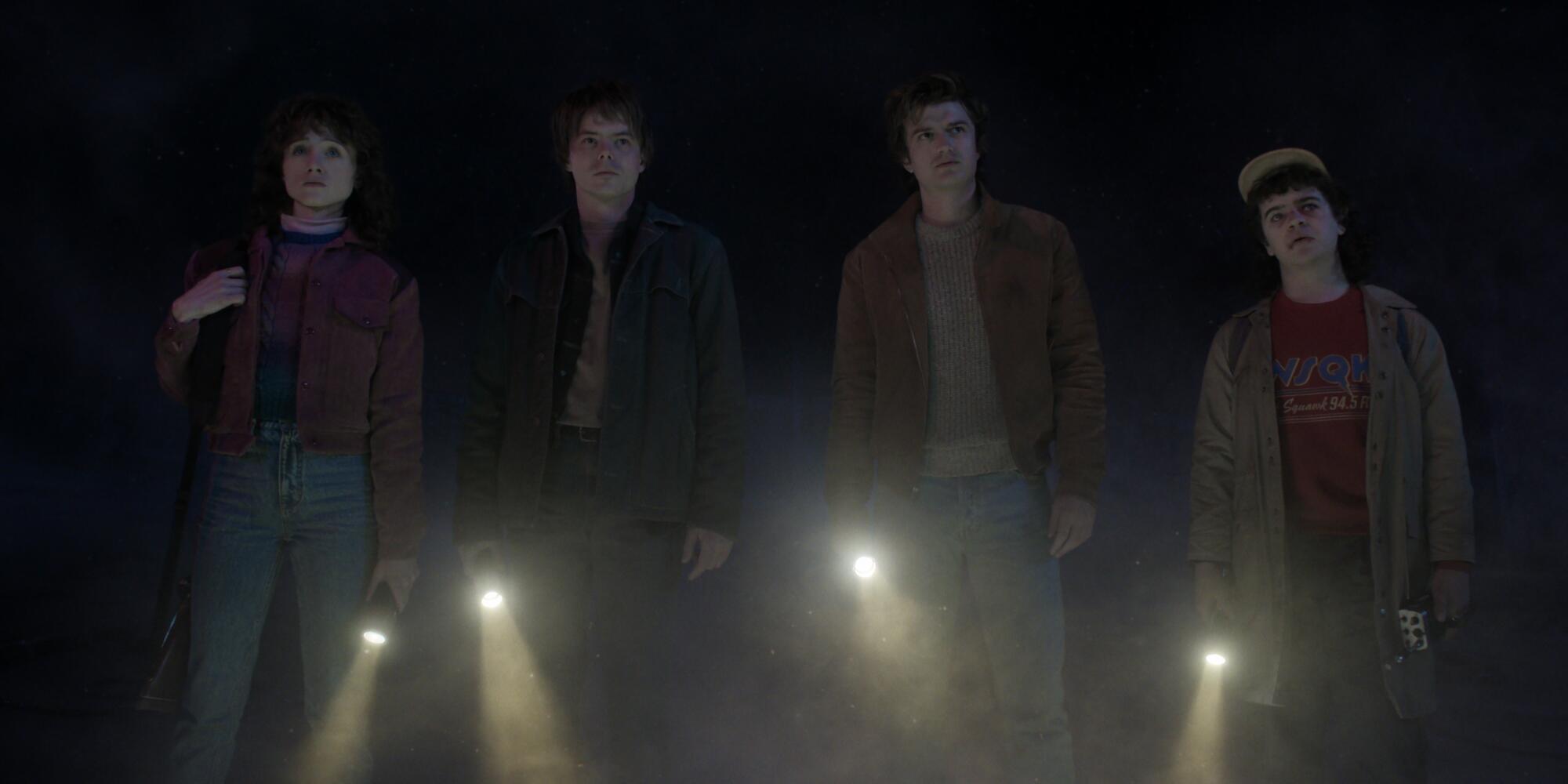
Nancy Wheeler (Natalia Dyer), Jonathan Byers (Charlie Heaton), Steve Harrington (Joe Keery) and Dustin Henderson (Gaten Matarazzo) in Season 5 of “Stranger Things.”
(Netflix)
For now, the drip-drop release around the year-end holidays continues, with Vol. 2 (Episodes 5 through 7) now streaming. The episodes contain some of the season’s bigger emotional beats, including one of TV’s most amicable breakups between teenagers, a mended friendship and a character finally living his true self openly. The Duffers discussed that and more in this edited conversation.
Let’s start with those final 10 minutes of Episode 7. Will [Noah Schnapp] shares a part of himself that he’s kept secret for a long time. He realizes that if he wants to be successful in defeating Vecna, he can’t feel afraid about this part of myself. How did you decide Will’s coming out would be revealed?
Matt: It’s something that we’ve been planning to do for a really long time. Initially, it was planned for Season 4, and we just felt it was unearned by the end of it. We wrote that scene with him in the back of the van and him talking to Jonathan [Charlie Heaton]. But I like the idea of Will slowly building to this moment. He has a breakthrough in Episode 4 in a major way, but he has this one final step to take in order to really unlock his full potential. Something we really wanted to do with the show is tie his emotional growth with these powers that he’s developed.
Ross: Putting it at the penultimate [episode] ultimately made sense because what we’re trying to do with the second volume is get our characters in a place where they all felt confident in themselves. Will being one of the major character arcs that carries through the season, but also with Dustin [Gaten Matarazzo] and Steve [Joe Keery] and Nancy [Natalia Dyer] and Jonathan — we wanted to get people, before they go into this final battle, having dealt with their internal fears and doubts.
Matt: Because that’s what Vecna weaponizes against you. If you don’t have that self-hatred or self-doubt or those insecurities, then he can’t hurt you. When Will purges himself of that, he becomes unstoppable — or that’s the hope.


1. Noah Schnapp as Will Byers, the show’s central character. 2. With his mother, Joyce (Winona Ryder). In Season 5, Vol. 2, Will comes out to her and his friends. “It’s something that we’ve been planning to do for a really long time,” says creator Matt Duffer. (Netflix)
What did you want that moment to be? What didn’t you want it to be?
Ross: We were nervous about it because you want to get it right, particularly working with Noah, who had recently come out himself. When he read it and we got his blessing, we felt really, really good about it. For us, it clicked writing it when we started talking about, “What are Will’s actual fears here in the future?” When the show really works for us is when we can combine both our mythology and the supernatural with the emotional. In this case, it’s going: Vecna is taking these fears and weaponizing them against Will, so Will actually talking to the group about these fears, as opposed to keeping them to himself — that’s when the scene really clicked.
The original plan was for him to come out to Joyce [Winona Ryder], and we started writing it and it felt really wrong because if he’s really going to be confronting these fears, he has to open up to to his friends as well. Once we did that, and we put the group in there, and we had him talk about what he saw in his future, that’s when the scene felt, as a coming-out scene, like something very unique to this show.
Matt: It’s the scene we spent the longest on this season because we were so anxious about it and getting it right. It was the most important scene of the season. I can’t emphasize enough how much the actors influence the characters, and their journeys as people really feed into what we’re writing and how we write those characters. You’re trying to channel Noah and what he went through and his growth, which we’ve watched as a person, as he’s found himself. Most of what is in the show is the first take, the first close-up that we did of Noah. It was incredible to watch because it’s one of those moments where Noah was not acting. Those words were real that he was saying. It was very emotional. It felt so real to Noah, so truthful to him. Hopefully the scene feels like that to other people because a lot of kids are watching. You feel a certain responsibility, especially with scenes like that. You can’t be careless about it.
Shipping is a hallmark in every fandom. There’s a moment where Will mentions a crush he’s harbored. He doesn’t directly state it’s Mike, but Mike knows. The viewer knows. How would you describe their dynamic?
Ross: There is a lot of shipping that’s going on with this show. In terms of all the relationships — this goes with the Will storyline, it goes with Jonathan and Nancy — for us and the writers, what’s interesting is not who ends up with who. What’s interesting to us is, how are our characters growing as people? And most of the time, the answer to that is them finding strength within themselves as opposed to finding strength with someone else. When we were talking about Will, those are the conversations that we have. How do we get Will in a place that he feels confident and strong? And that, ultimately, is him confronting these fears and exposing himself to everyone, including Mike.
Matt: When we were growing up, shipping was not a thing. This is a new thing and it gets intense. Part of me likes it because it shows how passionate people are for the show. I don’t mind people interpreting things however they want. Obviously, Ross and I have what we intended. Ross touched on it thematically — in [Episode] 4, when Will finds his power, what we were intending was not that his love for Mike gives him these powers, but his love for himself and tapping back into how he felt when he was younger — that was the key to unlocking his full potential.
Ross: It’s more of an important message to put out to younger viewers. When I’m thinking about my younger self and our struggle growing up, to put out a message that’s “It’ll all be right if this secret crush you have works out” versus “You don’t need that.” Even if it disappoints some people, it’s the more important message to put out into the world.
Matt: Not one crush of mine worked out. It hurts you, though, right? If you feel feelings and it’s unrequited, it feels like an attack on you or makes you feel unwanted. So much of the show is two things: just our love for the supernatural in the movies that we grew up on, and the other part of it is dealing with all the feelings that we had growing up. The best thing for me in the world is when younger people come up to us, the very few that recognize us, and tell us how it helped help them through a difficult time in their lives. Even Robin’s speech to Will, giving him the confidence to come out, that makes it all worth it.

“To write them being back together and friends again was just such a relief,” says Ross Duffer of Dustin, left, and Steve.
(Netflix)
I want to move on to Dustin and Steve. The strain on their relationship comes to a head in these episodes, but also reaches a reconciliation. That moment between them on the collapsing stairwell —
Matt: It’s a very short moment, but incredibly emotional. We were really moved by Gaten and Joe’s performance. It wasn’t hard for them to get into that spot. They’re very close, they have a very sweet friendship that’s not entirely dissimilar from their friendship on the show. The one frustrating thing about the show being split in the way it is, is we didn’t put out a season of the show in Volume 1 — that’s half of a show. I’m excited for people to see Volume 2, mostly for the Steve-Dustin resolution.
Ross: It was hard even writing it, keeping them apart. We felt it was right, emotionally, but to write them being back together and friends again was just such a relief because we’ve missed them, and hopefully the audience has too.
And I love that Steve gets to have his a-ha moment where he comes up with what may be the plan that ends all this.
Ross: It’s funny, we’ve joked about this; he’s very convenient for us as writers because he’s always confused. He doesn’t know what’s going on. Dustin dings him for that in Episode 5, and it was so satisfying to have Steve come up with the final plan, or the linchpin for the final plan. That was such a thrill to write to finally give Steve a moment because the brainstorming almost always goes to Dustin.
Nancy and Jonathan, at one point, are bracing for imminent death and find themselves having this touching and tender moment, sharing confessions and hard truths. What was the lay of conversation for what you wanted from that moment — there’s the acknowledgment of their trauma bond and a slightly romantic unproposal?
Matt: It’s not dissimilar, in some ways, to the Mike-Will stuff. These are people who do love each other very much; it’s just a question of, “What does that mean? What does the future look like for them?” Whenever we talked about Jonathan-Nancy — there’s got to be this feeling that they feel like they must be together because of what they’ve been through, and how could you ever connect with somebody else who hadn’t been through the same thing? But are they right, in the long run, for each other? We wanted to express that as best as we can.
Ross: It was a challenging idea. We’ve been building to it, but to get it across in five-ish minutes, it’s a complicated thing. It’s not just a soap opera where it’s shipping and who’s going to end up with who. I’ve been through experiences similar to this, when you’re with someone for a very long time, you grow so close and you go through so many things together, and it reaches a point where you go, “Well, how could someone else understand?” But at the same time, is that suffocating to your own self-growth? So when we were talking about Nancy and Jonathan, and where do they go from here, it felt like for Nancy to really grow, it’s not about Steve, it’s not about Jonathan, it’s about giving herself the space.
Matt: And for Jonathan. They both felt the same way, they just weren’t expressing it. Especially when you’re young, you have trouble understanding or expressing those feelings. We wanted to put them in a life-or-death situation where it’s their last opportunity to confess. The reference for that scene was “Almost Famous,” when the plane’s about to crash and everybody, in the moment of near-death, tells everybody everything. And then the plane doesn’t crash and it’s awkward. This is the opposite.

Matt, left, and Ross Duffer are closer to releasing the “Stranger Things” series finale. Is it a happy ending? “Even in victory, it’s not confetti and dance parties,” Ross says.
(Jason Armond / Los Angeles Times)
To return to this idea of the characters wrestling with what life looks like after this is over, if it’s ever over — is a happy or triumphant ending possible? Do you even think of it in those terms?
Matt: It’s weird because we didn’t realize until we had finished writing it, how much was a reflection on the show itself. Everybody had a tricky year emotionally; it was a real roller-coaster in terms of dealing with the fact that something we had been putting everything into for 10 years was coming to an end. Ultimately, the show is more about childhood, coming of age and leaving that behind for a new part of your life. It’s not really a question of a happy ending versus a not-happy ending. It’s just a question of capturing what it feels like to move on. It’s a bittersweet thing, but I think it’s something that everybody goes through.
Ross: Even in victory, it’s not confetti and dance parties. It’s a little more complicated than that. I remember “Lord of the Rings,” reading it and watching the films as a kid — there’s that moment when they’re just back in the Shire, and there’s bit of like, “How can you understand? And how do you move on from this?” I remember at the time, when I was younger, feeling a bit of disappointment. I was like, “Can’t they just come back and everyone just celebrate and there’s a party and then we fade out?” But watching it older now, there’s something so much more resonant about it. That’s why we talk so much over the course of this season about “Even if we are able to defeat Vecna, what does that look like for all of us?” Because this Vecna and the evil in the Upside Down brought all these people together.
Matt: In terms of the parallels to the show ending, that’s really a complicated and confusing mix of emotions. Everybody’s sad to move on, but then there’s that sense that you have to move on. We try to capture that feeling.
I need you to tell me what the workflow is like on a show like this. It’s lore, science and nerd-heavy. What are the checks and balances of making sure you’re not messing things up?
Matt: The challenge, especially as the lore and mythology has gotten too complicated, is to ensure that it’s not weighing down the show and that there’s enough room for the characters. That is more important than anything. What we’ve been trying to do as much as possible with this season, because there is so much mythology, is tie it into characters and their growth.
Ross: For instance, the Jonathan-Nancy scene — the melting lab was not an idea we had and then thought, “Oh, we could put Jonathan and Nancy in the situation.” We know we want this conversation with Jonathan and Nancy. How do we get there? Then going, “Oh, what if the dark matter makes the lab unstable?” Most of the time, you’re starting character first, and then we’re adjusting the mythology in order to make those character moments work.
Matt: But also, a melting lab is cool! Everybody was super enthusiastic about that — Netflix, our production designer.
Ross: Other dimensions, everyone was fine with the wormholes. But when we suddenly go, “The lab is going to melt,” everyone was like, “Excuse me?” No one knew how to do it.
Matt: We had to fight for that melting lab, from a production and cost standpoint.
I thought we were going to have a “Titanic” situation.
Ross: Oh, “Titanic” was a reference. But we wanted them both on the table.


1. Max Mayfield (Sadie Sink), left, and Holly Wheeler (Nell Fisher). 2. Jamie Campbell Bower as Vecna. (Netflix)
There’s a massive culture of forecasting and dissecting — it can be overwhelming to me as a viewer because I feel like I’m not watching closely enough. But I also love seeing how people interpret things.
Ross: Especially with the superfans, the tiniest of detail is picked up on. I think it’s fun for them because they’re rewatching this over and over again, so every little minute thing is seen as something significant even when that wasn’t our intention — not that we don’t plant things for later and do Easter eggs, but 99.9% of the writers’ room is just talking about these characters in the story they’re on. That is hopefully how you’re going to be watching the show because it can get overwhelming when you see this stuff online. But at the end of the day, we’re having people engage with a long-form story, so it makes us generally happy.
Matt: But you hit on something important, which is everybody experiences the show very differently. Sometimes I go, “What show are you watching?” Whatever show they’re watching is a completely different show than the show we thought we wrote. Then sometimes, some are on exactly our wavelength. And you see this with debates over the season. Season 3 is either the best season ever or the worst season ever. This is why you can’t write to fans, because which fan are you writing to? It would be impossible. Ross and I just try to write what we think is cool and what our writers think is cool.
There are so many theories out there about how the show is ending. Has there been one where the person got it or close to it?
Ross: I remember Season 4 someone early, very early, before we’d even released it, had figured out the Henry-Vecna-One thing, which was pretty impressive. This season, though, I have not seen anyone get the ending correct, which is, hopefully, a good thing.
Matt: I think it’s good. We’ll find out. I like that the ending is not obvious to people.
My understanding is the final scene of the series is one you’ve had in mind for about seven or so years. In the end, did you reach it the way you thought you would?
Matt: Yes. The show changed a lot in the course of seven years, so aspects of it certainly changed. But I think the fundamental state, more or less, the scene is what we always thought it was going to be.
Ross: I would say there was a key idea that we came up with, breaking [Season] 5, that wasn’t in there seven years ago. There was one element that we changed, but generally it is what we always hoped it would be. After the finale is out, we’ll be happy to tell you.
Matt: It didn’t change the scene, it just added something that I think was really important.
You spoke earlier about the circle of people that you share episodes with. How do you know you’re on the right path?
Ross: It’s such a small group. It really comes down to just our group of writers. What I love about our writers’ room is, even with Matt and I, people are very happy to tell us that an idea is not working. It’s usually everyone building off of each other, and then someone synthesizes those ideas, pitches it out to the room, and you feel this collective relief and excitement within that room. And when that happens, we go, “That’s it. That’s the idea.”
Matt: This is how we’ve always worked, once the draft is written, Ross and I will do multiple passes to the point where we’re really happy and confident. We don’t like turning in anything even remotely rough to Netflix. But the final episode, that was actually weird. We didn’t get any notes from Netflix or the producers. It is that first draft that we turned in. We did multiple drafts of it, but once we turned it in, that was it.
Were you on time with that draft?
Matt: We’re never on time, as you can tell with the gaps between seasons. Ross and I are not the fast. We were actually writing it in the midst of shooting, which was not a great idea. But Ross and I do the best work when we have a gun to our heads.
Ross: There’s not a single finale of the show that wasn’t written in the midst of production, but we like it because it allows us to get a sense of what the season is, what’s working, how the actors are performing, and we can really write to that. If you look at our season finales, generally, they’re some of our better episodes, part of it because the story is culminating, but also because we’ve learned over the course of the season what this season really is, what is really clicking. Then you can lean into that.
Matt: The only weird thing to have is because we were behind, and this has never happened before, is the Holly sequences that are in Henry’s mind, that’s in summer, so we couldn’t wait to shoot those. We were shooting any scene in the woods with Holly before the script was done. That was odd because we were handing actors scripts and scenes when they hadn’t even finished the episode. But it worked out quite well.
But now, I don’t know if it’s because of us, but Netflix won’t start shooting a season of anything until all the scripts are written. I do think they’re missing out on something because … like the sense of discovery that it allows. That’s the nerve-racking thing to me about doing a movie next, is we won’t have that ability to have it evolve.
What was the reaction at the table read for the series finale that stood out to you?
Matt: As nervous as we are of how the audience is going to react, it will never match the nerves we had in terms of how the actors were going to react to it. They’ve been in it with us since the beginning and they’re so invested in these characters. I think everybody was crying. Noah started crying first, then it just spread from there.
How do you feel you’ve changed since starting the show?
Matt: It’s hard to know. You have to try to remember back to how we were 10 years ago. We were really green. We had only directed one movie before. And we never directed television before. We’ve become, hopefully, better leaders and more confident and better at communicating. Ross and I, because we’re twins, we were really good at communicating with each other, but not with other people, and I think we’ve gotten a lot better at working with a large group of people, and hopefully we’ve evolved as as filmmakers.
Ross: There was a lot of fear making that first season. It was almost out of panic and fear both, if we get this wrong — our first movie was a failure — if we mess up, we’ll never be able to tell a story again. And the lack of experience, especially in terms of production. Production was scary because our production on the movie was such a challenge and it was a traumatic experience. Now, we know so much more. We keep making it hard for ourselves because we keep raising the bar in terms of the scale of the production [and] the number of people we’re hiring. But at this point, we can walk into a set, we’re much more flexible now if actors are coming in with ideas that are different from what we had planned, there’s a lot more ability to explore.

Caleb McLaughlin, left, Finn Wolfhard, Millie Bobby Brown and Gaten Matarazzo when they were much younger in “Stranger Things.”
(Netflix)
To expand on the learning curve, there was a recent report that said Millie Bobby Brown had filed a complaint of bullying and harassment against David Harbour. As first-time showrunners, how was it helming a show with young actors and figuring out how to balance the responsibility of making sure they feel safe and cared for on set?
Matt: Ross and I just love working with kids, and it was fun this season to go back to that, in terms of bringing in a new generation of kids. Mostly what we try to do is treat them respectfully and listen to them and listen to their ideas. I think you just get so much better work out of them that way. We’ve become very close because we got to know them when they were really young. It feels less parental and more like an older brother situation, and we try to make it very relaxed so they’re not nervous around us, and they certainly are not. I think what’s been challenging, and mostly challenging for the kids, who are no longer kids anymore, is when the show became bigger and [dealing with] social media. I think if something’s been damaging, it’s social media. I saw it happening with Jake [Connelly], who plays Derek this year.
Ross: And Nell [Fisher, who plays Holly], as well. That is something you feel more helpless about. But what has been beneficial for them, for Jake and Nell, [is] the kids that have been through it can help them through this more. Millie’s been through it. Finn’s been through it.
Matt: That’s the thing — yes, they have us, but they also have each other to get through this. I always think that that’s the key in terms of how they all turned out as grounded as they are. We were with all of them on this press tour, and I’m constantly impressed by how level-headed and grounded they are, and how ego-less they are; that they’re not broken by what they’ve been through. It’s been great with Jake to see it completely turn around. But that doesn’t excuse what people were doing before. It’s disgusting. I wish they had gone through this without social media.
A big talking point in Hollywood right now has been the bidding war for Warner Bros. Discovery. You have forged relationships with both Paramount and Netflix, the companies vying for it. How are you feeling about this moment and where things seem to be headed?
Matt: It’s just so hard to know what things are going to be like. It’s hard to say anything right now. Ross and I have been pretty open about wanting to make sure that the theatrical experience is preserved. For as long as stories have been told, it’s often in front of a group. There’s something about the communal experience and I just don’t want people being isolated. But as long as things are getting in theaters, I think it’s going to be OK. I’m trying to be optimistic about it.
Ross: I think the two fears are, with whatever happens, is you want to try to protect theatrical, which is in not the best state right now. And if you keep shrinking these windows, it just continues to de-incentivize people to go to the theater. That is not something we want to see. It’s a reason why we’re making a movie for theaters next; we believe in it and want to fight for it. The other is you need competition for artists because that’s the whole reason “Stranger Things” exists in the first place. If it’s too much consolidation, then shows like this are just going to become increasingly extinct.
Was it an easy sell, getting Netflix on board with releasing the series finale in theaters?
Matt: Yeah, actually. This is where the internet can frustrate me because something starts as a rumor and then goes around, then it’s fact. We pitched the idea to Netflix marketing — it was mine and Ross’ idea, then [Chief Content Officer Bela Bajaria] called us — it was only about five days [later] and [she] said, “Yeah, let’s do it.” We’re really grateful for them for supporting us. I cannot wait to go sneak into some theaters and watch it.
Ross: We’re definitely gonna go.