Coupang posts record sales; Q4 profit tumbles 97%

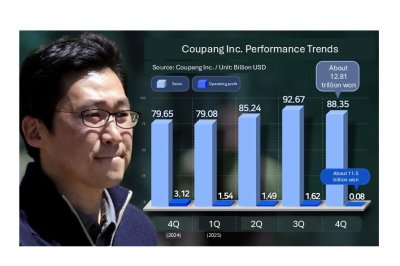
A graphic shows Coupang Inc.’s quarterly revenue and operating profit trends alongside Chairman Kim Beom-seok. Graphic by Asia Today
Feb. 27 (Asia Today) — Coupang Inc. reported record annual sales of 49.1 trillion won ($36.8 billion) in 2025 but said fourth-quarter operating profit plunged 97% following a personal data breach in December.
In a filing submitted Thursday to the U.S. Securities and Exchange Commission, the e-commerce company said annual revenue rose 14% from 41.3 trillion won ($30.9 billion) a year earlier. On a constant currency basis, revenue increased 18%.
Annual operating profit reached 679 billion won ($509 million), up 8% from 602.3 billion won ($451 million) the previous year, marking the third consecutive year of profitability. Net income for the year totaled 303 billion won ($227 million), more than triple the prior year. Earnings per share were 11 cents.
Despite the annual gains, profitability weakened sharply in the fourth quarter.
Revenue for the October-December period rose 11% on-year to 12.81 trillion won ($9.61 billion), but fell 5% from the previous quarter. Operating profit dropped to 11.5 billion won ($8.6 million) from 435.3 billion won ($326 million) a year earlier, while the operating margin narrowed to 0.09%. The company posted a quarterly net loss of 37.7 billion won ($28.3 million).
Coupang said the December data breach negatively affected revenue growth, active customer numbers, its Wow membership program and profitability, though it added that the impact has stabilized and recovery began in the first quarter.
Chairman Kim Beom-seok apologized during the earnings call, saying, “I once again apologize for the concern and inconvenience caused to our customers due to the personal information incident.”
“Our customers are the sole reason for our existence,” he said. “There is nothing more serious than failing to meet customer expectations at Coupang.”
By segment, product commerce – including Rocket Delivery, Rocket Fresh and its marketplace operations – generated fourth-quarter revenue of 10.74 trillion won ($8.06 billion), up 8% on-year. Growth businesses such as Farfetch, Taiwan, Coupang Eats and Coupang Play posted revenue of 2.07 trillion won ($1.55 billion), up 32%, but recorded an adjusted EBITDA loss of 434.9 billion won ($326 million), more than doubling from a year earlier.
Active customers in the product commerce segment totaled 24.6 million in the fourth quarter, up 8% from a year earlier but down 100,000 from the previous quarter. Revenue per active customer rose 3% on a constant currency basis to $301 (436,400 won).
Operating cash flow for the year fell to $1.8 billion from $1.91 billion, while free cash flow declined to $527 million from $1.02 billion, reflecting working capital impacts tied to the data breach and higher capital expenditures.
The company also repurchased 5.9 million shares of Class A common stock last year for $162 million.
— Reported by Asia Today; translated by UPI
© Asia Today. Unauthorized reproduction or redistribution prohibited.
Original Korean report: https://www.asiatoday.co.kr/kn/view.php?key=20260227010008222