Houthis Lose Ground Along Strategic Bab Al Mandeb Strait In Saudi-Backed Counteroffensive
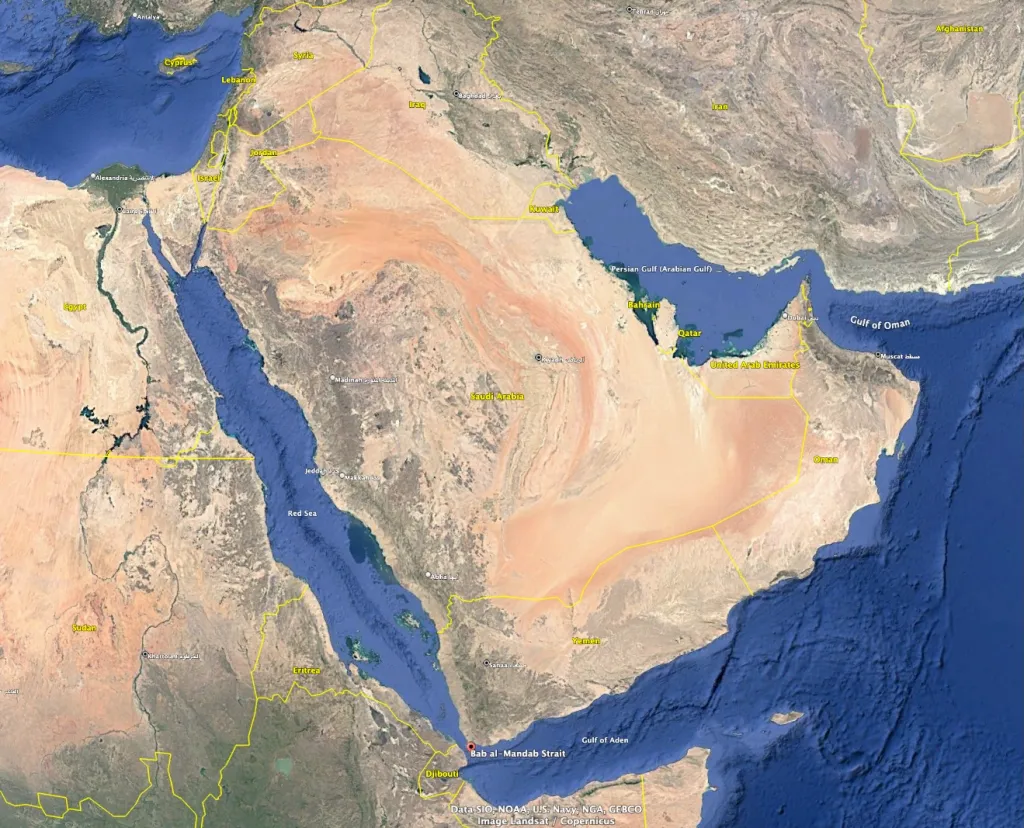
The Saudi-backed Yemeni forces battling the Iranian-backed Houthi rebels claim they have regained a large swath of territory in a new counteroffensive launched on Monday. This includes the recapture of the Red Sea port city of Mokha and other key positions near the highly-strategic Bab al-Mandeb Strait (BAM). As we reported last month, the Houthis had taken these areas during an offensive of their own.
“On Monday, the Nation Shield Forces, the Giants Brigades, and the Tihama Resistance—supported by the Popular Resistance—seized control of the city of Al-Mokha in western Taiz Governorate following fierce battles against the terrorist Houthi militias backed by the Iranian regime,” the official Yemeni Saba news outlet reported. “The forces, aided by air support, succeeded in capturing Al-Mokha after clashes with the terrorist Houthi militias, which had controlled the city since early last September. The battles, which took place at various locations surrounding Al-Mokha, involved the use of diverse weaponry and resulted in casualties among the terrorist Houthi militias, the capture of several of their members, and the flight of others.”
Dubbed Operation Yemen Dawn, the counteroffensive aims to “restore state institutions, liberate the capital Sana’a, and end the Houthi terrorist militia coup,” Rashad al-Alimi, president of the internationally recognized government of Yemen, stated Monday on X.
“With God’s aid, the will of our people, the valor of our armed forces and all military formations, and the support of our brothers and friends, Yemen will march toward a new dawn of freedom, peace, and stability,” al-Alimi added.
The claims about the recapture of Mokha follow statements made earlier on Monday that the National Shield Forces and Giants Brigades, “liberated Dhubab [also spelled Dhobab] District and strategic positions around the Bab al-Mandab Strait in western Taiz Governorate on Monday following clashes with Iran-backed Houthi militias,” Saba claimed. “The clashes left a number of Houthi fighters dead or wounded, while others fled under pressure from the military operation. Several military vehicles and pieces of equipment were also destroyed or disabled. The forces are continuing clearance and security operations in the liberated areas and cutting Houthi supply routes.”
In addition, the Kingdom’s Maj. Gen. Turki al-Maliki, spokesman for the Saudi-led coalition, stated that “100 fighter jets were providing support to the forces of Yemen’s internationally recognized government fighting against the Houthis,” according to The Associated Press. “He said the coalition has secured ‘air protection’ of the strategic Bab el-Mandeb Strait and destroyed hundreds of Houthi targets as part of the ongoing campaign.”
After Yemeni officials announced the new counteroffensive on Sunday, al-Maliki vowed “full operational support” to the Yemeni government forces, until the Houthis are “eliminated,” the AP added.
On Monday, the Humanitarian Operations Coordination Center (HOCC), an organization closely aligned with the Houthis, confirmed increased Saudi airstrikes and threatened a response. HOCC warned “all airlines operating in Saudi airspace that it is unsafe, with the exception of the airspace over ‘Mecca and Medina,’” the official Houthi Telegram channel reported.
HOCC did not elaborate on that warning.
While TWZ cannot verify these claims, independent Yemen analyst Mohammed al-Basha said it appears that the anti-Houthi forces have gained ground on the Red Sea coast.
The founder of the widely quoted Basha Report stated on X that he had “high confidence” that Yemeni government forces recaptured Dhobab Airport, “cutting off the Houthi supply route between Mocha and Bab al-Mandab.” He added that “Southern Giants Forces are now heading towards the city of Dhobab, Al-Omari Camp, and Bab al-Mandab.”
Videos have emerged showing what appears to be Saudi-backed forces running over Houthi fighters. The Houthis have called this a war crime.
Amid the spike in fighting, the State Department issued a new warning to Americans in Saudi Arabia.
“Due to the ongoing security situation in Saudi Arabia and the potential for aerial drone or missile attacks on Saudi Arabia, the U.S. Mission strongly encourages all U.S. citizens to remain vigilant and follow the guidance of national alerts released by Saudi Arabia’s Civil Defense,” the department stated on X.
Yemen Dawn was launched in the wake of large-scale Houthi advances. As we noted earlier in this story, the rebel group captured the port of Mokha and two key islands in the Red Sea, increasing its control over the Bab al-Mandab Strait (BAM). That moved the front lines to the key city of Taiz, which sits astride a major roadway linking it to the port city of Aden. The Houthis recently captured strategic hilltops near Taiz, advancing on the last road between the city and Aden, which serves as the interim capital of the Yemeni government.
The conflict between Saudi Arabia and the Houthis grew out of a civil war in Yemen that erupted in 2014. It expanded a year later when a Saudi-led coalition joined forces with the government ousted by the Houthis and raged on until the parties reached a tenuous ceasefire in 2022. The Saudis held off on getting involved in the recent Red Sea conflict which saw the U.S. and coalition warships duking it out with the Houthis, and eventually led to a U.S.-led air campaign over Yemen. Tensions, however, reignited after that conflict ended when the Houthis joined the U.S.-Iran conflict on the side of their major supporter.
Earlier this year, the Houthis imposed a blockade on the BAM and began striking Saudi ships in the southern part of the Red Sea as well as targeting critical energy terminals on that body of water and Saudi refineries. Iranian proxies have also struck the vital East-West pipeline that carries oil to the Red Sea to bypass the Strait of Hormuz, where Iran has vastly curtailed shipping after the launch of Operation Epic Fury. That line has reportedly since reopened after being shut down following a long-range drone attack.

On Monday, Turkey and Pakistan said they will undertake a “rapid deployment” of troops to Saudi Arabia under the Mecca Joint Defense Agreement, a pact designed to assist the Kingdom’s fight against the Houthis, the Middle East Eye reported.
“The announcement on Monday came after representatives of the three countries held an emergency meeting in Riyadh where they condemned recent attacks on Saudi Arabia, in particular those targeting the holy cities of Mecca and Medina, without mentioning the Houthis by name,” the publication added.
Concern about maintaining the flow of energy resources from the region has spurred France and the U.K. to send additional forces to help the Saudis.
As we reported two weeks ago, French President Emmanuel Macron said he was sending “soldiers, radar systems and defense systems, to protect” the Kingdom’s Yanbu oil facilities. Two days before Macron’s announcement, U.K.’s Royal Air Force (RAF) said it would deploy one of its Voyager aerial refueling jets to help Saudi Arabia defend against Houthi attacks. As with the French move, it is a response to concerns about the flow of oil.
You can see Macron’s announcement in the following video.
The U.S. also appears to be increasing its assistance to Saudi Arabia. Though President Donald Trump turned down the Kingdom’s request to directly attack the Houthis, the U.S. is “providing aerial refueling for Saudi warplanes conducting defensive air patrols,” The New York Times reported on Sunday. That’s in addition to the previously known assistance to Riyadh provided by “more than 200 U.S. intelligence and military analysts working in Saudi command centers helping to analyze and select targets in support of its Yemeni allies,” the newspaper added.
The stark reality, especially facing European leaders like Macron, is that if Saudi oil infrastructure and transport nodes near the Red Sea are destroyed or the pipeline that feeds them is shut down for months, the last major oil lifeline from the region — and especially to Europe — will be closed off, sparking a deeper energy crisis.
Iran has already severely curtailed the flow of oil through the Strait of Hormuz since the U.S. and Israel attacked it on Feb. 28. The movement of oil has been further impeded by a U.S. blockade on Iranian ports. However, transits have been increasing as of late, thanks in large measure to U.S. military escorts that U.S. Central Command claims have allowed more than a billion barrels of crude to pass through the Strait of Hormuz.
Still, the price of Brent crude continues to hover over $100 per barrel due to a combination of factors that still make this a very dangerous region. This includes the ongoing threats from the Houthis in the BAM and the aforementioned spike in fighting between the Houthis and Saudi-backed forces. In addition, there are continuing Iranian attacks on shipping, including one today and three over the weekend, the skyrocketing cost of insuring vessels and the possibility Gulf countries may be paying Iran to allow their oil through. Such payments, essentially a toll, are “potentially handing Tehran a significant portion of the value of the cargo,” Al Jazeera noted.
Asked about the Saudi-backed counteroffensive, Trump said “It will all work out very well.”
Meanwhile, talks between the U.S. and Iran to end hostilities between the countries remain at an impasse, though the two sides have not directly attacked each other in weeks. The U.S. rejected Iran’s conditions for reopening the Strait of Hormuz, and Tehran says it is preparing a reply to the U.S. counterproposal, CBS News reported Monday morning.
For his part, Trump continues to waver, suggesting the U.S. could “leave tomorrow” or resume striking Iran.
It is far too early to tell whether the new Saudi-backed counteroffensive in Yemen will have any lasting effect on the battlefield. The coalition arrayed against the Houthis isn’t known to be highly robust and the quality of its forces have been in question. Still, it has been clear that the Saudis and their allies had to act strongly, and this would be exactly that.
Contact the author: howard@twz.com