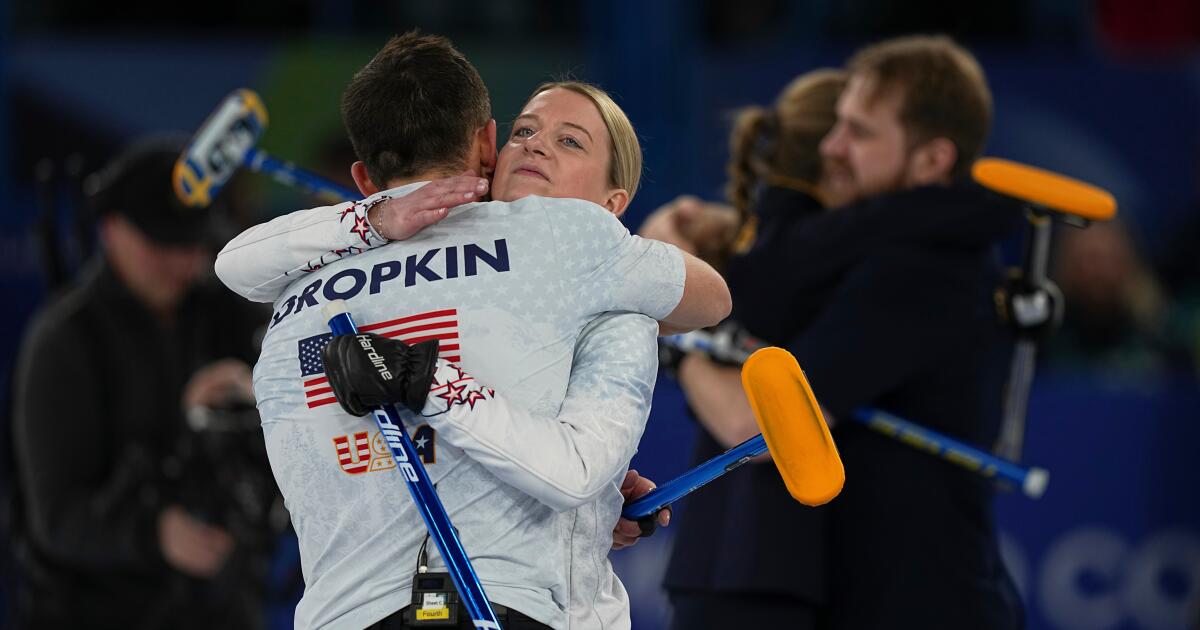
MILAN — Korey Dropkin and Cory Thiesse became the first U.S. curlers to medal in Olympic mixed doubles competition Tuesday, but the medal wasn’t the one they were trying to achieve.
The American pair lost in a dramatic final, 6-5, to the Swedish brother-sister combo of Isabella and Rasmus Wrana at the Cortina Curling Olympic Stadium in Cortina d’Ampezzo, Italy.
Dropkin and Thiesse led going into the final throw of the match.
A team skipped by John Shuster won gold in 2018, the last time the U.S. reached the medal podium in the sport. Shuster was also part of the only other U.S. medal-winning team, in 2006. That team was skipped by Peter Fenson.
Dropkin and Thiesse are the first Americans to win a medal in mixed doubles, which joined the Olympic calendar in 2018, while Thiesse is the first American woman to win a curling medal.
The U.S. reached the final when an incredible shot by Thiesse on the final delivery of Monday’s semifinal scored two points, turning a deficit into a 9-8 upset of Italy, a team that had beat the Americans in round-robin play. Sweden routed Britain 9-3 in its semifinal. Italy defeated Britain 5-3 for the bronze medal.
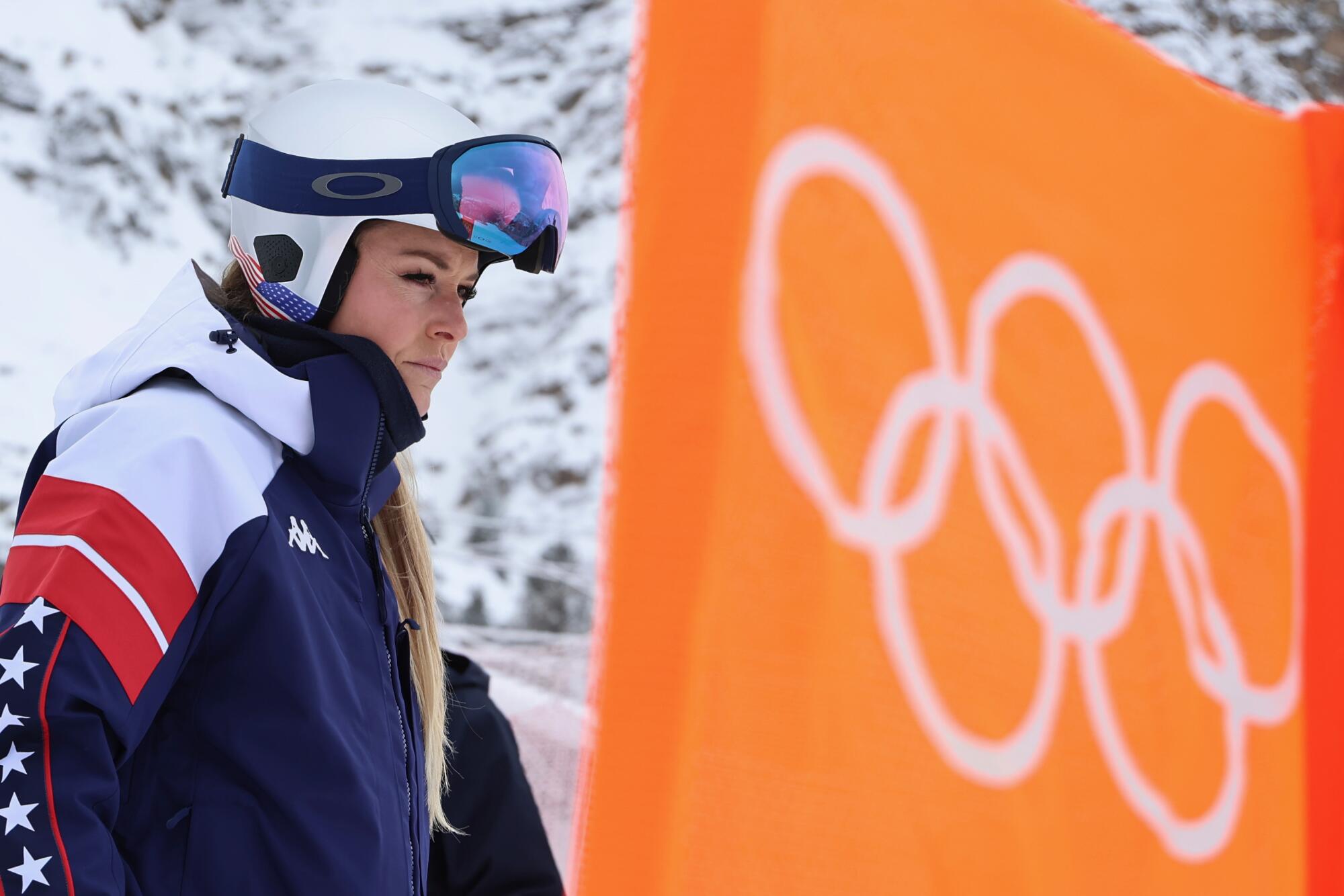
MILAN — One short week after Lindsey Vonn crashed in Crans-Montana, Switzerland, and tore her left anterior cruciate ligament, she was tearing down the hill in Cortina d’Ampezzo, Italy, a light knee brace warping the fabric of her racing suit the only obvious sign of anything amiss. When she finished the training run Friday, clocking the third-fastest time for a U.S. woman on the day, she casually fist bumped an American teammate at the finish line.
She made the feat look effortless. Sports medicine experts can say it’s anything but.
“It’s atypical to be able to compete without an ACL, at anything, but especially at a high level like Lindsey Vonn’s going to compete at,” said Clint Soppe, a board certified orthopedic surgeon and sports medicine specialist at Cedars-Sinai. “So this is very surprising news to me as well.”
The ACL, which connects the shin bone to the femur, is a main stabilizing force in the knee and protects the lower leg from sliding forward. Straight-line movement doesn’t stress the major knee ligament and some day-to-day tasks such as walking are easily accomplished without an ACL. But what Vonn is doing is far from normal.
“If you add cutting, pivoting, changing directions, in 95% of humans, you need an ACL to do that,” said Kevin Farmer, an orthopedic surgeon and professor at the University of Florida’s department of orthopedics and sports medicine. “She’s obviously fallen into that 5%.”
Farmer calls the rare group “copers.” They overcome the lack of an ACL by strengthening and engaging other muscles. It’s primarily the hamstrings and quadriceps, but everything, including the glutes, calves, hips and core, counts.
Vonn will have had just nine days between the Olympic downhill race and her injury when she stands at the start gate Sunday. But the 41-year-old has had her whole career to develop the type of strength and control necessary to carry her through the Games without an ACL. She’s already done it before.
Lindsey Vonn concentrates ahead of a downhill training run in Cortina d’Ampezzo on Friday.
(Marco Trovati / Associated Press)
Vonn skied on a torn right ACL for more than a month until withdrawing just before the 2014 Sochi Olympics. In 2019, she won a bronze medal at world championships without a lateral collateral ligament and three tibial fractures in her left knee. She said this week that the same knee feels better than it did during that bronze medal run.
“She’s dealt with knee injuries in this knee before, so she’s been able to develop mechanisms and strategies,” Farmer said. “She probably doesn’t even realize that, but just from years of practicing with a knee that’s not normal, her body has developed mechanisms of firing patterns that allow her knee to have some inherent stability that most people don’t have.”
For athletes who suffer major injuries for the first time, pain often prevents them from firing their muscles, said Jason Zaremski, a nonoperative musculoskeletal and sports medicine physician and clinical professor at the University of Florida’s department of physical medicine and rehabilitation. But Vonn, whose injury history is almost as long as her resume, looked calm during training, her coach Aksel Lund Svindal told reporters in Cortina on Saturday.
So even if she’s one ACL short, Vonn’s team knows she has more than enough of the intangibles to get her not only down the mountain, but into medal contention.
“Her mental strength,” Svindal told reporters in Cortina on Saturday. “I think that’s why she has won as much as she has.”
Vonn completed her second training run Saturday with the third-fastest time before training was suspended after 21 athletes. She was 0.37 second behind compatriot Breezy Johnson, who is intimately familiar with what Vonn is attempting.
Johnson, a medal contender for the United States who led the second training run at 1 minute and 37.91 seconds, attempted to ski in Cortina without an ACL in 2022. She had one successful training run, but crashed on the second one, sustaining further injuries that forced her to withdraw from the Beijing Olympics.
Johnson, like many, gasped when she saw Vonn’s knee buckle slightly on a jump during training Saturday. She said coming off jumps on this course are especially difficult.
“There are, I think, more athletes that ski without ACLs and with knee damage than maybe talk about it,” Johnson said at a news conference from Cortina. “… I think that people often are unwilling to talk about it because of judgment from the media and the outside.”
Critics say Vonn is taking a spot from a healthy teammate or that she simply refuses to give up the sport for good. But Vonn has already come to terms with the end of her career. She said she came out of retirement with a partially replaced right knee simply wanting an opportunity to put the perfect bow on her ski racing career at a course she especially loves.
The stage is different, but the sentiment is familiar to Zaremski. The doctor has worked with high school athletes who beg for a chance to play a final game after suffering a torn ACL. Through bracing, taping and treatment, sometimes there are temporary fixes for the biggest moments.
“If we’re trying to get a huge event like the Olympics, I would never put anything past [Vonn],” Zaremski said. “She’s an amazing, once-in-a-generation athlete.”
MILAN — History didn’t begin in Italy, but it made a number of significant advances there. The foundations for representative government, the 365-day Julian calendar, modern sanitation, newspapers, roads and the postal system were established in Rome.
Centuries later, the rest of the world is still doing as the Romans do.
But if Rome is Italy’s past, Milan is its present and future.
It is the country’s financial center, home to the Italian stock exchange. It’s the world’s fashion center, home to luxury brands including Prada, Versace, Armani and Dolce & Gabbana. And it has one of the largest concentrations of millionaires in the world, one for every 12 of the city 1.37 million residents.
“It’s a city that’s becoming more global and global,” said Giorgio Ricci, the chief revenue officer for Inter Milan, the city’s top soccer club. “Milano is now a real ambassador of that Italian culture, from lifestyle to design to food and whatever.”
And now, like Rome in the summer of 1960, it also has the Olympic Games.
The Milan-Cortina Games are the first Olympics officially shared between two host cities and the most logistically complex Winter Games ever, taking place over 8,500 square miles of northern Italy. And though most of the medals will be awarded in the surrounding mountains at Cortina d’Ampezzo, Valtellina and Val di Fiemme, Milan will be the beating heart of the Games, much as it is the beating heart of the country.
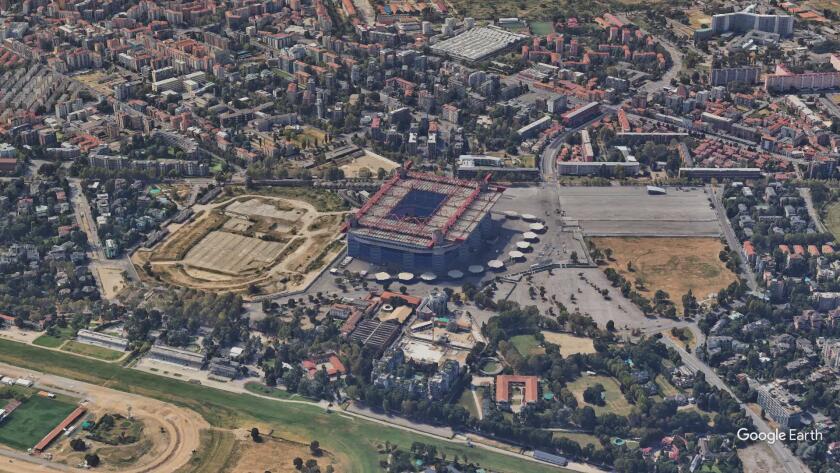
The main opening ceremony will take place at San Siro, the 75,000-seat stadium that is home to the city’s two first-division soccer teams, Inter Milan and AC Milan. Figure skating, speedskating and men’s and women’s hockey will also be held at four other venues across the city.
San Siro in Milan will host the opening ceremonies for the 2026 Milan-Cortina Winter Olympics.
And that will happen, organizers say, whether the venues are ready or not — and one of them is not. The 11,800-seat Unipol Dome, which will be known as Milano Rho Ice Hockey Arena during the Olympics, is one of just two competition venues that had to be constructed for the Games. It played host to the first games of the women’s hockey tournament Thursday despite the fact that construction crews were still administering the final touch-ups outside the building as Sweden was beating Germany in the opener.
“Do we have every area of that venue finished? No,” said Christophe Dubi, the International Olympic Committee‘s executive director for the Olympic Games said earlier this week. “Is it absolutely necessary for the Games? No. Everything that is public-facing, whether for media or athletes, will be first-class.”
Organizers certainly hope so because there’s a lot riding on these Games. If Milan can pull off an efficient, modern, sustainable and technologically “smart” event, it will reinforce the city’s status as one of the world’s top-tier global capitals, one with financial roots and a trendy multicultural image.
Fail in any one of those categories and Milan could suffer significant financial and reputational damage.
A singer busks late at night in Piazza del Doumo in Milan ahead of the Winter Olympic Games.
(Robert Gauthier / Los Angeles Times)
The competition is expected to draw 2.5 million people to Milan — many of them first-time visitors — while generating more than $7 billion in economic activity. Much of that spending went to upgrade the city’s and regional rail lines, which are expected to be overwhelmed given the spread-out nature of the Games.
Days before the Olympic torch was lit at San Siro, Milan’s Piazza del Duomo, which fronts the city’s elaborate Gothic cathedral, was packed with Olympic visitors, many wearing sweatshirts and jackets bearing the flags of their homelands. NBC will anchor its 700 hours of linear TV coverage from a temporary studio tower built in the square, with the iconic church as its backdrop.
Around the corner along the Via Orefici, which dates to the Middle Ages, many of the neighborhood’s trendy boutiques have hung neon signs with the Games logo, proclaiming themselves proud sponsors of the Olympics. At night, a singer who calls herself Anna Soprano performs a solo street opera.
However many locals have failed to catch Olympic fever with high ticket prices and fears about traffic, security measures and crowded Metro trains dampening enthusiasm.
An opera singer performs in Milan ahead of the 2026 Winter Olympics.
Buried beneath Milan’s rush to the modern from the Middle Ages — just beyond the Duomo Cathedral, which was begun in 1386, is the massive 15th Century Sforza Castle — lies a more recent history the city would just as soon forget. Milan was Italy’s Munich, the birthplace of Benito Mussolini’s fascist movement.
Yet it later became the center of anti-fascist resistance, with partisans seizing control of the city in the final days of World War II and executing Mussolini, hanging his corpse from the roof of an Esso station in the Piazzale Loreto. Milan marked that day by naming a prominent square in the city’s center April 25 Plaza for the day the uprising that liberated Milan began.
If Milan is modern Europe, some of the competition clusters outside the city, spread from Valtellina on the Swiss border in the north to Cortina d’Ampezzo, 27 miles south of the Austrian border, represent both the rustic and gentrifying Italy.
The scenic Fiemme Valley, site of cross-country skiing, ski jumping, and Nordic combined , is made up primarily of three small villages — Carano, Daiano and Varena — in the Dolomites mountain range. Despite a history of human activity that dates back more than 6,000 years, the area wasn’t officially established as the municipality of Val di Fiemme until the three townships merged in January 2020.
Today it is a major outdoor-sports destination, having played host to the FIS Nordic World Ski championship numerous times; in the summer it is a favored destination of hikers.
Valtellina, a 75-mile-long valley that runs along the Swiss border, will be the site of Alpine skiing, snowboarding, freestyle skiing and the debut sport of ski mountaineering. The region is known as the heart of the Alps and is a premier Alpine wine area, famous for the elegant reds that come from grapes grown on steep, terraced vineyards.
Cortina d’Ampezzo in northern Italy will host multiple events during the 2026 Olympics.
Cortina d’Ampezzo, meanwhile, is a breathtakingly beautiful ski resort and outdoor sports paradise about 35 miles from the Austrian border. Unlike Valtellina and Val di Fiemme, which are rustic and traditional, Cortina is one of Europe’s most expensive ski towns, its streets lined with high-end stores, luxury hotels and Michelin-starred restaurants. For year-round residents, property prices are the highest in the Italian Alps.
It was scheduled to host the 1944 Winter Olympics before World War II intervened, delaying the its arrival until 1956, when 32 nations — the largest to attend a Winter Games at the time — competed in four sports and 24 events. This month it will be the site of the biathlon, Alpine skiing, curling and sliding sports (bobsled, luge and skeleton).
The new $140-million Cortina Sliding Centre, the second Olympic venue whose construction fell well behind schedule, was completed days before the opening ceremony but a cable car intended to carry spectators to the women’s ski events was not expected to be finished in time. That could lead to traffic jams since visitors will have to take their cars more than a mile up the mountain.