COP30

World leaders, rights groups react to COP30 climate deal | Climate Crisis News

The annual United Nations climate conference has ended with an agreement that urges action to address global warming, but falls short of endorsing a phase-out of fossil fuels.

After two weeks of heated debates, meetings and negotiations at the COP30 summit in the Brazilian city of Belem, world leaders on Saturday agreed to a deal that calls for countries to “significantly accelerate and scale up climate action worldwide”.

Recommended Stories

list of 3 itemsend of list

The text lays out a series of promises and measures – including a call for developed countries to triple their funding to help poorer nations respond to the crisis – but makes no mention of a fossil fuel phase-out.

Dozens of states had been calling forthe COP30 deal to lay out a framework to ease away from their reliance on oil, gas and coal – the major drivers of the climate crisis – but several countries that rely on fossil fuels had pushed back.

While observers say the deal marks a step forward in the world’s effort to address climate breakdown, several have argued that COP30 fell short of expectations.

Here’s a look at how some world leaders and climate advocates have reacted to the agreement.

COP30 President Andre Aranha Correa do Lago

“We know some of you had greater ambitions for some of the issues at hand. I know that you, civil society, will demand us to do more to fight climate change. I want to reaffirm that I will try not to disappoint you during my presidency,” he said during Saturday’s closing session.

“As [Brazilian] President [Luiz Inacio Lula da Silva] said at the opening of this COP, we need roadmaps so that humanity – in a just and planned manner – can overcome its dependence on fossil fuels, halt and reverse deforestation and mobilise resources for these purposes,” he said.

“I, as president of COP30, will therefore create two roadmaps: One on halting and reverting [reversing] deforestation and another to transitioning away from fossil fuels in a just, orderly and equitable manner.”

UN Secretary-General Antonio Guterres

“COP30 has delivered progress,” Guterres said in a statement, including the call to triple climate adaptation financing and recognition that the world is going to surpass the 1.5 degrees Celsius (2.7 degrees Fahrenheit) target for global warming set under the Paris Agreement.

“But COPs are consensus-based – and in a period of geopolitical divides, consensus is ever harder to reach. I cannot pretend that COP30 has delivered everything that is needed. The gap between where we are and what science demands remains dangerously wide,” the UN chief said.

“I understand many may feel dissapointed [sic] – especially young people, Indigenous Peoples and those living through climate chaos. The reality of overshoot is a stark warning: We are approaching dangerous and irreversible tipping points,” he added.

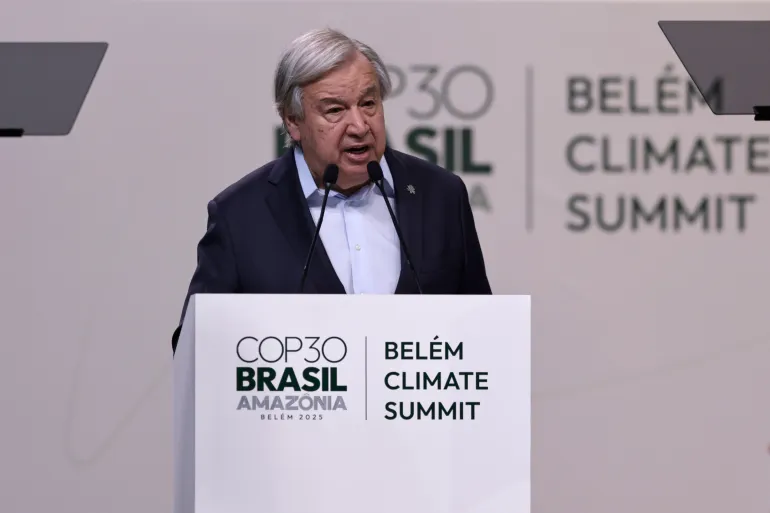
epa12508023 UN Secretary-General Antonio Guterres speaks during the opening of the COP30 leaders' summit at the Hangar Convention Center in Belem, Brazil, 06 November 2025. The leaders’ summit at the UN Climate Conference (COP30) kicked off in the Brazilian Amazon, with around 60 heads of state and government in attendance, seeking to lay the groundwork for negotiators. EPA/ANDRE COELHO
Guterres speaks during COP30’s opening session in Belem on November 6, 2025 [Andre Coelho/EPA]

Wopke Hoekstra, European Union climate commissioner

“We’re not going to hide the fact that we would have preferred to have more, to have more ambition on everything,” Hoekstra told reporters.

“It is not perfect, but it is a hugely important step in the right direction.”

Colombian President Gustavo Petro

“I do not accept that the COP30 declaration does not clearly state, as science does, that the cause of the climate crisis is the fossil fuels used by capital. If that is not stated, everything else is hypocrisy,” Petro wrote on social media.

“Life on the planet, including our own, is only possible if we separate ourselves from oil, coal, and natural gas as energy sources; science has determined this, and I am not blind to science.

“Colombia opposes a COP30 declaration that does not tell the world the scientific truth.”

Cuban Foreign Minister Bruno Rodriguez Parrilla

“While the results fell short of expectations, the Belem COP strengthens and demonstrates the importance of multilateralism in addressing major global challenges such as combating #climatechange,” he wrote on X.

“Among its key outcomes are the call for developed countries to provide climate finance for adaptation in developing countries, at least tripling current levels by 2035; the establishment of a mechanism to support our countries in just transitions; and the commitment from developed countries to fulfill their obligations under the Paris Agreement.”

China

“I’m happy with the outcome,” Li Gao, head of China’s delegation at COP30, told the AFP news agency.

“We achieved this success in a very difficult situation, so it shows that the international community would like to show solidarity and make joint efforts to address climate change.”

Alliance of Small Island States

A group representing the interests of 39 small island and low-lying coastal states described the deal as “imperfect” but said it nevertheless was a step towards “progress”.

“Ultimately, this is the push and pull of multilateralism. The opportunity for all countries to be heard and to listen to each other’s perspectives, to collaborate, build bridges, and reach common ground,” the Alliance of Small Island States said in a statement.

Amnesty International

Ann Harrison, climate justice adviser at Amnesty International, noted that COP30 host Brazil had promised to make sure “every voice is heard and made strenuous efforts to broaden participation, which should be replicated”.

“Yet the lack of participatory, inclusive, and transparent negotiations left both civil society and Indigenous Peoples, who answered the global mutirao [working together] call in large numbers, out of the real decision making,” Harrison said in a statement.

Still, she said “people power” had helped achieve “a commitment to develop a Just Transition mechanism that will streamline and coordinate ongoing and future efforts to protect the rights of workers, other individuals and communities affected by fossil fuel phase out”.

Oxfam

Viviana Santiago, executive director of Oxfam Brasil, said COP30 “offered a spark of hope but far more heartbreak, as the ambition of global leaders continues to fall short of what is needed for a liveable planet”.

“A truly just transition requires those who built their fortunes on fossil fuels to move first and fastest – and provide finance in the form of grants, not loans, so front-line communities can do the same. Instead, the poorest countries already in debt are being told to transition faster, with fewer funds,” Santiago said.

“The spark of hope lies in the proposed Belem Action Mechanism, which puts workers’ rights and justice at the centre of the shift away from fossil fuels. But without financing from rich countries, the just energy transition risks becoming stalled in many countries.”

Source link

COP30 fails to secure fossil fuels-elimination agreement

Brazilian President Andre Correa do Lago, center, attends the closing day of COP30 at the Hangar Convention Center in Belem, Brazil, which ran into Saturday with no fossil fuel agreements made. Photo by Andre Borges/EPA

Nov. 22 (UPI) — No agreements were made to phase out the global use of fossil fuels during the United Nations COP30 climate summit in Brazil that ended on Saturda, but discussions to draft one will begin.

Attending nations okayed a voluntary agreement to start discussions to create a plan seeking to gradually end the use of fossil fuels amid strong opposition from nations that produce oil and gas, according to The Guardian.

The climate change conference opened with a draft agreement to address the world’s changing climate, but it did not include a reference to fossil fuels.

In lieu of a fossil fuels deal, the conference produced an agreement from participating wealthy nations to allocate $120 billion to developing nations by 2035 to help them adapt to a changing climate.

The funds would count toward a $300 billion goal to finance climate change efforts in developing nations, the BBC reported.

Representatives from respective COP30 nations also agreed to create a Tropical Forest Forever Facility fund to counteract deforestation. The fund already has $6.6 billion.

Ahead of the climate change conference, many attendees had hoped to create a $1.3 trillion climate change fund, but that did not occur.

Many nations already have initiated measures to address climate change and its effects, but opposition has grown against the notion that a global consensus exists to end the use of fossil fuels to fend off a “climate crisis.”

President Donald Trump is among world leaders who want to expand the domestic use of fossil fuels and favor climate adaptation.

Trump earlier said the United States would not attend the COP30 conference that started on Nov. 10 and ran an extra day into Saturday in Belem, Brazil.

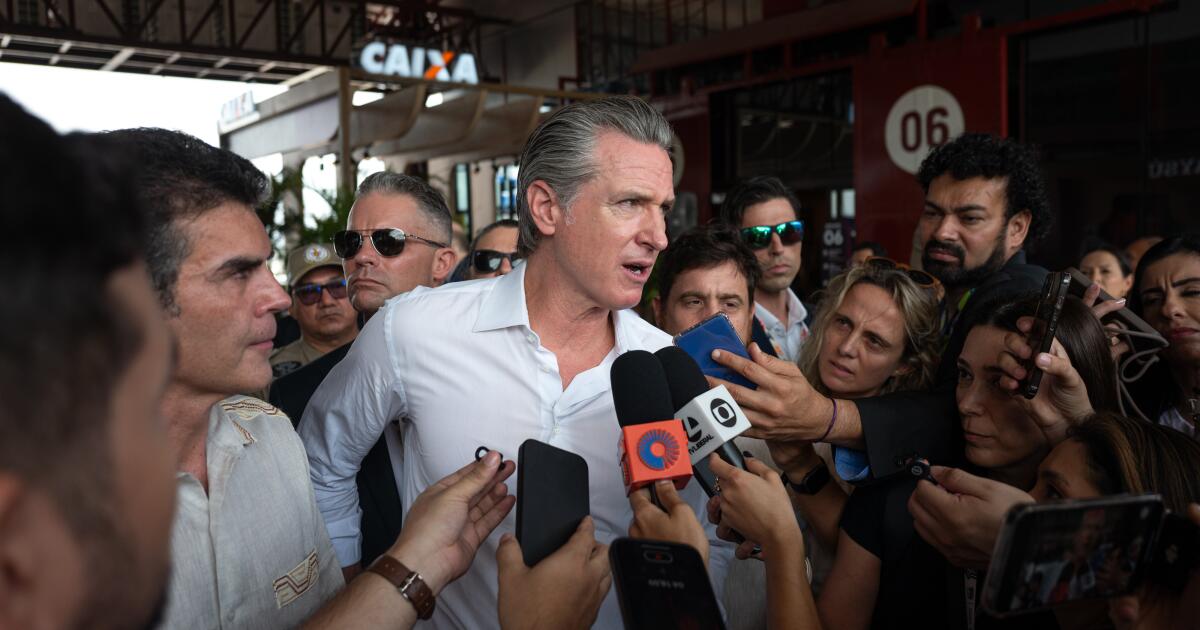
Some state-level representatives and others attended the conference, including California Governor Gavin Newsom, who criticized Trump for not sending a U.S. delegation.

The 2026 U.N. COP30 conference will be held in Turkey.

Source link

COP30 draft text urges more funds for poorer countries, omits fossil fuels | Climate Crisis News

Leaders welcome deal reached at UN climate summit as step forward but say ‘more ambition’ needed to tackle the crisis.

World leaders have put forward a draft text at the United Nations climate conference in Brazil that seeks to address the crisis, but the agreement does not include any mention of phasing out the fossil fuels driving climate change.

The text was published on Saturday after negotiations stretched through the night, well beyond the expected close of the two-week COP30 summit in the Brazilian city of Belem, amid deep divisions over the fossil fuel phase-out.

Recommended Stories

list of 3 itemsend of list

The draft, which must be approved by consensus by nearly 200 nations, pledges to review climate-related trade barriers and calls on developed nations to “at least triple” the money given to developing countries to help them withstand extreme weather events.

It also urges “all actors to work together to significantly accelerate and scale up climate action worldwide” with the aim of keeping the 1.5 degrees Celsius (2.7 degrees Fahrenheit) mark for global warming – an internationally agreed-upon target set under the Paris Agreement – “within reach”.

Wopke Hoekstra, the European Union’s climate commissioner, said the outcome was a step in the right direction, but the bloc would have liked more.

“We’re not going to hide the fact that we would have preferred to have more, to have more ambition on everything,” Hoekstra told reporters. “We should support it because at least it is going in the right direction,” he said.

France’s ecological transition minister, Monique Barbut, also said it was a “rather flat text” but Europeans would not oppose it because “there is nothing extraordinarily bad in it”.

Cuban Foreign Minister Bruno Rodriguez Parrilla also said in a social media post that while the outcome “fell short of expectations”, COP30 demonstrated the importance of multilateralism to tackle global challenges such as climate change.

‘Needed a giant leap’

Countries had been divided on a number of issues in Belem, including a push to phase out fossil fuels – the largest drivers of the climate crisis – that drew opposition from oil-producing countries and nations that depend on oil, gas and coal.

Questions of climate finance also sparked heated debates, with developing nations demanding that richer countries bear a greater share of the financial burden.

But COP30 host Brazil had pushed for a show of unity, as the annual conference is largely viewed as a test of the world’s resolve to address a deepening crisis.

“We need to show society that we want this without imposing anything on anyone, without setting deadlines for each country to decide what it can do within its own time, within its own possibilities,” Brazilian President Luiz Inacio Lula da Silva said earlier this week.

Earlier on Saturday, COP30 President Andre Aranha Correa do Lago said the presidency would publish “roadmaps” on fossil fuels and forests as there had been no consensus on those issues at the talks.

Speaking to Al Jazeera before the draft text was released, Asad Rehman, chief executive director of Friends of the Earth, said richer countries “had to be dragged – really kicking and screaming – to the table” at COP30.

“They have tried to bully developing countries and have weakened the text … But I would say that, overall, from what we’re hearing, we will have taken a step forward,” Rehman said in an interview from Belem.

“This will be welcomed by the millions of people for whom these talks are a matter of life and death. However, in the scale of the crisis that we face, we of course needed a giant leap forward.”

Source link

Brazil Bets on Forest Economy Ahead of COP30

Belem, the host of COP30, is trying to show that the Amazon can generate jobs without clearing trees. Para state has launched a new Bioeconomy and Innovation Park to help locals turn traditional forest products from acai to Brazil nuts into export-ready goods. The project sits beside the century-old Ver-o-Peso market, linking long-standing Amazon trade with modern processing labs and equipment meant to boost production and income.

WHY IT MATTERS

Brazil wants to demonstrate that a “living forest” can be economically competitive with cattle, soy and mining. Early studies show forest-product value chains already rival livestock income in Para, and officials hope to expand that into a recognisable industrial sector. With Belem about to host the world’s biggest climate summit, the state is under pressure to prove that conservation and development can advance together.

Producers, small businesses and forest communities stand to benefit from better processing facilities and higher-value markets. Companies like Natura already rely on Amazon ingredients, while newer ventures are scaling up acai, oils and specialty foods through the park’s labs. Farmers and cooperatives are also using the facilities to improve packaging, blends and shelf life, hoping to reach premium buyers at home and abroad.

WHAT’S NEXT

Para will use COP30 to court investors and expand infrastructure so forest-based industries can grow beyond small-scale production. The Bioeconomy Park is expected to push more Amazon products into global markets, but lasting success will depend on keeping forests intact as demand rises. For Brazil, Belem’s progress will serve as a showcase of what a viable “rainforest economy” could look like on the global stage.

With information from Reuters.

Source link

COP30 attendees in Brazil forced to evacuate pavilion following fire | Climate News

Officials at the climate conference say the fire was contained within six minutes, and 13 attendees were treated for smoke inhalation.

Sao Paulo, Brazil – Attendees have been forced to evacuate the 2025 United Nations Climate Change Conference, known as COP30, after a fire broke out at the venue in Belem, Brazil.

There were no injuries in Thursday’s blaze, according to Brazil’s Tourism Minister Celso Sabino. In a news conference afterwards, he downplayed the seriousness of the fire.

Recommended Stories

list of 3 itemsend of list

“There was a small fire here, which is possible at any large event,” he told journalists. “This small fire could happen anywhere on planet Earth.”

Organisers reported that the evacuation was “fast” and the fire was controlled within six minutes, leaving only minor damage.

Thirteen people were treated for smoke inhalation, according to a joint statement from the UN and COP30 leaders.

The affected area, known as the Blue Zone, is expected to remain closed until 8pm local time (23:00 GMT).

The cause of the fire remains unclear. But Helder Barbalho — the governor of the state of Para, where the summit is taking place — told the Brazilian channel GloboNews that authorities believe a generator failure or short circuit might have sparked the incident.

On social media, Barbalho assured the public that other parts of the COP30 conference zone continued to be in operation.

“We will find out what caused it, whether we can restart work here in the Blue Zone today or not,” he wrote. “The Green Zone is operating normally.”

Reports emerged about 2pm local time (17:00 GMT) of flames in the Blue Zone pavilion, a restricted area for negotiators and accredited media.

Videos on social media showed scenes of panic and security officials ordering attendees to exit the venue.

Al Jazeera spoke to Fernando Ralfer Oliveira, an independent journalist who was in the Blue Zone when the fire broke out and shared footage of the flames.

“I was in the big corridor that leads to the meeting rooms when a commotion of people started running. I had my phone in my hand and immediately started recording,” said Ralfer.

“When I got close to the pavilion, someone ran past me shouting, ‘Fire, fire, fire!’ So I ran a little and managed to record that bit of the fire. But at that moment, security was already coming towards us in force, saying ‘Evacuate, evacuate, evacuate.’”

Ralfer and other evacuees were then directed to the COP30’s food court area, located outside the pavilion.

Roughly an hour after the fire broke out, the UN Framework Convention on Climate Change (UNFCCC), which organises the conference, sent an email to attendees saying that the local fire service would conduct “full safety checks” at the venue.

They then announced the Blue Zone’s continued closure: “Please note that the premises are now under the authority of the Host Country and are no longer considered a Blue Zone.”

The Blue Zone fire happened a week after Brazil responded to the UN’s concerns around safety at COP30.

On November 13, Simon Stiell, the executive secretary with the UNFCCC, sent a letter to Brazilian President Luiz Inacio Lula da Silva and his government, raising issues ranging from faulty doors to water leaks near light fixtures.

That same day, the Brazilian government published a statement saying that “all UN requests have been met”, including the repositioning and expansion of police forces between the Blue and Green Zones.


Source link

COP30 cannot meet the 1.5C goal while military emissions stay uncounted | Environment

Militaries are major global polluters, yet they remain exempt from climate reporting, creating a blind spot that threatens the entire COP30 roadmap.

As COP30 negotiations in Belem enter their final stretch, there is hope that countries might finally agree on a roadmap to phase out fossil fuels — a breakthrough that is crucial if we are serious about keeping 1.5C alive. Yet even at this pivotal moment, one major highway is still missing from that roadmap that could undermine the progress made in Brazil: the carbon emissions of the military.

Under the Paris Agreement, governments are not required to report their militaries’ emissions, and most simply don’t. Recent analysis by the Military Emissions Gap project shows that what little data exists is patchy, inconsistent or missing entirely. This “military emissions gap” is the gulf between what governments disclose and the true scale of military pollution. The result is stark: militaries remain largely invisible in the Belem negotiations, creating a dangerous blind spot in global climate action.

The size of that blind spot is staggering. Militaries account for an estimated 5.5 percent of global emissions. This share is set to rise further as defence spending surges while the rest of society decarbonises. If militaries were a country, they would be the fifth-largest emitter on Earth, ahead of Russia with 5 percent. Yet only five countries follow the United Nations Framework Convention on Climate Change’s (UNFCCC) voluntary reporting guidelines for military emissions, and those cover fuel use alone. The reality is far broader: munitions production and disposal, waste management and fugitive emissions from refrigeration, air-conditioning, radar and electrical equipment are left out. And operations in international waters and airspace are not reported at all, leaving massive gaps in both climate accountability and action.

The military emissions gap widens further still when we consider the climate impact of armed conflicts. As if the horror and human suffering from fighting wars were not enough, wars also destroy ecosystems, leave a toxic legacy on lands for decades to follow, and result in significant CO2 emissions, including from the rebuilding following the destruction of buildings and infrastructure. But without any internationally agreed framework to measure conflict emissions, these additional emissions risk going unreported, meaning that we don’t know how much wars are setting back climate action.

But despite this, momentum for accountability is finally building. Nearly 100 organisations have signed the War on Climate initiative’s pledges ahead of COP30, and protesters and civil society groups in Belem are demanding the UNFCCC confront this long-ignored source of pollution. Policymakers are starting to shift, too. The European Union has taken steps towards more transparent reporting and decarbonisation in the defence sector, though this progress is now threatened by rapid rearmament. Combined with NATO’s new target for members to spend 5 percent of gross domestic product on militaries, these pledges could produce up to 200 million tonnes of CO2 and trigger as much as $298bn in climate damages annually, putting Europe’s own climate goals at risk.

International law reinforces the urgency and demand for accountability. The International Court of Justice’s recent landmark advisory opinion reminded states that they are obliged under climate treaties to assess, report and mitigate harms, including those caused by armed conflict and military activity. Ignoring these emissions doesn’t just undercount global warming; it masks the scale of the crisis and weakens the world’s ability to tackle its root causes.

The gap between current emission-reduction plans and what is needed to stay below the 1.5C limit remains catastrophic. If COP30 negotiators agree on a roadmap for phasing out fossil fuels, what happens next will determine whether it delivers real progress or remains symbolic. No sector can be exempt from climate action, and military emissions cannot continue to remain hidden.

Mandatory reporting of all military emissions to the UNFCCC – from combat and training activities to the long-lasting climate damage inflicted on communities – is essential.  That data must form the baseline for urgent, science-aligned reductions, embedded in national climate plans, and consistent with the 1.5C limit.

Security cannot come at the cost of the climate. Tackling climate change is now essential to our collective safety and the survival of our planet.

The views expressed in this article are the author’s own and do not necessarily reflect Al Jazeera’s editorial policy.

Source link

India wants COP30 to focus on climate adaptation, but dries up own fund | Climate Crisis News

Indian-administered Kashmir – On the night of September 2, Shabir Ahmad’s home was swallowed by mud and swept into the river after relentless rains triggered a landslide in Sarh village in Indian-administered Kashmir’s Reasi district.

“I had been building my house brick by brick since 2016. It was my life’s work. Only less than a year ago, I had finished constructing the second floor, and now there is nothing,” the 36-year-old father of three children told Al Jazeera.

Recommended Stories

list of 4 itemsend of list

Ahmad’s was among nearly 20 houses in Sarh lost to the Chenab River that night, including one belonging to his brother, as dozens of families helplessly watched their farmlands, shops and other properties worth millions of rupees vanish without a trace.

“We don’t even have one inch of land left to stand on,” said Ahmad from a government school in Sarh, where his family and other villagers were sheltering after the deluge.

The tragedy at Sarh was among the latest of increasingly frequent climate disasters across India that destroy lives and livelihoods, and displace millions of people to an uncertain future.

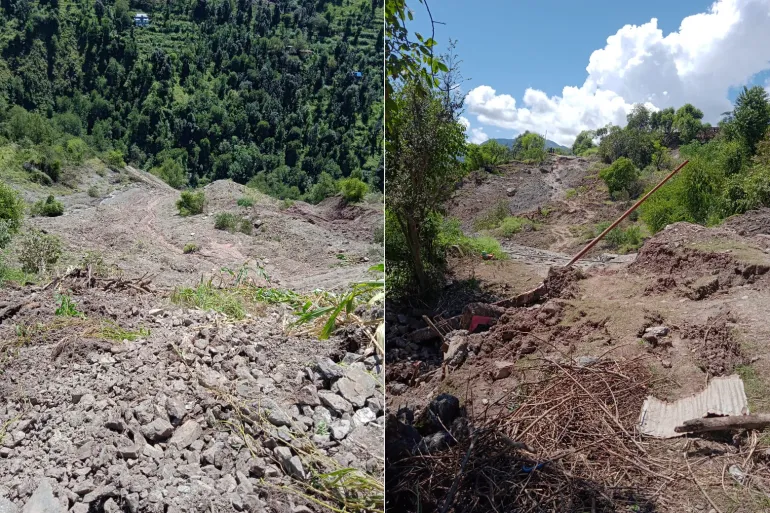
Only a few stones of house and traces of mud remain after land subsidence in Reasi district
A combination of photos shows the remains of what used to be houses in Reasi district, Indian-administered Kashmir, after they were destroyed by land subsidence [Junaid Manzoor Dar/Al Jazeera]

According to the Geneva-based Internal Displacement Monitoring Centre (IDMC), climate-related disasters forced more than 32 million people from their homes in India between 2015 and 2024, with 5.4 million displacements recorded in 2024 alone – the highest in 12 years. This makes India one of the three nations most affected by internal displacements due to climate change in that period, with China and the Philippines being the top two.

Moreover, in the first six months of 2025, more than 160,000 people were displaced across India due to natural disasters, as the country received above-average rainfall, triggering huge floods and landslides, and submerging hundreds of villages and cities.

Zero adaptation money for two years

To help millions of people like Ahmad who are vulnerable to the climate crisis, India’s Ministry for Environment, Forest and Climate Change launched a National Adaptation Fund on Climate Change (NAFCC) in 2015. Its goal was to finance projects that help communities cope with floods, droughts, landslides, and other climate-related stresses across India.

Managed by the National Bank for Agriculture and Rural Development (NABARD), the flagship scheme supported interventions in agriculture, water management, forestry, coastal protection, and climate-resilient infrastructure. Between 2015 and 2021, it financed more than two dozen projects, benefitting thousands of vulnerable households.

During a roundtable in Brazil’s Belem city last month – before the 30th United Nations climate change conference, or COP30, which officially opened on Monday – India’s minister for environment, forest and climate change, Bhupender Yadav, said the global meet should be the “COP of adaptation”.

“The focus must be on transforming climate commitments into real-world actions that accelerate implementation and directly improve people’s lives,” he said, according to a statement released by the Indian government on October 13. He highlighted “a need to strengthen and intensify the flow of public finance towards adaptation”, said the statement.

In another statement last Tuesday, a day after COP30 opened, India said climate “adaptation financing needs to exceed nearly 15 times current flows, and significant gaps remain in doubling international public finance for adaptation by 2025”.

“India emphasised that adaptation is an urgent priority for billions of vulnerable people in developing countries who have contributed the least to global warming but stand to suffer the most from its impacts,” said the statement.

But the actions of the Indian government back home do not match those words at the climate summit.

Government records show NAFCC received an average of $13.3m annually in the initial years of its launch. But the allocation steadily declined. In the financial year 2022-2023, the fund’s spending was just $2.47m. In November 2022, the Ministry of Environment, Forest and Climate Change moved NAFCC from the category of a government “scheme” to a “non-scheme”, providing no clear outlay for funds.

Since the financial year 2023-2024, zero money has been earmarked for the crucial climate adaptation fund.

As a result, several climate adaptation projects in areas prone to floods, cyclones and landslides have been stalled even as widespread climatic devastation continued to kill and displace people. While presenting the federal budget in parliament in February this year, Finance Minister Nirmala Sitharaman did not even include the words “climate change” and “adaptation” in her hour-long speech.

“Announcing lofty adaptation goals abroad while starving the fund that safeguards our own citizens is misleading and a moral failure,” Raja Muzaffar Bhat, an environmental activist in Indian-administered Kashmir, told Al Jazeera, calling Yadav’s statements in Brazil “a gross distortion of reality and a dangerous distraction”.

Al Jazeera reached out to the Ministry of Finance and the Ministry of Environment, Forest and Climate Change for their comments on cutting NAFCC funds, but has not received any response.

An official in the Environment Ministry, however, defended the government’s shift in funding priorities, claiming the authorities have not abandoned climate adaptation efforts.

“Funds are now being channelled through broader climate and sustainability initiatives rather than standalone schemes like the NAFCC,” the official told Al Jazeera on condition of anonymity because he was not authorised to speak to the media.

‘Climate injustice at its most blatant’

Meanwhile, climate crises continue to kill and displace people across India.

In the Darbhanga district of Bihar, India’s poorest state, 38-year-old Sunita Devi has been displaced five times in seven years as floods in the nearby Kosi River repeatedly destroyed her mud house built on bamboo stilts.

“We live in fear every monsoon. My children have stopped going to school because we shift from camp to camp,” she said, holding on to the family’s only lifeline: A government ration card that allows them to buy food grains at subsidised rates or get them for free.

This year saw one of the worst monsoons across India, as above-average rains killed hundreds and displaced millions. In Bihar alone, floods affected more than 1.7 million people, killed dozens and submerged hundreds of villages.

In Odisha, another impoverished eastern state, fisherman Ramesh Behera*, 45, watched his house in Kendrapara district’s Satabhaya village collapse into the Bay of Bengal in 2024, as rising seas continue to erase entire hamlets. “The sea swallowed my home and my father’s fields. Fishing is no longer enough to survive,” he told Al Jazeera.

Behera was forced to give up his family’s traditional livelihoods – fishing and farming – and was driven into distress migration to survive. He now works as a manual labourer in Srinagar, the main city in Indian-administered Kashmir.

In West Bengal state’s Sundarbans Islands, one of the largest mangrove forests in the world, rising seas and coastal erosion have consumed lands and homes, forcing thousands of families in the fragile ecosystem to relocate.

In the southern state of Tamil Nadu’s Nagapattinam district, 29-year-old Revathi Selvam says saltwater intrusion from the Bay of Bengal has poisoned her farmland and their paddy harvest has collapsed.

“The soil is no longer fertile. We cannot grow rice any more. We may have to leave farming altogether,” she told Al Jazeera, adding that many in her village are considering migrating to the state capital, Chennai, to work as construction workers.

In the Himalayan state of Himachal Pradesh, 27-year-old hotel worker Arjun Thakur saw his livelihood vanish when a cloudburst in 2024 buried the small tourist lodge where he worked. “The mountain broke apart. I saw houses collapse in seconds,” he recalled.

Thakur now stays with his relatives in the state capital Shimla, unsure if he can ever return to his native place.

The government-provided tarpaulin tents in Reasi district are too small for residents to stand
The government provided tarpaulin tents to affected families in Kashmir’s Reasi district, while the photo on the right shows Qamar Din’s relatives watching helplessly as his house collapses [Junaid Manzoor Dar/Al Jazeera]

Yet, with funds for NAFCC gone, people like Devi, Behera, Selvam and Thakur have no access to a government scheme that helps them cope with their tragedies.

A government official, who previously worked with NAFCC, told Al Jazeera several schemes approved by the government under NAFCC were never implemented after funds began to dry up as early as 2021, exposing thousands of households to a recurring climate crisis.

“The fund was created to help vulnerable communities adapt before disasters struck, and to reduce the kind of repeated displacement we are now witnessing,” the official said on condition of anonymity because he was not authorised to speak to the media.

“Once the allocations stopped, states lost a key channel to protect people living on the front lines of floods, landslides, and droughts. Now, these families are left to rebuild on their own, again and again.”

Activist Bhat said the government’s attitude to the NAFCC “signals that adaptation is no longer a priority, even as India faces record internal displacement from climate extremes”.

“People are losing homes, farms, and livelihoods, and the government has left them entirely to their fate. If this continues, the next generation will inherit a country where climate refugees are a daily reality,” he said.

“This is climate injustice at its most blatant.”

‘Migration no longer a choice but a survival strategy’

Climate Action Network South Asia is a Dhaka-based coalition of about 250 civil society organisations, working in eight South Asian countries to promote government and individual action to limit human-induced climate change. Its estimate says roughly 45 million people in India could be forced to migrate by 2050 due to the climate crisis – a threefold increase over current displacement figures.

“We are a vast nation with hot and cold deserts, long coastlines, and Himalayan glaciers. From tsunamis on our shores to flash floods, cloudbursts, and landslides in the mountains, we face the entire spectrum of climate extremes,” Bhat told Al Jazeera.

Bhat said it is not just nature causing displacement, but also unchecked “development” of vulnerable areas.

“Earlier, floods or cloudbursts were occasional, and population density was low. Now, haphazard construction around mountain passes, waterways and streams, along with rampant deforestation, has amplified these disasters,” he said.

“People who once fled New Delhi’s air pollution to settle down in [the Himalayan states of] Himachal Pradesh or Uttarakhand now find themselves living under a constant threat of landslides. Migration is no longer a choice but a survival strategy.”

Bhat warned that neglecting people affected by climate-related displacement could cause the world’s largest climate migration crisis.

“We are no longer behaving like the welfare state promised in our constitution. We pay taxes like a developed country but get services that leave people to die in a climate crisis… We are utterly unprepared for the mass migrations that will inevitably come from both our mountains and our plains,” he said.

Back at the temporary government shelter in Kashmir’s landslide-hit Sarh village, Ahmad fears an uncertain future for him and his family.

“If land and shelter are not provided, we will not merely be homeless; we will become refugees in our own land, cast aside without place or protection,” he said.

“When the state neglects the consequences of climate change, it issues a declaration: You are free to drown, but not free to rebuild.”

Source link

An Amazon climate summit built on contradiction, creating unease for California delegates

Two stark-white cruise ships loomed over a muddy Amazonian estuary, an odd sight from a beach where two children waded in the water.

The diesel-powered vessels towered over the impoverished riverfront neighborhood where trash littered the ground and a rainbow sheen from household and street runoff glistened on top of rain puddles.

The cruise liners — with their advertised swimming pools, seafront promenades and an array of restaurants and bars — were brought in to house thousands of delegates attending the 12-day United Nations COP30 climate summit in Belém, which ends Friday. The ships helped address a housing crunch created by an influx of roughly 50,000 people into the capital of Pará in northern Brazil.

Along with being a global economic powerhouse, Brazil is also one of the planet’s most important climate actors. The South American nation is home to tropical rainforests that absorb vast amounts of carbon dioxide but are increasingly threatened by deforestation and a drying Amazon.

A navy soldier patrols the Port of Outeiro, where a giant cruise ship is docked in the background.

A navy soldier patrols the Port of Outeiro, where cruise ships are docked to host delegations attending the COP30 U.N. Climate Change Conference in Belem, Brazil, on Nov. 8. Two cruise ships tower imposingly over a sleepy port in the Brazilian Amazon where some 50,000 people are gathering for a U.N. climate conference. With capacity for 6,000 people, the behemoths came from Europe to the riverine city of Belem on Brazil’s north coast to serve as floating hotels.

(Pablo Porciuncula / AFP via Getty Images)

The contrast — a climate conference relying on emissions-heavy cruise ships — has become the defining image of this year’s COP30, where wealth and scarcity sit side by side.

Belém residents said they felt a mix of curiosity and excitement watching the influx of foreigners, eager to show a culture that is often overshadowed by the country’s larger southern cities.

Many described COP30 as the first time the world had paused long enough to take notice of the people living at the mouth of the Amazon River, where locally grown açaí is sold on nearly every block. The region supplies the vast majority of Brazil’s açaí crop and much of what’s exported worldwide.

As humidity hung thick in the hot air, locals across the city of 1.3 million people pointed to expanded docks meant to attract future tourism, freshly painted walkways, restored colonial buildings with late-19th-century European touches and new cultural centers rushed to completion. But the sudden infusion of money layered atop long-standing inequality sharpened questions from residents about what will remain after the summit’s global spotlight fades.

Much of the summit footprint, they said, sits in areas where new structures were built fast, unevenly or only partly completed. Brazil’s government highlighted upgrades to Belém’s airports, ports, drainage systems, sanitation networks, parks and tourist areas, saying the work would leave a lasting legacy beyond COP30.

The BBC reported that a new four-lane highway built for COP30 resulted in tens of thousands of acres of protected Amazon rainforest being leveled, including trees locals relied on to harvest açaí berries to sell. One roadway to ease traffic to the climate summit remains unfinished and blocked by plastic orange netting.

“They cut all this forest to make that road and didn’t even finish it,” said Lucas Lina, 19, who works as an administrator at a Belém fire station, as he pointed to the unfinished road. “I don’t think they ever will. They will delay and delay.”

Lina said climate change is something locals feel acutely. The region has seen unpredictable rainfall, and in some years, receives little at all in an area used to its showers.

“The climate is going crazy,” Ana Paula, a government food safety inspector, said in Portuguese as Lina translated. “We can’t predict anything anymore.”

Even environmentalists acknowledge the optics are fraught, particularly as attendees flew more than 1,800 miles from events in Rio de Janeiro and São Paulo for satellite gatherings. That included members of California’s delegation and Gov. Gavin Newsom.

“It’s not well conceived because there’s not enough housing,” said Terry Tamminen, former California environmental secretary. “If we really cared about the climate, we’d have these events every year and they’d be 100% virtual.”

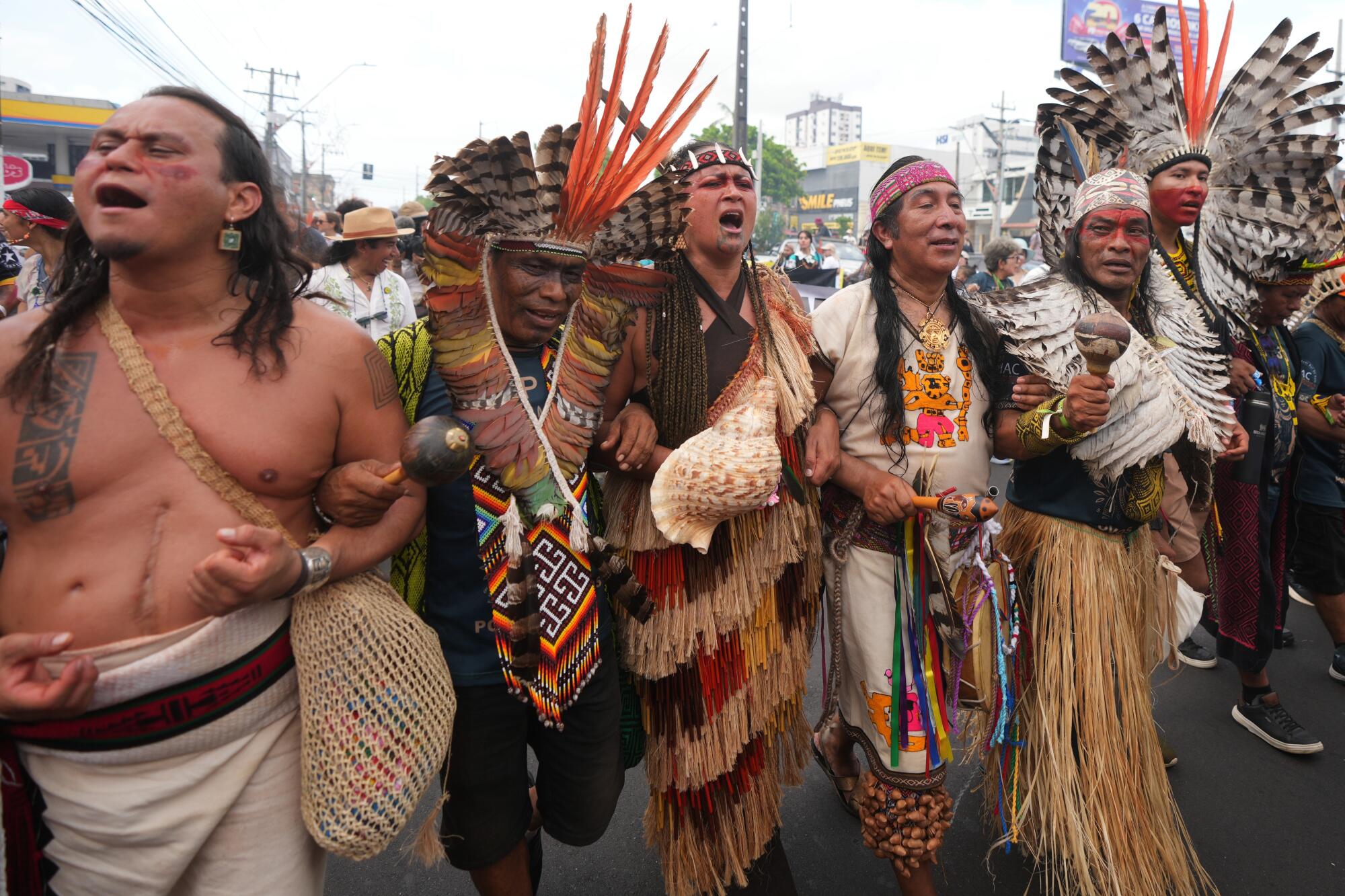
Such contradictions have often fueled demonstrations at climate summits, including on Friday when roughly 100 Indigenous protesters blocked the conference’s main entrance for more than 90 minutes. They formed a human chain as they denounced development plans they say would accelerate deforestation.

Indigenous activists participate in a climate protest during the COP30 U.N. Climate Summit.

Indigenous activists participate in a climate protest during the COP30 U.N. Climate Summit on Saturday in Belém, Brazil.

(Andre Penner / Associated Press)

“Our forest is not for sale,” they wrote in a statement.

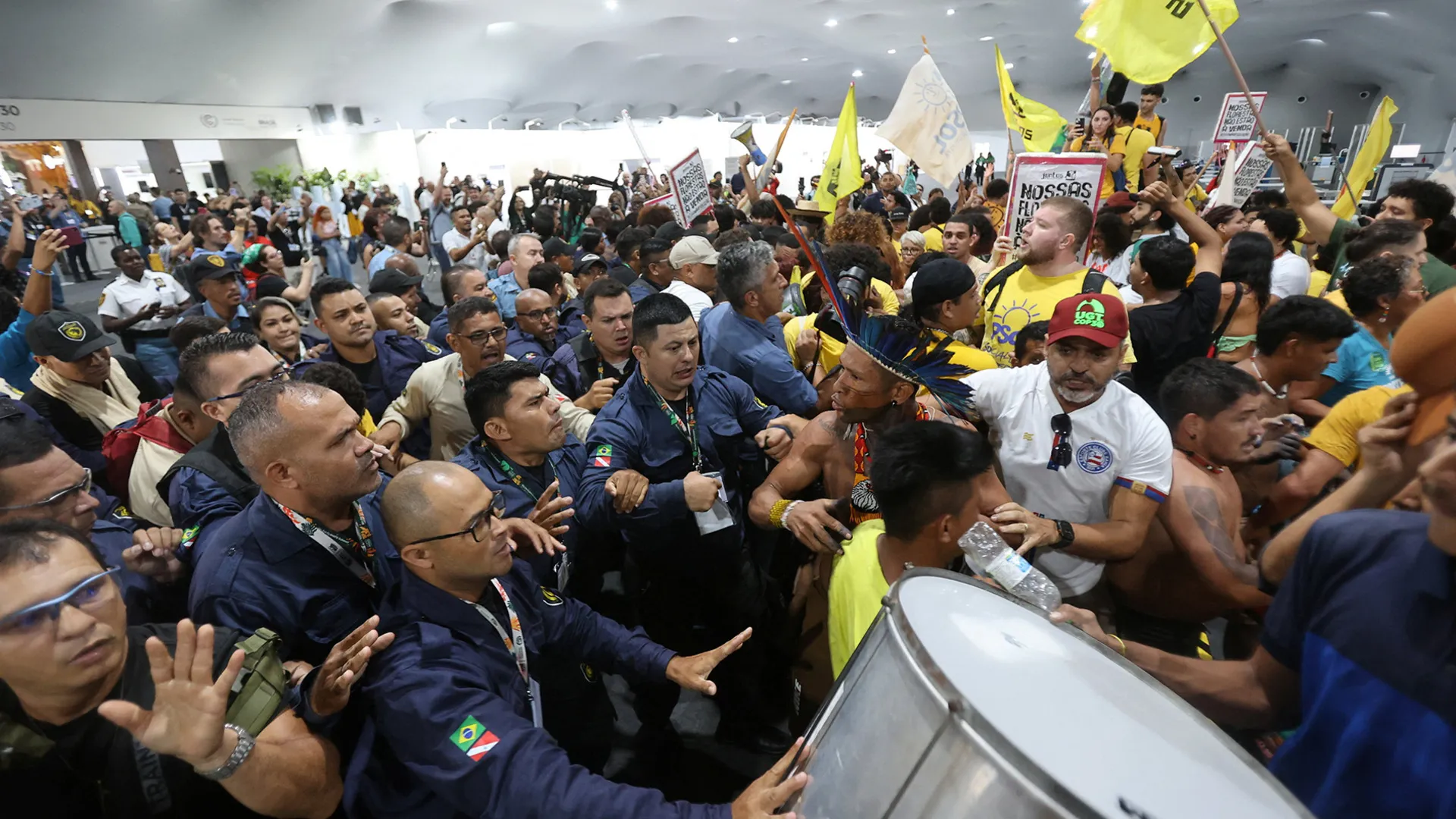
It was the second protest during the first week of COP30 after a brief clash inside the massive newly constructed facility resulted in two security guards suffering minor injuries.

“There are a lot of promises that the government made that are yet to be delivered,” said Lina, who taught himself English by watching YouTube and through online gaming. “We don’t know if these promises will actually be kept up after COP30.”

That tension — between symbolism and the city’s strained reality — defines this climate conference in a way that delegates say feels impossible to ignore.

Brazil remains one of the world’s top oil producers and recently approved new drilling near the rainforest. Many delegates argued that no setting better captures the stakes of the climate crisis than the Amazon, where Indigenous stewardship, extraordinary biodiversity and the consequences of deforestation are felt globally.

“I don’t know there’s a more important location than the rainforest,” Newsom told The Times. “The one area that consistently gets overlooked in the climate discussion is biodiversity.”

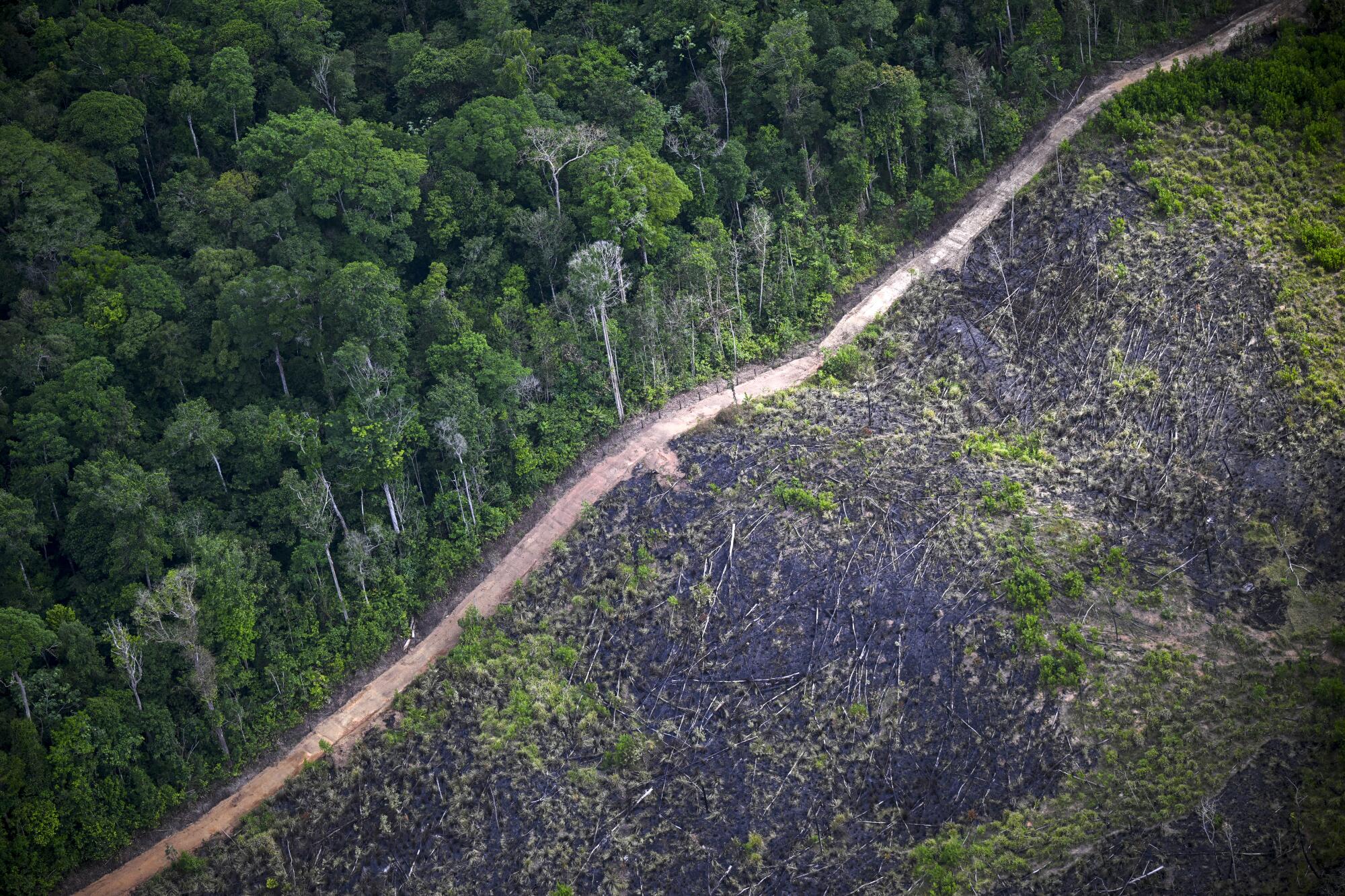
This aerial view shows a deforested area of the Amazon rainforest.

This aerial view shows a deforested area of the Amazon rainforest in the municipality of Moju, Brazil, on Wednesday during the COP30 U.N. Climate Change Conference.

(Mauro Pimentel / AFP via Getty Images)

With the summit came new investments that residents say they welcomed, including new bus routes, expansions at ports meant to increase future tourism and increased police presence to make streets safer.

“It’s very good for us,” said Maria Fátima in Portuguese while standing under an awning of a shuttered bar overlooking the cruise ships. She smiled and gave a thumbs up after saying she had never seen an American in Belém before.

“Everyone is very happy,” she said of the possibility that the newly expanded port will bring future tourism.

That port, which experienced an oil spill in April, is now being marketed as the Amazon’s next cruise-tourism hub. Its expansion cost $44 million and relied on nonstop work from construction crews in rotating shifts. The rush project doubled the pier’s capacity.

Room prices aboard the cruise ships soared to more than $1,400 a night for a balcony cabin, according to Times inquiries. On land, Belém’s modest supply of hotels and even seedy love motels that typically rent by the hour surged in price, pushing residents to rent their apartments and homes at rates many said they had never imagined.

People on a beach watch cruise ships docked at the Port of Outeiro, which will host delegations attending the COP30.

People on a beach along the Guama River watch cruise ships docked at the Port of Outeiro, which will host delegations attending the COP30 U.N. Climate Change Conference in Belém, Brazil, on Nov. 6.

(Carlos Fabal/AFP via Getty Images)

One attendee said her hotel room typically goes for $85 a night. Her room cost $1,000 instead.

Newsom even joked about the costs. When a Brazilian journalist asked whether California would make climate investments in the country, Newsom said the price of his room at the Holiday Inn in Belém already felt like an “economic contribution.”

But those prices didn’t benefit everyone. Local media reported that some renters were evicted ahead of the conference in order to open up rooms to foreigners.

Inside the summit, Newsom operated as a proxy for the United States while attending COP30 for two days after President Trump, an outspoken climate skeptic, declined to send any high-level federal officials.

Long Beach resident Dominic Bednar, attending his fifth climate summit, said the contradictions of this year’s summit don’t diminish the importance of being there.

“It’s a double-edged sword,” said Bednar, an assistant professor in the Department of Urban Planning and Public Policy at UC Irvine. “On one hand, it brings understanding to the city and is driving a lot of economic investment. But I’m also curious: What is the carbon footprint of everybody coming into COP and the construction of this place? We are using energy, and we’re contributing to climate pollution.”

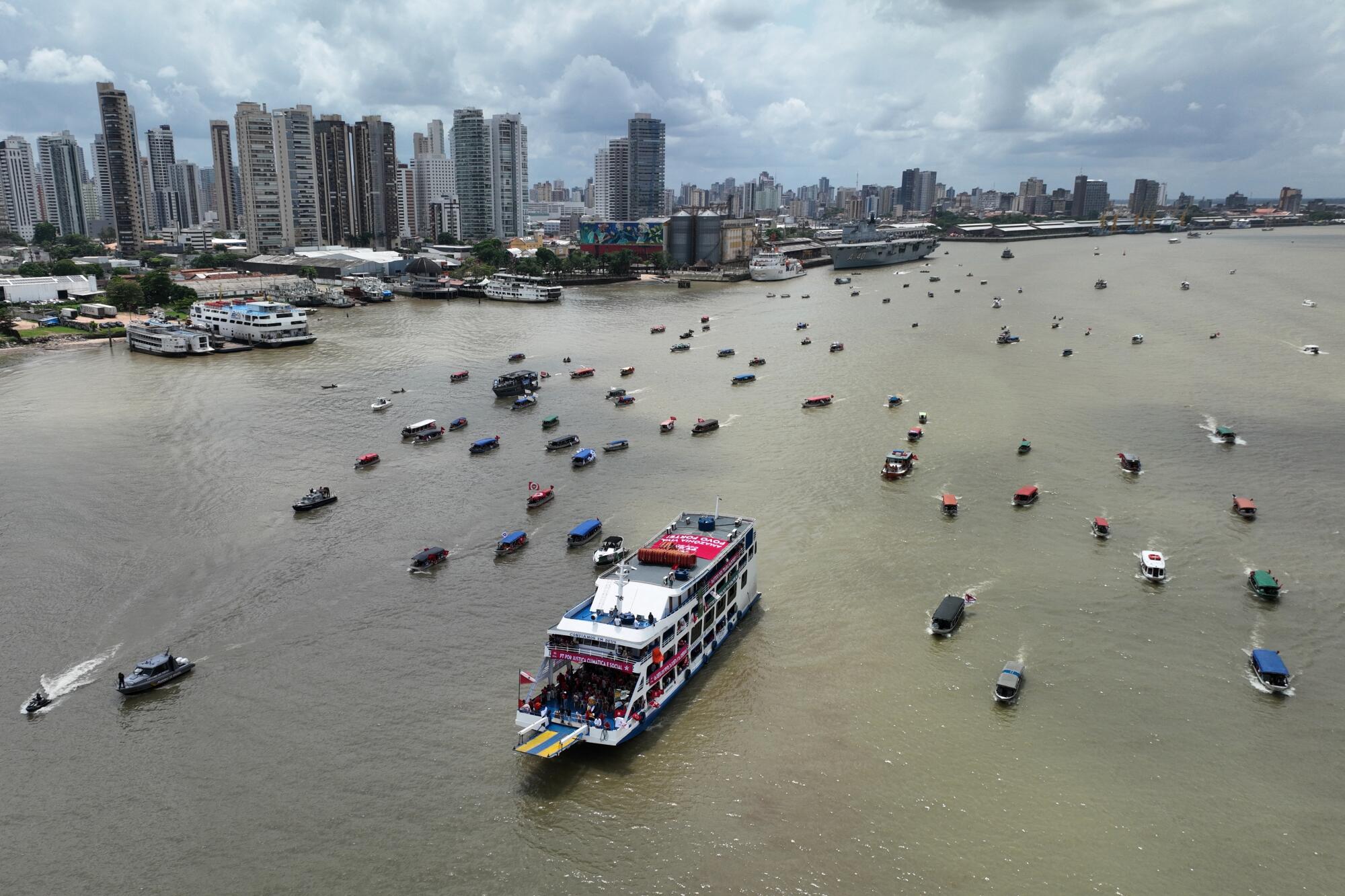
People riding in small boats in Guajara Bay with high rises on land in the background.

People riding in boats participate in a People’s Summit event on Guajara Bay during the COP30 U.N. Climate Summit on Wednesday in Belém, Brazil.

(Andre Penner / Associated Press)

Graduate students from UC San Diego’s Scripps Institution of Oceanography echoed that discomfort, but said not attending would only cede more ground to powerful energy interests that already dominate climate talks.

“We can empathize with not having our voices heard,” said graduate student Danielle McHaskell as she waited to take a photo with Newsom. “And that’s an important part of the climate movement — empathy for other people.”

Newsom, too, said he was aware of the contradiction of using fossil fuels to reach a climate summit.

Still, he defended the decision to hold COP30 in the Amazon. He said it offered a chance to “see what I’ve only seen on TV or could see disappear in my lifetime.” He added that he was particularly excited about venturing into the Amazon rainforest with a small delegation to learn in person about conservation efforts and connect with something beyond policy and negotiations.

“I think that spiritual element really matters in a world that can use a little bit more of that,” he said before returning to California on Sunday. “That’s one of the reasons I’m looking forward to getting deeper into the Amazon.”

Source link

Thousands march in Brazil town hosting COP30 for climate justice | Climate Crisis News

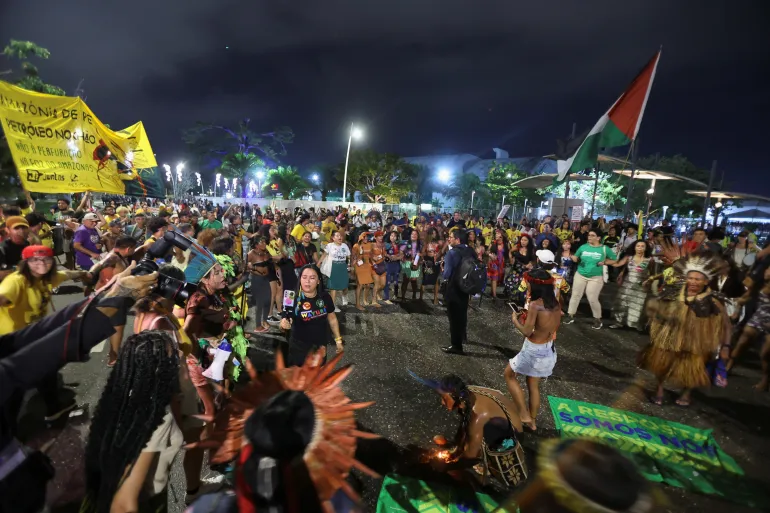
Tens of thousands of people have thronged the streets of an Amazonian city hosting the COP30 talks, dancing to pounding speakers in the first large-scale protest at a United Nations climate summit in years.

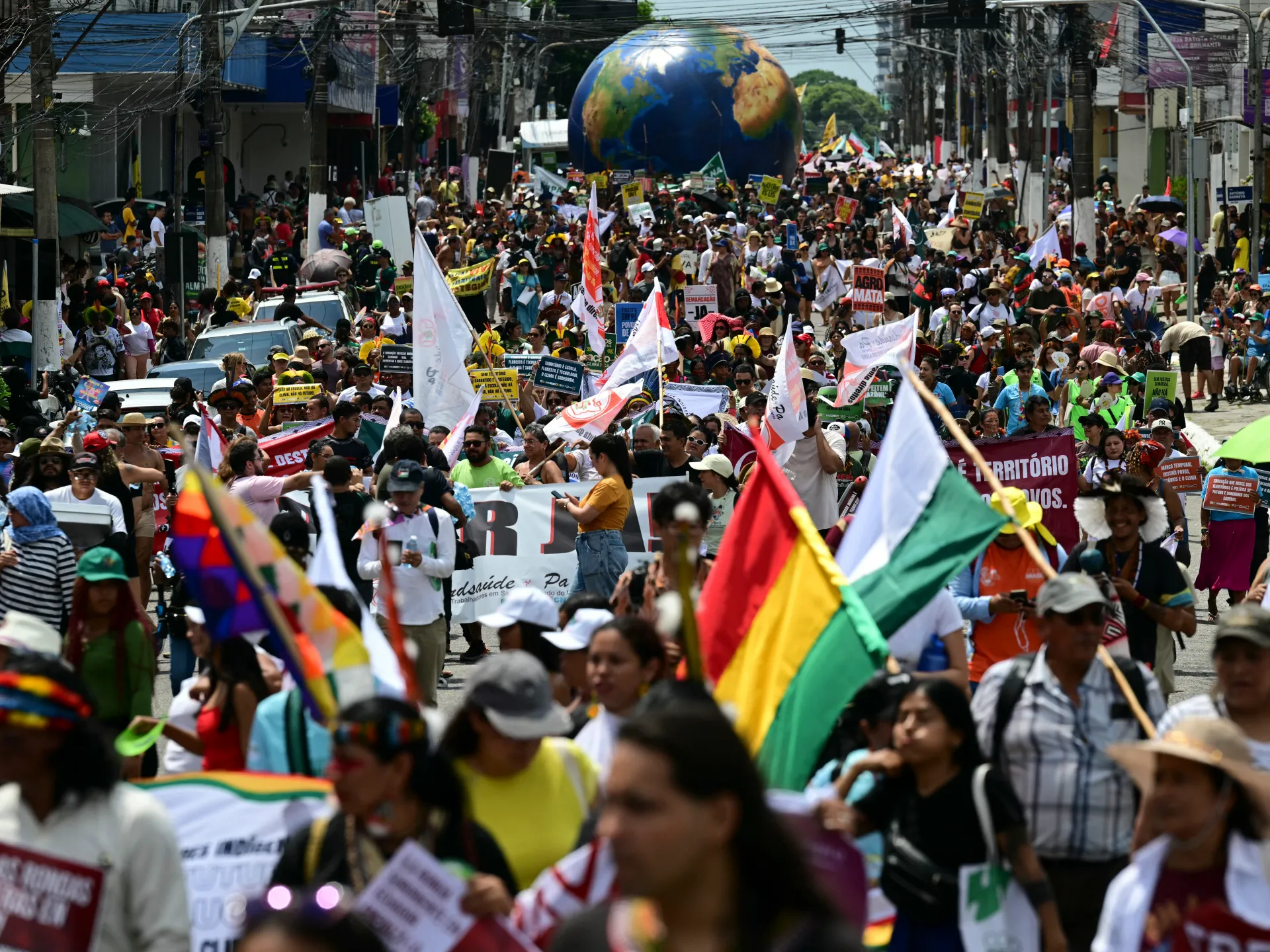
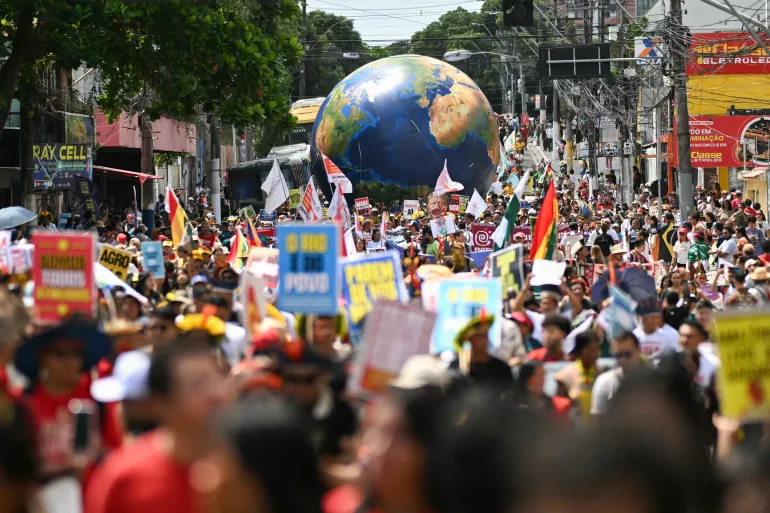
As the first week of climate negotiations limped to a close with nations deadlocked, Indigenous people and activists sang, chanted, and rolled a giant beach ball of Earth through Belem under a searing sun.

Others held a mock funeral procession for fossil fuels, dressed in black and posing as grieving widows as they carried three coffins marked with the words “coal”, “oil” and “gas”.

It was the first major protest outside the annual climate talks since COP26 four years ago in Glasgow, as the last three gatherings had been held in locations with little tolerance for demonstrations – Egypt, the United Arab Emirates, and Azerbaijan.

Called the “Great People’s March” by the organisers, the Belem rally came at the halfway point of difficult negotiations and followed two Indigenous-led protests that disrupted proceedings earlier in the week.

“Today we are witnessing a massacre as our forest is being destroyed,” said Benedito Huni Kuin, a 50-year-old member of the Huni Kuin Indigenous group from western Brazil.

“We want to make our voices heard from the Amazon and demand results,” he added. “We need more Indigenous representatives at COP to defend our rights.”

Their demands include “reparations” for damages caused by corporations and governments, particularly to marginalised communities.

After a 4.5km (2.8-mile) march through the city, the demonstration halted a few blocks from the COP30 venue, where authorities deployed soldiers to protect the site.

Inside the venue, COP30 President Andre Correa do Lago admitted that the first exhaustive week of negotiations had failed to yield a breakthrough and urged diplomats not to run down the clock with time-wasting manoeuvres.

Countries remained at odds over trade measures and weak climate targets, while a showdown looms over demands that wealthy nations triple the finance they provide to poorer states to adapt to a warming world.

Source link

Thousands march for climate action outside COP30 summit in Brazil | Climate Crisis News

Indigenous and other climate activists say they need to ‘make their voices heard’ as UN conference hits halfway mark.

Thousands of people have marched through the streets of the Brazilian city of Belem, calling for the voices of Indigenous peoples and environmental defenders to be heard at the United Nations COP30 climate summit.

Indigenous community members mixed with activists at Saturday’s march, which unfolded in a festive atmosphere as participants carried a giant beach ball representing the Earth and a Brazilian flag emblazoned with the words “Protected Amazon”.

Recommended Stories

list of 3 itemsend of list

It was the first major protest outside the conference, which began earlier this week in Belem, bringing together world leaders, activists and experts in a push to tackle the worsening climate crisis.

Indigenous activists previously stormed the summit, disrupting the proceedings as they demanded that Brazilian President Luiz Inacio Lula da Silva take concrete action to ensure their territories are protected from growing threats.

Amnesty International warned in a recent report that billions of people around the world are threatened by the expansion of fossil fuel projects, such as oil-and-gas pipelines and coal mines.

Indigenous communities, in particular, sit on the front lines of much of this development, the rights group said.

Thousands of people take part in the so-called "Great People's March" in the sidelines of the COP30 UN Climate Change Conference in Belem, Para State, Brazil on November 15, 2025.
Thousands of people took part in the climate march in Belem, Brazil, on Saturday [AFP]

Branded the “Great People’s March” by organisers, Saturday’s rally in Belem came at the halfway point of contentious COP30 negotiations.

“Today we are witnessing a massacre as our forest is being destroyed,” Benedito Huni Kuin, a 50-year-old member of the Huni Kuin Indigenous group from western Brazil, told the AFP news agency.

“We want to make our voices heard from the Amazon and demand results,” he said. “We need more Indigenous representatives at COP to defend our rights.”

Youth leader Ana Heloisa Alves, 27, said it was the biggest climate march she has participated in. “This is incredible,” she told The Associated Press. “You can’t ignore all these people.”

The COP30 talks come as the UN warned earlier this month that the world was on track to exceed the 1.5C (2.7F) mark of global warming – an internationally agreed-upon target set under the Paris Agreement – “very likely” within the next decade.

If countries do as they have promised in their climate action plans, the planet will warm 2.3 to 2.5C (4.1 to 4.5F) by 2100, a report by the UN Environment Programme (UNEP) found.

“While national climate plans have delivered some progress, it is nowhere near fast enough, which is why we still need unprecedented emissions cuts in an increasingly tight window, with an increasingly challenging geopolitical backdrop,” said UNEP chief Inger Andersen.

Despite that urgency, analysts and some COP30 participants have said they don’t expect any major new agreements to emerge from the talks, which conclude on November 21.

Still, some are hoping for progress on some past promises, including funding to help poorer countries adapt to climate change.

People hold a giant flag reading “Protected Amazon” during the so-called "Great People's March" on the sidelines of the COP30 UN Climate Change Conference in Belem, Para state, Brazil, on November 15, 2025.
People hold a giant Brazilian flag reading ‘Protected Amazon’ during the march [AFP]

Source link

At Brazilian climate summit, Newsom positions California as a stand-in for the U.S.

The expansive halls of the Amazon’s newly built climate summit hub echoed with the hum of air conditioners and the footsteps of delegates from around the world — scientists, diplomats, Indigenous leaders and energy executives, all converging for two frenetic weeks of negotiations.

Then Gov. Gavin Newsom rounded the corner, flanked by staff and security. They moved in tandem through the corridors on Tuesday as media swarmed and cellphone cameras rose into the air.

“Hero!” one woman shouted. “Stay safe — we need you,” another attendee said. Others didn’t hide their confusion at who the man with slicked-back graying hair causing such a commotion was.

“I’m here because I don’t want the United States of America to be a footnote at this conference,” Newsom said when he reached a packed news conference on his first day at the United Nations climate policy summit known as COP30.

In less than a year, the United States has shifted from rallying nations on combating climate change to rejecting the science altogether under President Trump, whose brash governing style spawned in part from his reality-show roots.

Newsom has engineered his own evolution when coping with Trump — moving from sharp but reasoned criticism to name-calling and theatrical attacks on the president and his Republican allies. Newsom’s approach adds fire to America’s political spectacle — part governance, part made-for-TV drama. But on climate, it’s not all performance.

California’s carbon market and zero-emission mandates have given the state outsize influence at summits such as COP30, where its policies are seen as both durable and exportable. The state has invested billions in renewables, battery storage and electrifying buildings and vehicles and has cut greenhouse gas emissions by 21% since 2000 — even as its economy grew 81%.

“Absolutely,” he said when asked whether the state is in effect standing in for the United States at climate talks. “And I think the world sees us in that light, as a stable partner, a historic partner … in the absence of American leadership. And not just absence of leadership, the doubling down of stupid in terms of global leadership on clean energy.”

Newsom has honed a combative presence online — trading barbs with Trump and leaning into satire, especially on social media, tactics that mirror the president’s. Critics have argued that it’s contributing to a lowering of the bar when it comes to political discourse, but Newsom said he doesn’t see it that way.

“I’m trying to call that out,” Newsom said, adding that in a normal political climate, leaders should model civility and respect. “But right now, we have an invasive species — in the vernacular of climate — by the name of Donald Trump, and we got to call that out.”

At home, Newsom recently scored a political win with Proposition 50, the ballot measure he championed to counter Trump’s effort to redraw congressional maps in Republican-led states. On his way to Brazil, he celebrated the victory with a swing through Houston, where a rally featuring Texas Democrats looked more like a presidential campaign stop than a policy event — one of several moments in recent months that have invited speculation about a White House run that he insists he hasn’t launched.

Those questions followed him to Brazil. It was the first topic posed from a cluster of Brazilian journalists in Sao Paulo, Brazil’s largest city and financial hub, where Newsom had flown to speak Monday with climate investors in what he conceded sounded more like a campaign speech.

“I think it has to,” said Newson, his talking points scribbled on yellow index cards still in his pocket from an earlier meeting. “I think people have to understand what’s going on, because otherwise you’re wasting everyone’s time.”

In a low-lit luxury hotel adorned with Brazilian artwork and deep-seated chairs, Newsom showcased the well-practiced pivot of a politician avoiding questions about his future. His most direct answer about his presidential prospects came in a recent interview with “CBS News Sunday Morning,” on which Newsom was asked whether he would give serious thought after the 2026 midterm elections to a White House bid. Newsom responded: “Yeah, I’d be lying otherwise.”

He laughed when asked by The Times how often he has fielded questions about his plans in 2028 in recent days, and quickly deflected.

“It’s not about me,” he said before fishing a malaria pill out of his suit pocket and chasing it with borrowed coffee from a nearby carafe. “It’s about this moment and people’s anxiety and concern about this moment.”

Ann Carlson, a UCLA environmental law professor, said Newsom’s appearance in Brazil is symbolically important as the federal government targets Californa’s decades-old authority to enforce its own environmental standards.

“California has continued to signal that it will play a leadership role,” she said.

The Trump administration confirmed to The Times that no high-level federal representative will attend COP30.

“President Trump will not jeopardize our country’s economic and national security to pursue vague climate goals that are killing other countries,” White House spokesperson Taylor Rogers said.

For his own part, Trump told world leaders at the United Nations in September that climate change is a “hoax” and “the greatest con job ever perpetrated on the world.”

Since Trump returned to office for a second term, he’s canceled funding for major clean energy projects such as California’s hydrogen hub and moved to revoke the state’s long-held authority to set stricter vehicle emissions standards than those of the federal government. He’s also withdrawn from the Paris climate agreement, a seminal treaty signed a decade ago in which world leaders established the goal of limiting global warming to 2 degrees Celsius (3.6 degrees Fahrenheit) above preindustrial levels and preferably below 1.5 degrees Celsius (2.7 degrees Fahrenheit). That move is seen as pivotal in preventing the worst effects of climate change.

Leaders from Chile and Colombia called Trump a liar for rejecting climate science, while Brazilian President Luiz Inácio Lula da Silva broadly warned that extremist forces are fabricating fake news and “condemning future generations to life on a planet altered forever by global warming.”

Terry Tamminen, former California Environmental Protection Agency secretary under Gov. Arnold Schwarzenegger, contended that with the Trump administration’s absence, Newsom’s attendance at COP30 thrusts even more spotlight on the governor.

“If the governor of Delaware goes, it may not matter,” Tamminen said. “But if our governor goes, it does. It sends a message to the world that we’re still in this.”

The U.S. Climate Alliance, a bipartisan coalition of state leaders, said three governors from the United States attended COP30-related events in Brazil: Newsom, Wisconsin’s Tony Evers and New Mexico’s Michelle Lujan Grisham.

Despite the warm reception Newsom has received in Belém, environmentalists in California have recently questioned his commitment.

In September, Newsom signed a package of bills that extended the state’s signature cap-and-trade program through 2045. That program, rebranded as cap-and-invest, limits greenhouse gas emissions and raises billions of dollars for the state’s climate priorities. But, at the same time, he also gave final approval to a bill that will allow oil and gas companies to drill as many as 2,000 new wells per year through 2036 in Kern County. Environmentalists called that backsliding; Newsom called it realism, given the impending refinery closures in the state that threaten to drive up gas prices.

“It’s not an ideological exercise,” he said. “It’s a very pragmatic one.”

Leah Stokes, a UC Santa Barbara political scientist, called his record “pretty complex.”

“In many ways, he is one of the leaders,” she said. “But some of the decisions that he’s made, especially recently, don’t move us in as good a direction on climate.”

Newsom is expected to return to the climate summit Wednesday before traveling deeper into the Amazon, where he plans to visit reforestation projects. The governor said he wanted to see firsthand the region often referred to as “the lungs of the world.”

“It’s not just to admire the absorption of carbon from the rainforest,” Newsom said. “But to absorb a deeper spiritual connection to this issue that connects all of us. … I think that really matters in a world that can use a little more of that.”

Source link

Indigenous activists storm COP30 climate summit in Brazil, demanding action | Climate Crisis News

Hundreds of people have joined an Indigenous-led protest on the second day of the UN climate summit in the Brazilian city of Belem, highlighting tensions with the Brazilian government’s claim that the meeting is open to Indigenous voices.

Dozens of Indigenous protesters forced their way into the 30th annual United Nations Climate Change Conference (COP30) on Tuesday evening after hundreds of people participated in a march to the venue.

Recommended Stories

list of 4 itemsend of list

“We can’t eat money,” said Gilmar, an Indigenous leader from the Tupinamba community near the lower reaches of the Tapajos River in Brazil, who uses only one name, referring to the emphasis on climate finance at many of the meetings during the ongoing summit.

“We want our lands free from agribusiness, oil exploration, illegal miners and illegal loggers.”

A spokesperson from the UN, which is responsible for security inside the venue, said in a statement that “a group of protesters breached security barriers at the main entrance to the COP, causing minor injuries to two security staff, and minor damage to the venue”.

The protest came as Brazilian President Luiz Inácio Lula da Silva has highlighted Indigenous communities as key players in this year’s COP30 negotiations, even as several industries continue to further encroach on the Amazon rainforest during his presidency.

Lula told a leaders summit last week that participants at the COP30 would be “inspired by Indigenous peoples and traditional communities – for whom sustainability has always been synonymous with their way of life”.

However, Indigenous participants taking part in rolling protests in and around the climate change meeting say that more needs to be done, both by Lula’s left-leaning government at home and around the world.

A joint statement ahead of the summit from Indigenous Peoples of the Amazon Basin and all Biomes of Brazil emphasised the importance of protecting Indigenous territories in the Amazon.

As “a carbon sink of approximately 340 million tons” of carbon dioxide, the world’s largest rainforest, “represents one of the most effective mitigation and adaptation strategies”, the statement said.

Protesters, including Indigenous people, participate in a demonstration on the sidelines of the UN Climate Change Conference (COP30), in Belém, Brazil, November 11, 2025. REUTERS/Anderson Coelho
Protesters, including Indigenous people, participate in a demonstration on the sidelines of the UN Climate Change Conference (COP30), in Belém, Brazil, on Tuesday [Anderson Coelho/Reuters]

The statement also called for Indigenous territories to be excluded from mining and other activities, including “in particular, the Amazon, Congo, and Borneo-Mekong-Southeast Asia basins”.

Leo Cerda, one of the organisers of the Yaku Mama protest flotilla, which arrived at the summit after sailing 3,000km (1,864 miles) down the Amazon river, told Al Jazeera that Indigenous peoples are trying to secure nature not just for themselves but for humanity.

“Most states want our resources, but they don’t want to guarantee the rights of Indigenous peoples,” Cerda said.

As the flotilla sailed towards COP30, Brazil’s state-run oil company, Petrobras, received a licence to begin exploratory offshore oil drilling near the mouth of the Amazon River.

Cerda also said it was important for Indigenous people to be present at the conference, considering the fossil fuel industry has also participated in the meetings for several decades.

According to The Guardian newspaper, some 5,350 fossil fuel lobbyists participated in UN climate summits over the past four years.

Representatives from 195 countries are participating in this year’s summit, with the notable absence of the United States. Under President Donald Trump, the US has fought against action on climate change, further cementing its role as the world’s largest historical emitter of fossil fuels.

Most recently, Trump has torpedoed negotiations to address emissions from the shipping industry.

Notably, this year’s meeting is the first to take place since the UN’s top court, the International Court of Justice (ICJ), ruled that countries must meet their climate obligations and that failing to do so could violate international law.


Source link

Protesters break into COP30 venue in Brazil

Georgina Rannard,Climate reporter, Belém, Brazil and

Tabby Wilson

Watch: Protesters clash with security at COP30 venue in Brazil

Protesters carrying signs reading “our forests are not for sale” broke through security lines of the COP30 climate talks on Tuesday night in Belém, Brazil.

BBC journalists saw United Nations security staff running behind a line of Brazilian soldiers shouting at delegates to immediately leave the venue.

The UN told BBC News that the incident caused minor injuries to two security staff, in addition to limited damage to the venue.

Social media videos showed protesters that appeared to be from indigenous groups and others waving flags with the logo of a left-wing Brazilian youth movement called Juntos.

Protesters, some wearing what appeared to be traditional indigenous dress, stormed the COP30 entrance, chanting and kicking down doors, before tussling with security personnel, videos posted online showed.

Demonstrators crossed the first security barriers of the venue and were then prevented from getting further in, the UN told the BBC.

A security guard said he was hit in the head by a drum thrown by a protester, according to the Reuters news agency.

It is highly unusual security breach at a conference that has strict protocols.

Brazilian and UN authorities are investigating the incident, according to the UN.

Reuters Protesters try to enter the COP30 venue in Brazil.Reuters

Delegates from almost 200 countries are attending COP30 talks, which officially runs from Monday 10 November to Friday 21 November.

This year’s gathering takes place ten years after the Paris climate agreement, in which countries pledged to try to restrict the rise in global temperatures to 1.5C.

It is the first time the conference is being held in Brazil, with the talks taking place in Belém on the edge of the Amazon rainforest.

The location has proved a controversial decision for a number of reasons, in part due to the Amazon’s residents, many of whom are vocal critics of the environmental damage caused to their home by climate change and deforestation.

Brazil has also continued to grant new licences for oil and gas which, alongside coal, are fossil fuels, the main cause of global warming.

An indigenous leader from the Tupinamba community told Reuters, “we can’t eat money,” and that they were upset about development in the rainforest.

“We want our lands free from agribusiness, oil exploration, illegal miners and illegal loggers,” he said.

The meetings this year have been dubbed “the Indigenous peoples COP”, with Brazilian organisers promising to put indigenous people at the centre of the talks.

Brazil’s Minister of Indigenous Peoples Sonia Guajajara hailed COP30 as “historic” event, and estimated that 3,000 Indigenous peoples from around the world would be in attendance.

A UN report released earlier this year said that Indigenous people safeguard 80% of the planet’s remaining biodiversity – yet receive less than one per cent of international climate funding.

Indigenous peoples are disproportionately impacted by climate change due to their dependence on the natural environment and its resources.

Brazilian President Luiz Inácio Lula da Silva told the opening of the summit that the world must “defeat” climate denialism and fight fake news.

He said that the decision to hold COP30 in Belém was designed to show that the Amazon is an essential part of the climate solution, adding that “COP30 will be the COP of truth” in an era of “misrepresentation” and “rejection of scientific evidence”.

According to the president, the “most diverse biome on Earth” is home to nearly 50 million people, including 400 Indigenous groups.

Source link

COP30 opens in Brazil with calls for unity to tackle climate crisis | Climate News

About 50,000 people are expected to attend the 12-day climate summit in the Brazilian city of Belem.

The 30th annual United Nations climate change conference (COP30) has started in the Brazilian city of Belem, with leaders calling for countries to take a united approach against global warming.

“In this arena of COP30, your job here is not to fight one another – your job here is to fight this climate crisis, together,” the UN’s climate chief, Simon Stiell, told delegates on Monday.

Recommended Stories

list of 3 itemsend of list

Some 50,000 people from more than 190 countries are expected to attend the 12-day event, which is being held at the edge of the Brazilian Amazon rainforest.

Addressing the conference, Stiell said that previous climate talks had helped, but that there was “much more work to do”.

The UN climate boss noted that countries would have to move “much, much faster” in driving down greenhouse gas emissions. “Lamenting is not a strategy. We need solutions,” he said.

His comments came as a new UN analysis of countries’ climate plans found that the pledged reductions fall far short of the drop needed by 2035 to limit temperatures to 1.5C (2.7F) above pre-industrial temperatures.

If this threshold is breached, the world will experience far more severe impacts than it has so far, experts say.

“Climate change is no longer a threat of the future. It is a tragedy of the present,” Brazilian President Luiz Inacio Lula da Silva stressed at the start of COP30.

Brazil’s leader condemned those seeking to undermine efforts to combat the climate crisis.

“They attack institutions, they attack science and universities,” he said. “It’s time to inflict a new defeat on the deniers.”

The United States is not sending any delegates to COP30 in keeping with President Donald Trump’s anti-climate change stance.

“It’s a good thing that they are not sending anyone. It wasn’t going to be constructive if they did,” the US’s former special envoy for climate, Todd Stern, said of the Trump administration’s decision.

COP30 President Andre Correa do Lago said the US’s absence “has opened some space for the world to see what developing countries are doing”.

Pablo Inuma Flores, an Indigenous leader from Peru, urged world leaders to do more than simply give pledges at this year’s conference.

“We want to make sure that they don’t keep promising, that they will start protecting, because we as Indigenous people are the ones who suffer from these impacts of climate change,” he said.

In a letter to COP30 that was published on Monday, dozens of scientists expressed their fears about the melting of glaciers, ice sheets and other frozen parts of the planet.

“The cryosphere is destabilising at an alarming pace,” they wrote. “Geopolitical tensions or short-term national interests must not overshadow COP30. Climate change is the defining security and stability challenge of our time.”

Source link

COP30 summit in Brazil: What to know about the UN climate conference? | Climate News

The 30th annual United Nations climate change conference (COP30) begins on Monday in the Brazilian city of Belem. About 50,000 people from more than 190 countries, including diplomats and climate experts, are expected to attend the 11-day meeting in the Amazon.

Delegates are expected to discuss the climate crisis and its devastating impacts, including the rising frequency of extreme weather.

Recommended Stories

list of 4 itemsend of list

The hosts have a packed agenda with 145 meetings planned to discuss the green fuel transition and global warming as well as the failure to implement past promises.

Andre Correa do Lago, president of this year’s conference, emphasised that negotiators engage in “mutirao”, a Brazilian word derived from an Indigenous word that refers to a group uniting to work on a shared task.

“Either we decide to change by choice, together, or we will be imposed change by tragedy,” do Lago wrote in his letter to negotiators on Sunday. “We can change. But we must do it together.”

What is COP?

COP is the abbreviation for the Conference of the Parties to the Convention, which refers to the UN Framework Convention on Climate Change (UNFCCC), a treaty adopted in 1992 that formally acknowledged climate change as a global threat.

The treaty also enshrined the principle of “common but differentiated responsibility”, meaning that rich countries responsible for the bulk of carbon dioxide emissions should bear the greatest responsibility for solving the problem.

The UNFCCC formally went into force in 1994 and has become the basis for international deals, such as the 2015 Paris Climate Agreement, designed to limit global temperature increases to about 1.5 degrees Celsius (2.7 degrees Fahrenheit) above pre-industrial levels by 2100 to avoid the most catastrophic effects of global warming.

The first COP summit was held in the German capital, Berlin, in 1995. The rotating presidency, now held by Brazil, sets the agenda and hosts the two-week summit, drawing global attention to climate change while trying to corral member states to agree to new climate measures.

What’s on the agenda this year?

Brazil wants to gather pledges of $25bn and attract a further $100bn from the global financial markets for a Tropical Forests Forever Facility (TFFF), which would provide financing for biodiversity conservation, including reducing deforestation.

Brazil has also asked countries to work on realising past promises, such as COP28’s pledge to phase out fossil fuel use. Indeed, the Brazilian government’s overarching goal for this COP is “implementation” rather than setting new goals.

“Our role at COP30 is to create a roadmap for the next decade to accelerate implementation,” Ana Tonix, the chief executive of COP30, was quoted as saying in The Guardian newspaper.

At a summit last week before COP30, Brazilian President Lula Inacio Lula da Silva said: “I am convinced that despite our difficulties and contradictions, we need roadmaps to reverse deforestation, overcome dependence on fossil fuels and mobilise the resources necessary for these objectives.”

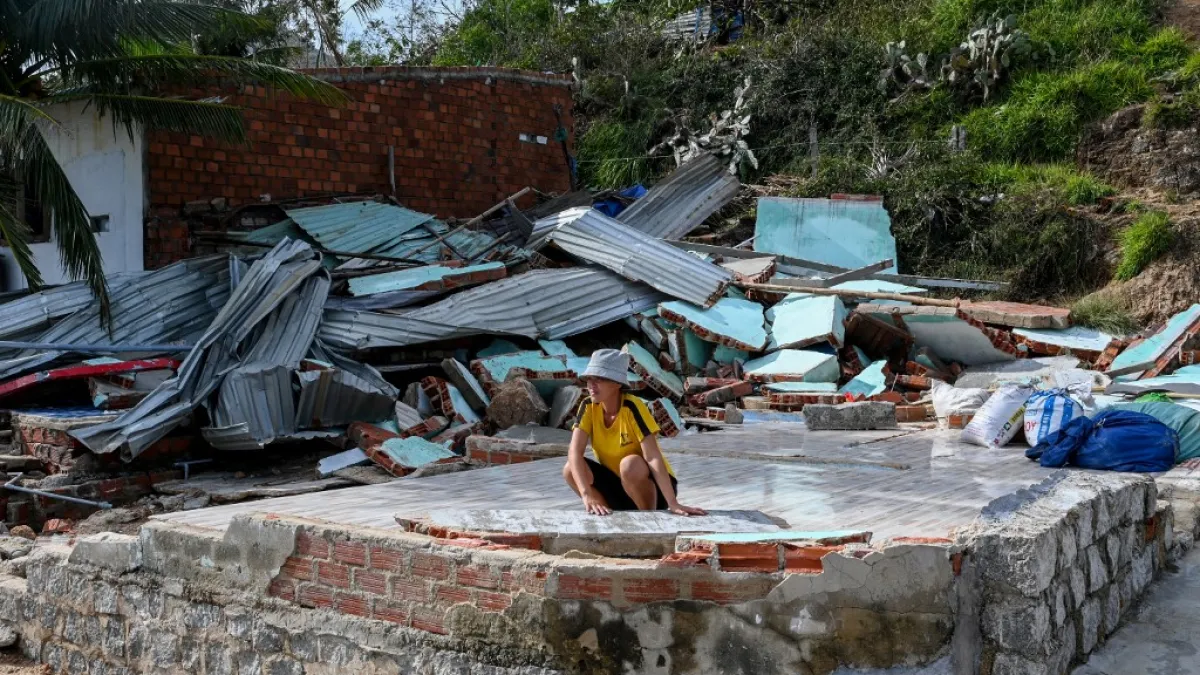
In a letter to negotiators released late on Sunday, Simon Stiell, the UN climate chief, said the 10-year-old Paris Agreement is working to a degree “but we must accelerate in the Amazon. Devastating climate damages are happening already – from Hurricane Melissa hitting the Caribbean, super typhoons smashing Vietnam and the Philippines to a tornado ripping through southern Brazil.”

Not only must nations do more faster but they “must connect climate action to people’s real lives”, Stiell wrote.

COP30 is also the first to acknowledge the failure to so far prevent global warming.

Who will participate?

More than 50,000 people have registered to attend this year’s COP in Belem, including journalists, climate scientists, Indigenous leaders and representatives from 195 countries.

Some of the more prominent official group voices will include the Alliance of Small Island States, the G77 bloc of developing countries and the BASIC Group, consisting of Brazil, South Africa, India and China.

In September, United States President Donald Trump told the UN General Assembly that climate change was “the greatest con job ever perpetrated on the world”, based on “predictions … made by stupid people”.

Trump’s aggressive approach to deny the climate crisis has further complicated the agenda at the conference, which will have no representation from Washington. Trump withdrew the US from the Paris Agreement twice – once during his first term, which was overturned by former President Joe Biden, and a second time on January 20, 2025, the day his second term began. He cited the economic burden of climate initiatives on the US. Trump has called climate change a “hoax”.

The US historically has put more heat-trapping carbon dioxide into the air from the burning of coal, oil and natural gas than any other country. On an annual basis, however, the biggest carbon polluter now is China.

COP30 organisers have been criticised for the exorbitant prices of hotel rooms in Belem, which has just 18,000 hotel beds. Brazil’s government has stepped in, offering free cabins on cruise ships to poorer nations in a last-minute bid to ensure they can attend.

As of November 1, only 149 countries had confirmed lodging. The Brazilian government said 37 were still negotiating. Meanwhile, business leaders have decamped to host their own events in the cities of Sao Paulo and Rio de Janeiro.

Brazil has also been slammed for clearing forest to build a new road to reach the conference venue.

What progress has been made since last year’s summit?

Renewables, led by solar and wind, accounted for more than 90 percent of new power capacity added worldwide last year, according to the International Renewable Energy Agency. Solar energy has now become the cheapest form of electricity in history.

Meanwhile, one in five of new cars sold around the world last year was electric, and there are now more jobs in clean energy than in fossil fuels, according to the UN.

Elsewhere, the International Energy Agency has estimated that global clean-energy investment will reach $2.2 trillion this year, which would be about twice as much as on fossil fuel spending.

At the same time, global temperatures are not just rising, they are climbing faster than ever with new records logged for 2023 and 2024. That finding was part of a study done every few years by the Intergovernmental Panel on Climate Change.

The new research shows the average global temperature rising at a rate of 0.27C (0.49F) each decade, almost 50 percent faster than in the 1990s and 2000s when the warming rate was around 0.2C (0.36F) per decade.

The world is now on track to cross the 1.5C threshold by 2030, after which scientists warn that humanity will trigger irreversible climate impacts. Already, the planet has warmed by 1.3C (2.34F) since the pre-industrial era, according to the World Meteorological Organization.

At the same time, governments around the world spend about $1 trillion each year subsidising fossil fuels.

At a preparatory summit with dozens of heads of state and government, UN Secretary-General Antonio Guterres said: “The hard truth is that we have failed to ensure we remain below 1.5 degrees.”

“Science now tells us that a temporary overshoot beyond the 1.5 limit – starting at the latest in the early 2030s – is inevitable. We need a paradigm shift to limit this overshoot’s magnitude and duration and quickly drive it down,” he said on Thursday.

“Even a temporary overshoot will have dramatic consequences. It could push ecosystems past irreversible tipping points, expose billions to unliveable conditions and amplify threats to peace and security.”

How did climate change affect the world in 2025?

The India-Pakistan heatwave began unusually early, in April this year. By June, temperatures had reached a peak of about 48C (118.4F) in the Indian state of Rajasthan. Hundreds of lives were lost, and crops were decimated.

Europe also faced extreme heat this year. Over the summer, the region endured a heatwave that pushed cities like Lisbon past 46C  (114.8F). In London, a prolonged period of elevated temperatures in late June caused an estimated excess 260 deaths.

At the same time, Mediterranean wildfires ravaged large tracts of Southern Europe with more than 100,000 people evacuated and dozens of deaths.

Turkiye suffered one of its worst droughts in decades, hitting agricultural areas. Rainfall dropped by up to 71 percent in some areas compared with the previous year, stressing ecosystems and energy and food production.

Source link

UN warns of millions displaced by climate change as COP30 opens in Brazil | Climate Crisis News

Climate-related disasters and conflict have displaced millions of people across the globe, the United Nations has warned before the opening of its annual climate change conference.

The UN’s High Commissioner for Refugees (UNHCR) said in a report, published on Monday to coincide with the launch of the 30th annual UN Climate Change conference (COP) in Brazil, that weather-related disasters caused about 250 million people to flee their homes over the past decade.

Recommended Stories

list of 3 itemsend of list

The migration agency issued its second major report on the effect of climate change on refugees – No Escape II: The Way Forward – in the run-up to COP 30, as it appears that the enthusiasm of countries to agree action to curb climate change continues to ebb.

“Over the past decade, weather-related disasters have caused some 250 million internal displacements – equivalent to over 67,000 displacements per day,” the report said

The UNHCR added that climate change is also increasing the difficulties faced by those displaced by conflict and other driving forces.

“Climate change is compounding and multiplying the challenges faced by those who have already been displaced, as well as their hosts, particularly in fragile and conflict-affected settings,” it continued.

Floods in South Sudan and Brazil, record heat in Kenya and Pakistan, and water shortages in Chad and Ethiopia are among the disasters noted in the report.

The number of countries facing extreme exposure to climate-related hazards is projected to rise from three to 65 by 2040.

Those 65 countries host more than 45 percent of all people currently displaced by conflict, it added.

“Extreme weather is … destroying homes and livelihoods, and forcing families – many who have already fled violence – to flee once more,” UN refugees chief Filippo Grandi said in a statement.

“These are people who have already endured immense loss, and now they face the same hardships and devastation again. They are among the hardest hit by severe droughts, deadly floods and record-breaking heatwaves, yet they have the fewest resources to recover,” he said.

By 2050, the report reads, the hottest 15 refugee camps in the world – in The Gambia, Eritrea, Ethiopia, Senegal and Mali – are projected to experience nearly 200 days of hazardous heat stress per year.

Weakening commitment

The refugee agency’s report emphasised that while the effect of climate change is growing, the commitment towards dealing with it has been weakening.

The UNHCR hopes to reawaken efforts to fight the effects at the conference in Brazil.

Under President Donald Trump, the United States, traditionally the world’s top donor, has slashed foreign aid.

Washington previously accounted for more than 40 percent of the UNHCR’s budget. Other major donor countries have also been tightening their belts.

“Funding cuts are severely limiting our ability to protect refugees and displaced families from the effects of extreme weather,” Grandi said.

“To prevent further displacement, climate financing needs to reach the communities already living on the edge,” he said. “This COP must deliver real action, not empty promises.”

About 50,000 participants from more than 190 countries will meet in Belem, in the Amazon rainforest, to discuss curbing the climate crisis.

One topic on the agenda exposing the difficulties of agreeing on global action is the European Union’s Carbon Border Adjustment Mechanism (CBAM).

The policy is designed to prevent “carbon leakage” by requiring importers of carbon-intensive goods like steel and cement to pay the same price for embedded emissions that EU producers face domestically.

While the EU promotes CBAM as a necessary environmental tool to encourage greener practices, critics of the policy, including major trading partners like the US and China, view it as a veiled act of protectionism.

Developing nations, meanwhile, are concerned that it unfairly shifts the financial burden of climate action onto them.

Source link