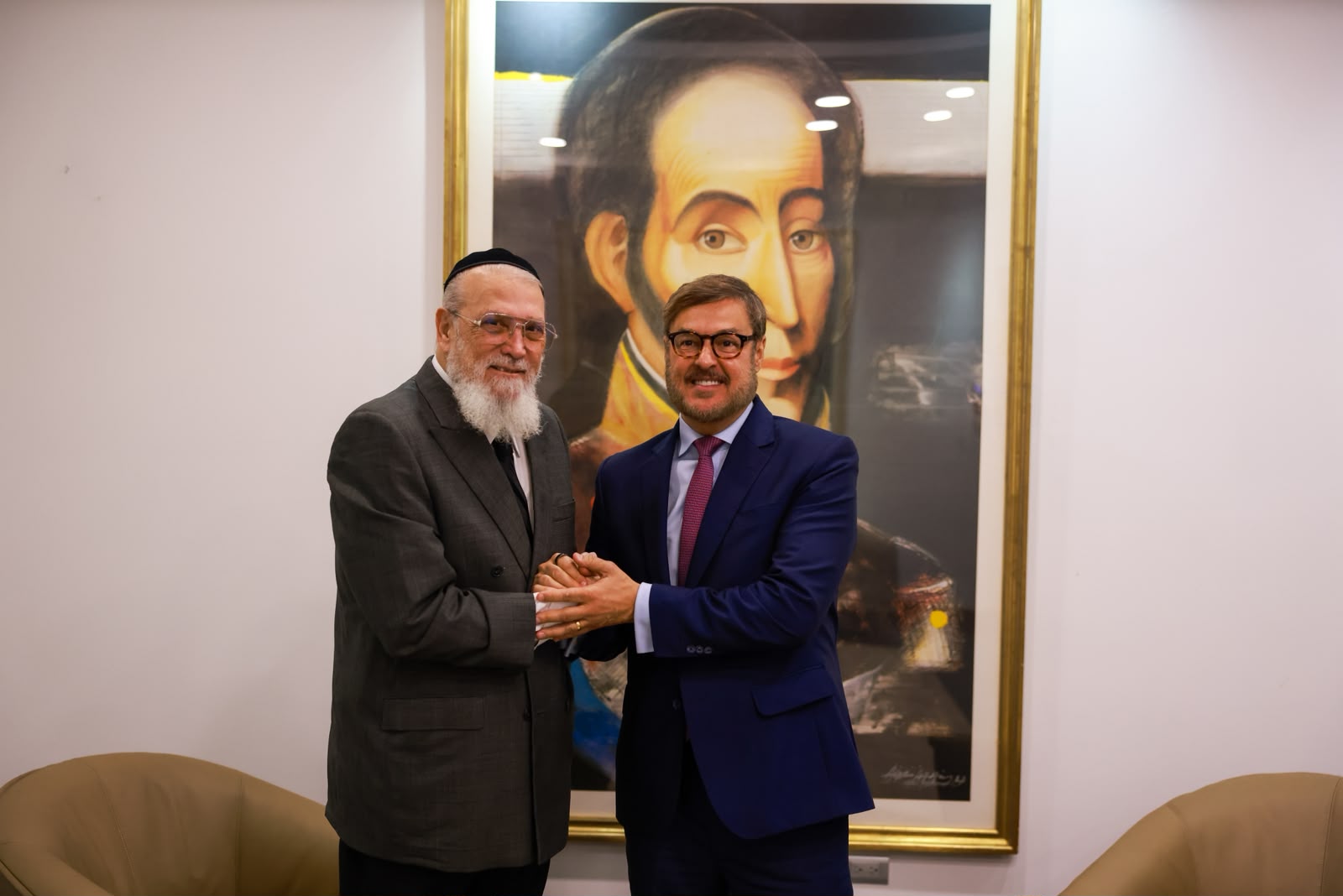
Cohen helped arrange the deployment of an Israeli diplomatic and military mission after the June 24 earthquakes. (Cancillería VE)
Caracas, August 11, 2026 (venezuelanalysis.com) – The Venezuelan government led by Acting President Delcy Rodríguez is advancing diplomatic normalization with Israel after 17 years of severed relations.
In statements published on Tuesday, the Venezuelan and Israeli foreign ministries announced that, following “high-level talks,” the two countries would continue “bilateral technical cooperation” amid “recovery efforts” related to the June 24 double earthquake in the Caribbean nation.
“The two countries have also agreed to establish a coordination mechanism to provide consular services to their citizens residing in the other country,” the communiqués read.
Caracas additionally underlined that the ties between Israel and the Venezuelan Jewish community “constitute an important and historic friendship bridge between both countries.”
Israeli Foreign Minister Gideon Sa’ar hailed the renewal of consular relations as “good news.” He added that the decision was agreed to in “conversations” with Venezuelan counterpart Félix Plasencia, creating “an official coordination channel” for the first time since 2009.
The announcement also followed a meeting Sunday between Plasencia and Orthodox Rabbi Isaac Cohen in which the latter formally requested that Venezuela reestablish diplomatic ties with Israel.
According to the Foreign Ministry, Cohen delivered a letter addressed to Acting President Delcy Rodríguez, arguing that normalizing relations with Tel Aviv is necessary to “tend to the needs of the Jewish community” in Venezuela.
Venezuela’s top diplomat thanked Cohen, on behalf of the Rodríguez administration and the Venezuelan people, for Israeli “assistance” following the June 24 double earthquake.
Cohen, a rabbi from the Venezuelan Jewish Association (AIV), was reportedly one of the intermediaries for the arrival of an Israeli diplomatic and military mission one week after the earthquake. The delegation included IDF officers and weapons contractors, while several Tel Aviv-aligned organizations likewise deployed on-the-ground teams.
Rodríguez held multiple meetings with the Israeli team, praising its members as “highly trained and professional” and thanking them for their work. IDF spokesman Roni Kaplan stated that the Israeli team had created a “dashboard” for Venezuelan authorities to evaluate damaged buildings, while Brigadier General Elad Edri was pictured presenting a “Project for Future Reconstruction” slideshow.
The Israeli mission has sparked growing protests, with Venezuelan popular movements reaffirming support for Palestine, condemning the genocide in Gaza and Lebanon, and burning Israeli flags.
Following the latest decision to deepen the engagement with Tel Aviv, the Venezuelan Movement in Solidarity with Palestine Al Awda issued a statement rejecting “normalization with the genocidal state of Israel.”
“We reject the use of ‘cooperation’ rhetoric to cover for barbarism and apartheid. Diplomacy cannot be used to whitewash crimes against humanity,” the text read.
Similarly, the International Platform in Solidarity with the Palestinian Cause argued that it was “unacceptable and unjustifiable” to strengthen relations “with a government formally accused of genocide.”
“We warn that reestablishing ties with [Israel] amounts to validating its crimes, in Palestine and all over the world, and becoming complicit before history,” its communiqué stated.
Former President Hugo Chávez severed ties with Israel in 2009, fiercely denouncing the US ally for genocide and demonstrating unwavering support for the Palestinian cause. His stance was maintained by Maduro, who endorsed South Africa’s activation of the Genocide Convention against Israel at the International Court of Justice (ICJ) in 2024.
Following the January 3 US military strikes and kidnapping of Maduro, Rodríguez fast-tracked a diplomatic rapprochement with Washington alongside a broader radical shift in Caracas’ geopolitical alignment.
Apart from re-engagement with Israel, the Venezuelan government is also reestablishing ties with far-right US allies in Latin America, including Chile, Peru, and the Dominican Republic, while distancing itself from historic partners in Havana and Tehran. During the recent US-Israel war against Iran, Caracas offered no backing for Tehran, instead voicing “solidarity” with US Gulf allies such as Qatar and the United Arab Emirates.
[Updated on August 11]
Edited by Lucas Koerner in Philadelphia, USA.