Contested

From the IAEA to the G7: The Contested Meaning of Global AI Governance

In May 2026, just hours before President Donald Trump met President Xi Jinping, OpenAI’s Vice President of Global Affairs Chris Lehane floated the idea of a US-led global governance body for artificial intelligence that would include China as a member. The model, according to media reports, was compared to the International Atomic Energy Agency (IAEA), a familiar reference for managing strategic technologies with global consequences.

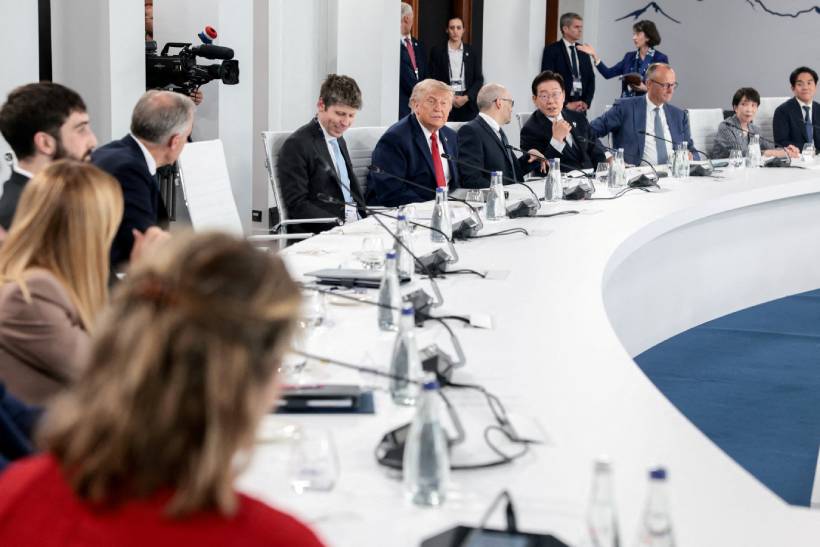
One month later, at the G7 summit in Évian-les-Bains, a different tone emerged. Several influential AI executives joined leaders from advanced economies to discuss AI governance, online safety, and global security. According to Axios, Anthropic’s Dario Amodei and Google DeepMind’s Demis Hassabis leaned towards a more selective framework among democratic countries, while OpenAI’s Sam Altman used broader language, calling for an international forum to develop shared testing standards and risk assessments.

These two moments reveal something important: the meaning of “global AI governance” remains unsettled. In one setting, global means including China for legitimacy. In another, it can mean a trusted coalition designed to manage access, capability, and strategic risk. AI governance is becoming part of the architecture of global power.

Three Voices, Different Emphases

Stay ahead of the geopolitical week.

MD Briefing delivers expert analysis across five global fronts — the Indo-Pacific, energy, geoeconomics, European security, and the Middle East — every Monday morning. Free.

Their presence at the G7 showed how quickly AI firms have moved from building systems to helping shape the politics around them. The leaders of OpenAI, Anthropic, Google DeepMind, Mistral, Cohere, and other firms were not simply observers of geopolitics. They were part of the conversation about how technological power should be governed.

Their positions were not identical. Amodei reportedly urged democratic countries to coordinate more closely so that AI governance would not fragment. Hassabis stressed the strategic importance of frontier capability. Altman, by contrast, used more institutionally neutral language, suggesting that advanced AI should not be shaped only by the companies building the most capable systems.

Even among frontier AI developers, there is no settled imagination of global governance. Should it include all major AI powers, including strategic rivals? Should it be built around trusted coalitions? Should it prioritize safety, democratic values, geopolitical advantage, or public legitimacy?

The question became more complicated because the G7 discussions came shortly after the US government imposed export controls that forced Anthropic to suspend foreign access to its Fable 5 and Mythos 5 models. Reuters reported that the order required Anthropic to block access to the models for foreign nationals, leading the company to disable them more broadly to ensure compliance. The episode showed how frontier AI governance can move from abstract principles to abrupt restrictions. Even among democratic allies, technological solidarity has limits. When AI becomes strategic infrastructure, every country begins to think about its own room for maneuver.

The Asymmetry of “Global”

The deeper issue lies in who has the power to define the word “global” in the first place. In May, global governance could mean a US-led institution that includes China. In June, it could mean coordination among democracies to manage frontier capability and strategic access. The definition changed because the political room changed.

This reveals a double asymmetry. The first is technical: only a small number of firms can define what counts as a frontier model, how its capabilities should be tested, and who should be allowed to access it. The second is narrative: the same ecosystem also helps frame the language through which the world discusses governance.

For countries outside the frontier AI circle, they may be invited to conversations but not always to the stage where categories, thresholds, and governance priorities are first shaped. They may be asked to adopt best practices whose assumptions were formed elsewhere. They may be told that risks are global, even when preparedness remains highly unequal.

G7 outreach to partner countries such as India, Brazil, Kenya, South Korea, and Egypt is important. It recognizes that AI governance cannot remain a conversation among advanced economies alone. Yet there remains a difference between being present in a forum and helping design the architecture of the forum itself. The question is who defines the table, the agenda, the risk categories, and the meaning of global governance itself.

When the AI Frontier Moves Towards the Market

There is another reason why a broader governance imagination is necessary. Frontier AI innovation is no longer centered primarily in universities or public research institutions. It is increasingly shaped by private firms with the capital, compute, talent, data access, and infrastructure required to train and deploy the most capable models.

Stanford’s AI Index 2025 noted that nearly 90 per cent of notable AI models in 2024 came from industry, up from 60 per cent in 2023. A report prepared for the European Economic and Social Committee on generative AI and foundation models also described significant US dominance across the value chain. These findings point to a structural shift: the frontier is becoming more concentrated, more expensive, and more closely tied to corporate and geopolitical capacity.

Much of AI’s progress has come from companies willing to take risks, scale products, and build technical capability at extraordinary speed. But the center of gravity has shifted. When frontier AI is largely financed, defined, and deployed by market actors, the default imagination of AI development can tilt towards commercial viability, platform advantage, user growth, and strategic positioning.

Public interest does not disappear in such a system. It risks becoming secondary unless other actors are strong enough to bring it back into the room.

Open Future, a European digital policy organization, has warned that concentrations of power in AI can make public activities dependent on “a narrow group of monopolists.” The phrase matters because infrastructure-level dependency can weaken society’s ability to negotiate the terms of the technologies it relies on.

A Wider Public-Interest Layer

In a multiplex digital world, power does not flow only through states or markets. It also moves through universities, civil society organizations, professional associations, media, labor groups, open-source communities, public-interest technologists, and moral institutions. Together, these actors form the society layer often missing from discussions dominated by states and markets.

States define security priorities. Companies define technical possibility. Society must help test legitimacy. Who bears the risk? Who benefits from deployment? Who is excluded from design? What harms are being normalized because they are commercially convenient or geopolitically useful?

This is why Pope Leo XIV’s recent intervention on AI is politically relevant beyond its religious context. In his encyclical Magnifica Humanitas, he argues that protecting the human person in the age of AI requires renewed reflection on the common good, solidarity, social justice, and human dignity. Such interventions will not replace regulation or technical standards. They help recover a truth easily lost in frontier AI politics: governance is also about preserving the human meaning of technological progress.

The same question of authorship is beginning to appear in empirical research. Ongoing fieldwork-based research at the University of Oxford has started to examine whether countries in the Global South are developing approaches to AI governance that are neither simple copies of Western regulatory templates nor rejections of international cooperation but pragmatic syntheses shaped by local institutional capacity, regulatory sequencing, and historical experience with technology transfer. Indonesia has appeared as one of the country cases in this line of inquiry.

Governance models worth studying are not only those negotiated in Évian, Brussels, Washington, or New York. They are also being improvised, often informally, by mid-sized digital economies navigating dependency and ambition at the same time.

The United Nations’ Global Digital Compact (GDC), adopted in September 2024, offers a useful multilateral reference point. It frames digital cooperation and AI governance around inclusion, human rights, open standards, interoperability, digital public goods, and multi-stakeholder cooperation. The Compact does not resolve the power asymmetries of frontier AI by itself, but it gives societies, alongside states and firms, a language for claiming a legitimate role in digital governance.

The practical task is to strengthen public-interest evaluation: the ability to test social impact, language bias, local risks, institutional misuse, and deployment consequences in different societies. The aim is to preserve enough room for public reasoning so that the future of AI is not defined only by those with the largest models, the biggest markets, or the strongest strategic leverage.

Imagining a More Inclusive AI Governance

The lesson from the IAEA analogy and the G7 discussions is not that one model is right and the other is wrong. Both reflect real concerns. A broadly inclusive governance arrangement may be necessary for legitimacy, especially when AI risks cross borders. A trusted coalition may also be necessary when capability access raises genuine security concerns. The problem begins when either model claims to be global while leaving too many societies downstream of decisions made elsewhere.

For emerging economies, the strategic challenge is not simply to wait for a better invitation to the next summit. Participation matters, but it is not enough. Countries and societies need stronger capacity to evaluate AI systems, understand their dependencies, articulate local risks, and negotiate governance terms with greater confidence.

This is a call for a more plural architecture of governance, where states, markets, and society all have meaningful roles. The uncomfortable question is not whether AI requires international coordination. It clearly does. The harder question is whether that coordination can remain open enough for societies, not only states and companies, to shape the terms of technological power.

In the age of frontier AI, the future will not be determined only by who builds the largest models. It will also be shaped by who gets to define risk, test systems, question assumptions, and decide what counts as progress.

Every era that has tried to govern a transformative technology eventually learns the same lesson: legitimacy borrowed from power is not the same as legitimacy earned through participation. The IAEA’s own history shows that global trust is rarely built at the moment institutions are created; it is earned over time, through broader representation, credible restraint, and shared accountability. The real question for AI governance is whether it can shorten that distance by design, rather than waiting for legitimacy to arrive only after contestation.

Source link

YFQ-44 Fury Fighter Drone Wraps Contested Operations Test That Could Accelerate Its Fielding

  • YFQ-44 Fury drone completes critical test. The U.S. Air Force concluded a key exercise with a YFQ-44 Fury prototype at Edwards Air Force Base to test its deployment in contested environments.
  • Warfighting Acquisition System aims for speed. The exercise tested a framework to accelerate CCA deployment, allowing operators to refine tactics early.
  • Operators used Menace-T system. The system enabled autonomous operations from a simulated forward base, aligning with Agile Combat Employment concepts.
  • CCAs to enhance combat capabilities. The Air Force sees CCAs as vital for extending sensor coverage and adding combat mass in high-end conflicts.

Bottom line: The YFQ-44 Fury drone’s recent test at Edwards Air Force Base marks a significant step in the Air Force’s efforts to rapidly field combat-ready CCAs. This exercise focused on operational integration and logistical challenges, aiming to enhance the Air Force’s capabilities in contested environments.

The U.S. Air Force has concluded what it describes as a “critical exercise” with Anduril’s YFQ-44 Fury ‘fighter drone’ prototype, flown out of the base that is the heart of flight testing, the legendary Edwards Air Force Base, California. The drills involved the Air Force’s Experimental Operations Unit and were intended to demonstrate how CCAs can be deployed and sustained in a contested environment. For the exercise, the YFQ-44A flew from Edwards back to Anduril’s Southern California test site.

As well as the Experimental Operations Unit (EOU), which falls under Air Combat Command (ACC), the exercise involved personnel from Air Force Materiel Command’s (AFMC) 412th Test Wing. This wing is headquartered at Edwards Air Force Base, and the squadrons attached to it are responsible for flight testing of virtually all the aircraft in the Air Force’s inventory.

A YFQ-44A takes off from the runway at Edwards Air Force Base, California, during a Collaborative Combat Aircraft exercise. U.S. Air Force photo by Ariana Ortega Ariana Ortega

Multiple sorties were flown — we have asked Air Combat Command for more details on exactly how many and their scope. The exercise took place last week, according to Anduril’s vice president of autonomous airpower, Mark Shushnar.

The YFQ-44 is one of two designs now being developed as part of the first phase, or Increment 1, of the Air Force’s CCA program. The other is General Atomics’ YFQ-42A Dark Merlin. We have reached out to Edwards to see whether the YFQ-42 was originally expected to take part in the exercise before its recent takeoff accident.

Imagery published by the Air Force shows a YFQ-44A carrying inert AIM-120 Advanced Medium Range Air-to-Air Missiles (AMRAAM) on pylons under the wings, something that we first saw earlier this year, during captive-carry evaluations, as you can read about here. It should be noted that the Fury, at least as it exists now, does not have an internal munitions bay.

MSgt Ricardo Villalva, EOU removes fins
Master Sgt. Ricardo Villalva Jr., with Air Combat Command’s Experimental Operations Unit, performs pre-flight checks on an inert AMRAAM at Edwards Air Force Base, California. U.S. Air Force photo by Ariana Ortega Ariana Ortega

The primary function of the exercise was to explore the practicalities of what the Air Force calls the Warfighting Acquisition System. This framework is intended to speed the delivery of CCAs to operational units by enabling operators to get their hands on the drones earlier in the program. In this way, they can refine tactics and procedures before deliveries to the front line.

ACC has stressed in the past how it wants CCAs to operate seamlessly within the existing command structures and legal frameworks that govern all Air Force weapons systems.

“This experimental operations event was executed by EOU members from start to finish. Every sortie generated and flown was done with a warfighter, not an engineer or test pilot, kicking the tires and controlling the prototypes,” explained Lt. Col. Matthew Jensen, EOU commander. “We are learning by doing, at a speed and risk tolerance accepted by the USAF’s most senior leaders, to ensure CCA is ready to operate and win in the most demanding combat environments.”

A YFQ-44A flies over Edwards Air Force Base, California, during a Collaborative Combat Aircraft exercise. U.S. Air Force photo by Ariana Ortega Ariana Ortega

Above all, the sorties stressed operational and logistical procedures for using CCAs in a contested environment. The issue of logistics is a critical one, including how CCAs will get to the area of operations and how they will be maintained in the field.

According to Shushnar, Anduril’s Menace-T command, control, communications, and compute (C4) solution was used as the main ground element for YFQ-44A flight operations during the exercise. “EOU operators used Menace-T’s ruggedized laptop to upload mission plans, initiate autonomous taxi and takeoff, task the aircraft while in flight, and manage post-flight data ingestion and checks,” he explained. “That enabled the EOU to conduct operations out of a simulated forward operating base, successfully launching, recovering, and turning YFQ-44A without the infrastructure of a large, established base.”

This is entirely in line with the Air Force’s drive toward short-notice and otherwise irregular deployments, often to remote, austere, or otherwise non-traditional locales. Agile Combat Employment (ACE) is the term the service currently uses to describe a set of concepts for distributed and disaggregated operations.

While the warfighters of the EOU were at Edwards to carry out the practical aspects of CCA employment, exploring tactics, techniques, and procedures, the 412th Test Wing, meanwhile, was on hand to gather data from the test events.

“By uniting the distinct test authorities of AFMC and the operational authorities of ACC, officials were able to fast-track the event, enabling groundbreaking, hands-on experimentation by operators at a uniquely early stage of development,” the Air Force explained in a media release.

An earlier photo, in which the Air Force gave us our first look at a YFQ-44 carrying an inert AIM-120 Advanced Medium-Range Air-to-Air Missile (AMRAAM). U.S. Air Force

“The collaboration we saw in this exercise is the cornerstone of our acquisition transformation. By embedding the operators from the EOU with our acquisition professionals, we create a tight feedback loop that lets us trade operational risk with acquisition risk in real-time,” said Col. Timothy Helfrich, portfolio acquisition executive for fighters and advanced aircraft. “This isn’t just a test; it’s a demonstration of how we are adopting a more agile process. An 85 percent solution in the hands of a warfighter today is infinitely better than a 100 percent solution that never arrives.”

The CCA program is viewed as a pathfinder for the Warfighting Acquisition System, and success with this could lead to the same approach being employed to get other systems into operational service much more quickly than in the past.

The Air Force has not yet determined whether it will procure one or both Increment 1 CCA designs at scale. Whichever option it selects is expected to become its first operational “fighter drones,” built to carry live munitions into combat alongside crewed aircraft.

Three examples of the YFQ-42A Dark Merlin. General Atomics

CCAs will also extend the sensor coverage of the crewed fighters they accompany. More broadly, the Air Force views them as a way to add vital combat mass and unlock new tactical options, particularly in high-end conflicts against adversaries like China. Back in late 2024, Brig. Gen. Douglas “Beaker” Wickert, commander of the 412th Test Wing, told TWZ that, “[the-then Secretary of the Air Force Frank Kendall] “has been very clear that we are out of time, that our Air Force has never been older or smaller than it is right now, and that the People’s Liberation Army has been specifically designed to defeat us.”

“The investments we’re making right now in modernization and testing for the USAF are designed for success and aimed at changing Chairman Xi’s calculus about pushing back aggressively against the international rules-based order. What we are doing here and across USAF flight-testing is extremely consequential.”

Since then, Wickert has moved on to become Director of Air, Space and Cyberspace Operations at AFMC, but the test wing’s remit remains the same. Meanwhile, the People’s Liberation Army Air Force has doubled down on its rapid expansion, including many of its own CCA programs.

If all goes to plan, the completion of this recent exercise at Edwards could well be a key milestone in fielding a combat-ready force of CCAs and go some way toward realizing the Air Force’s ambition for a new capability that should extend the reach and the survivability of its crewed aircraft.

Contact the author: thomas@thewarzone.com

Thomas is a defense writer and editor with over 20 years of experience covering military aerospace topics and conflicts. He’s written a number of books, edited many more, and has contributed to many of the world’s leading aviation publications. Before joining The War Zone in 2020, he was the editor of AirForces Monthly.


Source link