Hellfire Missile Launcher Tucked Inside A Container Rolled Out By Lockheed
Lockheed Martin has developed a launcher called Grizzly that fires AGM-114 Hellfire missiles from within an otherwise unassuming 10-foot shipping container. Employed alone or in groups networked together, Grizzly presents a flexible and relatively low-cost means of bolstering point defenses against aerial threats, including drones, and targets on the surface. The launchers can also hide in plain sight, intermixed with regular containers, creating targeting dilemmas and uncertainty for opponents.
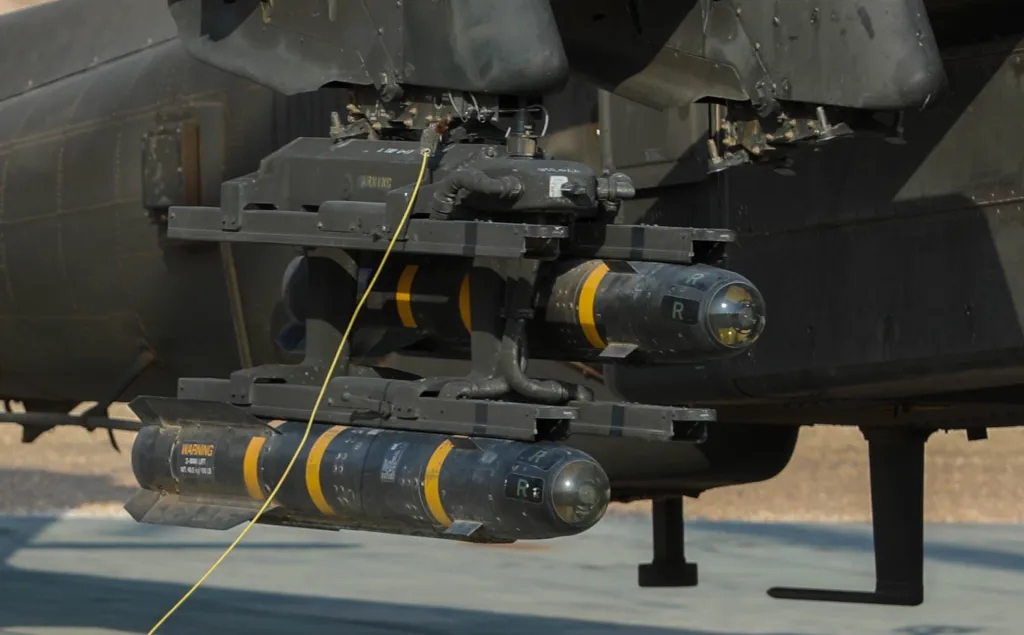
Grizzly has already successfully completed two live-fire tests, according to a press release Lockheed Martin put out today. The launcher took just six months to build, and makes heavy use of existing and often commercial off-the-shelf components. This includes leveraging the proven M299 four-rail launcher, which is in widespread use globally today, most commonly as a means for launching Hellfires from various types of helicopters.

In “one test we launched missiles vertically,” Chris Murphy, senior manager of Business Development for Integrated Air and Missile Defense Advanced Programs, told TWZ and other outlets during a call yesterday. “In another test, we launched them at an angle to prove out some of the flexibility of the system.”
The container itself has a roof that hinges open for firing. Lockheed Martin says the containerized launcher can be configured to be self-powered or make use of a tertiary power source.

Broadly speaking, “you might think of a depth of magazine as being a really large magazine,” Murphy explained. “Another way to achieve depth of magazine is to have several launchers. What we’ve tried to do is take a lot of the cost out of those launchers and use containers where possible.”
“The idea is that you can leave these somewhat unattended,” he continued. “Obviously, they would be in proximity to some support, but as opposed to having a full-on launcher sitting out someplace or moving around someplace, you’ll just have some ideas to have some containers available. And they protect the system from weather, but they also then allow rapid access and also rapid reload when the time comes. “
“The idea is to provide these [Grizzly container launchers] in multiple places and to… make the enemy uncertain of what is where,” Murphy added. “By using commercial materials and commercial launchers, it’s not obvious where you have protection capability, and it allows you to spread the protection out geographically. It allows it to be remotely operated.”
In general, containerized launchers are also inherently mobile and readily deployable via truck, as well as by cargo aircraft and ships. They also offer opportunities to be employed from any vessel with sufficient deck space, which we will come back to later on.

Lockheed Martin’s press release today otherwise says that Grizzly is “command and control and sensor agnostic” and can be utilized to “support any service or mission, anywhere.”
That being said, the fact that the Integrated Air and Missile Defense Advanced Programs division led the development of Grizzly points to a clear surface-to-air application for the launcher. The millimeter-wave radar-guided AGM-114L variant of the Hellfire has a demonstrated anti-air capability against various types of drones, which is a particular pressing threat. Loaded with AGM-114Ls and linked to air search radars and other sensors, the containerized launch system could offer a way to rapidly boost air defenses, especially at forward locations.
The current conflict with Iran provides a number of real-world instances where this could be valuable. In particular, Iranian-backed militias have launched repeated drone attacks on the U.S. Embassy complex in Baghdad, Iraq. In line with the remote operation concept Lockheed Martin’s Murphy outlined, Grizzly launchers could be placed around the outer edge of the larger Green Zone in Baghdad, creating an outer layer of close-in defense.
The U.S. Embassy in Baghdad is currently protected by Centurion counter-rocket, artillery, mortar (C-RAM) systems linked to Saab Giraffe-1X radars, as well as microwave counter-drone radars and other sensors, all of which Grizzly could also leverage. The Centurion is a ground-based version of the Phalanx Close-in Weapon System (CIWS) used on warships.
Grizzly could be used to fire AGM-114Ls, along with laser-guided Hellfire variants, at targets on land or at sea. The picture Lockheed Martin included in its press release today notably shows the launcher firing a laser-guided Hellfire vertically during a test. As an aside, several countries already have or are developing ground-based launch systems for Hellfire that are designed to be employed in the coastal defense role against landing craft and amphibious vehicles. With assistance from the United Kingdom, Ukraine’s armed forces have also fielded a launch system for the Hellfire-derived Brimstone missiles concealed inside civilian-style trucks that has been used for more general surface-to-surface attacks.
The video below includes clips of a Hellfire launcher concealed inside a typical civilian truck now in development in Taiwan for coastal defense applications.

《國防線上-國防自主軍備研製》打造更堅韌有力的防衛力量
As noted, Grizzly has the potential to be employed from ships and locations on land in any role. Purpose-built launchers for the AGM-114L are already integrated onto some of the U.S. Navy’s Freedom and Independence class Littoral Combat Ships (LCS) to provide extra protection against drones and swarms of small boats.

USS Detroit (LCS 7) Successful Missile Test Firing
“The idea behind Grizzly was for it to be a low-cost approach, and we believe that it’s appropriate for multiple customers,” Lockheed Martin’s Murphy said yesterday in response to a question about using the launcher in this domain. “The maritime environment may pose some challenges that you might have to rethink a couple of things, but the general concept is valid.”
Hellfire might not be the only missile Grizzly can fire, either. Murphy said that the launcher was designed to allow for the ready integration of additional functionality, including other missiles, down the line “without having to change much of anything.” One obvious candidate would be the AGM-179A Joint Air-to-Ground Missile (JAGM), which is derived from the AGM-114R and can already be fired from many of the same launchers, including the M299. Conceivably, the overall concept could be expanded to a launch system in a larger container with more total missiles.

Containerized systems, in general, present particular benefits for expeditionary or distributed operations. Launchers like Grizzly could be particularly relevant for supporting operations in forward areas across the broad expanses of the Pacific during a future major conflict with China. As mentioned, having the additional benefit of being able to deploy them discreetly presents challenges for opponents.
“I think, again, it aligns to our ability to operate in multiple domains,” U.S. Army Gen. Ronald Clark, head of U.S. Army Pacific (USARPAC), said in response to a general question about containerized launch capabilities at an event last year that the Center for Strategic & International Studies (CSIS) think tank in Washington, D.C. “Our ability to target our adversaries at scale and our ability to be able to be literally ubiquitous with boxes of rockets at different places, that look like boxes of something else, really gives our adversary pause, because it’s in real time providing deterrence.”
Lockheed Martin has also touted Grizzly simply as an example of its ability to rapidly produce a working prototype system, which could then be produced and fielded on at least a limited level without necessarily having to commit to large-scale production.
“There are many instances where you can develop a prototype, such as this Grizzly launcher, and maybe you only need a few of them, but maybe you need a couple 100. Those are still not numbers that you come up with – that you would come up with for a large-scale production line,” Lockheed Martin’s Murphy said. “We’ve got a couple other programs that we’re working through the same approach and are proving to ourselves and proving to our customers that this is a very good intermediate step between one or two prototypes versus dozens, or maybe even hundreds of early capability products, until you get to the point where you think that you’re ready for let’s go ahead and have a full-scale, full-rate production.”
Grizzly, in its current form, certainly offers potential anti-air and other capabilities that could be of interest across the U.S. military, as well as to foreign customers, especially armed forces that already have Hellfire variants in inventory.
Contact the author: joe@twz.com