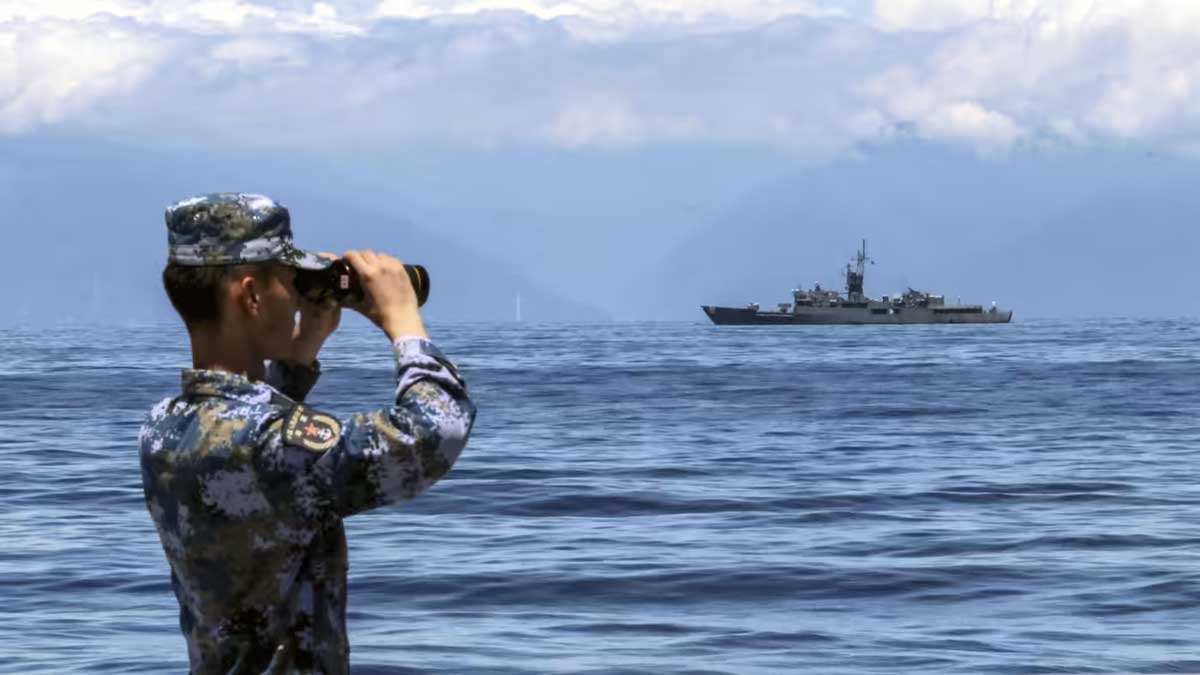
conflicts

Taiwan — The Endgame After All International Conflicts?

As the world moves into the final weeks of 2025, the global landscape looks markedly different from that of 2024. Over the past year, the world has witnessed a greater number of conflicts than at any time since the turbulence in the Middle East in the early 2000s. The Israel–Iran confrontation, the Thailand–Cambodia clashes, and most recently the U.S.–Venezuela conflict—together with earlier crises such as the Russia–Ukraine war that began in 2022 and Myanmar’s protracted internal turmoil—illustrate how sharply the global strategic chessboard is being reshaped.

These conflicts form a chain of consecutive flashpoints, each diverting global attention away from Taiwan—a uniquely sensitive entity for China.

China’s Moves Behind the Scenes

Following Donald Trump’s victory in the 2024 U.S. presidential election, Chinese President Xi Jinping proclaimed on December 31, 2024, “No one can halt China’s drive to reunify with Taiwan.” Far from being a one-off remark, this declaration reflects a long-standing stance repeatedly voiced by Xi. He had frequently told President Joe Biden that Taiwan remains a “loaded gun” positioned by the United States at China’s doorstep—mirroring the Cold War dynamic when the Soviet Union stationed missiles in Cuba during the Bay of Pigs crisis. For Beijing, the absorption of Taiwan is therefore seen as indispensable to securing China’s national defense interests.

Across global media, China has been detected amassing large quantities of weaponry and military personnel in Fujian Province, only about 130 kilometers from Taiwan at its nearest point. Well before the Russia–Ukraine war broke out in 2022, Beijing had already been discreetly improving infrastructure in Fujian and stockpiling cutting-edge weapons in preparation for future contingencies.

Any state planning a major military operation must invest years into upgrading logistics networks, fortifications, and weapons production. Since 2022—while the world has been preoccupied with overlapping conflicts—China has had ample time to build the capacity needed for a move on Taiwan.

With multiple crises flaring at once, the United States cannot realistically stretch its resources to fully assist all allies. This dynamic underscores the possibility that the succession of global conflicts since 2022 has ultimately helped divert attention and dilute Western, especially American, bandwidth—conveniently easing China’s path toward its long-standing objective regarding Taiwan.

What has the US done?

Despite a clear weakening since the beginning of the 21st century, the United States still holds a ‘relatively’ firm position in leading the world order. Many US officials across two presidential administrations have shared the view regarding the possibility of China annexing Taiwan by force in 2027. President Joe Biden, a member of the Democratic Party who was initially an advocate for minimizing disagreements with China, has also exerted maximum pressure on Beijing throughout his term, surprising and confusing many experts.

In 2024, the establishment of the US-Japan-Philippines trilateral link signals the utmost concern from policymakers regarding China’s activities. Strategically, US partners and allies will therefore form a continuous arc-shaped formation to deter China’s negative activities. This support will generate significant regional influence and form the US ecosystem in the Indo-Pacific. In the event of a conflict in the Taiwan Strait, US partners and allies will assist Washington in pressuring Beijing, forcing the country to reconsider the possibility of escalating the conflict with Taiwan.

After Trump’s election, he strengthened cooperation with Taiwan. When he imposed tariffs on Taiwan, along with other countries, it was not merely a simple economic move but also demonstrated his desire for the world’s attention on this entity. Notably, the increase in TSMC’s investment in the US to $165 billion in March 2025, compared to $65 billion, suggests the Trump administration’s subtle backing of Taiwan. When a crucial company from an investing nation is attacked, resources and investment activities will be delayed, leading to economic damage, in this case, to the US. Although the role of Taiwan was not directly integrated, the Trump administration made a very sharp move.

Furthermore, the bombing of Iranian nuclear facilities in Israel’s Operation Rising Lion in June 2025 serves as a signal to China regarding the possibility of military conflict escalation with US presence should Beijing use force against Taipei. The renaming of the department back to the ‘Department of War’ further reinforces the possibility that the US could proactively attack any nation that confronts Washington’s interests.

Will a conflict in the Taiwan Strait occur?

Many experts and scholars have discussed whether China will invade Taiwan, as asserted by the country’s leaders. When a conflict occurs in a region/area, the global order will easily witness numerous impacts.

For China, in the event that Beijing captures the island, the country will incur sanctions from the US and its allies and partners. Furthermore, the possibility of intervention from countries within the US’s ‘hub-and-spoke’ model in the Taiwan situation is entirely feasible.

Japan is the country that made the strongest declaration when the new Prime Minister, Sanae Takaichi, stated in a National Assembly meeting that if Taiwan is attacked, Japan will be directly affected and it concerns Tokyo’s ‘survival.’ Japan has also progressively amended and interpreted its constitution to legitimize the action of deploying troops overseas to assist its partners. The fact that an individual who has just taken office as Prime Minister of Japan has made such tough statements regarding Taiwan indicates that a conflict in the Taiwan Strait is entirely possible, lending more credence to the 2027 forecast.

According to a RAND report, the countries that could potentially join the group defending Taiwan alongside the US include the UK, Australia, and Japan within the next ‘3–6 months,’ corresponding to Q1 and Q2 of 2026. This further reinforces the possibility of a conflict occurring in the Taiwan Strait, aligning with the statements made by US defense officials (and later the Department of War), as well as President Xi Jinping’s long-standing declarations regarding the possibility of annexing Taiwan by 2027.

It is clear that Taiwan, despite being an island, has a significant impact on the US-China competition. In the context of ongoing global conflicts, Taiwan is viewed as the final destination for conflicts in recent years. The US and its partners and allies may increase their presence on this island in various forms to ensure its ‘safety.’ 
Source link

Adamawa Farmers Bury Their Dead as Old Conflicts Flare Again

The midday sun blazed over Bare village, but the heat that lingered in the air was nothing compared to the heaviness in people’s hearts. Two days had passed since three young farmers were killed in a violent attack by armed men, yet the air still pulsed with grief and fear.

Men sat in groups, deep in deliberation, while children lingered quietly around their mothers in front of their homes. The quiet was not peace—it was mourning.

A few nights earlier, the rice fields on the outskirts of Bare, a rural community in Numan Local Government Area of Adamawa State, northeastern Nigeria, had turned into a killing ground.

The night the harvest turned deadly

A few days earlier, Peter James, 24, secured a job harvesting rice on a commercial farm. He invited his friend, Cyprian, 20, and ten others to join him. It is the height of the harvest season in Bare, when labourers often camp overnight in the fields, working by moonlight. It’s a source of livelihood for many young people in the community.

But that Tuesday night, Nov. 4, the serenity of the farmland was shattered around 9 p.m.

“We were gathering the rice into bags when we heard gunshots,” Peter recalled, his voice unsteady as he spoke from a mat in his father’s compound. “The people appeared out of nowhere. When they came closer, we realised that they were herders. They didn’t say anything or take anything. They just opened fire on us.” 

Peter said he recognised them as herders because some have grazed their cattle within the community for years.

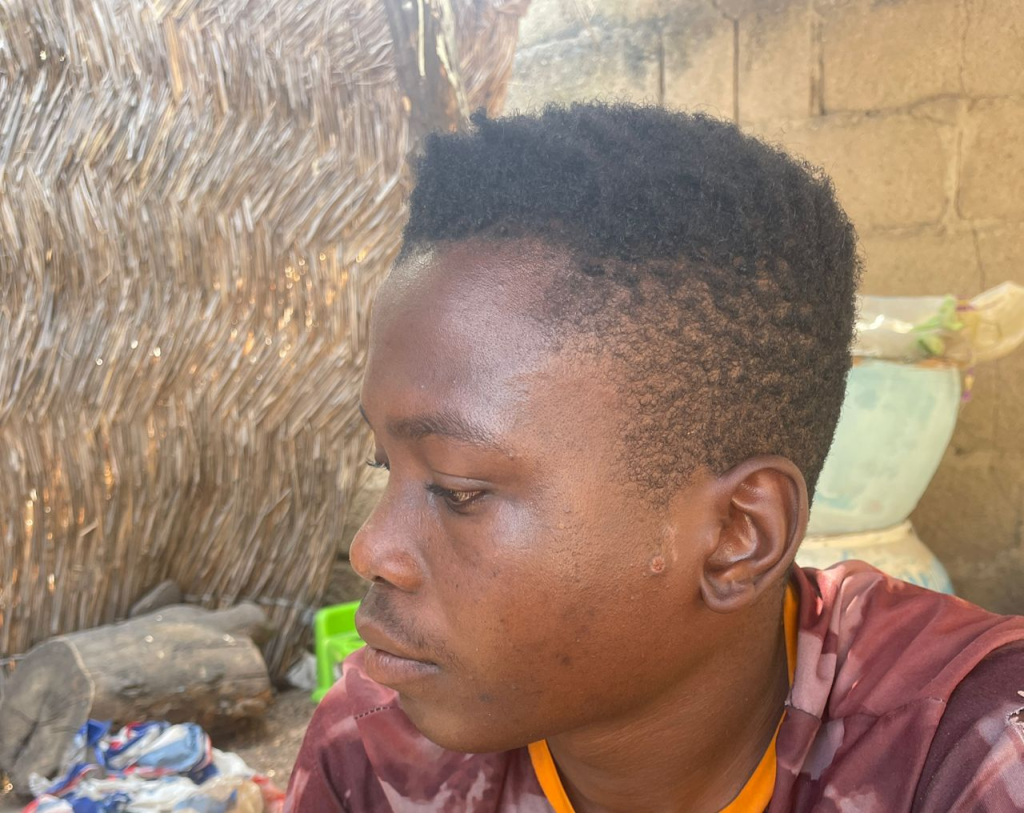
In the chaos that followed, Cyprian was hit in the neck and collapsed beside him. Peter felt a burning pain in his cheek and arm—gunshot wounds. Somehow, he fled into the darkness and staggered home, bloodied and half-conscious, arriving close to midnight.

Peter James escaped the attack with gunshot injuries. Photo: Saduwo Banyawa/HumAngle

“I heard a scream outside, and when I went out, I saw my son staggering. His face and his shirt were covered in blood,” 49-year-old Gloria James, Peter’s mother, told HumAngle. 

The farm lay an hour’s walk from the village, but Peter’s injuries slowed him to a crawl, taking him two hours. Gloria raised an alarm after she saw her son, and villagers mobilised a rescue team. By the time they arrived at the farm, the gunmen had vanished. Cyprian was dead. Two others were critically wounded. 

They carried the injured back to the village and buried Cyprian the next morning. Both wounded men died later that day.

There are currently no security operatives stationed in the community. After the incident, members of Bare reached out to the police station in Numan town; officers came, assessed the situation, and left, promising to follow up.

Three people carry a makeshift stretcher through grassy terrain, with a person lying on top covered in hay and cloth.
Villagers retrieved Cyprain’s body and buried him the following day. Photo provided to HumAngle by locals. 

When contacted, Suleiman Yahaya Nguroje, the Spokesperson for the Adamawa State Police Command, told HumAngle that he had not yet been briefed on the incident. “I will let you know if I have any information,” he said. 

No arrests in connection with the attack have been made yet, according to residents and local leaders who spoke to HumAngle. 

A pattern of violence

The attack is the first reported in Bare this year and is part of a long, bitter struggle between farmers and herders in the area—a conflict that residents say has festered for nearly a decade. Bare and neighbouring communities like Mararaban Bare have seen repeated cycles of bloodshed, often triggered by disputes over land and water. 

When HumAngle visited Bare, the District Head was away in Yola, the state capital, attending a meeting convened by the Adamawa State government over the recent violence, so we spoke with his representative, Anthony Duwaro.

Anthony said that the locals lived peacefully with the herders who settled in their communities for generations. One herder we met during a trip to the area in October is 40 years old and has lived there all his life.

A man in a black shirt sits by a large tree with people and woven mats in the background, set outdoors on a sunny day.
Anthony bears scars from previous attacks. Photo: Saduwo Banyawa/HumAngle

The herders have their settlement about half an hour away from Bare. Anthony said they traded and used resources together. But things changed in 2017, during the harvest. 

“We went to the farm and realised that they led their cattle into it. We confronted them, and that’s when the problem began,” he recalled. 

Since then, clashes have become almost predictable. “It happens every harvest season,” Anthony said, lifting his shirt to reveal scars from a previous attack. “We report to the authorities, but the cycle continues. Now, people are afraid to return to their farms.”

Despite several reconciliation meetings between both sides, he said the latest attack on the young men proved that the conflict was far from over. “One time, the clash was so brutal that people lost their lives, farms and properties were also destroyed. Most of us were rushed to the General Hospital in Numan,” he recounted. 

With no police station nearby, only one in Numan town, several kilometres away, villagers rely on local vigilantes for protection. The community’s police outpost was burnt down during a similar incident in 2018 and has not been restored. 

Anthony described the conflict as a “battle of survival”. “We depend on farming to feed our families. They depend on grazing for their cattle. But when the cattle destroy our crops, we can’t just fold our arms. If we confront them peacefully, they retaliate with attacks.”

Several peace talks have been held between the host community and the herders, yet tensions remain unresolved. Just a week before the latest attack, locals accused herders of grazing on their farms, further heightening the conflict.

While the herders have not claimed responsibility for the killings, they say worsening environmental pressures are making it harder for their cattle to find feed. “We do not wish to provoke anyone; we are only after the welfare of the cattle,” Alhaji Ngala, the chairperson of the local herders’ community, told HumAngle in an interview before the recent attack.

He blamed the clashes on the loss of “traditional grazing routes”. “If we can have access to routes and enough water supply, then our minds will be at peace,” he said. 

Another herder, Muza Alhaji Shenya, who has lived in the Bare area for two decades, said industrialisation and farmland expansion have pushed them onto the highways as they go in search of water and greener pastures.

A person in a green headscarf stands in a grassy field with cows grazing in the background under a blue sky.
Muza has been a herder in Mararaban Bare for two decades. Photo: Saduwo Banyawa/HumAngle. 

HumAngle recently reported how nearby Mararaban Bare has faced its own crisis due to the contamination of the only local water source by cattle waste. An uneasy arrangement now exists: locals use the river in the morning, and herders use the water in the afternoon. Still, residents say they need to treat the water before drinking or cooking with it. 

“There has never been a time when we confronted the herders except when they led their cattle to our farms,” Anthony said. “We don’t have a problem with them.”

A national crisis 

The struggle in Bare mirrors a broader crisis playing out across Nigeria’s rural and urban communities. In July, a HumAngle analysis showed how pastoral life is collapsing due to climate change, farmland expansion, and urbanisation in Nigeria. This situation is forcing some herders to cross to neighbouring countries in search of food and water for their cattle. 

Authorities have attempted various interventions, but with little success. In recent years, several state governments have enacted anti-open grazing laws, requiring herders to rent land for ranching, which has been protested by some associations of cattle breeders.

Although the Adamawa State has not passed such legislation, officials announced in December 2024 plans to establish grazing reserves “as a measure to bring an end to farmers and herders clashes in the state”.  

The idea is not new. In 2019, the Nigerian government introduced the Rural Grazing Area (RUGA) scheme to establish designated settlements for herders nationwide. But the initiative was derailed by mistrust and controversy, and later suspended by the former President Muhammad Buhari’s administration.

A few months later, another intervention, the National Livestock Transformation Plan (NLTP) was inaugurated to “create a peaceful environment for the transformation of the livestock sector that will lead to peaceful coexistence, economic development, and food security…” The Plan, whose first phase execution was budgeted at ₦120 billion, has not been actualised. 

“If implemented properly, [the NLTP] could resolve many of these issues,” said Malik Samuel, a Senior Researcher at Good Governance Africa, who researches armed violence in the country. “Ranching is the most effective alternative. Moving cattle around will always spark conflict.” 

Grief remains

Back in Bare, the national debate feels distant.

Chrisantus Bong sits under a tree surrounded by relatives murmuring words of comfort. A few metres away, beside a silo, lies the grave of his son, Cyprian.

A small thatched hut in a dry, fenced yard with a brick wall, near houses with metal roofs under a clear blue sky.
Cyprain was buried in his family compound in Bare. Photo: Saduwo Banyawa/HumAngle

The sixty-one-year-old told HumAngle he is still struggling to accept the loss. He said if he could turn back the hands of time, he would have prevented him from going to the farm that night.

While he struggles with his grief, he fears that more tragedy lies ahead. “They have taken others before. They took my son this time. They might take someone else tomorrow,” Chrisantus said.

Residents say the killings have left the community paralysed by fear and anger.

“We have reported this issue countless times to the authorities,” Chrisantus added. “The perpetrators are not strangers. They live around us and should be interrogated.”

Peter is healing from his gunshot wounds, but the emotional scars remain. Cyprian was his closest friend, and he watched him die. “I saw the bullet pierce his neck,” he whispered. Peter’s mother said he has hardly left his room since the attack.

Source link