Will MLB lose World Series TV revenue for sake of competitive balance?
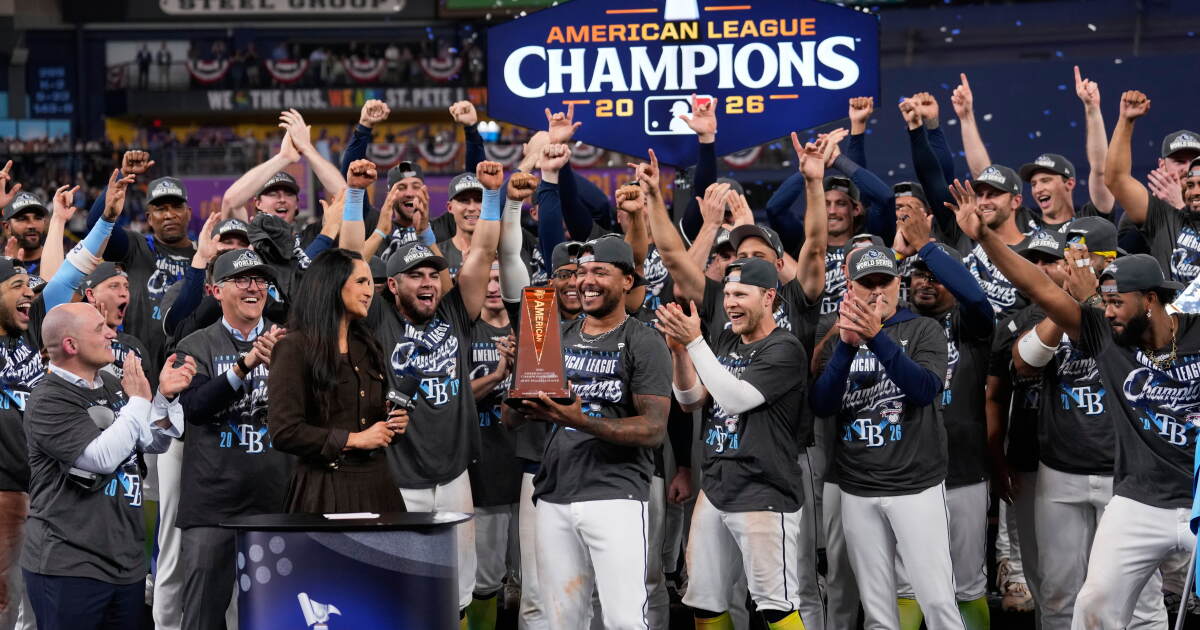
The World Series is upon us, and this one should be a delight: The team with the best record in the National League, the Milwaukee Brewers, against the team with the best record in the American League, the Tampa Bay Rays.
The players are about to take baseball’s grandest stage. Yet this has somehow become a strange national obsession: not how Jacob Misiorowski or Junior Caminero might shine in the series, but how many people might watch it.
Should you care? Not really. Have you ever thought about watching a World Series game and thought, “Hmmm, let me consider what the ratings might be before I decide to tune in?”
Major League Baseball cares, of course, because its owners count on billions of dollars from the sale of television rights, and those rights are worth more money when more people watch the games. And, since the fog of a collective bargaining war has enveloped the sport, the ratings make for an intriguing subplot in the World Series.
This World Series is what owners say they want: less of, say, the Dodgers and the New York Yankees, more of teams from smaller markets that seldom advance through the playoffs, if they even get there. Neither the Brewers nor the Rays have won a World Series.
Yet the ratings for the Dodgers-Yankees World Series in 2024 almost doubled those for the Arizona Diamondbacks and Texas Rangers in 2023, and this year’s ratings should be much closer to 2023 than 2024.
So, in a sport that already generates the majority of its broadcast revenue in national rather than local packages, amid the collapse of regional sports networks, are the owners taking a risk of making less money on the World Series?
Fox currently airs the World Series as the jewel of a seven-year, $5.1-billion deal that expires in 2028.
Ed Desser, a Santa Monica-based consultant who launched NBA TV and helped negotiate the Dodgers’ record SportsNet LA deal, said the value of a World Series featuring teams such as the Dodgers and Yankees goes beyond the large audiences they command because they play in large markets.
“It’s commonplace for people to hate the Dodgers, hate the Yankees — and, to some extent, that’s good for business, because it’s another rooting interest. Anything that gets people to focus their attention is good,” Desser said. “It’s easy to hate a team that’s in a glamorous place and spends more than almost anybody.
“I’m not sure that anybody has an ax to grind against the Rays or the Brewers. Sports is about passion.”
That said, neither Desser nor Bob Thompson, the former president of Fox Sports Networks, believes MLB is setting itself up for a big fall in revenue from the Fall Classic.
For Fox — and whatever other bidders might emerge come 2028 — ratings would be important, but not as much as you might think.
“Does expected audience matter? Of course,” Desser said. “They’re in the media business, and the way you monetize is by selling subscriptions to your channel and selling advertising.
“But, typically, you’re taking a much longer viewpoint. You’re making a deal that might be five, eight, 12 years. When you do that, you have an expectation that some teams get better, some teams get worse, sometimes you get a large market, sometimes you get a small market. It kind of evens out.”
This is the fifth season of the current Fox contract. The 10 World Series berths have been spread among nine teams, with the Dodgers appearing twice.
To a broadcast outlet, Thompson said, financial success in the World Series is not just about ratings.
“It’s about how good the matchup is and how long the matchup goes. The bulk of the advertising is sold up front (before we know the teams),” Thompson said. “Ratings for the series aren’t going to be a huge deal, unless you’re selling time in, say, Game 6 and Game 7, where you can really be jacking your rates.”
Last year’s Dodgers-Blue Jays World Series extended to seven games, attracting viewers amid a dramatic finish and ultimately getting a higher rating than the 2024 Dodgers-Yankees series, even though Canadian viewers weren’t included in that Nielsen count. The Dodgers-Yankees series lasted five games, and the Dodgers beat up on the Yankees when the Yankees weren’t beating themselves.
Even if the World Series itself might be worth less with more lower-profile teams competing, Thompson said MLB could include it as part of a larger package, or dangle it as an incentive for streaming outlets or other new bidders.
He also noted that the latest MLB collective bargaining proposal calls for fewer regular-season games and more postseason games.
“Playoffs are going to get you a premium over regular-season games,” Thompson said.
And, to the extent that postseason ratings might be in decline, ratings for everything — sporting events, awards shows, news shows, dramas, comedies, you name it — are in decline. Only the NFL is immune to lower ratings.
“Big events matter more than they used to, even with smaller audiences,” Desser said. “The World Series is still a big event, and there is a premium for that.”
The three most-watched shows on broadcast television in the week of Oct. 5-11, according to Nielsen: Sunday Night Football (Atlanta Falcons vs. Baltimore Ravens) with 17 million viewers; SEC Football (Alabama vs. Georgia) with 12 million viewers; NLCS Game 1 (Dodgers vs. Brewers) with 11 million viewers.
The top entertainment show that week: Tracker (CBS), with 7.4 million viewers.
The owners will make their money on the World Series, one way or another.
“Even at a lower expectation for audience, there is still going to be that value,” Desser said. “It’s one of the biggest things happening in October.”