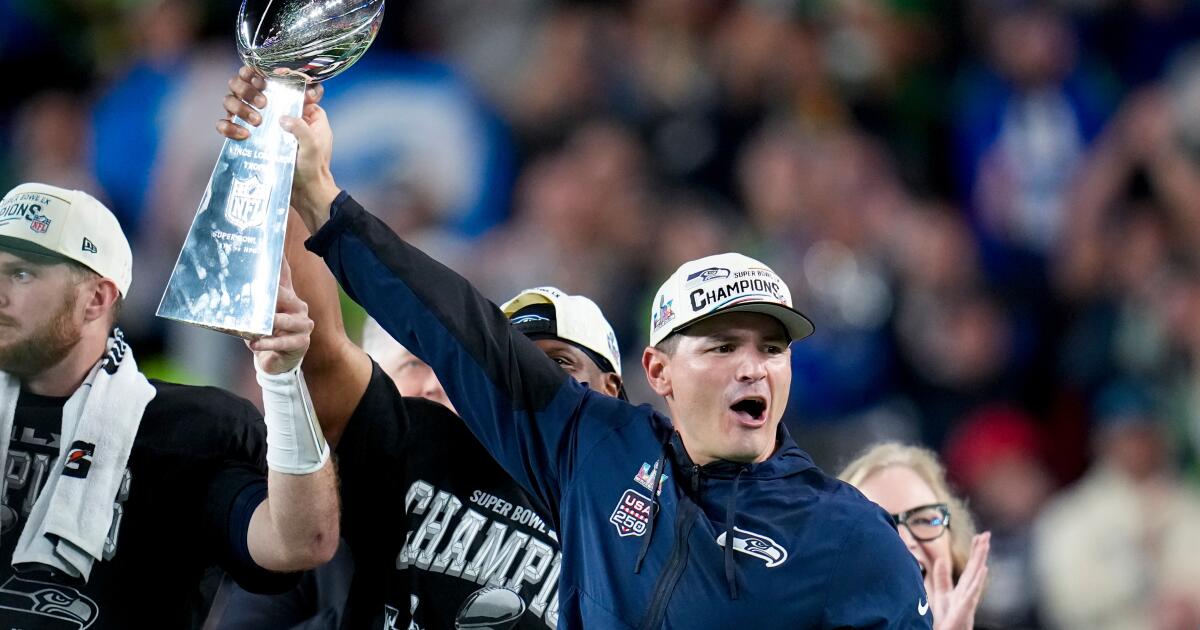
The Walt Disney Co. said Wednesday it has sold out the commercial time for ESPN’s telecast of the 2027 Super Bowl, which airs on ABC Feb. 14.
Hugh Johnston, chief financial officer for Disney, announced the sellout on the company’s earnings call. In addition to ABC, the game from SoFi Stadium in Los Angeles will air on ESPN, and have an alternative ESPN feed hosted by Peyton and Eli Manning. The game will be streamed on the ESPN app and the NFL+ app.
ESPN, which has carried NFL games since 1987, has never produced a Super Bowl. ABC last aired the game in 2006, when the network had its own sports division.
The Super Bowl is perennially the most watched TV event of the year, bringing in a huge pot of revenue for the media company holding the rights. Fox said it took in more than $800 million across its platforms for the 2025 game that saw the Philadelphia Eagles win 40-22 over the Kansas City Chiefs.
Disney did not divulge a price for the commercial time, although reports said the company was seeking $10 million for a 30-second spot. NBC sold several commercials at that rate last year.
Johnston said Disney sold Super Bowl spots to 58 brands across 34 product categories, including financial services, candy, personal care and software. Nine of the brands are in the game for the first time.
As the rest of traditional TV has seen ratings diminish, the Super Bowl has remained resilient, setting a viewership record in 2025, with 127.7 million viewers watching on Fox and its streaming platform Tubi, according to Nielsen. Last season’s contest drew 125 million viewers on NBC, Telemundo and Peacock.
When ABC had Super Bowl XL in 2006, the Pittsburgh Steelers’ 21-10 win over the Seattle Seahawks scored 90.7 million viewers. Nielsen did not include out-of-home viewing in its data at the time.
Live sports has become attractive to advertisers as it is one of the few ways to reach a massive audience in real time.
The advertisements all start the same way. It could be a barber, an aunt or a family member in discussion with others about the FIFA World Cup, but in each case, they assume Egypt will be heading home after the group stage.
Then an Egyptian footballer pushes back: “To all the doubters, this time we’re staying longer.”
It’s a line that’s resonating like never before in the nation of 120 million people, as Egyptian football fans wait with bated breath for the final round of group stage matches that could send The Pharaohs, as the national team are known, into uncharted territory: the knockout stages.
Here’s why these commercials have captured the zeitgeist in Egypt:
Egypt’s poor World Cup track record
Egypt was the first African and Arab nation ever to play in a World Cup, back in 1934. It has won the Africa Cup of Nations a record seven times. Football in Egypt isn’t just a sport, it’s a national identity, and The Pharaohs have long been a source of genuine pride and belief.
But the World Cup has always told a different story. Before this tournament, Egypt had qualified just three times — in 1934, 1990 and 2018.
It had never won a single match. Fans still carry the painful memories of a penalty shootout loss to Senegal that kept Egypt out of the Qatar World Cup 2022 entirely.
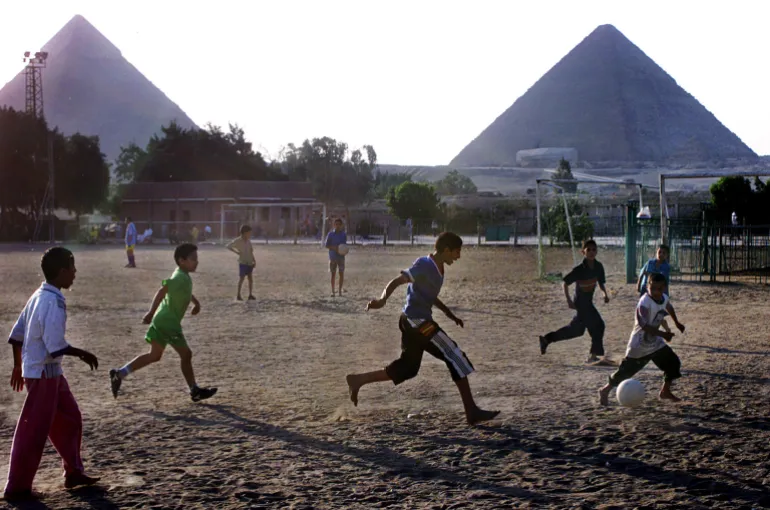
Egyptian children play football in front of the Giza Pyramids in Giza, on Friday, May 17, 2002 [Amr Nabil/ AP Photo]
What’s different this time?
Everything — at least, so it seems.
After two games at the World Cup, Egypt sits at the top of Group G, above Iran, Belgium and New Zealand.
The 26th ranked Egypt drew 1-1 with Belgium — ranked 10 in the world — in its first match. Then, it beat lower-ranked New Zealand 3-1.
Its four points are the most Egypt has ever earned at a World Cup. Its four goals are the most Egypt has ever scored at a World Cup.
Now, on Friday night in Seattle — early Saturday morning in Egypt — the team faces Iran in their final group game. A win or a draw would guarantee that Egypt’s national team goes into the knockout stages for the first time.
If Egypt loses to Iran, they might still make it to the round of 32, but their fate will depend on what happens in the Belgium-New Zealand match that will be held at the same time, and potentially, on the outcomes of matches in other groups. Eight of the 12 teams places third in their groups will also move into the next round.
So in a nutshell, Egypt is on the cusp of going where it never has before — and only a rare set of permutations can deny it that chance.
Hossam Hassan, now the Egyptian coach, seen here manoeuvring the ball during a friendly international match against Zambia in Cairo January 9, 2001 [Reuters]
But it isn’t just the performances. Part of what makes this year feel different, to many fans, is the identity of the main man standing outside the pitch, next to the Egyptian dugout.
Hossam Hassan is Egypt’s all-time top scorer and one of the most iconic figures in the country’s football history. In 1990, he scored the goal that ended a 56-year wait and sent Egypt to the World Cup in Italy. Now, more than three decades later, he is the national team’s coach, making him the first Egyptian ever to reach the World Cup as both player and manager.
For older fans, his presence carries the memory of a time when Egypt genuinely believed it could make its mark on the world stage.
Mohamed Salah scored during the second half against New Zealand in the 2026 FIFA World Cup in Vancouver on June 21, 2026, as Egypt registered its first-ever win at the tournament [Anne-Marie Sorvin /Reuters]
So what are the advertisements really about?
They aren’t really making fun of the team. They’re making fun of the deeply ingrained expectation that Egypt won’t go very far. And that expectation, many argue, goes beyond football. Years of economic hardship and political uncertainty have made expecting the worst feel like common sense for many Egyptians. They protect themselves from disappointment. They assume it won’t work out before it doesn’t.
That’s what has also made the campaigns somewhat divisive. For some viewers, the humour felt honest — a reflection of a habit fans know they have. It prompted real questions about why low expectations have become so normal. Others argued the advertisements risked making those same low expectations feel permanent, even acceptable.
Either way, they underscore how the 2026 World Cup has reignited faith among Egyptian fans, as they wait for the Iran match. An advertisement campaign challenging doubters has come to reflect the broader hopes, doubts and debates surrounding The Pharaohs.