comedy fan

David Cross says stand-up specials aren’t special anymore unless comics start breaking some rules

Ranting about the decline of comedy specials while releasing a new one at the same time feels a bit like an oxymoron. But somehow it still makes sense coming from alt-comedy pioneer David Cross, who isn’t just complaining; he’s finding his own route to making specials feel special again. The only way to do that is by putting one out in the manner he’d like to see more often — starting by making the whole crowd stand up too.

Capturing the energy of a concert at the famous 40 Watt Club in Athens, Ga., was the first step in differentiating “The End of the Beginning of the End” from the typical hour you watch on a big streamer. And, with this new special, Cross is able to get back to his own beginnings of touring across the country with love bands as his openers, performing for crowds for as long as he could until he had to run offstage to pee.

Premiering the special earlier this month on his website (and on April 7, it will be available on YouTube via production company 800 Pound Gorilla), Cross is hoping the special connects with comedy fans in a way that we’ve forgotten specials could.

This interview has been edited for length and clarity

Your new special is called “The End of the Beginning of the End.” What does that title mean to you as it relates to the impending doom of what we’re all living right now.

David Cross: Well, you can look at it in a couple different ways. To me, it signifies that the beginning of the end has occurred. And we are now at the end of the beginning of the end. And from where you go with that, that’s for you to decide.

One of the things I love about the special is the fact that you shoot it at a club in the style of a livemusic concert.

I’ve shot specials in theaters and it’s just different, not that one is better than the other, but they’re just different. You have a different relationship with the audience. When I first started touring, I would go to music venues and I’d have a band open for me and then I would just go up and pretty much [perform] as long as I could until I had to pee. Sometimes I’d have a band playing, sometimes two bands, then I’d go out. And I did that a couple of times, and then stopped doing that and did theaters, and I decided for the last two specials I’m going to go to, when I shoot it, I’ll go to a music venue, and I was at the 40 Watt Club in Athens this last time, I was at the Metro in Chicago before that, both places I played on earlier tours, and, you know, it’s not seated. People are standing there at the stage, and I prefer it. It’s more fun. It’s not as lucrative but, to me, a more fun show to do.

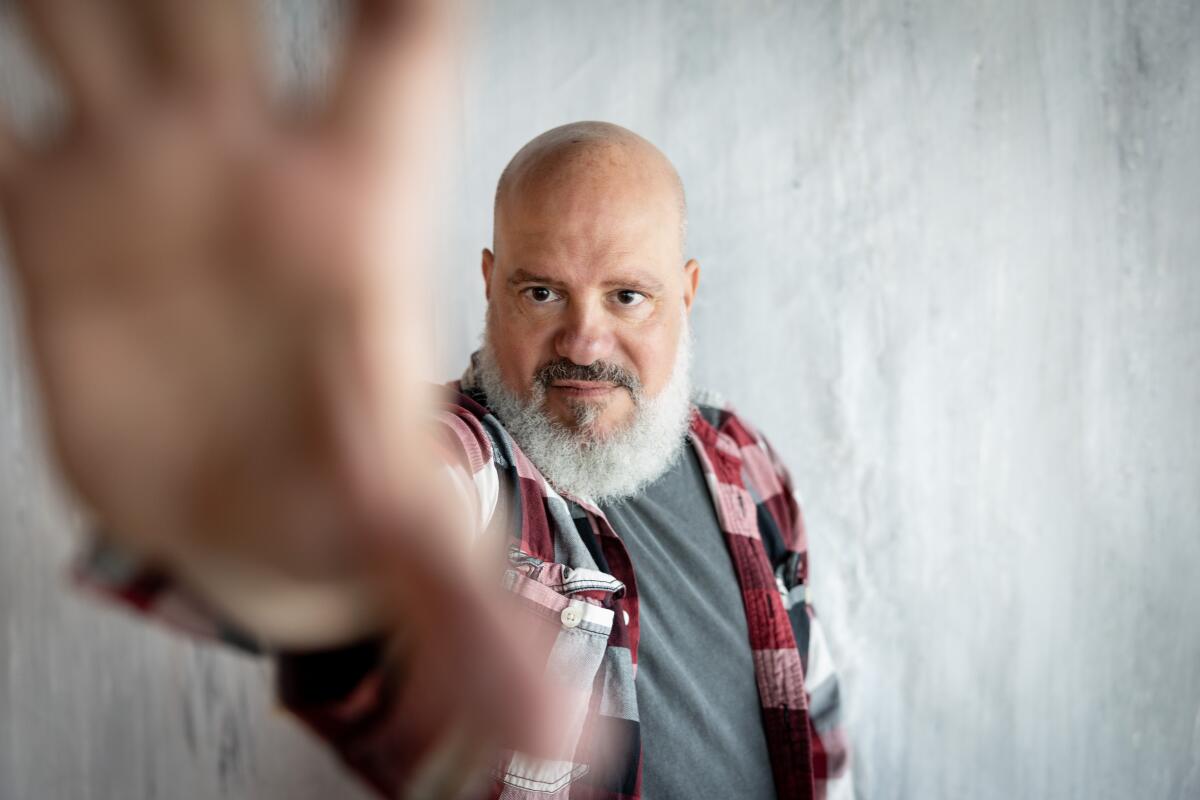
Comedian David Cross poses for a portrait

Comedian David Cross

(Jason Armond / Los Angeles Times)

The ambience of it was great. You can hear people shouting and drinking and having a good time, and the crowd work is also a little more spontaneous and fun than it would be in a regular venue.

Yeah, well, there’s more opportunity for that. But my thing has never been about crowd work. I like engaging with it, it’s kind of a nice distraction from the set that you’ve been doing 100 times, 150 times at that point. So it’s always fun to have that thing happen and that feeling of spontaneity. And like the guy [who I talk to in the crowd during the special], I could not have asked for [someone better]. I mean, even if it was scripted, it wouldn’t have been as good. The guy who [I talk to] during the stuff about hiking Machu Picchu [with Bob Odenkirk], that’s just… [chef’s kiss].

Speaking of Bob Odenkirk, you guys have this long relationship. How would you describe the dynamic of working with Bob and just how you guys bounce ideas off each other?

I mean, it’s great. We have an inordinate amount of respect for each other, both as people and as creative partners. And so there’s never any real issues. There’s things we will definitely disagree with, but we’re both decent people. So you know somebody backs off and says, “OK, let’s do it that way.” But even then, there aren’t that many of those [issues]. We just have really worked well at building something or molding it, creating it and shaping it. And our aforementioned hike to Machu Picchu, we have a documentary about that, that will be premiering at a fancy festival at some point in the near-future. And so we got that doc and we’ve been working on that. And for the way we work now, because he lives in L.A. and I live in New York, and it’s been like that for a while, he’ll write a bunch of stuff, I’ll make notes, I’ll write my things, send it back. And so we’re able to do that and not necessarily have to be in the same room because we’ve had 30-plus years of working with each other.

It’s a kind of like an unspoken language you guys probably have in terms of comedy, which is super important, I imagine, just for collaborating.

Yeah, and it’s something we discovered very early on … before there was even “Mr. Show,” what would ultimately become “Mr. Show,” when we got together to write sketches for this bigger kind of comedy collective thing, and these shows that we would all do with each other, for each other, and the stuff that we would write together was just, like, really good, easy writing — again, one person adding this thing and one person saying here’s a switch yeah and another person adding this thing in. It was fun, it’s cool, still is. One thing he doesn’t get credit for is he’s a really decent human being. And with all the awfulness in the world that’s magnified, every sense is bombarded with it — it’s just good to be hanging with somebody whose energy is a good person, a decent person and an equitable, nice guy, so that’s good as well.

Comedian David Cross poses for a portrait

Comedian David Cross poses for a portrait ahead of his comedy special “The End of the Beginning of the End.”

(Jason Armond / Los Angeles Times)

One thing you guys also have in common is you both have kids, and he has a comedy show for kids called “The Appropriate Show.” Have you taken your daughter to see it?

It’s a sketch show [in which] all the sketches are appropriate for kids to watch. And the sketches have been done in other sketch shows onstage, live. And he puts together this thing once, twice a year here in L.A. And I took my daughter to it last year. It’s just sketches that kids can [understand]. At least if they don’t understand the actual references they get the archetype. “Oh, that’s the boss, that’s that uh… And it’s great, it’s a really cool idea uh… “ And would an ass— think of [a show like] that? No, one good decent person; a good man. But listen, this interview isn’t about me, it’s about Bob Odenkirk, so let’s get back to that.

Well, speaking of having comedy geared toward kids, your daughter’s at an age where she’s probably consumed or seen some of your comedy at this point.

Not, not really. No, no.

Do you shield her from your stuff, or are you not so concerned about it?

I don’t actively shield her, but I don’t introduce her to anything. So I was a little bummed out, and I got over it pretty quickly, but when I found out that she had seen a little bit of “Alvin and the Chipmunks,” and only because I don’t want to spoil the enjoyment of what movies are and what kids’ movies are and how things work. And I feel like that would introduce an element of reality that I want her to be able to just enjoy these things without — she’s seen “Kung Fu Panda”when she was younger, like, I don’t know, three, four, five times, has no idea that I’m in that, that my voice is in there. She knows I do stand-up, she gets that now. And when she was younger, she’d say, “Daddy’s silly for a living.” … I’m just trying to ride the balance of letting her have those childhood joys and experiences.

David Cross poses for a portrait

Comedian David Cross.

(Jason Armond / Los Angeles Times)

Does having a kid make you think about what’s coming up in the future of comedy, or what kids are gonna maybe find funny, or what they find funny now? Do you have any thoughts on kid comedy in general?

Not really. I mean, I can see that she and her friends, who are kind of like-minded, are naturally funny, and then that’s kind of encouraging and heartwarming and they’re silly, but I’ll be long gone when that generation is is providing comedy. And I’m still, although I’ve kind of given up, I’m still trying to grasp what works now. I mean, it’s short-term TikTok, Instagram stuff. There are some amazing, like really, really great things being done as far as film sketches for YouTube channels. “Almost Friday,” they’ve got genius-level stuff. I mean, really good. And where the sketch goes in a place, you’re never ahead of it, goes in a place where you’re not expecting. It’s really well written and well performed.

What are your thoughts on what a comedy special is nowadays or what it should be?

I mean, that’s a great question. I think anybody who plays with the form, whether I think it’s that funny or not, is different. But I’m happy when anybody kind of tries at least to play with a form. I just went to Rory Scovel‘s taping last week of his latest special. I don’t know when that’ll air, but if you’ve seen the beginning to his first special, stuff like that where you’re like, “Wait, what’s happening? What’s going on?” I love stuff like that.

I still get excited to watch specials by some of my favorite comics, but there’s a quality that’s missing. And these are stand-ups I love, and they’re not that great. They’re not bad but they’re not special, you know? And all those guys I mentioned, and more, have great specials. Like, you can go back and they’re great. And I don’t know why that is. I mean, there’s still funny stuff, but I don’t ever want to get to that place where its just feels a little phoned-in a little bit… that is, in part, why the last two specials were shot in this more intimate setting that feels special. And … as I said, the energy’s different, it’s a little bit different, and it’s less slick. It feels like you’re in the moment. You don’t need a million dollars to shoot a special. You don’t 28 camera angles, it‘s just bull—. And it takes something away.

Comedian David Cross poses for a portrait

Comedian David Cross

(Jason Armond / Los Angeles Times)

It all should feel the right amount of unsafe as well, I think.

That’s never gonna happen at a theater show. You’re never gonna feel that. And I don’t know, it really does feel almost like maybe we peaked in a sense, like there’s too much, and because of that, these things aren’t special. They’re not revelatory, they’re not unique. I dunno, can 18,000 people in an arena really relate to a … billionaire talking about how they’re gonna get canceled. I mean, is that a thing I guess? Those other big, slick specials that are shot in, like, a 3,200-seat, 3,500-seat theater, it just feels like, “Oh this person is up there and I’m listening to their jokes.” There’s nothing wrong with that. They’re often very funny jokes, but it doesn’t go beyond that. It’s just like, “All right, tell me your joke.” It might as well be an audio thing, you know?

Well, hopefully the robots aren’t coming for your job anytime soon.

Absolutely not. I mean, this could be naive, but I feel 100% safe that you are never going to replicate an evening of stand-up at a nigtclub like that. And not sitting down at tables while you’re having drinks and waitresses are coming by. I’m talking about everybody’s up on the stage, sold-out, maximum capacity; everybody’s there, focused, we’re all sharing that thing. You can’t. AI’s not going to be able to do that.

Yeah, the robots can’t do that, Terminator can’t do that..

Oh, I forgot about Terminator. He could do that. G— it.
Source link

‘Keep it Kountry’: How Kountry Wayne refused to code-switch and became comedy’s most authentic voice

Kountry Wayne likens the dream he’s currently living to an old sitcom that has made the world laugh for decades. “I feel like I’m the new version of ‘Beverly Hillbillies,’” he says. “I’m in Hollywood — I’m here, but I’m still not here, so I just think that’s the most country thing about me.” To his point, the comedian born DeWayne Colley has definitely hit the big time after getting his start in comedy in 2014 (trying his skills as a rapper before that) by working on his stage craft and cooking up Southern-fried viral skits inspired by his small-town Georgia roots. Fast-forward 12 years and his growing empire includes independent movies (including his upcoming film “That’s Her,” which he financed himself), a flood of both dramatic and comedy-driven short skits featuring a wide range of actors, a debut Netflix special (2023’s “A Woman’s Prayer”) and now his latest hour, “Nostalgia,” premiering Monday on Prime Video.

By spending a new hour looking back at a bygone period, specifically the ’90s, when Wayne grew up, the 38-year-old comedian is bringing a fresh approach to the Def Comedy Jam era that he hopes resonates with comedy fans of his generation and younger fans who found him through TikTok and had no idea he even did stand-up. As someone whose comedy career has skyrocketed over the last several years, Wayne’s sights continue to be set toward future opportunities to bring relatable humor to the masses who have that country cousin who walks, talks and jokes just like him.

This interview has been edited for length and clarity.

What does the word “Nostalgia” mean to you?

A good feeling. It means bringing people together through laughter like the good old shows back in the day — “Saved by the Bell,” “Family Matters.” It just is that feeling, whatever that feeling was that we couldn’t put in a jar, I wanted to bring that in my special to just make everybody laugh and forget about the stuff that’s always gonna be here — bills and drama and violence. Just take a break, have fun, and take the breaks we used to take when we used to watch those TV shows in the ’90s.

By the shows you mentioned, I know we’re about the same age. We grew up with the same TV sitcoms and yet still valued being outside, which feels like a foreign concept today.

Yeah, it’s that feeling of all those movies. Man, “Clueless,” when I see that movie, to this day, I still got crushes on all [those girls]. I always wanted to go to the high school in “Saved by the Bell.” So I just want to give that feeling that I felt, because a lot of the new generation didn’t get to experience those shows and those feelings. So even for the younger generation, I want them to be able to experience that through my special.

What was smalltown life in Millen, Ga., like for you as a funny kid growing up?

I was so poor, it wasn’t nothing really funny. The town was so small — one [stop]light, the elementary school, high school, all in one school. You had to joke your way to make you think that you weren’t there. You kind of had to escape through jokes. So I just made people laugh wherever I was. No matter how serious the situation is, I can’t do anything about it. I might as well laugh. I remember the lights went off one time when we were eating cereal. I was like, “Mama, hey, come on. I can’t see — I can’t see the milk, the cereal, the bowl. And you’re telling me I need to do my work. I think you need to go to work.” In a small town, you had to laugh because there was nothing else, there was no opportunity.

 Comedian Kountry Wayne

“In a small town, you had to laugh because there was nothing else, there was no opportunity,” Kountry Wayne said about growing up in Millen, Ga.

(Christina House / Los Angeles Times)

You gravitated to music early in life, becoming a rapper before you did stand-up. What was it about performing that helped you forget about the troubles that were going on around you?

I always felt like I was onstage already, so by the time I actually got onstage, the lights never did nothing to me, or the fame and all of that. Because I’m just so thankful to be able to do stand-up and have people come and watch me do it. I never had time to really feel the fame and all of that. So I just think everything I went through in that small town helped me. Everything is a small town to me. Hollywood is still a small town to me, because whoever I know, that’s who I know; whoever I don’t know, I just don’t know ’em. Because in that small town, you were so far away from the big cities like Atlanta, New York, L.A. I was three hours from Atlanta [growing up], so I think that really helped me to get where I’m at today to do comedy the way I do it.

Just keep it “kountry.”

Yeah, keep it kountry. Man, oh, that’s the next [title of a new special].

What do you feel like is the most country aspect of you as someone who’s now a popular comedian?

My family — all my family around me. You come to my house. It’s an uncle, daddy, a sister, brother, kids everywhere. I feel like I’m the new version of “Beverly Hillbillies.” I’m in Hollywood, I’m here, but I’m still not here, so I just think that’s the most country thing about me. If you meet my family, you understand. They don’t say shrimp, we say “scrimps” or “o’er dere” [instead of] “over there.” With my accent, imagine it’s 10 times worse with my family. So I think I remind people that everybody in L.A., New York got a cousin somewhere in Mississippi, because a lot of us are from the South anyway. So I just think I remind people of simple, country people.

With the Southern flavor you bring to comedy, I kind of liken it to hip-hop, when it comes to the regional styles of different comics. How does that play into creating a special that brings the South to the world?

It’s crazy that you say that [you] think about hip-hop when I do that. I’m gonna be me so much that people who don’t know me are gonna be interested in me, because it’s different than everybody else. I feel like I’m a really country person with that Southern drawl or the way I talk. I talk like them uncles and all of that. So I just feel like it’s gonna make everybody feel at home. I didn’t try to switch it up. I’m gonna be me because I feel like, deep down, everybody knows [someone like] me somewhere. They’re gonna relate to me in some kind of way, and it feels safe because I’m being me. I’m not out there being fake, this how I talk. I’m a country boy. I’m not from the big city, and this is what I’m giving the world. And those who love it, I appreciate it. Those who don’t love it, I still love you.

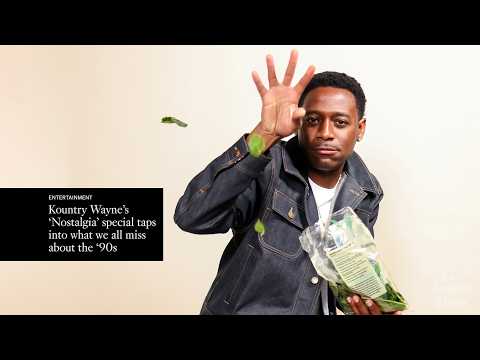
Comedian Kountry Wayne throwing spinach

“I think I remind people that everybody in L.A., New York got a cousin somewhere in Mississippi, because a lot of us are from the South anyway,” said Kountry Wayne.

(Christina House / Los Angeles Times)

Being a dad to 10 kids is something that’s been a part of your storyline in comedy and that people have gravitated to. How does your ability to survive and make it all work play into your comedy?

Child support would really make you very, very funny. It actually plays a lot into it, because if it wasn’t for those kids, I don’t think I’d stand out as much as I am. Because we’ve heard every joke, everybody’s been funny. Come on, man, we’ve seen Jim Carrey, we’ve seen Eddie Murphy, we’ve seen Dave Chappelle. Funny has already been done. So I think what helps me stand out is my story with my kids and my family. It’s funny, but it’s still OK. This is a different perspective than we see with all those kids, the mothers, you know, but he’s not with the mothers, but he’s there with the kids, and you take care of the mothers. It’s so much of a unique situation that I think that’s what makes it stand out.

Who’s your funniest kid?

[My daughter] Honest. Honest is the funniest person in my life. Her name’s Honest, but she lies — she makes up all these stories about what happened at school. [She’ll say,] “I got arrested today.” I’ll be like, “Honest, you did get arrested?” [She’ll say,] “Well, they was about to arrest me, but they didn’t.” She reminds me of me, but she is just a little bit more witty because she don’t got no trauma like I did. I come from poverty. She’s rich. She goes to this Christian school full of white people, and she thinks she’s a white baby now. The white girls have this clip they put on their hair. She bought her clip. Now her hair not floating like theirs. Her hair is definitely stiff. I’m like, “Honest, you don’t need that clip!” She’s in dancing. She don’t go to practice. When she goes to the dance recitals, it’s clear that she can’t dance and we always ask her, “Do you know the dance?” Every time she gets there, she says, “Yeah,” but she gets there and she’s always watching the other kids. She was the only one [who’s] off.

She is so funny. I put her in the skits. She says the wittiest things. She asked me one day — I got a lot of kids — and she said, “Daddy, which one of your kids you love the most?” She said, “Do you love all your kids?” I said, “Yeah, I love all of y’all.” She said, “Well, come here. Let me talk to you right quick.” She took me to a picture I had in my man cave, “She said, ‘Well, why all of us [not in the picture]?’”… She’s my comedian.

Speaking of the skit-producing pipeline/network you‘ve developed over the last several years, how has that been instrumental to your comedy career, and also your career as sort of a producer in developing content?

I think that content helped me more [with] being known as a producer and a filmmaker and an actor. So I think it helped my acting career, the first part of my life, and all the skits helped my comedy because it was just me being funny, but the skits I put out now help people look at me more as a businessman, an entrepreneur and an actor. And it’s crazy, some people now even know me from the skits. And when they come to the [stand-up] show, they’re going to be shocked. A lot of my fans who met me when I started writing the storylines, when they see this [“Nostalgia”] special they’re like, “He never showed us that!” Because that person I am onstage, I don’t be that on social media anymore, so you have to go watch me on stand-up to give that energy that I give. But my Day 1 fans met that guy. These fans I’ve made over the last four or five years were probably equivalent to my Day 1 fans. It’s a large fan base but they don’t even know that I could [do] stand-up like that.

Comedian Kountry Wayne holds up his gold neck chain with his mom's face on it.

Comedian Kountry Wayne holds up his gold neck chain with his mom’s face on it.

(Christina House / Los Angeles Times)

That’s nostalgic in a way. I’m thinking of a TV dad like Bob Saget, who was so different when you saw him do stand-up. You’re like, “Wow, Danny Tanner is filthy!” That’s great that you can kind of separate the two personas. What do you feel is next for you in comedy?

To bring that to the big screen, for sure. All my talents and gifts that I worked on, in a way, [have] gotten better. I put the work in, I’m ready to show it on the screen. I think it’s happening organically, like the special [on] Amazon, that’s organic. I had one on Netflix now they wanted me to do one at Amazon, and I just want to show the world what I’ve been working on, and the time, energy I put into a broader scale … So I’m just excited, and I feel like a kid again, because I got so many responsibilities and kids I take care of. It took a while for me to get back to this point where I could just be an artist. Because I wanted to be an artist, but then I had a lot of kids, so I had to be a provider. But now I’m in a position where all that is handled, so I feel like a kid again when it comes to the art.

Source link