collective

‘Collective punishment’: Family home of suspect demolished in West Bank | Israel-Palestine conflict News

Nablus, occupied West Bank – The Sanoubar family say the Israeli soldiers only gave them two minutes to leave their homes. Then, the apartment block the extended family lived in was demolished.

The explosion in Nablus on Tuesday shook the area as huge clouds of dust and smoke billowed out of the building’s floors.

Recommended Stories

list of 3 itemsend of list

The home belonged to the extended family of Abdul Karim Sanoubar, a 30-year-old bombing suspect currently detained in Israel. More than 30 people lived in the apartment building, all punished collectively for the alleged actions of Sanoubar.

‘They did this to frighten us’

Sanoubar, a high-profile prisoner who was arrested in July this year, is notorious among Israeli authorities for evading their capture for five months after being accused of conspiring to perpetrate bus bombings in Bat Yam near Tel Aviv in February.

No one was injured or killed in the incident, as the explosives went off while the buses were parked.

Sanoubar was eventually captured after a two-day manhunt in Nablus, in which Israeli forces stormed hospitals and residential buildings near Sanoubar’s family home.

After the demolition, Sanoubar’s uncle, Moayed, condemned Israel’s destruction of a building “when the people inside have nothing to do with any crime” as an “act of terrorism” against his family.

“We’re not the terrorists; they are,” he told Al Jazeera. “This is completely unjust.”

Sanoubar’s father, Amer, 61, said the destruction of his home was the latest act in an onslaught of “collective punishment” imposed on his family over his son’s alleged crimes.

“They did this to frighten us,” he said. “They want to make sure no young Palestinian ever thinks of carrying a single bullet.

He gestured wildly, surrounded by the dusty ruins of his lifelong home, now with a gaping hole looking out over west Nablus.

“It is meant as a deterrent action against the entire Palestinian people.”

The family told Al Jazeera that the Israeli army informed them that their now-demolished home had also been confiscated, making it illegal for them to return to it or rebuild the damaged skeleton that is still standing.

The Israeli army said that the home had been demolished as part of the so-called “Operation Five Stones”, which it launched in late November as a “counterterrorism” operation.

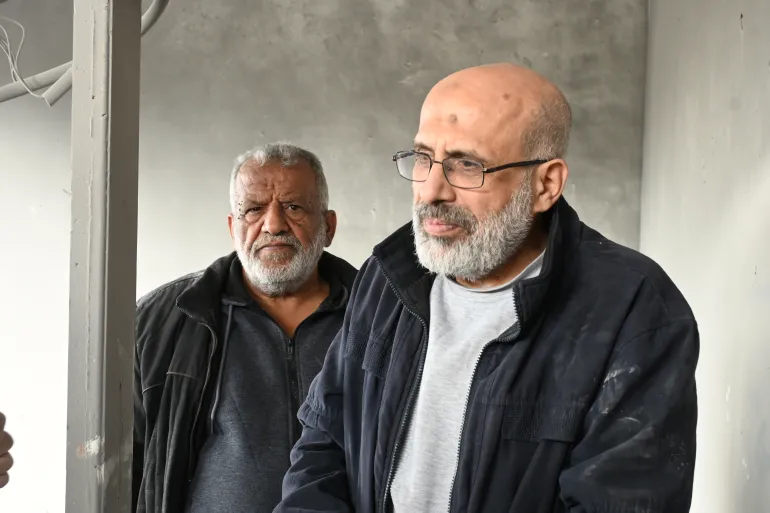
Two men
Amer Sanoubar [right], Abdul Karim’s father, says he has been detained three times since his son was detained [Al Jazeera]

Collective punishment

Israel’s punitive destruction of homes in the occupied West Bank is widely denounced as a strategy of collective punishment, condemned as being against international law by human rights groups.

Sanoubar’s brothers, Ahmad and Omar, aged 31 and 33 respectively, have also been imprisoned since their younger brother was detained.

All three siblings are being held under Israel’s system of administrative detention, which allows prisoners to be jailed indefinitely without trial.

Amer, the father, says he has been detained three times since Sanoubar was accused of the bombing, and Sanoubar’s mother and sister have also been detained.

Israeli soldiers have stormed the family apartments on several occasions, destroying furniture and possessions.

Amer said the punitive actions were an effort to coerce his son into surrendering while he was on the run.

The family received a demolition notice in April and was given just 72 hours to file an objection, which the Israeli courts rejected.

The demolition was scheduled for November 18, and the family says it has been on tenterhooks awaiting the sound of military vehicles since then.

“The devastation caused by the blast inside our apartment building is unimaginable,” Amer added.

Sanoubar’s displaced family is now scattered around Nablus and the surrounding areas, sheltering with different family members.

Other families living nearby, who were evacuated for the demolition, have returned to their homes, many with external damage to repair, such as shattered windows.

The remains of Sanoubar’s top-floor bedroom were visible from the roof, including the words “We fight so we can live” emblazoned on the wall.


epa12564005 An Israeli soldier prepares explosive devices to demolish the house of Palestinian prisoner Abdul Karim Sanoubar in the West Bank city of Nablus, 02 December 2025. According to the Palestinian news agency Wafa, Israeli forces demolished the apartment of imprisoned Palestinian Abdul Karim Sanoubar in the West Bank village of Zawata, west of Nablus, following a raid at dawn. Sanoubar was detained by Israeli forces on 20 February 2025. EPA/ALAA BADARNEH
An Israeli soldier prepares explosive devices to demolish the house of Palestinian prisoner Abdul Karim Sanoubar in the West Bank city of Nablus, December 2, 2025 [Alaa Badarneh/EPA]

Source link

Former head of UCLA’s football NIL collective denies wrongdoing

The former head of UCLA’s football name, image and likeness collective on Thursday denied any impropriety related to a report that revealed efforts by the school’s athletic department to funnel NIL donations through his non-profit charity.

The story published by the muckraking college football website foiaball.com showed email communications from UCLA athletic department officials directing payments intended for Bruins for Life, the onetime NIL collective of the school’s football program, through Shelter 37 Inc., a tax-exempt charity that purports to empower home ownership and help local youth through a variety of activities.

Donating through Shelter 37 would provide a tax deduction not available to those giving directly to Bruins for Life — a standard practice in the NIL sphere — but it also raised questions about a potential conflict of interest and the control of funds given James Washington ran Bruins for Life until recently and remains the president of Shelter 37.

The story also questioned Shelter 37’s charitable endeavors and suggested that UCLA athletic department officials encouraged the evasion of Internal Revenue Service guidance regarding so-called donor-advised funds, directing money to Shelter 37 that couldn’t go to other firms taking a more conservative approach with regard to NIL rules.

Emails obtained by foiaball.com through a public records request showed nearly a half million dollars of donations intended for Bruins for Life going through Shelter 37, with school officials requesting that anyone who sent their money through the latter organization to specify that it be earmarked for football NIL.

Washington said there was nothing untoward about an arrangement that was approved by UCLA and involved full transparency.

“There’s nothing that’s happening between Shelter 37 and UCLA and Bruins for Life that’s in the closet,” Washington, a former UCLA safety who went on to win two Super Bowls with the Dallas Cowboys, told The Times. “Everything has been discussed, every move, every act that I’ve taken toward the NIL, every step — bookkeeping and everything — has been handled and handed over to UCLA.”

In a statement, a UCLA athletic department spokesperson said that “UCLA athletics operates with integrity and transparency, in a manner that is consistent with industry best practices. Our development team educates potential donors on a range of giving opportunities, including avenues to support our student-athletes.”

In what Washington described as an unrelated move confirmed by an athletic department official, UCLA recently shifted its football NIL operations to new leadership, allowing Bruins for Life to pivot into an alumni club for football. Washington said the Bruins for Life website was temporarily inactive as part of that transition and that it would still have an NIL component providing community outreach opportunities for football players.

Alongside longtime UCLA donor John Manuck, James had spearheaded the fundraising efforts of Bruins for Life when it debuted in October 2024 as the new NIL arm of UCLA football.

“It’s really exciting,” UCLA athletic director Martin Jarmond said at the time, “because it’s going to support our football student-athletes in a real positive way.”

The foiaball.com story contended that the Bruins for Life website stated that it was not a 501(c)(3) organization, meaning that any donations it accepted were not tax deductible. The website directed those wishing to donate to Shelter 37, a 501(c)(3) organization that said it could receive tax-deductible contributions.

The story reported that Shelter 37’s 2024 IRS 990 tax form, published by ProPublica, showed a revenue jump to $4.8 million in 2024, up from $800,000 the previous year. The document stated that $3.6 million had been raised for the Bruins for Life NIL program but only $200 for scholarships for at-risk youth.

Washington said that latter number was misleading because Shelter 37 was not a scholarship-based organization, even though it assisted at-risk children through a variety of community services. The Times reviewed one Shelter 37 tax document reporting nearly a combined seven figures spent on scholarships, education programs and housing.

“This is when people are not fact-checking,” Washington said, “and they’re just putting stuff out there and they’re just trying to make the story bigger than what it needs to be.”

Over the years, Washington said, Shelter 37 has held many community-based events such as turkey drives, football camps for inner-city kids and “I’m going to college” days in which the organization paid for buses to transport students to football games at the Rose Bowl.

The foiaball.com story contended that Shelter 37 was used as a workaround for donor-advised funds that were in limbo. One UCLA athletic department employee, informed of a denial of one donor-advised fund, forwarded the message to other internal fundraisers, along with a message saying, “Just as an FYI. Here is info for Shelter 37 for DAF gifts.”

A new home for donor-advised funds was needed after another NIL firm, Blue Print Sports, ceased its charitable operations in the wake of the IRS recommendation, its legal counsel citing “no path forward.” According to the documents reviewed by foiaball.com, a UCLA athletic department official sent an email to Washington not long after the IRS guidance was issued, informing him of a $15,000 donation through Bank of America that should be directed to Bruins for Life.

Washington said there was nothing illegal about accepting donor-advised funds and that every move made by his organizations was within the rules.

“Any dollar that was given to me, there’s a track record and we have a communication document that shows what came out and how it was received,” Washington said. “They [UCLA athletic officials] know exactly what came into accounts, they know exactly what came out because everything was disclosed and we were communicating and I was acting as a vessel during the time of the Wild, Wild West to try to help UCLA’s football program succeed in this new era of what we call the NIL.”

Source link