President Donald Trump is considering renewed military action against Iran, including limited strikes, following the breakdown of negotiations in Pakistan, The Wall Street Journal reported Sunday, citing officials familiar with the discussions.
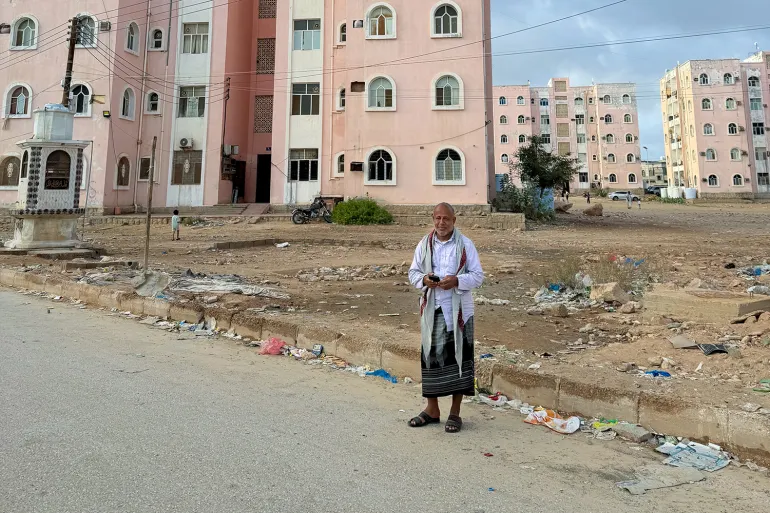
Mukalla, Yemen – Mohammed Salem heads out every morning for his job as a teacher at a government-run school. But once his shift is finished at that school, he then goes to a private school, where he also teaches. After a brief stop home for lunch, Mohammed is off to his third job, in a hotel, where he works the rest of the day.
“If I had any spare time for a fourth job, I would take it,” Mohammed, a teacher with 31 years of experience, said. He spoke to Al Jazeera outside his flat in a large housing complex in the eastern suburbs of Yemen’s southeastern port city of Mukalla.
Recommended Stories
list of 3 itemsend of list
He has been forced into taking on the extra jobs because of Yemen’s dire economic situation, and specifically the Yemeni riyal’s slide against the US dollar in recent years.
“I return home at night completely burned out,” he said. “Teachers are devastated and have no time to take care of their students. During classes, they are preoccupied with the next job they will take after school.”
Despite working from morning until night, the father of six says he earns less than half of what he made a decade ago, down from the equivalent of $320 a month to $130.
For more than a decade, Yemen has been mired in a bloody conflict between the Iran-backed Houthis and the Saudi-backed government, a war that has killed thousands, displaced millions and affected nearly every sector, including education.
The conflict has devastated the country’s main sources of revenue, including oil exports, customs and taxes, as rival factions wage an economic battle alongside fighting on the front lines.
The Houthis, who control Yemen’s densely populated central and northern highlands, including the capital Sanaa, have not paid public sector salaries since late 2016, when the internationally recognised government relocated the central bank from Sanaa to the southern city of Aden.
The Yemeni government, which controls Aden and the south, has also failed to raise public sector wages or pay them regularly, citing dwindling revenues after Houthi attacks on oil export terminals in southern Yemen.
Thousands of Yemeni teachers have voiced frustration over stagnant and delayed pay, saying their salaries have not improved since the war began. When they are paid, it is often late, and the wages have lost much of their value as the Yemeni riyal has plunged from approximately 215 to the dollar before the war started, to about 2,900 to the dollar in mid-2025. The Yemeni riyal is currently valued at about 1,560 to the dollar in government-controlled areas.
Faced with meagre and irregular incomes, teachers like Mohammed have adopted harsh survival strategies to keep their families afloat. His family has been forced to skip meals, cut out protein-rich foods such as meat, fish and dairy, and move to the outskirts of the city in search of cheaper rent.
He also asked one of his children to forgo university and instead join the military, where, he said, soldiers earn about 1,000 Saudi riyals ($265) a month.
“If we have money, we buy fish. When there is nothing, we eat rice, potatoes and onions. We do not look for meat, and we can only get it during Eid through donations from the mosque or charities,” Mohammed said.
During holidays and weekends, he lets his children sleep until the afternoon so they do not wake up asking for breakfast.
And when one of his children falls ill, he first treats them at home with natural remedies, such as herbs and garlic, only taking severe cases to hospital to avoid unaffordable medical bills. “I only take them to the hospital when they are extremely sick,” he said.
Mohammed Salem, a teacher with 31 years of experience in Mukalla, says he has taken on three jobs to make ends meet after his salary lost much of its value due to the rapid devaluation of the Yemeni riyal [Saeed al-Batati/Al Jazeera]
Generation at risk
According to the United Nations Office for the Coordination of Humanitarian Affairs (OCHA), in its Yemen Humanitarian Needs and Response Plan 2026 released on March 29, the country’s education sector continues to be hit by a catastrophic, multilayered crisis.
An estimated 6.6 million school-aged children have been deprived of their right to education, while 2,375 schools have been damaged or destroyed. Teachers have also been severely affected, with about 193,668, nearly two-thirds of the national total, receiving no salaries.
In the al-Wadi district of Marib province, Ali al-Samae, who has been teaching since 2001, said his salary of about 90,000 Yemeni riyals barely covers his own expenses.
The financial strain has forced him to leave his family of seven in his home city of Taiz.
“Instead of focusing on preparing lessons and using modern teaching methods, our entire focus is on how to earn enough money to support our families,” he said. “Before the war, my salary was equivalent to 1,200 Saudi riyals [$320]. Now it is about 200 Saudi riyals [$52],” al-Samae told Al Jazeera.
To survive, he has taken on extra jobs, while his family has been forced to skip meals and cut out meat and chicken. He now visits them only once a year, often arriving empty-handed after spending most of his salary on transportation.
“We now live just to survive, rather than to teach. In the past, salaries covered our basic needs, but now they are not enough; even milk has become a luxury. Life has become very difficult.”
Part-time teachers say they are worse off than their full-time counterparts, as the government has neither raised their salaries nor added them to the official payroll.
Hana al-Rubaki, a part-time teacher in Mukalla, and the sole breadwinner for her mother and three sisters, told Al Jazeera that her salary barely covers expenses for 10 days.
Despite eight years of service, she earns the same as newly hired contract teachers. “There is no job security, despite my eight years of service. There is no difference between me and a contractor hired last year; everyone receives the same salary,” she said. “After taxes, my salary is just 70,000 Yemeni riyals [$44] a month. With the high cost of living, it feels more like a token allowance than a real salary.”
She added that delayed payments further worsen her situation. “Delayed salaries disrupt our daily lives and leave me struggling to meet even my most basic needs. While some teachers can find additional work to support their families, it is incredibly difficult for us female teachers to do the same.”
Protests and patchwork solutions
To highlight their plight and pressure the government to improve salaries, teachers across government-controlled areas have staged sit-ins, taken to the streets in protest and gone on strikes, disrupting education for months.
The cash-strapped government, which is mired in internal divisions and spends much of the year operating from abroad, has largely left the issue to provincial authorities.
Some governors have responded by approving modest incentives. In Hadramout, a raise of 25,000 Yemeni riyals ($16) a month was approved, while in other areas they have ranged between 30,000 Yemeni riyals ($19) in others and up to 50,000 Yemeni riyals ($32).
“The incentives provided by local authorities vary from one province to another, depending on each governor’s priorities and capacity to support teachers in their region,” Abdullah al-Khanbashi, head of the teachers’ union in Hadramout, told Al Jazeera, adding that protests would continue until teachers receive better and regular pay.
“Teachers are showing up in torn clothing, and sometimes their students have more money in their pockets than they do. Some families have broken apart, while others have been evicted from their homes because they could not pay the rent. Other teachers have children suffering from malnutrition because they cannot afford to feed them,” he said.
In Marib, Abdullah al-Bazeli, head of the teachers’ union in the province, said local farmers have stepped in to help teachers remain in classrooms by giving them some of their produce.
“Farmers support teachers, especially those coming from outside the province, by giving them tomatoes, potatoes and other vegetables for free,” al-Bazeli said.
He also called for teachers’ salaries to be raised to the level of ministers. “A teacher’s salary should be equal to that of a minister. Teachers educate generations, while ministers often fail to make a meaningful impact. Some teachers have begun to die from hunger,” he told Al Jazeera.
In Houthi-controlled areas, teachers have rarely taken to the streets to protest the suspension of their salaries, as authorities suppress dissent and blame the Yemeni government and the Saudi-led coalition for imposing a “blockade” that they say has hindered their ability to pay public sector wages.
Acknowledging the problem of low salaries, the Yemeni government says dwindling and disrupted revenues during the war have prevented it from increasing public sector pay. “The main reason is weak financial resources resulting from the war and recurring instability, which have undermined institutions and revenue streams,” Tareq Salem al-Akbari, who served as Yemen’s education minister from 2020 to 2026, told Al Jazeera.
Teachers interviewed by Al Jazeera say they are running out of patience with the repeated promises that their salaries will be improved, warning that they may abandon the profession altogether if they find better-paying jobs that could spare them from hunger or begging in public.
“The idea of leaving teaching is always on my mind, but I have not found an alternative job,” Mohammed Salem said. “I feel pity, and sometimes cry, when I see a teacher begging in mosques or calling from a hospital, asking for help to pay for a child’s medical treatment.”
British singer-songwriter Lola Young is opening up about the “breaking point” that steered her toward recovery.
The “Messy” hitmaker told Rolling Stone in a recent interview that she was grateful that she fainted onstage late last year, and framed the scary ordeal as a wake-up call. “What do you call that? Like, a breaking point which allowed me to then be able to be here today, allowed me to be better for my fans, better for the future, and better for myself,” she told the outlet.
In September, the Grammy winner collapsed onstage during a performance at the All Things Go Music Festival in New York City. Following the health scare — which drew speculation and worry from fans who’d watched the viral video of Young stumbling and dropping her microphone before falling backward — Young canceled the remainder of her tour, which included a 21-stop North American run.
The tour, in support of her third album, “I’m Only F— Myself,” was expected to conclude with two dates at the Hollywood Palladium in December. Instead, she spent two months seeking holistic addiction treatment in a facility that prioritizes psychotherapy. She’s now attending 12-step meetings and working with a sponsor.
When announcing that she would have to nix forthcoming performances to prioritize her health, Young told fans on social media that she was “going away for a while” and apologized, writing, “I love this job and I never take my commitments and audience for granted so I’m sorry to those who will be disappointed by this. … I really hope you’ll give me a second chance … once I’ve had some time to work on myself and come back stronger.”
Young told Rolling Stone that, naturally, some folks were really angry that she’d canceled her tour. “[I]t was a decision that I had to make, and it was sad that I had to do that. What else was I going to do, die? That was the reality of where my addiction was heading.”
This wasn’t the first health incident for Young, who is known for her chart-topping breakout hit, “Messy.” The budding megastar performed at the Coachella Valley Music & Arts Festival in 2025, and during her Weekend 1 performance, she struggled to get through. The heat lingered around 100 degrees, and while Young danced and sang, she began to visibly gag and retch before running off the stage and asking for a bucket.
The acclaimed artist has been candid about her struggles with cocaine and alcohol addiction and often explores those struggles in her lyrics. In the song “d£aler,” a bouncy goodbye letter to her drug dealer, she sings about spending the day trying to be sober but feeling miserable nonetheless: “I wanna get away, far from here / Pack my bags, my drugs, and disappear.” … “Pack my bags and tell my dealer I’ll miss him.”
Young also sat down with the Times UK and said that she didn’t want to say too much but confirmed that she was in recovery for drug addiction. “But what I would say is that recovery is an ongoing process. I’m not the finished article, but I’m doing a hell of a lot better.”

![Mohammed Salem, a teacher with 31 years of experience in Mukalla, says he has taken on three jobs to make ends meet after his salary lost much of its value due to the rapid devaluation of the Yemeni riyal. (Saeed al-Batati/Al Jazeera]](https://i0.wp.com/www.aljazeera.com/wp-content/uploads/2026/04/IMG_0930-1-1775144238.jpg?w=640&ssl=1)