collaboration

Beyoncé shows love for Selena Quintanilla in ‘Irreemplazable’ cumbia remix

One could say that I’ve been waiting my whole life for this moment.

It’s a musical event some might have thought unlikely or impossible — but to me, it wasn’t a matter of if Beyoncé would ever release a collaboration with Selena but when. And on Thursday night, with the release of the special anniversary edition of Beyoncé’s sophomore album, “B’Day,” it finally happened.

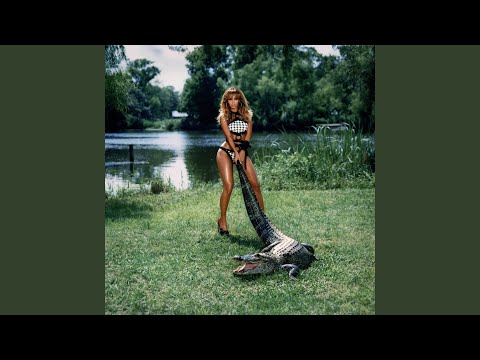
Alongside an expanded track list that includes remastered versions of the 2006 album’s original songs, plus new remixes and collaborations, there’s “Irreemplazable (Como La Flor),” a mashup of Beyoncé’s first Spanish-language release and one of Selena’s most beloved hits.

In her tragic absence, Selena’s estate gave a rare blessing to Beyoncé for the collaboration. A press release for the album noted that this “resounding approval” from the Quintanilla family “made it possible for this timely and meaningful duet.”

“Two women from Texas. Two unmistakable and irreplaceable voices that broke down and continue to break down barriers,” read the statement.

But not everyone was happy about the remix. Some fans viewed the collaboration cynically, criticizing it as a way for Beyoncé to capitalize on Selena’s legacy, or to court more Latino fans. Some voiced their dissatisfaction under a post from Selena’s husband, Chris Pérez, on Instagram — but he was quick to shut them down.

“Shout out to Beyoncé for showing respect to an ICON,” wrote Perez on Instagram. “In my opinion, nobody will ever, CAN ever, top Selena’s performance. But, dammit … can’t you just appreciate that another iconic/amazing artist chose to highlight Selena in this way?”

For those who need reminding: This isn’t Beyoncé’s first foray into Spanish-language music — and it’s not even her first tribute to Selena.

Long before Beyoncé reached superstardom, she was a girl from Houston who grew up listening to Selena on the radio. In 2007, she credited the “Queen of Tejano” with inspiring her to release “Irreemplazable,” a Spanish-language companion album to “B’Day.”

Working alongside Cuban American composer Rudy Pérez, the songs on that record were workshopped to retain the spirit of their English lyrics without being word-for-word translations: the catchy “To the left, to the left” refrain in “Irreplaceable” became “Ya lo ves, ya lo ves / Te olvidé, te olvidé” (“Now you see, now you see/I forgot you).”

Like Selena, Beyoncé learned to sing in Spanish phonetically, and in a 2007 MTV Tr3s documentary on the making of the album, you can see her angling toward perfection as Pérez and a friend corrected her pronunciation. Some of the lyrics she was tasked with delivering were tongue-twisters, even for native Spanish speakers. Try saying “Tú creías que eras imprescindible” five times fast and in key.

“I spent a lot of time on it making sure it was perfect because I didn’t want to disrespect the language, because it’s so beautiful,” Beyoncé told People en Español that year.

At the time, Beyoncé wasn’t the only major American artist making waves in Latin music. The pop landscape was undergoing a massive shift, thanks to the work of such crossover sensations as Daddy Yankee, Don Omar, and Shakira — and artists in the States were eager to tap into the burgeoning Latino market.

And while that was certainly a part of Beyoncé’s calculus when plotting “Irreemplazable,” she has a personal attachment to Spanish music. “A lot of my family, a lot of my friends who I grew up with speak Spanish, I grew up in Texas,” she said in the MTV doc. “I just have so much respect for the culture, and I really relate to it.”

“The heart and rhythm of the music and the drums and the spiciness,” she added, in her People interview, “it all reminds me of Creole, which is my heritage, and where I come from.”

While Beyoncé’s early solo releases were built on R&B, she demonstrated a curiosity for global sounds like reggae, Latin and Arabic music. Selena’s background was in Tejano, yet she was heavily influenced by heavy-hitters in pop, disco and R&B — namely Jody Watley, Janet Jackson and Donna Summer.

The two share a similar cultural background, one forged by migration, changing borders and centuries of history. And, as second- and third-generation Texans, Beyoncé and Selena were both able to take their heritage and interpret it, while also melding it with the melting pot of influences they were surrounded by.

Twenty years after the release of “B’Day,” Beyoncé has had the luxury of growing and maturing as an artist. She’s delivered masterful musical dissertations that challenge rigid ideas of “genre” and reemphasized the Black origins of traditions like country, rock and Americana.

Selena didn’t have the benefit of time; but in the years since her death, her music has been kept alive, replayed, reinterpreted, and remixed, so that new generations continue to celebrate her Tejano roots. With “Irremplazable (Como La Flor),” Selena and Beyoncé’s artistry gets to coexist.

It’s a blending of their worlds and voices — the merging of two songs empowering women to move on from their heartbreak, as well as a union of two artists who are so different, but so very much alike.


Source link

Art translated from Iran to L.A. in new exhibit at the Brick

The group exhibition “To Share a Stomach” is a bit like the children’s game Telephone, in which a phrase, whispered from person to person, inevitably comes out a bit garbled. Urgently conceived by curator Aram Moshayedi in March, on the heels of the latest U.S.-Israeli attacks on Iran, it features works envisioned by 25 Iranian artists that were fabricated with varying degrees of collaboration by 24 counterparts here in the U.S.

Hampered by significant internet blackouts, displacements and the loss of studios and artwork in Iran, as well as an extremely compressed timeline (just five months), the results are understandably rangy and uneven. Yet the show, now on view at the Brick through Sept. 19, is an achingly beautiful meditation on the difficulty of communication and the shared goodwill that intermittently, imperfectly, surmounts it.

A gallery show in Los Angeles

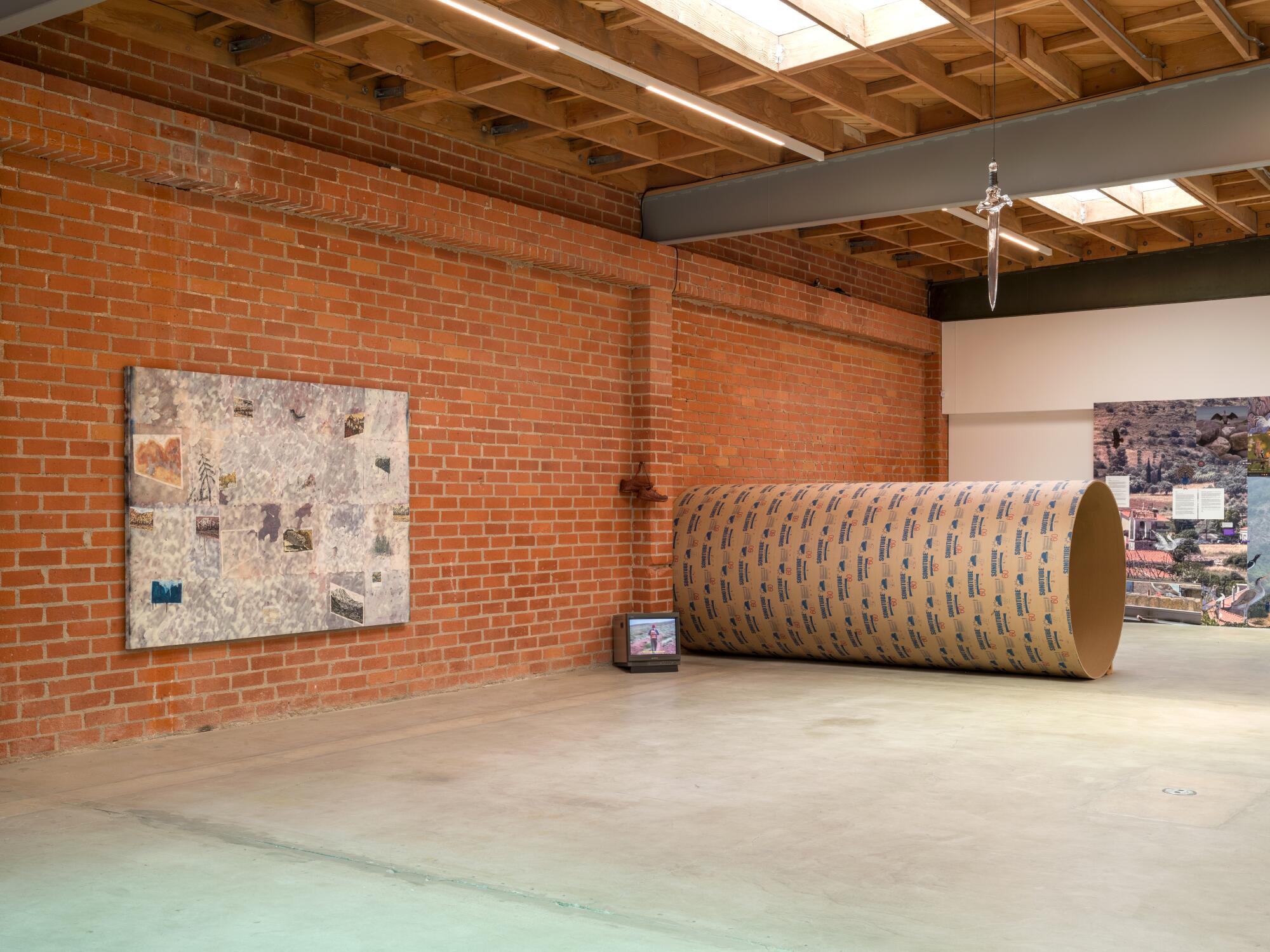
Sina Ghadaksaz and John Ziqiang Wu, “What the Clouds Remember and the Mountains Forget,” 2026; Carmen Argote, “Aram’s sneakers: Mount Eynali,” August 6, 8–1030p.m., 2026; Mohammadreza Jahanshir, “Glory / 50904020,” 2026; Maryam Lashkari, Hodjat Salimi, and Oscar Tuazon, “Can You S…?,” 2026; Kelly Akashi and Mimi Amini with David Gutierrez, Matt Rademacher and Kazuki Takizawa, “The Anatomy of a Postponed Intent: The Glass Blade,” 2026; Fatemeh Kazemi and Olivia Mole, “The Conference of the Birds,” 2026, can be seen in the exhibition “To Share a Stomach,” at the Brick in Los Angeles.

(Ruben Diaz 2026)

None of the works address the recent bombardments directly, although the precarious context of ongoing threat, instability and struggle can be felt in almost all of them. Ducking into Maryam Lashkari, Hodjat Salimi and Oscar Tuazon’s interactive sculpture — an enormous cardboard tube lying on its side — feels like entering a culvert or a bomb shelter. Inside, one lies on a crude bed of felt blankets and dons a set of headphones; the sounds of jet planes, a party, conversations and emergency sirens are interspersed with an imperious voice reading a guided meditation on how to be present in one’s body during a bombing. The harsh realities of war are woven into the textures of everyday life, warping and fraying into something absurd. Viewers may scan a QR code for their own copy of the audio track, which deteriorates in sound quality with every download.

Slow disintegration also appears in a triptych of videos by Ismail Ghanbari (facilitated by Tala Madani but not credited as a collaboration). In the largest central one, we see Ghanbari holding two nearly destroyed boxing gloves as he explains how he trained so intensely for a performance in which he boxed for five hours that the gloves began to fall apart. Their tattered remnants, barely held together with patches and stitching, are poignant metaphors for a battered will that keeps fighting even as protections wear thin.

Vulnerability and violence also co-exist in Mimi Amini and Kelly Akashi’s collaboration: a sword made of clear glass. Hanging from the rafters, the tip of its blade points down ominously over viewers’ heads, emphasizing both the danger of the weapon and its fragility. If it fell, would it pierce one’s skull or shatter into bits? It exists suspended between latent violence and the risk of its own annihilation.

A gallery show in Los Angeles.

Fatemeh Kazemi and Olivia Mole, “The Conference of the Birds,” 2026; Fatemeh Kazemi, “What the Birds Did Not Tell Upon Their Return,” 2026, in the exhibit, “To Share a Stomach,” at the Brick in Los Angeles.

(Ruben Diaz 2026)

These impressions are responses to the works as they exist in the gallery, but the show has another layer, revealed in an accompanying booklet that reproduces the initial emails or texts from the Iranian artists to the curator. Interwoven with stories of life during wartime are proposals or instructions, allowing viewers to assess for themselves how much the works in the gallery reflect the artists’ original ideas. For example, the tube-bunker was initially envisioned as a “completely dark space” twinkling with a variety of malfunctioning countdown clocks. Ghanbari’s video appears in lieu of the gloves themselves, and Amini’s original digital rendering of the glass sword is much more detailed and intricate than the comparatively “low-res” version on view.

If we think of an artwork as an intentional, carefully wrought creation that comes directly from an artist, what are we to make of these incomplete, unfaithful interpretations? I was reminded of the reality TV show “Nailed It!,” in which amateur bakers fail spectacularly to reproduce complex cakes. I cackle at the distance between perfection and utter collapse, but I also feel a pang of tenderness: I am moved by their effort.

Artists, of course, are no strangers to things not going to plan. While the exhibit is enabled by the entwined ubiquity of the English language and the internet, the artists know these technologies aren’t transparent. Most of the Iranian artists left their instructions generously open-ended, inviting the interpretations and transmutations of their U.S. peers. In some cases, it seems the partners did not continue the conversation; whether due to disagreement, bombardment or government-imposed internet blackouts (described to chilling effect in an essay by Negar Karimkhani) is unclear. The U.S. artists were constrained by a very compressed timeline (and presumably budget and space) to fabricate and display the works. Even without these limitations, to hand over one’s vision to someone else, and conversely, to shoulder the responsibility for realizing it are both touching acts of trust.

A gallery show in Los Angeles.

Ali Ansari and Renée Petropoulos, “Between Entries”, 2026; Salman Khoshroo and Daid Roy, “Defensive Wall,” 2026; Ismail Ghanbari, “Proxy (Neyabati) 1,” “Proxy (Neyabati) 2,” “Proxy (Neyabati) 3,” 2026, on view as part of the exhibition, “To Share a Stomach,” at the Brick in Los Angeles.

(Ruben Diaz 2026)

Viewers must exert themselves a little too. Understanding who is responsible for what work and to what degree requires consulting a floor plan, a checklist and the booklet: an awkward juggling act that would have been eased by some wall labels. Still, as I shuffled papers, I became part of the buffering, incomplete chain of communication. As Amini wrote of the glass blade, “the perfection of this form is preserved only with the mental space shared between the conceptualizing artist and the interpreting artist.” I venture to add the viewer to that space, thinking of Yoko Ono’s instruction artworks (across town at the Broad) which short-circuit any physical acts of making to take shape only in our minds.

This kind of intimacy — thinking, envisioning, constructing together — is rare when it comes to American intersections with Iran. I was previously unfamiliar with the Iranian artists in the show, and I’m sure I missed many cultural and linguistic references in their works. My focus on pieces evoking violence predictably reflects my limited knowledge of Iran as other than a locus of U.S. antagonism (the result of a different information blackout).

Yet, “To Share a Stomach” lays down — gingerly, gently — an alternate connective thread, spun from a mutual recognition of fallibility. In his introductory essay, curator Moshayedi reveals that the show’s title is his mistranslation of the Farsi word for “empathy.” (The correct translation is “to share a heart.”) He goes on to confess that after many years’ study, he finally gave up on learning the language. We will never understand each other perfectly; I am still moved by the effort.

Source link