
cocreator

Justin Halpern interview: ‘Abbott Elementary’ co-creator talks new novel ‘Get Lost’

p]:text-cms-story-body-color-text”>

Justin Halpern had a best-selling nonfiction book, co-created “Harley Quinn,” is co-showrunner for “Abbott Elementary” and has recently published his first novel, “Get Lost.”

But today he wants to mostly talk baseball. He recalls rooting for the Mets as a child in San Diego because he was so enamored with Dwight Gooden’s “electric” fastball and his disappearing curve. He spills about the big game he blew as a tween when a simple throw to first went horribly awry, about the two no-hitters he threw at Point Loma High School, how his dreams of stardom went south while at San Diego State, about feeling bitter toward the game and then rediscovering his love for it.

This wasn’t just idle chatter. Baseball is integral to Halpern’s own character arc and to “Get Lost” both on the page and behind the scenes. Take that terrible error when Halpern was 12. Afterward, his father didn’t console him with platitudes. He told the boy to dismiss the “it’s just a game” pity from his coach and accept that for Justin it was a big deal and it made sense to feel awful, but that also meant he had something he felt passionate about.

On the Shelf

Get Lost

By Justin Halpern
Cardinal: 256 pages, $29

If you buy books linked on our site, The Times may earn a commission from Bookshop.org, whose fees support independent bookstores.

That paternal talk helped less in the moment than down the road: Halpern’s struggling writing career exploded when he started tweeting his dad’s life advice and then, with his writing partner, Patrick Schumacker, turned those “S—My Dad Says” tweets into a best-selling book. (He’s acutely aware of how lucky he got but also says he and Schumacker were well prepared to capitalize on that opportunity.)

And that particular story, Halpern says, was “foundational” for “Get Lost.” The novel follows Lila Dixon, an acerbic, cynical baseball scout living a dreary and closed-off life in her 30s. When her mentally ill mother goes missing, yet again, Lila must return to the hometown she loathed to search for her, but this time she must also deal with her estranged father, John “Dix” Dixon. Dix was a baseball prodigy too cocky and flashy for his own good who now coasts through life on his long-ago heroics coupled with charm and an undeserved diet of luck.

Halpern’s father’s message resonated for this novel because Lila, who was neglected, abandoned and ultimately shuttled off to foster care as a kid, “has been wandering the planet without finding anything she gives a damn about. Now she needs to find something.”

Halpern quit baseball in college after an injury and the realization that he’d never make the majors. “Aside from talent, you have to be willing to do all these tiny little boring things every single day,” he says. “You have to be obsessive. I worked hard but I wasn’t willing to do that.”

The team’s assistant coach told Halpern it was the biggest mistake of his life and he’d “never make a penny writing” but writing was the one thing where he was willing to tackle the tiny little boring things needed to keep improving.

The adaptation of “S— My Dad Says” for television failed but he felt he improved with each successive show. He also didn’t give up when his first two attempts at novels were “terrible” with “nothing salvageable” in either attempt.

He learned to stop imitating his favorite writers. “I was trying to copy authors more skilled than I was and wasn’t taking the time to find my own voice.” And he strived to break the habits of writing for TV (although he’s quick to acknowledge that “Get Lost” remains dialogue heavy), including working alone. A perpetual collaborator who describes himself as “codependent,” going solo “was a huge challenge that almost shut down the novel a couple of times.”

He contemplated calling friends to run ideas by them when he got stuck but ultimately resisted. “If I didn’t figure out how to solve things myself I was never going to finish this novel anyway,” he says, adding with a laugh, “I’m definitely still codependent, but the novel forced me to venture into waters that I never would have gotten into on my own.”

The deepest of those waters came from learning he does not like exploring his emotions. “My wife probably learned this many years ago,” he says wryly. “Every time I need to sit in a feeling, I try to wiggle my way out of it and that’s probably really annoying for the people in my life. To make “Get Lost” work, he had to burrow into the “complex emotional stew” of Lila’s multiple traumas and make her journey feel earned. Each morning he’d take “epic walks” with his dog. “I’d just talk in the voice of the characters in my head, without it having anything to do with the plot.”

Creating Lila’s flippant father came easily, which is why Halpern refused to settle on Dix as the main character. He didn’t want to make Dix loathsome, but he also didn’t want to glamorize his behavior, thinking back to how he felt “The Wolf of Wall Street” made the sleazy finance bros seem too cool to many in the audience.

Writing a female protagonist, especially one who had so many reasons to be guarded, he didn’t want her to be too likable or to be sexualized or to have solutions come easily. “I didn’t want Lila to need to lower expectations of her father and just love the man for who he is but to realize the limitations of this man and not let that affect how she feels about herself.”

It’s easy to read “Get Lost” hearing Aubrey Plaza in Lila’s sardonic tone, and Halpern heard her voice, and others, while writing but kept reminding himself that he’d have no talented actress to add humanity to his dialogue.

“I knew there’d be no Aubrey Plaza here to save my ass,” he says, although he and Schumacker are now planning a movie adaptation. “I had to figure out how to create this complicated character myself,” Halpern tells me via video from the writers room in L.A. for “I Suck At Girls,” an upcoming Netflix series loosely based off another of his nonfiction books. Schumacker came in and dryly praised “Get Lost” by saying: “Justin knows words that I didn’t think he knew.”

Halpern is more self-aware than he lets on as becomes clear when analyzing his baseball journey — when he quit he admits he felt resentful. “I’d given so much time to the game and it owed me something, but hadn’t given me what I’d asked,” he reflects.

Several years later, he realized he needed to embrace the game for what it offered, not what he wanted. He started playing in adult leagues and became so invested that in his mid-30s, when a surgeon told him he’d torn his labrum, he said, “Is my career over?”

The surgeon asked, “Aren’t you a writer?”

Halpern recovered and, when he’s not joyfully coaching his kids’ Little League team, he’s still heading for the mound at age 45, thrilled with the challenges of outsmarting hitters and reveling in the social aspect of being on a team. “Even with a bunch of older people, there’s just something about sports that still really takes me to a higher place,” he says. “I’ve had a super blessed writing career, but the highest highs I’ve ever had are on a baseball field.”

Miller is a freelance writer in Brooklyn, N.Y., who frequently writes about movies.
Source link

Larry David’s U.S. history show is like ‘Curb’ in costume, co-creator says

How well do you remember your U.S. history class from high school or college? Did some of the key moments in America’s 250 years of existence involve Larry David playing a founding father? OK, maybe not, but it’s fun to imagine what that would be like. And that’s precisely what David and Jeff Schaffer have done with their new HBO series “Life, Larry and the Pursuit of Unhappiness.”

The series, premiering Friday, is a timely look at some of America’s big moments in history with a comedic twist that will remind viewers of “Curb Your Enthusiasm,” partly because it also features some cast members from the show. The series arrives on the cusp of the 250th anniversary of America’s founding, and offers an alternative history that’s still steeped in facts. Schaffer stopped by Guest Spot to talk about creating the series with David and what it was like to work with former President Obama.

Speaking of laughter, if you like yours with a whole lot of drama, FX dropped the final season of “The Bear” Thursday on Hulu. The series, which premiered in 2022 and made phrases like “cousin,” “yes, chef,” and “every second counts” memorable, ties up a lot of strings for its crew of chefs. Jeremy Allen White and Ayo Edebiri, the actors who were at the center of the show for five seasons, spoke to us about “The Bear” coming to a close, where their characters end up and what it feels like to leave them behind (be forewarned, the interview has lots of spoilers).

The finale feels like a fitting end to one of the best shows of the past decade (so far) — but we won’t say much more. Enjoy each episode like a multi-course meal at a fine-dining restaurant. You’ll want to savor each bite before it’s over.

You are reading Screen Gab newsletter

Sign up to get recommendations for the TV shows and streaming movies you can’t miss, plus exclusive interviews with the talent behind your favorite titles, in your inbox every Friday

Also in this week’s Screen Gab, our writers recommend an animated series with monsters and mystery and a documentary about one of America’s greatest bands. I’ll get my flags, fireworks and BBQ supplies ready in the meantime. — Maira Garcia

Turn on

Recommendations from the film and TV experts at The Times

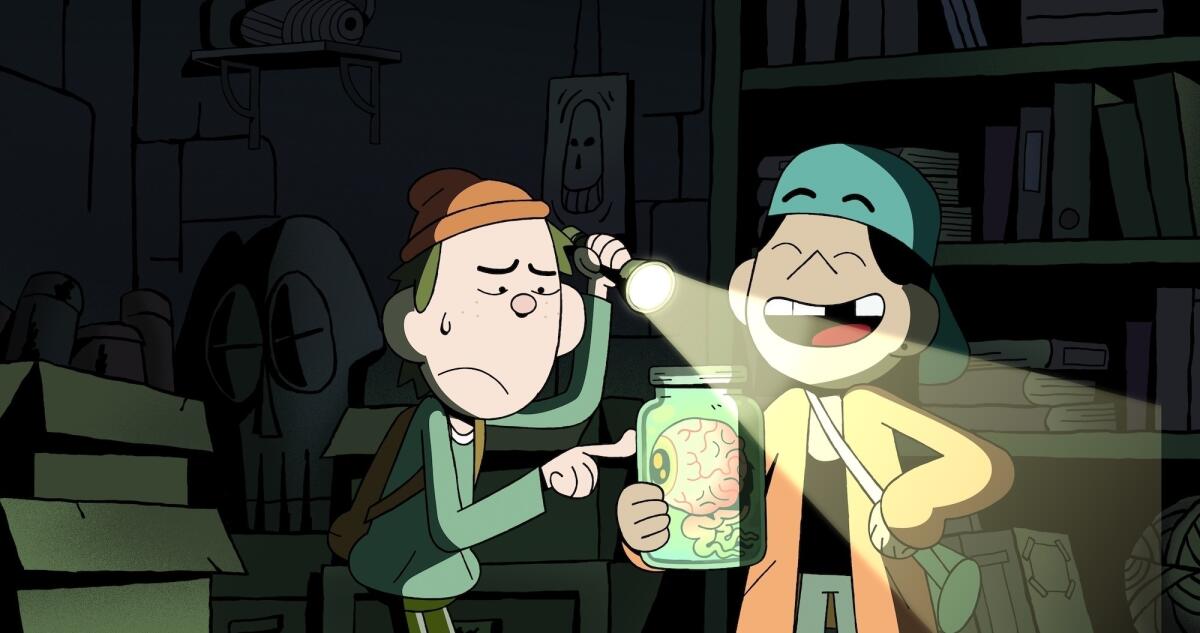
Two cartoon boys stand in a dark room as one holds a flashlight at a jar with an eyeball that the other is holding.

Bobby and Romy in Disney+’s “The Doomies.”

(Disney)

“The Doomies” (Disney+)

If you’re missing “Widow’s Bay,” and like cartoons, here’s another tale of monsters loose in a coastal tourist town, with the difference that the town, called “Ouimpre,” is decidedly on the Atlantic coast of northwest France. (It’s a Franglais pun.) There are half-timbered buildings; what used to be a Camembert factory after it was a beret factory; a cafe that serves crepes, not pancakes; and boulangeries, not bakeries. (It’s a French production; Disney encouraged animator Andrés Fernandez to go local.) As in “Stranger Things,” which no one may be missing by now, the protagonists are kids — Romy, who is excitable and impulsive, and Bobby, who is neither — abetted by a formidable female teenage demon slayer and a lighthouse keeper with occult knowledge. The series is energetic, funny and character-driven — even the monsters. The action is well-staged and intense, the color palette moody and evocative, and the design not at all reminiscent of a hundred other cartoons, which makes the show refreshing as well as fun. — Robert Lloyd

Earth, Wind & Fire in HBO's "Earth, Wind & Fire (To Be Celestial vs. That's The Weight Of The World)"

Earth, Wind & Fire in HBO’s “Earth, Wind & Fire (To Be Celestial vs. That’s The Weight Of The World)”

(Jeffrey Mayer / HBO)

“Earth, Wind & Fire (To Be Celestial vs. That’s the Weight of the World)” (HBO Max)

Even if you think you don’t know Earth, Wind & Fire, chances are they’ve soundtracked a wedding, bar mitzvah, awkward office party or some other memorable celebration in your life. Somewhere between “Shining Star,” “Let’s Groove” and “September,” the band mastered the art of coaxing three or four generations of a family onto the same dance floor. Questlove’s new documentary explores how that happened. If his recent Sly Stone film examined how genius can curdle into self-destruction, this one asks a different question: How did Earth, Wind & Fire founder Maurice White build something that lasted? Abandoned by his mother as a child, White set out to create not just a band but a family, assembling a sprawling ensemble around a musical and spiritual vision. Questlove is too thoughtful a filmmaker to sand down the rough edges. White emerges as both inspiring and flawed: a gifted bandleader, spiritual seeker and demanding perfectionist whose drive sometimes came at a personal cost. Drawing on interviews with everyone from former bandmates to Stevie Wonder, Lionel Richie and Barack and Michelle Obama, Questlove builds a portrait of White that never shies away from his contradictions. In the process, he shows how White’s fascination with spirituality, Egyptology and the cosmic unknown shaped both the band’s music and mythology. You may occasionally wish the film lingered longer on the performances themselves (for a reminder of what made Earth, Wind & Fire such a formidable live act, start with the 1975 concert album “Gratitude”). But by the end, you have a deeper appreciation for the band’s unlikely feat: turning something so eccentric into something so universal. — Josh Rottenberg

Guest spot

A weekly chat with actors, writers, directors and more about what they’re working on — and what they’re watching

A man in a hat and dirty blue vest sits outdoors with a gold pan in his hand as he gestures with the other.

Larry David in “Life, Larry and the Pursuit of Unhappiness.”

(John Johnson / HBO)

Is Larry David about to be the most entertaining (and crankiest) history teacher America has ever had?

To celebrate the arrival of the nation’s semiquincentennial, the comedian teamed up with Barack and Michelle Obama’s Higher Ground Productions to revisit the truth of our history with some comedic chaos. The result is “Life, Larry and the Pursuit of Unhappiness,” a seven-episode sketch comedy series from the mind of David and his longtime “Curb Your Enthusiasm” collaborator Jeff Schaffer that pairs reenactments of seminal milestones from America’s past with David’s misanthropic humor — or, as its creators dub it, “‘Curb’ in costume.” Subtitled “An Almost History of America,” it features a star-studded roster of actors dressing up in period clothes alongside David, including “Curb’s” Jeff Garlin, J.B. Smoove and Susie Essman, as well as Bill Hader, Kathryn Hahn, Jon Hamm and Jerry Seinfeld. The first episode premieres Friday at 9 p.m. ET/PT on HBO and will stream on HBO Max.

Over a video call, Schaffer discussed the show’s genesis, former President Obama’s improv skills and the British TV series that has him entertained. — Yvonne Villarreal

Tell me about getting into business with the Obamas. Their production company approached Larry. How did it evolve into this?

Larry and President Obama know each other a little bit. They really enjoy each other’s company, or at least Larry enjoys needling Obama, and Obama really enjoys needling Larry. The moment that we all met together to have our first meeting, the first thing Obama does — I’ve never met the president [prior]— he starts just ragging on Larry’s golf game, and how he wears so much sunscreen on the golf course. And Larry just goes to President Obama, “Oh, I’m sorry, my dad’s not from Kenya.” And that’s how it started. They have a great rapport and they wanted to do something special for the 250th [anniversary]. Larry says no to everything — his best friend can be having a premiere of a movie, and Larry will go, “Where is it in Hollywood?” But Larry’s not going, that’s too far. When this came around, Larry was like, “Huh, that’s actually pretty interesting.” He responded right away to the historical nature of it because, as he would say, he’s an American history buff.

The genesis for Larry and I is that we had done a tiny test run of this with that FTX ad for the Super Bowl a few years back. I don’t know, whatever happened to those people — I’m sure they’re fine — but he remembered how much fun he had being in costume. And honestly, I think he forgot how much he hated being in a wig. It’s like childbirth, enough time had passed.

Given the sort of tenor of the times, why does this type of comedic look at America’s history feel like the appropriate way to mark this anniversary?

It’s the 250th and I get that celebrating the country right now may feel like throwing a birthday party for your friend who’s in rehab — he’s all f— up — but we still love him, right? There’s a way to look at the country’s history, warts and all, the two steps forward and the one step back. And I think one of the best ways to do that is through comedy.

Going back to President Obama — what are the negotiations to get him to appear in it? Or was that on the table from the beginning?

Once I saw the two of them interact together, that became my primary mission. We’ll write the sketches, and we’ll do the documentary stuff, we’ll make it all historical and fun, whatever, but we have to get you two on screen together. It was also sort of the promise of the show, too. When I originally talked to Amy Gravitt at HBO about it, I remember I said, “What if I could give you a show that brought together two people half of America loves?”

What was it like directing them in a scene together? He gives the opening remarks at the start of the show.

He is a truly inspiring, amazing human being who also happens to have great comedic timing. He and Larry get into a groove immediately, which is very fun, and it was honestly one of the coolest things I’ve ever done in my life, directing them. The president said, “I guess I like being annoyed by Larry. Once we get together, I start sounding like him.” It’s like Larry’s this black hole of negativity that sucked Obama in for these brief periods of time; it was just fun.

Is he good at improv then on the spot like that?

Yes, he is. He’s got some really funny stuff in the sketch they’re in together that is all him — 100% the president.

Do you have a favorite moment from this first episode — it features the Declaration of Independence, segregation and Rosa Parks.

There’s different things in each of them. The thing that I’m most excited about is when you don’t know what the next one’s going to be, and then when the narration for the little documentary section starts, and it starts talking about Rosa Parks, I can just see [viewers] going, “Oh no …” That’s a great “Curb” feeling. It’s a comedy horror film — “Oh no, don’t do that, oh no.” Then you get sucked in.

We tried really hard to make sure that production-wise, there’s historical accuracy, so it really felt like you were in this moment. Then Larry gets dropped in, and all hell breaks loose. Same thing with World War I — I got to shoot a whole bunch of World War I fighting — and there’s Larry pretending to be dead. One of the things that attracted us to it in the very beginning was the idea of the juxtaposition between these big dramatic moments and then Larry. History is writ large, and Larry writes so small and that dynamic is fun for us.

One of the great things about a show like this — or what’s come before, like “Drunk History” — are the lessons that can be learned. Is there something you learned while filming this series or a takeaway you had in looking back at our history?

There are things I did not know. One of the things that was also enjoyable is being able to talk about modern things in a historical context, even with that phone. We don’t write dialog — we write some, but it’s basically like doing “Curb.” Larry knew that people were going to ask some questions about the phone, but I just was peppering these people with questions about all of the modern stuff, and just watching Larry get angrier and angrier at these people. At a certain point, the membrane of actor, of character to real human being was breached. He was so mad at them, but that’s what making the show is. Actually, at the end of the our shoot, President Obama said to me, “I see how it works. Larry makes the world uncomfortable, and you make sure the world makes Larry uncomfortable.” That’s literally how we make the show.

Would this format work for current historical events? How do you think, 250 years from now, a reboot of this show would tackle something like telling the story of the UFC fight on the White House lawn?

That’s the problem — we’ve entered an era of America parodying itself. It’s insane. One of my good friends, Dave Mandel, used to do a “Veep” and he’s like, “What do you do now?” I think what we tried to do, and you’ll see as you go further into episodes, we try to address a lot of things that are happening right now through a historical lens. So we might be back in colonial times, and we might be back in the ‘50s, but we’re actually talking about something that’s happening right now.

Before I let you go, what is the TV show or movie out right now that you’re telling everyone to watch?

I just started watching “Steve and Alice” [Hulu, Disney+]. It’s so well done; it’s so dark and funny and really engaging.

What’s the comfort show or movie you return to again and again?

I can pretty much put on any “Lord of the Rings” [HBO Max] movie anywhere and not be able to get my butt off the seat.

ICYMI

Must-read stories you might have missed

Source link