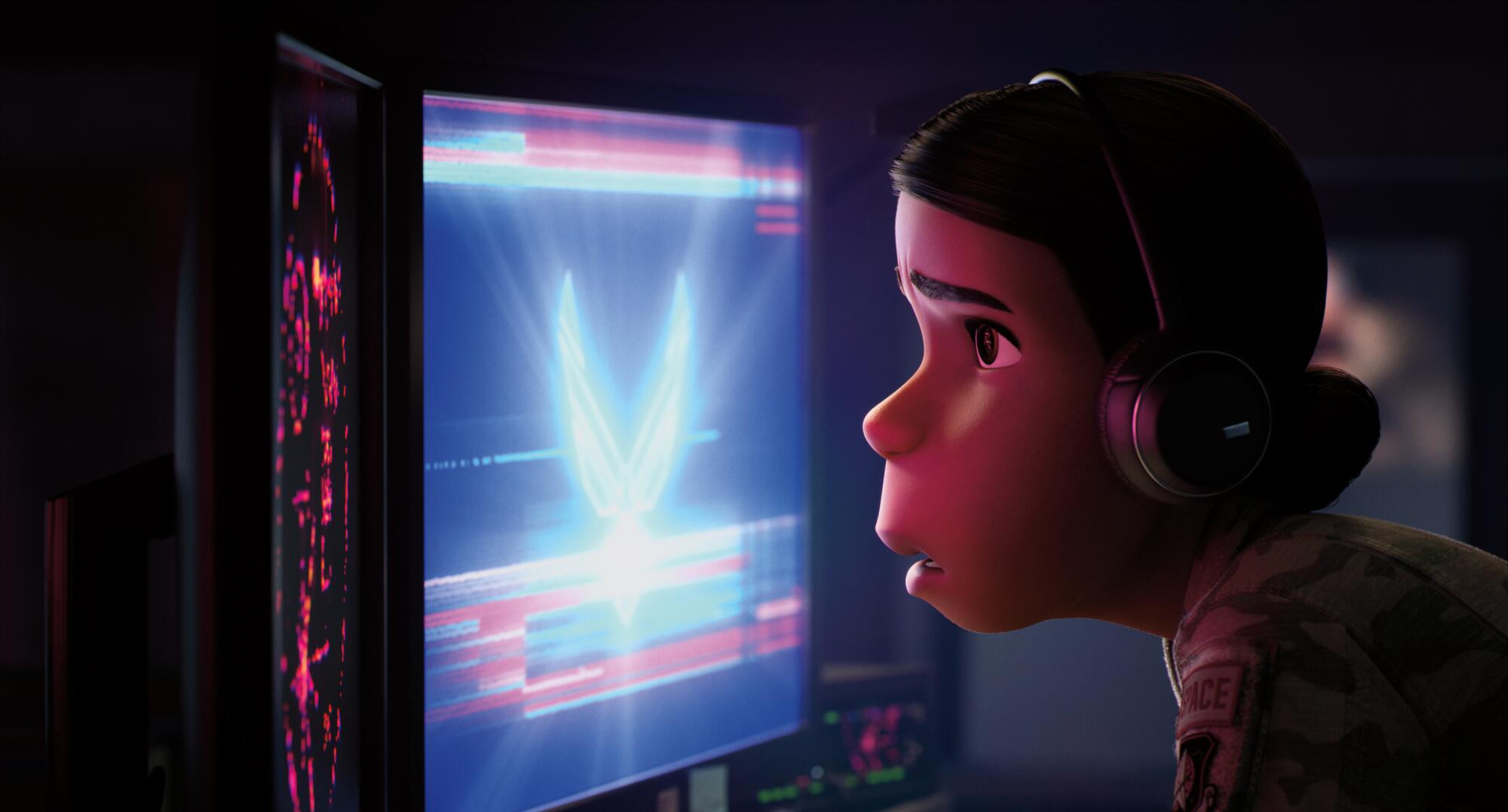
How the look of ‘Elio’ changed during its journey to the screen
Inside its sci-fi trappings — space travel, crazy technology, oodles of extraterrestrials — Pixar’s “Elio” is the story of an outsider kid who finds a new family. That’s true of the protagonist, a lonely boy who longs to leave Earth, and of the film itself.
“Elio’s” original mission was launched by Adrian Molina, co-writer of “Coco,” who worked on writing and directing the project for a couple of years before departing, officially to devote himself to “Coco 2.” Molina was replaced in “Elio’s” director’s chair(s) by Domee Shi, who helmed “Turning Red” and won an Oscar for her short “Bao,” and Madeline Sharafian, a story artist on “Coco” and story lead on “Turning Red.”
“The basic premise from Adrian’s beginning, five years ago, has stayed the same,” says Sharafian: “A lonely, weird little boy gets abducted by aliens and is mistaken for the leader of Earth. The biggest change we made, and everything rippled from there, was that Elio always wanted to be abducted by aliens, to find a place where he belongs.”
Shi says, “Both of us were weirdo kids in our respective hometowns who dreamed of not being the only one. I was one of the only kids in my school that liked anime. When I finally got into animation school, I was like, ‘I found my people, and I didn’t realize how much I wanted this.’ ”
One tectonic shift under Shi and Sharafian came from screenwriter Julia Cho, who co-wrote “Turning Red” with Shi: Instead of Olga (voiced by Zoe Saldaña) being Elio’s mom, she would be his aunt. Elio (voiced by Yonas Kibreab) would lose both parents before the film. That reconfigured his alienation, so to speak. A harsh confrontation between mother and child usually rests on the foundation that they already know and love each other. For an orphaned boy and his guardian aunt, that closeness must be earned.
“That love isn’t a given,” says Sharafian. “There was no assumption it would be there. So when it is, it’s all the more moving.”


“Elio” directors Domee Shi and Madeline Sharafian’s shared “visual language” reshaped the film after they took on the project from its initial director, Adrian Molina.
(Pixar Animation Studios)
Amid the changes, Shi and Sharafian say the working relationship they established on “Turning Red” was invaluable.
Shi says, “Though we have different backgrounds, we grew up watching a lot of the same movies. Both of us love Miyazaki films, we love ‘Sailor Moon,’ we love Disney, Pixar.”
Sharafian adds, “We speak the same visual language. There would be many moments when it was time to come up with a new shot and we both drew the same thing.”
In its 28 previous features, Pixar had dabbled in sci-fi, but “Elio” is immersed in it, with just a soupçon of … horror?
“We’re huge fans of sci-fi horror,” says Shi, “and we wanted to use those moments with Elio’s clone and Olga to have fun, to playfully scare some kids — and some adults too.”
That “clone” is a dead ringer for the protagonist, but it emerged from space goo and formed into an eerily cheerful version of the boy, like something from “Invasion of the Body Snatchers” or “The Stepford Wives,” but nice.
“The movies that impacted me the most as a kid, a lot of them did scare me, but they rewarded me as well,” says Shi. “Our film has this Spielberg-y, comfortable, nostalgic, family sci-fi vibe. So when the audience is at their most comfortable, that’s the perfect opportunity to give ’em a little spook.” Both directors cackle.
Sharafian adds, “ ‘Close Encounters’ is so scary, but in an amazing, tense way, and the musical [phrase] the aliens sent, I was so haunted by that. When we had the universe reach out to Elio, we were like, ‘How do we capture that same feeling — we want to know more, but we’re unsure of their intentions?’ ”
Beyond Steven Spielberg’s “Close Encounters of the Third Kind” and “E.T.,” the shared influences of the sci-fi horror of “The Thing” and “Alien” influenced their choice of a virtual anamorphic lens for their cinematography and aping the visual noise and atmospheric mist in those films.


Among the changes Shi and Sharafian made to “Elio” is its “epic” widescreen aspect ratio.
(Pixar Animation Studios)
Shi adds that they also changed the aspect ratio from 1.85 (standard widescreen) to 2.39:1 (anamorphic widescreen, an ultrawide look): “It helped shots of Elio on Earth feel more lonely, but also made space feel more epic.”
“To lay that on top of” Molina’s existing work, says Sharafian, “completely changed what the movie looked like.”
The directors agree that most of the film seamlessly blends their input, though Shi specialized in the horror and action sequences, while Sharafian leaned into the emotional scenes.
“A lot of Act 1 was you, Maddie,” says Shi, “where he’s feeling soulful and lonely. I love that. Yearning, watching the stars. I feel like that’s probably from your own childhood.”
Sharafian chuckles and says, “Yes, I was very lonely! My sister and I say we had ‘rich inner lives’ because we didn’t have a lot going on outside.”
It’s not “Up”-level gut-wrenching, but the scenes establishing the heartbroken boy’s lingering trauma hit pretty hard.
“I feel like it’s good to be sad,” says Sharafian. “At Pixar, we’re lucky; we get to stay in a childlike headspace for a really long time. I think we forget how deep children’s emotions are and how, when you’re young, you’re already thinking about very sad things and dark things. So I don’t think it’s too much.”