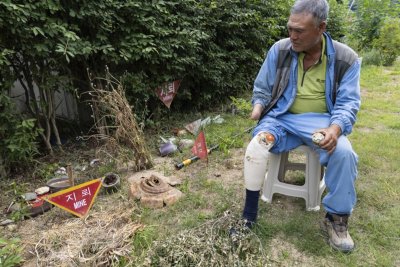
South Korean Lee Hyung-il (65), who lost his leg after stepping on a landmine while farming at age 24, looks on landmine signs on display during an interview in the border village of Haemaru-chon near the Demilitarised Zone (DMZ) in Paju, South Korea, 17 June 2026. Former South Korean soldier Kim Ki-ho has spent more than two decades working alone to remove millions of landmines left along the border since the Korean War (1950–53). Kim said he will continue the high-risk work for the rest of his life to help promote regional peace. Photo by JEON HEON-KYUN / EPA
June 26 (Asia Today) — South Korean defense experts, mine-clearance researchers and technology companies called for broader government, military and civilian cooperation to remove land mines and unexploded ordnance near the Demilitarized Zone, saying the weapons continue to threaten residents more than seven decades after the Korean War.
The Defense and Security Forum held its fourth roundtable Thursday at the Korea Mine Clearance Research Institute’s DMZ Peace Center in Haemaru Village in Paju, a restricted border area north of the Civilian Control Line.
The event, titled “Korean War DMZ Field Forum: Peace Grows When the Land Heals,” coincided with the 76th anniversary of the outbreak of the 1950-53 Korean War and South Korea’s month of remembrance for veterans.
Security specialists, field researchers, border residents and representatives of defense and information technology companies discussed mine removal, restoration of contaminated land and cooperation among government agencies, the military and private organizations.
The forum said areas contaminated by land mines, unexploded ordnance and other explosives in and near the DMZ and Civilian Control Zone are estimated to cover about 128 square kilometers, or 49 square miles.
It also cited estimates that about 2 million land mines remain buried across the Korean Peninsula’s heavily fortified border region.
The mines are not merely remnants of a past conflict, participants said. They continue to endanger people living in border communities and impede plans to preserve the DMZ as an internationally recognized area of peace and environmental conservation.
Residents in front-line communities face risks while farming, traveling and using land near suspected minefields.
Participants said previous mine-clearance accidents have also made local governments reluctant to pursue development, public infrastructure and community revitalization projects in some border regions, including areas around Cheorwon in Gangwon Province.
The discussion came after South Korea’s mine-action law took effect in February 2025.
The law establishes procedures for safely detecting and removing mines, unexploded ordnance, abandoned munitions and booby traps that are no longer considered militarily necessary.
It also allows qualified private corporations and organizations to conduct detection and removal work under government approval and safety requirements. The military previously handled most such operations.
Participants said cooperation with civilian specialists has become increasingly important as South Korea’s military faces declining troop numbers and difficulties retaining experienced mine-clearance personnel.
Baek Gun-ki, chairman of the Defense and Security Forum, said the country must remember the lessons of war while working toward a safer future.
“We must reflect on the tragic lessons of war and open the way toward a secure future for South Korea,” Baek said.
Seo Nam-yeol, president of the forum, moderated the discussion.
Kim Ki-ho, director of the Korea Mine Clearance Research Institute, presented an assessment of unconfirmed minefields and proposed directions for future clearance operations.
Forum director Kang Tae-jun outlined the South Korean Defense Ministry’s mine-action road map and discussed steps needed to expand cooperation between military and civilian organizations.
Representatives of South Korean defense and technology companies developing artificial intelligence-based detection systems and other advanced mine-clearance equipment also attended.
They discussed the technical limitations of equipment now used by the military and civilian organizations and agreed to pursue cooperation on developing and testing more advanced systems under field conditions.
Participants said mine action is evolving from a labor-intensive military task into a broader security and humanitarian undertaking that combines advanced technology, government policy and specialized civilian expertise.
Following the roundtable, participants visited a nearby area classified as an unconfirmed minefield.
The forum said the visit demonstrated that land mines are not solely a military issue but also affect public safety, land use, economic development and the daily lives of people in border communities.
“Land mines are like bullets lodged in the waist of the Korean Peninsula,” the forum said. “Only after those bullets are removed can vitality return to the peninsula and the lives of border residents fully recover.”
The group called on the central government, military, local governments and private mine-clearance organizations to develop a coordinated national response.
The forum said it plans to launch a nationwide campaign supporting mine clearance across the Korean Peninsula.
It also plans to strengthen South Korea’s mine-action capabilities and expand cooperation with international organizations and overseas specialists, including the United Nations Mine Action Service.
Organizers said South Korea could use its growing defense technology expertise to contribute to international humanitarian mine-clearance operations as well as domestic efforts.
A preliminary discussion featuring Kim and Seo was released online before the event. Video of the roundtable and field visit is expected to be published through the YouTube channel Cheongunmanma.
— Reported by Asia Today; translated by UPI
© Asia Today. Unauthorized reproduction or redistribution prohibited.
Original Korean report: https://www.asiatoday.co.kr/kn/view.php?key=20260626010009324