classics

Peabo Bryson dies: R&B singer known for Disney classics was 75

Peabo Bryson, a Grammy-winning R&B singer known for his duets from Disney classics “Aladdin” and “Beauty and the Beast,” has died. He was 75.

His family confirmed to The Times that he died Tuesday in Marietta, Ga. The cause was complications from a stroke he suffered over the weekend.

“We are tremendously moved by the outpouring of love, prayers and support from fans, friends, and colleagues around the world,” the family shared. “While our hearts are broken, we find comfort in knowing how deeply Peabo was loved and how many lives were touched by his voice and his generous spirit. His legacy and music will live on for generations to come.”

Bryson was a fixture on the R&B scene for decades, scoring with such hits as “Tonight I Celebrate My Love” and “If Ever You’re in My Arms Again.”

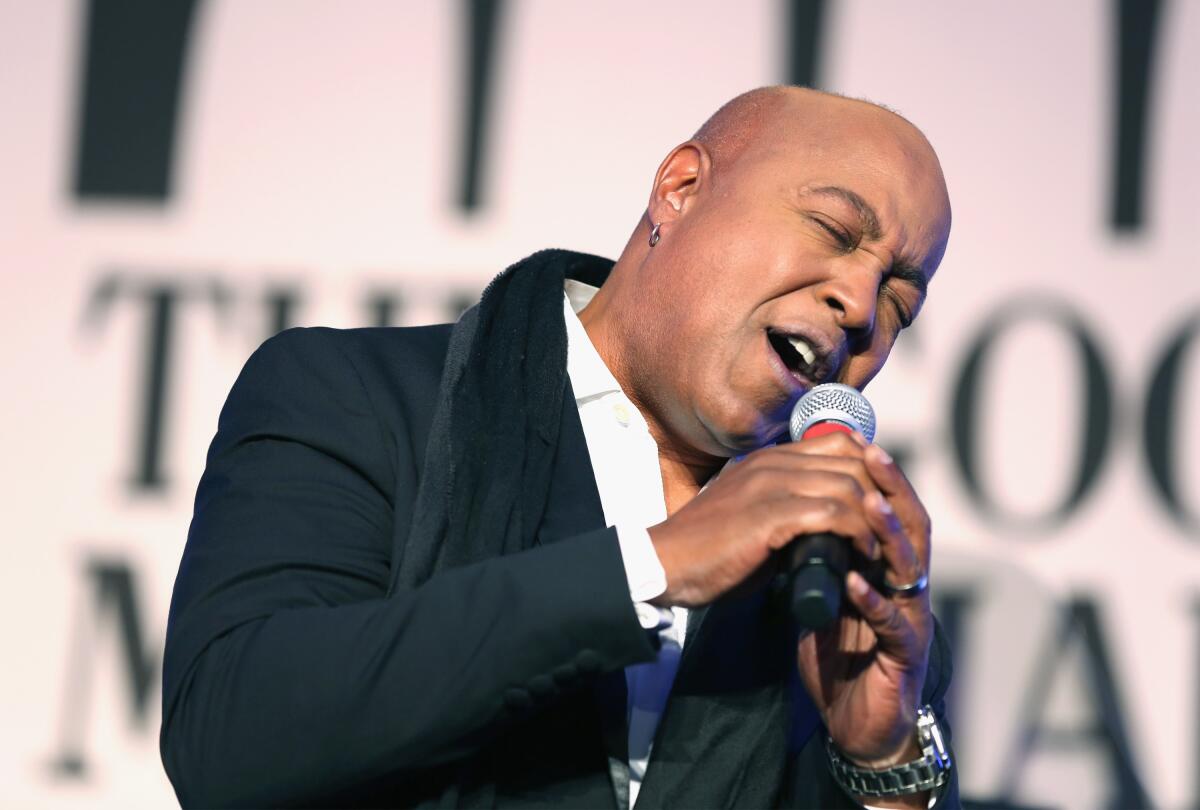
Peabo Bryson performs onstage during the Thurgood Marshall College Fund 28th Annual Awards Gala

Peabo Bryson, pictured performing in Washington, D.C., in 2016, won Grammy Awards in back-to-back years in 1993 and 1994.

(Teresa Kroeger / Getty Images)

In a career peak in 1992, the singer was featured on recordings that topped four separate charts: “A Whole New World,” a duet with Regina Belle from the Disney animated movie “Aladdin,” topped the Pop and Adult Contemporary charts; “The King and I” album, featuring Bryson, was No. 1 on the Classical Crossover charts, and Kenny G’s “Breathless” album, featuring Bryson on “By the Time the Night Is Over,” topped the Contemporary Jazz charts.

He nabbed two Grammy Awards back to back in 1993 and 1994 for his performance of “Beauty and the Beast” with Céline Dion, and his performance of “A Whole New World” with Regina Belle.

“I don’t think there’s anything I can’t do,” Bryson told The Times. “I see myself as a true Renaissance man. I don’t like one-dimensional concepts of myself.”

Robert Peapo Bryson was born on April 13, 1951, in Greenville, S.C. He grew up attending concerts his mother would bring the family to, and by the time he was in high school, he knew he wanted a career in music.

In 1978, he told David Nathan, an editor for Blues & Soul magazine, that his mother wasn’t thrilled about the prospect of him chasing his dreams in the rhythm-and-blues biz and worried he’d get into trouble.

“As far back as I can remember, I’ve always been into music,” Bryson said. “It’s all I ever wanted to really deal with. … I had to make that decision, when I was around 14, as to what I was going to get into, career-wise. Well, I’d thought about being a doctor or something like that, but I really felt that music was my thing.”

He cut his teeth as a backing vocalist in various groups, but none of his bandmates could properly pronounce “Peapo,” his French West Indian name, so he changed up the spelling to make it simpler. The stage name Peabo was born. In the late 1960s, he linked up with “My Elusive Dreams” hitmaker Moses Dillard. “I started out just singing, although I progressed into percussion, guitar and, much later, playing piano — that was basically when I started getting into songwriting,” he told Nathan.

In 1967, he signed his first record deal, with Bang Records, and in 1976, he made his solo debut with the single “Underground Music” and his eponymous album, “Peabo.” The next year, he hit it big time and signed with Capitol Records, where he put out back-to-back gold-selling albums: “Reaching for the Sky” in 1977 and “Crosswinds” in 1978.

Peabo Bryson performs during the Centennial Olympic Park's 4th of July Celebration at Centennial Olympic Park

Peabo Bryson performs at the Centennial Olympic Park’s Fourth of July Celebration in Atlanta.

(Robb D. Cohen / Invision / Associated Press)

By the ’90s, Bryson was at a career high, collected Grammy nominations and became the definitive voice of Disney duets. But the music scene was changing, and Bryson wasn’t keen on the new direction. He told The Times in 1994 that MTV had stopped considering talent as the criteria to be played on the music channel and that he thought mainstream music had taken a hostile and negative turn.

“I guess I [tick] people off because I don’t go away,” he said with a chuckle. “I’m like a tenacious forest fire — you snuff me out over here, and I’m still burning down the back 40 just when you think it’s over. I have a great faith in God, and because of my great faith in God, I have faith in the self.”

Fortunately for legions of fans of the soulful balladeer, Bryson was right and he wasn’t going anywhere for another couple of decades. The Grammy winner continued to grace stages with his flashy blazers and smooth baritone, and recently performed a concert with Jeffrey Osborne at Trilith Live in Fayetteville, Ga.

The event in early May was a standalone performance, apart from the crooner’s Golden Touch tour, which he announced last year, amid his celebration of 50 years in the music industry.

In recent years, Bryson said he had been hitting the gym and prioritizing his health after a scare seven years ago when the artist suffered a heart attack at his Georgia home. He told the Soul Train Cruise 2020 that he flat-lined for nearly 30 minutes, “long enough to make friends on the other side.”

“It turns out that dying is not that hard,” Bryson said. “Didn’t hurt that much. It’s the living afterwards that’s the really difficult part. I mean, why are you still here? You have to ask yourself those hard questions: Are you a good father? Are you a good husband? Are you a good friend? Are you a good brother? Are you a good human being?”

Bryson said he was able to answer yes.

“Then you have to ask yourself the question that makes the answer null and void — can you be better?”

Bryson is survived by his wife, Tanya Boniface Bryson; son Robert Bryson (who goes by Kit); daughter Linda Bryson; and three grandchildren.

Memorial arrangements will be announced at a later date.

Source link

Cannes: Sony Pictures Classics chiefs on AI, ‘Club Kid’ price tag, more

At this year’s festival to unveil our inaugural Cannes issue, I had to opportunity to sit down with Sony Pictures Classics co-founders and co-presidents Michael Barker and Tom Bernard and EVP of Acquisitions, Production and Business Affairs Dylan Leiner on the Main Stage at the Marché du Film to discuss the company’s festival strategy, bidding wars, artificial intelligence and more. Watch the full conversation and read edited excerpts below.

How much does the festival reception of a movie, the reviews coming out of a festival, the buzz around it, shape decisions that you’re making? Or is it just confirming what your gut already knows?

Leiner: I want to tell one story that speaks to that, which was at the first Berlin Film Festival we attended after COVID. I remember, in the same day, I ran into three international distributors who all asked if we had seen “The Teacher’s Lounge.” And I didn’t even know what the film was. It wasn’t on our radar, it wasn’t in competition. So we quickly saw “Teacher’s Lounge” and we acquired the film [which went on to be nominated for the 2024 international feature Oscar]. And that was one of the great values of an in-person festival, the ability very quickly to communicate with distributors, with tastemakers, with critics from around the world and get that kind of information. Gut, personal taste… It plays into it a lot, but then we need reassurance. And being at a festival and being in this fishbowl environment is really helpful for that.

For a lot of people, myself included, the mystique of a festival is often around the bidding war narratives: Who’s going to pick up what and what are they going to pay? I’m curious for your take on the first big acquisition of this year’s Cannes, A24 buying “Club Kid” for a reported $17 million.

Bernard: Throughout the years, there were companies [that would] maybe overpay, or they were going to bid to get this movie no matter what, because they were the headline in all the newspapers covering this festival. So in terms of a company that’s branding — which, A24 is one of the best in branding — I think that that had to do with a little bit of the cash that went up. … There’s a branding aspect in a lot of festivals for a movie that’s a hot movie that the press has decided to seize on.

Barker: Here’s a key to how we have survived. It’s different from the way you talk about it. When we acquire a movie, whether anyone else has offers, we try to block it out. And we have trained ourselves to not let that noise bother us. What is it worth to us? What do we think it’s going to do? Dylan runs these incredible models of what it’ll do on the low end, what it will do on the high end. And then you decide where you want to be.

Bernard: Or we think we can make it work.

Barker: But at no point do we sit around and worry about who else has a higher offer for the movie. Because I have to say, in very few instances, on the movies we buy, are we the higher offer. We just do the best we can, and if we lose it, we lose it.

Bernard: [French film producer] Serge Silberman, a sage of the past, he always said, “You never lose money on a movie you didn’t buy.”

That brings up a question that I had about “Nuremberg,” which was a real success. What you’re saying is, it performed in alignment with your expectations. Were there any lessons that you took away from that in terms of future projects that might come along?

Leiner: Yes, it performed in accordance with our expectations. What’s interesting about that film, we acquired it here last year. Nobody else was really interested in the movie. … So our challenge basically was to figure out how to convince the filmmaking team that, because it was a very expensive film, that we were the right company to acquire the film on the terms that we could afford and that we could make it work. And it was a very intense series of phone conversations, in-person meetings.

Bernard: We felt like we were auditioning to get married to somebody. We were never going to be able to pay to make their money back. It was a $40-million movie, and they were really sort of out there without anybody really looking at it. And we said, “Listen, sell it to us. We think it’s going to be a great success. We’ll make your movie way more valuable over the test of time.”

Barker: There are two types of movies that are being made and distributed. One are the big tentpole studio movies. It’s about winning the weekend theatrically. These are the theatrical-driven movies. And it’s all about making that huge budget back very quickly. But the other kind of film, which is why we are in business, is the evergreen. Every one of our films, we open it with the best marketing push we can. Yes, we try to get the highest box office. But what we know will happen, even if the box office ends up being less, we believe in these films as long-term players. And these films have really long tails. You look at movies like “Run Lola Run” or “Call Me By Your Name” or even “Living” … They have generated revenues to the filmmakers and to us that’s way beyond what the box office would have portended when it opened.

I would be curious, what areas of the filmmaking process or the film distribution process do you think AI is appropriate for use, that you’ve experimented with it, that you’re excited about its prospects? And where are your red lines, if you have any?

Barker: One of the people on our staff — we really love our young staff. One of them was writing a screenplay with AI, and told me they got certain rules on AI. And I’m listening to all these rules. You can’t have your main character die in a first scene. You can’t have your romantic female lead be totally unlikable, people aren’t going to go. I’m listening to this, and I said, “Have you ever seen ‘Sunset Boulevard?’” And she goes, “No, what is that?” I said, “Go watch that movie.” She came back and she was like, “Holy cow.” I said, “Billy Wilder sat down and made that up based on what he observed.” AI is not going to be able to do that.

Source link