Virtually all NFL players come via the US college system, and in many parts of America, college football is more popular than the NFL.
College games often have bigger crowds – eight of the world’s 10 biggest stadiums are for college football, all holding more than 100,000.
The fans are also more passionate as support is often passed down from one generation to another, and multiple generations attend the same school. Kansas player Calvin Clements, for example, is a fifth-generation Jayhawk.
Actor Paul Rudd is also a Jayhawk, while lifelong fan Jason Sudeikis grew up in Kansas and frequently weaves KU references into his work.
“They’re very spirited, and you get the tribalism, so it’s the closest thing we have to European football fanbases,” Dubiski told BBC Sport.
Both the NFL and college football have tailgate parties, where fans gather in the car park and eat and drink for hours before the game.
But college football fans chant during games, which feature marching bands and spirit squads – made up of cheerleaders, dancers and mascots.
“We want the game to showcase what we think is one of the greatest sports in America,” said Yormark.
“There’s something special about college football – the pageantry, the traditions, the fandom. It’s dynamic – there’s a lot of energy and passion. It truly is an experience.”
Young Brits are swapping traditional beach-day pastimes for paddleboards, surfing and a dip in the sea – but they still love one thing
15:25, 01 Sep 2026Updated 15:25, 01 Sep 2026
Gen Z beachgoers are doing things differently(Image: PinPep)
Gen Z is redefining the great British day at the seaside, replacing traditional favourites like arcade games and crazy golf with paddleboarding and surfing. A poll of 2,000 adults found 11% of Gen Z consider paddleboarding to be essential to the perfect day by the sea, compared to just 7% of Millennials and 3% of Boomers. They were also far more likely to take a dip, with 38% saying swimming in the sea is a beach day priority.
Classic seaside pastimes appear to be losing their appeal among younger adults as 74% would skip arcade games, and 87% would happily avoid a round of crazy golf.
But seaside traditions such as tucking into fish and chips, a picnic and coastal walks were still among the most treasured experiences across all those surveyed.
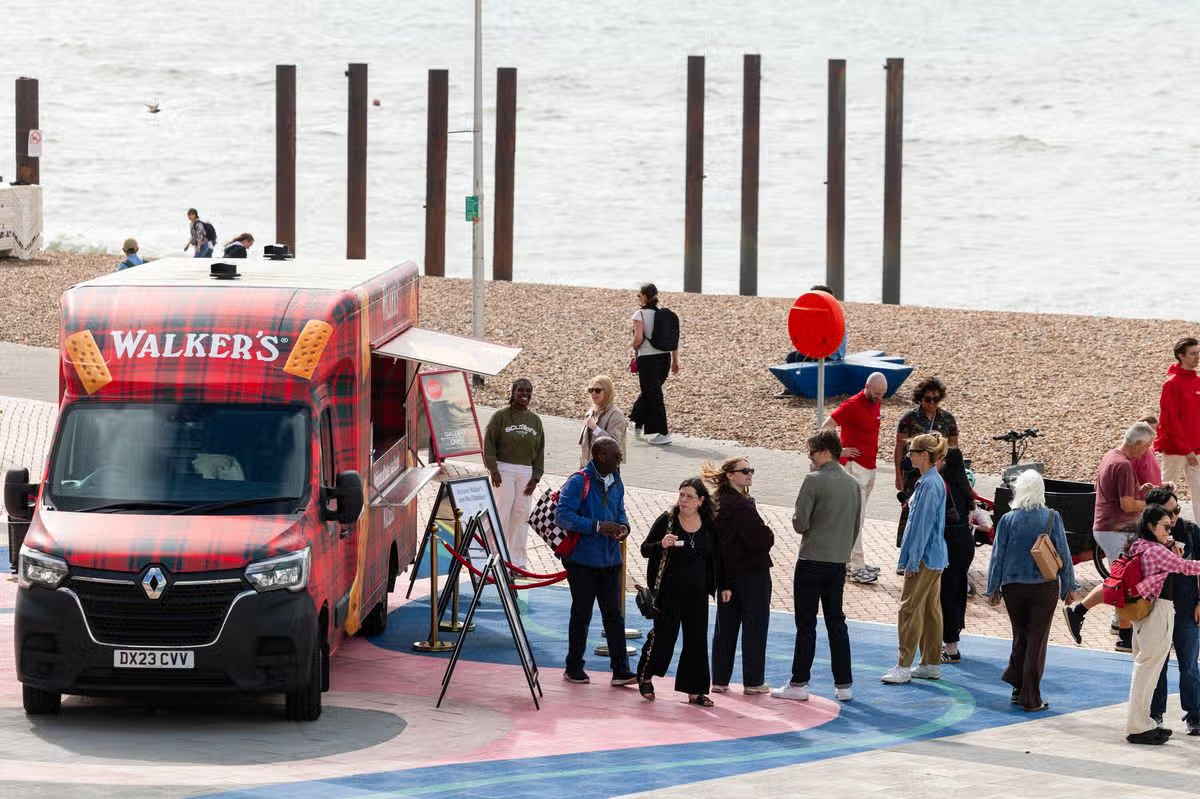
Bryony Walker from Walker’s Shortbread, which brought its newly launched Wee Chunkies bites to a seaside pop-up on Brighton beach, said: “While the research shows beachgoers still crave the classic seaside experiences, it’s interesting to see what now makes up the ideal day at the beach.
“Activities like paddleboarding are becoming more popular with younger generations, but what remains constant is a dip in the sea.
“The coast holds special appeal, combining nostalgia, quality family time and the simple joys of a well-packed picnic, fresh air and time outdoors.”
The study, conducted through OnePoll, revealed that 15 minutes is considered the perfect amount of time to spend in the water.
Following the dip, beachgoers enjoy wrapping themselves in a toasty towel (49%) or tucking into a warm sweet snack to restore energy levels (18%) – a tradition the Scots refer to as a ‘Shivery Bite’ – something only 9% of Brits are familiar with.
Due to the unfamiliarity with this Scottish phrase, Walker’s Shortbread decided to introduce the Shivery Bite concept to Bank Holiday beachgoers and swimmers along Brighton’s bustling seafront.
Bryony Walker added: “The insights have revealed the nation’s ideal beach day, with fresh sea air, sunshine, blue skies and that essential paddle in the water. “After a summer of intense heat, beachgoers are craving a moment of relief, whether it’s a colder coastal breeze or cosy comfort food.
“Few things beat wrapping up after a swim or enjoying a warm treat, something in Scotland we call a ‘Shivery Bite’, and our new shortbread offering is exactly for this moment, best served warm, to help make the most of the post-dip feeling.”
EVER watched a TV show or film and wished you could live in the characters’ worlds for a day?
Now, a growing number of iconic TV and film properties are opening their doors to fans to book to stay overnight.
Gavin and Stacey fans can stay in Uncle Bryn’s terrace house – with it being featured on AirbnbCredit: WNSUncle Bryn, played by Rob Brydon. filming on Trinity StreetCredit: WNS
Gavin and Stacey viewers, for example, can book the exact house that was home to Uncle Bryn (played by Rob Brydon) on Airbnb.
Based on the iconic Barry Island in Wales, it is decorated just as it was in Bryn’s ‘bachelor paradise’ during episode three of series three.
Sign up for the Travel newsletter
Thank you!
It can house six guests across two bedrooms, with two nights in September for three guests setting you back £455.
But it’s not the only filming location you can walk onto.
Here are 10 iconic TV and film sets around the world where you can spend the night…
De Vere House (Harry Potter and the Deathly Hallows – Part 1)
You can rent a room in what was used as Harry Potter’s childhood homeCredit: airbnbThe exposed brick and fire creates a very cosy atmosphere in the houseCredit: airbnbYou can separately book one of the two ensuite De Vere House roomsCredit: Warner BrosHarry and Hermione visit the house in the penultimate filmCredit: Alamy
While it may not be Hogwarts, you can also have a magical stay sleeping at Harry Potter’s birthplace and childhood home in Godric’s Hollow.
Located in medieval Lavenham, the Grade I-listed De Vere House was built in the 14th century and features four-poster beds and traditional stone fireplaces.
You can separately book one of the two ensuite rooms, which have access to a guest sitting room where you can toast marshmallows and crumpets over the fire.
The stay also includes a full English breakfast and fluffy robes – but sadly no flying broomsticks. You are required to book two nights minimum, which costs from £390.
Yew Tree Farm (Miss Potter)
Guests can stay at Yew Tree Farm in the English Lake District, which was once the home of Beatrix PotterCredit: GettyThe farm stared in the movie Miss Potter, with Renée ZellwegerCredit: handout
Experience a slice of history by booking the exact home owned by Beatrix Potter herself in the 1930s.
The Grade II-listed 17th-century Lake District property also doubled as Hill Top Farm in the 2006 Miss Potter movie starring Renée Zellweger and Ewan McGregor.
The three-bedroom holiday rental comfortably sleeps six and comes with dark oak beams, four-poster beds, and antique furniture that belonged to Beatrix Potter.
Guests can enjoy the surrounding fells, meet roaming Herdwick sheep, and relax in a private outdoor hot tub on the estate.
You can typically book the property out for around £750 per night.
The Spice Bus (Spice World)
You can rent out the iconic Spice Bus from the Spice World movieCredit: ATPPosh Spice at the helm of the bus in the Spice World movieCredit: Alamy
It’s not only bricks and mortar filming locations that you can book.
Spice Girls fans can have a night in the Union Jack-decorated Spice Bus, which featured in the 1997 pop movie Spice World.
Parked on the Isle of Wight, the original 1978 Bristol double-decker bus is now a cozy retreat that sleeps up to three people from £99 a night.
While it can be booked for nostalgic stays, it could also be the ideal party or hen do backdrop too.
Highclere Castle’s London Lodge (Downton Abbey)
Have a lavish time at Highclere Castle in Hampshire, which is the home of Downton AbbeyCredit: PA:Press AssociationWhile you can’t stay in the main house, you can stay in a lodge on the groundsCredit: Alamy
Downton Abbey fans can step into the world of the privileged family by checking into filming location Highclere Castle.
While you can’t sleep in Lord Grantham’s main bedroom, you can stay on the Crawley family’s estate at the restored London Lodge for from £350 a night.
During the day, guests can wander the estate’s rolling parklands and enjoy views of the main castle facade.
Porthpean House (About Time)
You can rent out Porthpean House, seen in the movie About Time, for holidays or even weddingsCredit: Facebook/The Big Beautiful Beach HouseThe Cornish property was the home of actors Domhnall Gleeson and Bill NighyCredit: Alamy
Nestled right above the coastal waters in St Austell, Cornwall, this 19th-century manor served as the beloved family home of Tim (Domhnall Gleeson) and his dad (Bill Nighy) in Richard Curtis’s About Time film.
Known off-screen as Porthpean House, the 12-bedroom property sleeps up to 21 guests and opens straight out onto rolling lawns that lead down to a secluded beach.
Guests can spend their time in the grand drawing room complete with a piano, play croquet on the grass, or potter barefoot down to the water just like the Lake family.
Not only is it available for private family rentals, but also weddings too.
Lostwithiel Manor (Poldark)
The ginormous property has been used for multiple shows including PoldarkCredit: Oliver’s TravelsThe manor gives off royal vibes with the enormous dining roomCredit: Oliver’s TravelsPoldark has been filmed on the grounds as have many other showsCredit: BBC
This wildcard rental is The Lostwithiel Manor Estate that sits deep in the Cornish countryside, four miles from Lostwithiel.
It’s a property perfect for a wedding, or special event due to its sprawling size.
Lostwithiel Manor that has been the filming location for so many shows from The Three Musketeers, My Cousin Rachel, Delicious starring Dawn French and of course, Poldark.
One guest said: “Fires and candles lit every morning. Flowers from the garden on the tables. Relaxed, attentive staff with a genuine love of the house and its history.”
The nine-bedroom property has a library, gallery, a drawing room with a working fireplace, and a beautiful garden room.
If you fancy getting married or having a party at a filming hot spot, head to Oliverstravels.
Bella Swan’s House (Twilight)
The actual house used as the home of Kristen Stewart’s character, Bella Swan, in the first Twilight movie is on AirbnbCredit: refer to captionThe house in the movie was set in Forks, Washington State, but the real house is located in a quiet neighbourhood in Oregon, and has cardboard cut-outs of the starsCredit: refer to caption
If you grew up watching Twilight, you will recall the iconic 1930s home used for the interior and exterior filming of Bella and Charlie Swan’s house.
Costing around $450 (£350) per night, the Oregon property has been kept as a homage to the 2008 hit film.
Movie memorabilia and photographs fill every room of the five-bedroom property, and you can even eat at the same dining table where Charlie and Bella shared their meals on screen.
Villanelle’s Art Nouveau Apartment (Killing Eve)
Stay in Villanelle’s grand apartment from Killing EveCredit: AirbnbThe beautiful dwelling in Barcelona was used by the glamorous assassinCredit: BBC
Many Killing Eve fans will recall the striking flat that assassin Villanelle stayed in during the third season of the show.
Located in Barcelona‘s trendy Gràcia district, it features lofty ceilings and stained-glass details.
Not only can you soak up the stunning architecture in the two bedroom flat, which is around £232 per night, but you also get access to a garden pool.
DEL MAR — Bill Mott was nearly 2,500 miles from Del Mar on Saturday night, but if you listened closely as the field raced down the backstretch in the $1 million Pacific Classic, you probably could hear the Hall of Fame trainer scream.
Thirty years ago, Mott brought Cigar to this same track for this same race, hoping his superstar horse would set the modern-day North American record for consecutive victories. But Cigar, at odds of 1-10, got caught up in a speed duel and wound up losing to a 39-1 long shot named Dare and Go.
Now it seemed like it might be happening again.
Knightsbridge went off at odds of 11-10 instead of Cigar’s 1-10 and he wasn’t racing for history, but the race took on an eerie similarity as the favorite dueled head-and-head with Full Serrano for much of the 1¼ miles. And they were going fast — not quite as fast as Cigar but close enough (1 minute, 10.02 seconds to 1:09.29) for some anguish.
“I thought maybe they were going a little too fast down the backside,” Mott told Del Mar publicity by phone from Saratoga Springs, N.Y.
He had no way of knowing, but so did his jockey.
“I was a little worried we were going a little too fast,” Junior Alvarado said.
As it turned out, neither man had reason to worry. Knightsbridge had a short lead as the two horses passed the mile marker, and when they straightened out in the stretch, the race was over. He continued on, Full Serrano weakened, and the others were too far back.
The final time was 2:02.28, with Original Sin 6¼ lengths behind in second and Full Serrano third. Om N Joy, the first filly to try the Pacific Classic in a decade, finished fourth, followed by Hit Show, Malarchuk, Forged Steel, British Isles, Navajo Warrior, Subsanador and Finger, a Japanese 3-year-old.
With the victory, worth $4.20 to his backers and $600,000 to owners Godolphin, Knightsbridge earned an automatic berth in the Breeders’ Cup Classic on Oct. 31 at Keeneland. But whether he runs in that race or the Dirt Mile will be a decision for Mott and Godolphin, who also have Sovereignty, last year’s horse of the year and the top-ranked horse in the Breeders’ Cup’s initial poll for Classic contenders.
“They’re two different horses,” said Alvarado, who rides both. “It’s nearly impossible to [compare]. This horse carries a lot of speed. The other horse has a hell of a turn of foot coming for home … from the half-mile all the way to the wire, very strong at a mile and a quarter. I don’t recall having such a strong finisher like Sovereignty. So it’s going to be interesting. We got time just to decide what we’re going to do next.”
The idea that Knightsbridge would even be under consideration for the 1¼-mile Classic would have been unthinkable until last month; his first 10 career races were all around one turn at either seven furlongs or a mile. But Mott decided to try him at 1⅛ miles in the Monmouth Cup on July 18 at Monmouth Park, and the 5-year-old son of Nyquist won by 10¼ lengths in a time that earned him the fastest Beyer Speed Figure of the year (122).
With the West Coast handicap division weakened, Mott figured it was a good time to try the Pacific Classic again. He had won the race in 2008 with Go Between and enjoyed other successes here, including last year’s Breeders’ Cup Distaff with Scylla, but he also had to scratch Sovereignty from last year’s Breeders’ Cup Classic when the horse got sick.
Now he has another positive memory — his second win in Del Mar’s signature race, which has been won by only two other trainers not based in California, Todd Pletcher (Fierceness last year) and Dale Romans (Dullahan in 2012).
“It was quite impressive,” Mott said. “They went quick, but gosh he had something to finish with.”
The victory completed a Grade 1 sweep Saturday for Alvarado, who one race earlier captured the $300,000 Del Mar Oaks aboard Tam Tam ($7.40) for trainer Philip Bauer.
How did he plan to celebrate?
“We’re going to celebrate it going back to New York tonight on the red-eye flight,” he said, smiling.
In the other Breeders’ Cup Challenge race here Saturday, the 5-year-old gelding Sorrento Sky ($16), ridden by Umberto Rispoli for trainer Phil D’Amato, earned a spot in the Turf Sprint by capturing the $200,000 Green Flash Handicap by a length over No Nay Hudson. D’Amato and Rispoli also won the $300,000 Del Mar Mile with King of Gosford ($12.40).
The crowd of 15,187 was a 13% increase from last year. The mutuel handle of $29.14 million was the second highest in Del Mar history outside of the Breeders’ Cup, surpassed only by $36.02 million in 2021 when there was a Pick 6 carryover and mandatory payout.
The first time that artist and filmmaker James Spooner heard Patti Smith’s song “Rock n Roll N—,” he cringed and reflected on the years of racism, microaggressions and abuse he dealt with as a young Black punk rocker in California’s high desert and later, New York.
According to Spooner’s new book, “It Starts With Anger,” this moment of reflection is a catalyst that prompts him to pursue a closer examination of the experiences and challenges Black people face in punk rock and alternative music scenes that are predominantly white.
“If there was such a thing as a ‘Rock n Roll N—’ Patti Smith wasn’t going to be the one to define it. Right then, I decided I was going to make a movie,” Spooner writes in his book.
In 2003, Spooner started working on a documentary called “Afro-Punk,” which took him across the country as he interviewed Black artists, musicians and fans to talk about their experiences in punk rock. “Afro-Punk” starts by calling out Smith’s controversial song before diving into what it means to be Black in a music scene intended to welcome outsiders, but which nonetheless alienates and projects harmful values toward people who are not white.
“I don’t think she’s a bad person, I think she’s a white person who was trying to be edgy and then just like doubled down her whole career,” Spooner told The Times. “I’m all for and have always been understanding of people who make mistakes, people should have an opportunity to correct themselves.”
The punk rock documentary is being rereleased this month after Spooner launched a successful Kickstarter campaign to remaster the film. The rerelease coincides with the publication of Spooner’s new book, “It Starts With Anger,” which covers the author’s personal history, the creation of the documentary, the larger Afropunk brand (it does not use a hyphen like the film), and the eventual demise of his brainchild at the hands of corporate ventures. “Afro-Punk” will premiere in Los Angeles and New York, with a special screening and book talk on Sunday at the Skirball Cultural Center with former S.O.A. and Black Flag vocalist Henry Rollins.
“Young people at the time needed it,” Spooner says about his documentary “Afropunk.” They needed that connection to see that there were other young Black punk rockers, they needed to hear from them and know that they had common experiences.”
(Lisa Nola )
“Before there was anything negative attached to it and before there was any corporate interest attached to it, people saw the movie and were like, ‘Oh, that’s my story, I guess I’m an Afropunk and didn’t even know it,’ and then they started calling themselves that,” Spooner said. “I helped define an experience for a group of people in the underground, I inadvertently helped to define an experience for a lot of people who feel othered and ostracized.”
Spooner, who upheld punk’s DIY ethos by shooting, producing, directing and editing the entire project himself, recently regained the rights to his film after a contentious years-long legal battle against his former business partner, Matthew Morgan, and Essence Ventures, the current owners of the Afropunk brand.
“The way that it all turned out in the end, it’s like, not everybody gets to see the long arc of justice in their lifetime, but to be so hurt and slighted and then watch karma do its thing is like, why waste time with being pissed off anymore? There are still things that I wished wouldn’t have happened, but I’m lucky in the end,” the Afropunk founder said.
After Spooner made his documentary, he realized how much the film resonated with Black punks who yearned for community and acceptance. Damon Locks, a visual artist and musician who was featured in the documentary and later worked as a publicist for the Afropunk festival, said he was “really impressed” with the film when it first came out, and that “James’ instincts were correct” when it came to the vision and execution.
“Young people at the time needed it, they needed that connection to see that there were other young Black punk rockers, they needed to hear from them and know that they had common experiences,” he said.
Eager to extend the reach of “Afro-Punk” beyond the documentary, Spooner began organizing a series of DIY underground punk shows known as “The Liberation Sessions,” with the goal of developing this concept into a major festival. He also decided to enter a business relationship with Morgan, who offered to manage Spooner’s creative affairs and help him take “Afro-Punk” to the next level.
According to Spooner, Morgan wanted to bring in corporate sponsors and feature music genres outside of punk to generate more interest and maximize profits. Spooner said he reluctantly compromised, yet after several years of working with Morgan, Spooner grew disillusioned with what Afropunk the festival became.
Maurice “Moe” Mitchell, vocalist for hardcore band Cipher and national director of the Working Families Party, was featured in the documentary and performed at several Afropunk shows and festivals. He said what happened with Afropunk is “a tale as old as time” and Morgan being outside of the movement led to “moneyed interests” altering what Spooner had created.
“At some point, those interests figure out how to co-opt, how to monetize, how to profit, how to take over this thing and it becomes a shell of itself, no longer owned or operated by the original originators, just a product or a marketing scheme for some company,” Mitchell said. “And that is rinse and repeat what happens to really good art and really good movements, and it’s what happened with Afropunk.”
By 2008, Spooner decided he wanted to walk away. He moved to Los Angeles and signed over the Afropunk rights and trademark to Morgan.
“My priority was to the kids … and I didn’t want for them to not have Afropunk just because I was over it, just because I moved on to the other side of the country, I could have just been like, ‘F— you, everything’s in my name, if you want it, sue me,’ I could have done that and I probably would have won because everything is in my name,” the punk filmmaker said. “I also was incredibly broke, I was not only broke when I moved to L.A., I was like $20,000 in debt on credit cards, so it was not like I was in a good place to continue this thing.”
As “Afro-Punk” returns to screens in Los Angeles and New York, Spooner leans into punk’s rebellious ethos, reclaiming his work and spotlighting Black liberation in loud, uncompromising ways.
(Lisa Nola )
In 2020, Spooner sued Morgan for failing to make contractual annual payments and failing to observe a clause in their 2010 agreement that mandated that if more than 50% of the company was sold, Spooner was entitled to a share of the profit. In 2020, Essence Ventures acquired the Afropunk LLC, but Spooner was not made aware of the sale. After a complicated legal battle against both Morgan and Essence Ventures, Spooner settled, successfully recovering the rights to the film in 2025, which he says was more important to him than financial compensation.
Representatives for Essence Ventures did not immediately return requests for comment.
“I didn’t start ‘Afro-Punk’ with money in mind, I wanted people to see my film,” Spooner said. “I wanted people to see my film, and then people saw the film, and then I wanted those people to stay in the room together and become friends, and all of that happened.”
Mitchell, who ended up becoming friends with Spooner after participating in the documentary, said he is “very happy” that Spooner “came out vindicated” in the legal struggle. The Cipher frontman believes “Afro-Punk” is an important documentary that shows “what it means to be a person of color in America,” and which makes visible the identity issues Black people experience beyond the punk rock community.
“That’s also the story of Black people when we lean into our liberation, right?” Mitchell said. “Like we are expressing ourselves in very loud and uncompromising ways that challenge the status quo and so I’m really happy that this film is coming out because this is a moment where we need as many people, as many Black people, to lean into who we are in loud and uncompromising ways, because we have a whole political structure that is demanding our compromise.”
As Spooner celebrates the release of his new book and the premiere of his remastered film — which he says still needs distribution — he hopes that he can continue shedding light on the Black experience and sharing the legacy of what he created as a young Black punk rocker.
“It’s wild to me that I made something when I was 25 that people still care about, and I hope that it keeps reaching another generation and proves itself to be valuable in some kind of way,” he said.