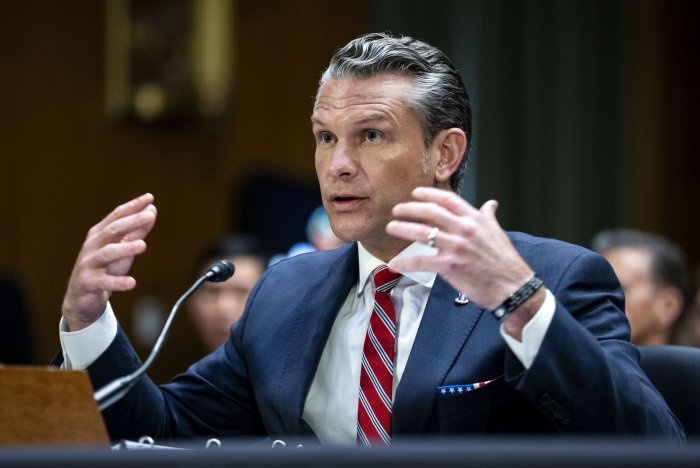
Chris Wright

Wright: Trump ‘open’ to suspending gas tax during Iran War price surge

May 10 (UPI) — Energy Secretary Chris Wright said Sunday the Trump administration is “open” to the possibility of suspending the federal tax on gasoline sales as prices spike amid the U.S.-Israeli war against Iran.

Wright said during an appearance on NBC’s Meet the Press he and Trump are “open to all ideas” to lower energy prices, including following the lead of some U.S. states in temporarily shelving taxes on gas at the pump amid the price surge.

“All measures that can be taken to lower the price at the pump and lower the prices for Americans, this administration is in support of,” he said. “We are constantly looking for different ideas.”

Citing previous measures such as releasing oil from the U.S. strategic petroleum reserves and “revising federal regulations on summer gasoline blends to make it easier for American refineries to produce more gasoline,” Wright said the suspension of the 18-cents-per-gallon federal tax on gas is also on the table.

“We are working every day to offset this rise in prices because of a critical conflict in Iran to drive prices down, and we’re open to all such ideas,” he said.

Wright’s comments came as the average national price of a gallon of unleaded gasoline stood at $4.52 per gallon as of Sunday, according to the Automobile Association of America.

U.S. drivers have seen sharp increases in pump prices in recent weeks after Iran blocked the vital Strait of Hormuz waterway connecting Persian Gulf oil and natural gas producers with world markets.

The move came in retaliation to a wave U.S.-Israeli bombing attacks on Iran beginning Feb. 28, which Washington and Tel Aviv claim were necessary to prevent the imminent development of a nuclear weapon by Iran’s rulers.

The price of regular gas last week surged 25 cents for the second consecutive week to $4.55 — $1.40 higher than they were a year ago and marking their highest level since 2022, the AAA reported.

Crude oil prices have dipped below $100 per barrel while a fragile cease-fire between the United States and Iran has been in place and negotiations to reopen the Strait have been ongoing. But with global oil supplies tightening, upwards pressure on pump prices continues.

In a separate appearance on CBS News’ Face the Nation on Sunday, Wright refused to predict were gas prices were heading.

“I don’t know the future of gas prices,” he said while admitting that “gasoline and diesel prices are up, and they will remain up while this conflict’s in place, and then they will come back down.

“And, ultimately, they’ll come back down lower than they were before.”

President Donald Trump is joined by Defense Secretary Pete Hegseth as he announces that Boeing has won a contract for a new fighter jet in the Oval Office of the White House on Friday. Photo by Yuri Gripas/UPI | License Photo

Source link

Venezuela in talks with Siemens, GE over power crisis

Avilio Troconiz (C), regional president of the Primero Justicia party in Zulia, speaks at a press conference in front of the Las Tarabas electrical substation in Maracaibo, Zulia state, Venezuela, on March 26. The party denounced the the electricity crisis, which has worsened in recent months. Photo by Henry Chirinos/EPA

April 20 (UPI) — Venezuela’s interim president, Delcy Rodríguez, said her government is talking with two major companies to address the country’s power crisis, citing recent diplomatic engagement with the United States.

“Thanks to that diplomatic dialogue, I can say we are now in direct contact with Siemens and General Electric to resolve the electricity problem in Zulia state,” Rodríguez said Sunday during a public event broadcast by state television.

She said the government decided to “open a new chapter in national political life” and in Venezuela’s international relations following a Jan. 3 U>S> military operation that captured President Nicolás Maduro and his wife, Cilia Flores.

Analysts say Zulia, a key oil-producing region in western Venezuela, is critical to the country’s hydrocarbons industry. Persistent electricity shortages have limited efforts to boost crude production, making restoration of the power system a strategic priority for economic recovery.

Situated at the western edge of the national grid, Zulia is the last region to receive electricity transmitted from the south. Failures in the transmission network often leave it disconnected. The system in the region operates at less than 40% of installed capacity.

According to local outlet El Tequeño, both companies conducted technical missions in March to assess Venezuela’s electrical infrastructure and present rehabilitation proposals.

The inspections included hydroelectric facilities in the Bajo Caroní complex in Bolívar state, following a February visit to Caracas by U.S. Energy Secretary Chris Wright.

Rodríguez made the remarks at the launch of a 13-day pilgrimage she called to demand the full lifting of economic sanctions imposed on Venezuela.

“Enough sanctions against the noble Venezuelan people,” she said, addressing the governments of the United States and Europe, according to Globovisión. She added that economic freedom is a sovereign right, not a concession from foreign powers.

The mobilizations began in Zulia, Amazonas and Táchira states and were led by Rodríguez, National Assembly President Jorge Rodríguez and ruling party leader Diosdado Cabello.

International sanctions have worsened Venezuela’s electricity crisis by limiting access to financing and technology needed to maintain and upgrade infrastructure.

A partial easing of U.S. sanctions on the oil and mining sectors has opened the door to talks with companies such as Siemens and General Electric to address those gaps.

Source link

White House disputes claim of Navy escort on Strait of Hormuz

March 10 (UPI) — President Donald Trump posted on social media that the United States has destroyed 10 inactive mine-laying vessels on the Strait of Hormuz while the White House cleared up a claim by another administration official.

White House press secretary Karoline Leavitt said Tuesday that the U.S. Navy did not escort an oil tanker through the Strait of Hormuz after Energy Secretary Chris Wright claimed it did on social media.

Leavitt said President Donald Trump may consider using Navy escorts for oil tankers on the strait but that has not happened yet.

“The U.S. Navy has not escorted a tanker or vessel at this time,” Leavitt told reporters during a press briefing Tuesday.

Earlier in the day, Wright posted that the U.S. Navy “successfully escorted an oil tanker through the Strait of Hormuz to ensure oil remains flowing to global markets.”

Leavitt said she was “made aware of this post,” but had not spoken with Wright about it.

The post was later taken down.

The price of crude oil fell below $80 per barrel briefly following Wright’s post. It climbed again after the post was deleted.

Iran has taken measures to close the Strait of Hormuz, a critical oil trade route, since the United States and Israel launched strikes on Feb. 28.

To combat the impact the military conflict with Iran will have on the global oil market, the United States has discussed plans to escort oil tankers through the Strait of Hormuz. However, retaliatory strikes by Iran have demanded more military resources, Wright previously said.

Source link