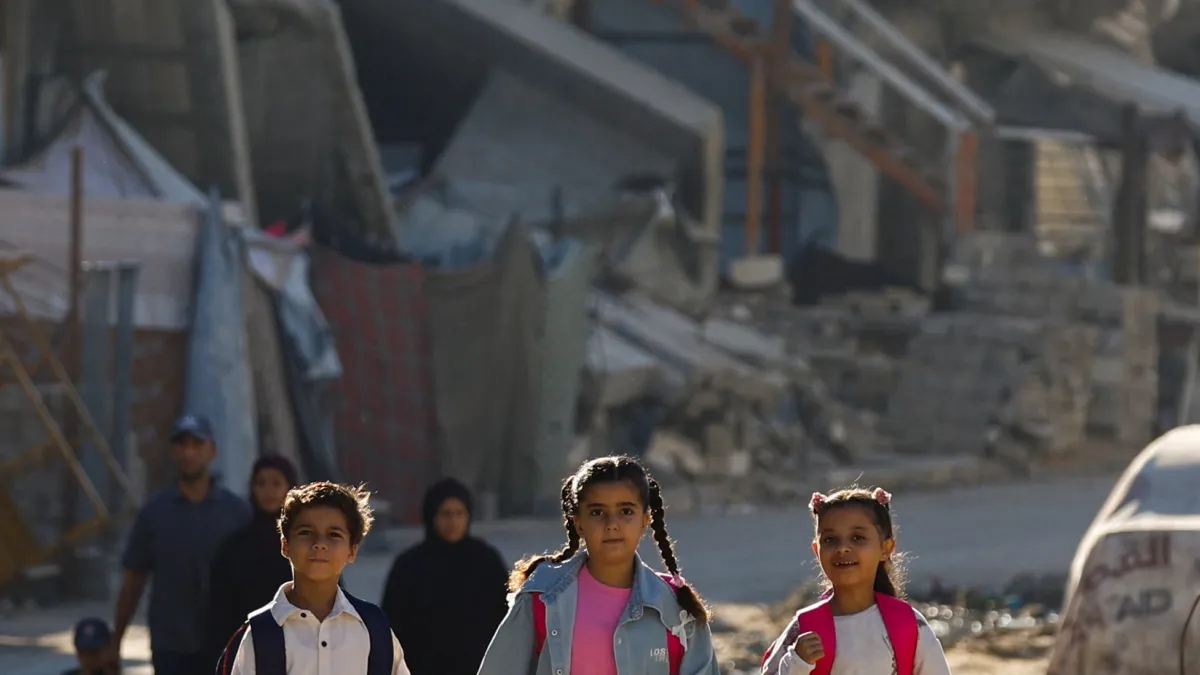
Recreational activities combined with yoga in Gaza help children recover a sense of normalcy despite war, teacher says.
Gaza City – In northern Gaza, a Palestinian teacher has transformed a tent into a small space for yoga classes, offering children moments of peace from the hardships of daily life in the besieged enclave.
The idea to bring the practice to Gaza City came from Hadeel al-Gharbawi, who has been working on finding ways to help children cope with trauma. Through simple movements and breathing, the class offers moments of calm, safety and joy.
Recommended Stories
list of 3 itemsend of list
Children sit cross-legged on a thick mat, eyes shut. Some concentrate, while others fight back shy smiles, sneaking sideways glances to see whether their classmates are following the teacher’s instructions, amused by the unfamiliar exercise.
“I wanted to expand the activities I do with children beyond drawing and colouring. I searched online and discovered that yoga can help children recover from trauma,” al-Gharbawi told Al Jazeera.
“Since yoga isn’t widely available here in Gaza, I decided to learn online and practice it with the children. Through yoga, they can release stress and cope with the difficult life around them.”
Children in Gaza have been exposed to continuous cycles of violence and trauma, profoundly affecting their mental health, according to a report by the World Health Organization.
The constant bombing, displacement, loss of family members and physical pain of Israel’s two-year war on Gaza have caused emotional distress, social withdrawal and grief, among other symptoms, the report says.
International organisations have been warning that the conflict will leave a long-lasting impact.
“All children in Gaza require mental health, and psychosocial support services after two years of horrific war, displacement, and exposure to traumatic events,” the United Nations Children’s Fund (UNICEF) said earlier this month.
This is why yoga classes are more than physical exercise in Gaza; they allow children to step away from fear, release emotions, and feel in control, even for a few minutes, the participants say.
“We come here to do yoga, to learn and to do art,” Suwar, a displaced student, told Al Jazeera. “These activities allow us to forget, even for a short time, the war, the harsh weather and the queues for water. Yoga, in particular, gives us a moment of calm and helps us feel safe and happy.”
Alongside yoga, the tent offers educational and recreational programmes that al-Gharbawi said aim to activate the children’s imaginations.
“Combining learning with playful and therapeutic activities helps the children deal with trauma and regain a sense of normalcy,” al-Gharbawi said.
Nablus, the occupied West Bank – For decades, the Zenabia Elementary School has been offering an intimate learning environment to aspiring young students from across the educational spectrum in the northern West Bank city of Nablus.
But now, due to Israel’s years-long withholding of tax revenues owed to the Palestinian Authority, the Palestinian school system is effectively broke. Like administrators at all government-run schools in the West Bank, the Zenabia school principal, Aisha al-Khatib, is struggling to keep her small, public school in session.
For most of the week, the Zenabia school is shuttered, and children roam the streets or stay at home. School supplies are woefully missing, with even regular schoolbooks now reduced to “bundles of pages”.
“We do everything we can, but we do not have the time or the materials or the consistency to properly teach our children and keep them off the streets,” says al-Khatib. “And this is everywhere in the West Bank.”
Targeting the education of Palestine’s children, she says, “means destroying the nation”.
Under the direction of far-right Finance Minister Bezalel Smotrich, Israel has systematically been withholding billions of dollars in tax revenues over the past two years that Israel collects on behalf of the Palestinian Authority (PA). The measure is partly intended to punish the PA for its longstanding policy of paying families of Palestinians imprisoned by Israel for resisting the occupation – even after the PA announced early last year that it was reforming such policies.
Public services have faced severe cuts, affecting the salaries of bureaucrats, sanitary workers, and the police.
But possibly nowhere has that budgetary crisis been felt more than in the education sector.
At Zenabia and elsewhere in the West Bank, public schools are currently only open for a maximum of three days a week. Teachers face long stretches of not being paid, and when they are, they only receive about 60 percent of what they were earning before, resulting in strikes.
And the effects of these cuts in education are showing up on the days when school is in session. Class time is so diminished at Zenabia that teachers focus almost solely on teaching mathematics, Arabic, and English, with subjects like the sciences being essentially cut altogether.
The result, educators warn, could be lasting educational gaps for a generation of Palestinian students.
“As principal of the school, I know that [the students] are not [at] the same [educational] level as before,” al-Khatib says.
‘We are always absent from school’
Spending most of his days out of school, star student Zaid Hasseneh, 10, tries to keep improving his English by looking up words on Google Translate. Zaid dreams of going to university someday in the United States, with hopes of becoming a doctor.
“I want my son to grow up to be cultured – not just memorise the material he learns at school,” says his mother, Eman. “No, I want his cultural knowledge to develop and become diverse and advanced.”
Eman helps Zaid when she can with his studies, but she is busy keeping the family afloat financially after her husband lost his work in Israel. Before Israel’s war on Gaza began in 2023, Eman’s husband worked in Tel Aviv as a mechanic. After Israel revoked his work permit, along with those of some 150,000 other West Bank Palestinians, he has been unable to find work. Eman now works in a halawa factory as the sole breadwinner.
“I go home tired from work, but I have to keep up with [Zaid] regularly,” says Eman. “I tell him, ‘The most important thing is studying. Studying is essential for life.’”
But Eman realises how limited she is in helping her son with his studies. “The teacher knows one thing, but I don’t know how to explain it,” says Eman. “And now, the books [they receive in school] aren’t complete books anymore. They’re bundles. Regular books are 130 pages, but these are 40 or 50 pages.”
To compound the dearth in school resources, students and their families describe erratic schedules that make cumulative learning a near impossibility. “The whole family’s routine is affected,” says Eman.
Even Zaid is now often spending his days out in the streets rather than studying in the classroom – or otherwise on his phone, playing mobile games.
That is the case for most students these days.
Muhammad and Ahmed al-Hajj joined Zenabia four years ago as six-year-olds when they faced extreme bullying in another school. They came to love the new school and the intimate setting it offers. But the twins now mostly spend their time on their phones. With their parents also struggling to earn enough money to get by, they’re left at home alone during their days off from school.
“It’s not good at all. We are always absent from school,” says one of the twins. “It’s not like a full schedule, and we try to study as much as we can, but still, we don’t feel good about it.”
Some families have switched their children over to private schools, but few can afford to do so. “My [monthly] salary is 2,000 shekels [$650],” explains Eman Hassaneh. “About 1,000 goes towards the home rent. Another 500 goes towards bills. And only very little is left for food. I cannot also take care of his education.”
Eman Hassaneh and her 10-year-old son, Zaid [Al Jazeera]
Teachers quitting, and mounting dropouts
Collectively, the PA’s multi-year budget cuts of billions of dollars are shrinking both the attendance of students and the number of teachers, too.
“Many of the teachers left working in the schools to work in factories because they do not get enough salary,” says al-Khatib. “And they don’t feel that they are giving what they need to give the students.”
Tamara Shtayeh, a teacher at Zenabia, nowadays only teaches maths, English, and Arabic due to the reduced funding. “As a teacher, the three-day solution is a bad solution because it doesn’t cover the minimum education that is needed,” she said. “Not for the students, and not for the teachers as well.”
Due to her reduced salary, Shtayeh, a mother of three girls, is selling products online on the side to support her family. Even the school’s principal, al-Khatib, says she can now only afford to send one of her two college-age daughters to university, with the other daughter staying at home.
School hours are reduced even further as Israeli soldiers regularly raid the surrounding areas, closing the school every time they do so. With the crisis stretching on for years now, Shtayeh is sensing a generational gap widening between the previous generation that received five days of school, and this one going to school for about half of that.
Shtayeh and al-Khatib worry about the lack of routine in the children’s lives. For every student like Zaid, who is devoted to educating himself despite the circumstances, many more students are dropping out of the system altogether.
Abu Zaid al-Hajj with his twin sons, Muhammad and Ahmed, age 10 [Al Jazeera]
Not far from Zenabia, Talal Adabiq, 15, now spends his days selling sweets and drinks for eight hours a day on the streets of Nablus.
“I don’t really like school,” says Talal. “I prefer working.”
Talal told his parents about a year ago that he wanted to drop out of school. Though they wanted him to continue his studies, he told them he did not find much use for school anymore – and he used the irregular school schedule to prove his point.
Offering to help support his struggling family financially, Talal subsequently dropped out of al-Kindi School. He now makes “about 40 to 50 shekels a day” ($13-16) hawking street goods.
As he sells lollipops and other sweets on a Tuesday afternoon, several teenage boys looked on nearby. They say they’re still in school, but on this budget-mandated day off, some of the boys joke about how “fun” it would be to not go to school at all.
Talal, meanwhile, shrugs off questions about what dropping out of school portends for his future. “God willing, things will be better,” says Talal. “I don’t know how.”
In the estimations of educators and representatives from the Palestinian Authority, about 5 to 10 percent of students have dropped out of school in the West Bank in the past two years.
Talal Adabiq, 15, has dropped out of school completely and now sells items on the street [Al Jazeera]
‘Our children deserve a chance at life’
While massive budget cuts roil the education sector, the Palestinian Authority is struggling to come up with solutions as its budgetary woes deepen – and schoolchildren otherwise face threats, violence and demolitions at the hands of Israeli soldiers, settlers and the Israeli Civil Administration.
Even before the war on Gaza began, the school sector was facing a variety of crises, with teacher strikes commonplace, as well as Israeli attacks on school infrastructure and children on their way to class, with at least 36 demolitions of 20 schools between 2010 and 2023.
But systemic attacks on education are now intensifying. According to Ghassan Daghlas, the governor of Nablus, in his district alone, three schools have been attacked in the last two months by settlers. In nearby Jalud last month, settlers set a school on fire. The rise in violence is leaving students at once traumatised and fearful of going to school, says Daghlas.
“In the past three months, most of the invasions that target homes in the Nablus district are targeting schoolchildren. They will take the kid along with one of the parents. They subject them to interrogation for a few hours,” says the governor. “What kind of psychological state will the students have after these interrogations?”
According to PA estimates, more than 84,000 students in the West Bank have had their education disrupted by incidents including settler attacks, military raids and demolitions of schools. More than 80 schools serving approximately 13,000 students are under threat of full or partial demolition by Israeli authorities in the West Bank and occupied East Jerusalem. Between July and September 2025 alone, more than 90 such education-related incidents were documented in the West Bank.
In Area C – the 60 percent of the West Bank under full Israeli military control – students from isolated villages sometimes have to walk several kilometres to reach their schools, in which they regularly face harassment or attacks from settlers as well as soldiers on the way, with a rising trend in settler outposts deliberately placed near schools.
“These are not individual acts by some violent settlers,” says Mahmoud al-Aloul, the vice chairman of the central committee of Fatah, the Palestinian Authority’s ruling political party. “Rather, it’s a general policy that is supported by the occupation.”
In 2025, Nablus governorate alone had 19 students killed by Israeli army gunfire, according to Daghlas. A total of 240 were injured.
Education officials say the longer the crisis persists, the greater the long-term impact will be as teacher attrition, interrupted learning and rising dropout rates compound over time.
“The continuation of the crisis means risking long-term institutional erosion, in which temporary solutions become permanent, and the regime becomes less able to restore its previous level of quality, efficiency and justice,” says Refaat Sabbah, the president of the Global Campaign for Education. “Saving education today is not a sectoral option, but a strategic necessity to protect society and its future.”
For Eman Hassaneh, that means safeguarding her son Zaid’s future hopes and dreams. “We hope all of these barriers to education won’t actually affect our children and their passion for learning,” she says.
Two lawsuits accusing the world’s largest social media companies of harming children begin this week, marking the first legal efforts to hold companies like Meta responsible for the effects their products have on young users.
Opening arguments began today in a case brought by New Mexico’s attorney general’s office, which alleges that Meta failed to protect children from sexually explicit material. A separate case in Los Angeles, which accuses Meta and the Google-owned YouTube of deliberately designing their platforms to be addictive for children, is set to begin later this week.
Recommended Stories
list of 4 itemsend of list
TikTok and Snap were also named in the original California lawsuit but later settled under undisclosed terms.
The New Mexico and California lawsuits are the first of a wave of 40 lawsuits filed by state attorneys general around the US against Meta, specifically, that allege that the social media giant is harming the mental health of young Americans.
New Mexico case
In the opening argument in the New Mexico case, which was first filed in 2023, prosecutors told jurors on Monday that Meta – Facebook and Instagram’s parent company – had failed to disclose its platforms’ harmful effects on kids.
“The theme throughout this trial is going to be that Meta put profits over safety,” said lawyer Donald Migliori, who is representing the state of New Mexico against Meta.
“Meta clearly knew that youth safety was not its corporate priority… that youth safety was less important than growth and engagement.”
Prosecutors say they will provide evidence and testimony that Meta’s algorithms and account features not only enticed young people and made them addicted to social media, but also fostered a “breeding ground” for predators who target children for sexual exploitation.
Late last month, in the process of discovery, the New Mexico attorney general’s office said the company did not put in safeguards to protect children from accessing sexualised chatbots on Facebook and Instagram.
In emails obtained by the court, some of Meta’s safety staff had expressed objections that the company was building chatbots geared for companionship, including sexual and romantic interactions with users, according to the Reuters news agency.
The artificial intelligence chatbots were released in early 2024. The documents cited in the state’s filing do not include messages or memos authored by Meta CEO Mark Zuckerberg. In October 2025, Meta added parental controls to the chatbots.
California case
The California case is more wide-reaching and alleges that Meta and YouTube, which is a unit of Alphabet-owned Google, used deliberate design choices that sought to make their platforms more addictive to children to boost profits.
The case centres around a 19-year-old identified only by the initials KGM. The case could determine how thousands of other, similar lawsuits against social media companies will play out.
KGM claims that her use of social media from an early age made her addicted to the technology and exacerbated her depression and suicidal thoughts.
“Borrowing heavily from the behavioral and neurobiological techniques used by slot machines and exploited by the cigarette industry, Defendants deliberately embedded in their products an array of design features aimed at maximizing youth engagement to drive advertising revenue,” the lawsuit says.
Executives, including Zuckerberg, are expected to testify at the trial, which will last six to eight weeks. It is unclear if they will attend the New Mexico case.
The tech companies dispute the claims that their products deliberately harm children, citing a bevvy of safeguards they have added over the years and arguing that they are not liable for content posted on their sites by third parties.
“Recently, a number of lawsuits have attempted to place the blame for teen mental health struggles squarely on social media companies,” Meta said in a recent blog post. “But this oversimplifies a serious issue. Clinicians and researchers find that mental health is a deeply complex and multifaceted issue, and trends regarding teens’ well-being aren’t clear-cut or universal.
Narrowing the challenges faced by teens to a single factor ignores the scientific research and the many stressors impacting young people today, like academic pressure, school safety, socio-economic challenges and substance abuse.”
A Meta spokesperson said in a recent statement that the company strongly disagrees with the allegations outlined in the lawsuit and that it is “confident the evidence will show our longstanding commitment to supporting young people”.
Jose Castaneda, a Google spokesperson, said the allegations against YouTube are “simply not true”.
“Providing young people with a safer, healthier experience has always been core to our work,” he said in a statement.
High stakes
The outcome of the cases could shape the future of social media.
“In my mind, an existential question for social media services is whether they’re liable for harm suffered by users from using the services. If so, the damages could be more money than the defendants have, Eric Goldman, a professor at the Santa Clara University School of Law, told Al Jazeera.
“We’re talking about massive financial stakes, and we’re also talking about the ability of the plaintiffs to veto or potentially override editorial decisions by the services about what’s in the best interests of their audiences,” he said.
“It’s essentially taking away power from the services to decide and handing it to plaintiffs’ lawyers. So, not only could there be existential damages, but there could also be a massive loss of editorial control over their services. The stakes could not be higher for social media services or the internet.”
Goldman said this was because the same argument could be used to shape claims against video game makers and generative AI, which refers to AI that can create original content, including text and video.
“If these theories work against social media, they might also work against video games, against generative AI, and who knows what else. That’s why I said the stakes are so high for the internet,” he added.
There are already lawsuits that claim that interactions with OpenAI’s ChatGPT led to instances of suicide and murder-suicide.
On Wall Street, Meta stock is trending up by more than 3 percent in midday trading.
The long-awaited re-opening of Gaza’s Rafah crossing has been deemed too late for many seeking treatments, in life-or-death conditions. Al Jazeera’s Hind Khoudary spoke to a mother who had lost her sick child while waiting for the crossing to open.
Liam Conejo Ramos and his father, Adrian, were accompanied home by Texas Democratic Representative Joaquin Castro.
Published On 1 Feb 20261 Feb 2026
Share
A five-year-old boy and his father, who were detained as part of United States President Donald Trump’s aggressive immigration raids and held at a detention facility in Texas, have returned to their home in Minnesota.
Liam Conejo Ramos and his father, Adrian, who are asylum seekers from Ecuador, spent 10 days in the Dilley detention centre until US District Judge Fred Biery ordered their release on Saturday.
Recommended Stories
list of 3 itemsend of list
US Representative Joaquin Castro, a Texas Democrat, wrote in a social media post that he picked them up on Saturday night at the detention facility and escorted them home on Sunday.
“Liam is now home. With his hat and his backpack,” Castro wrote, including photos of the child. “We won’t stop until all children and families are home.”
Immigration and Customs Enforcement (ICE) agents arrested Liam and his father on January 20 as the boy arrived home from preschool.
Images of the boy with a blue bunny hat and backpack being held by officers spread around the world and added fire to public outrage at the federal immigration crackdown, during which agents have shot dead two US citizens.
Liam was one of four students detained by immigration officials in a Minneapolis suburb, according to the Columbia Heights Public School District.
In a statement, Department of Homeland Security (DHS) Assistant Secretary Tricia McLaughlin said ICE did not target or arrest Liam, and that his mother refused to take him after his father’s apprehension. His father told officers he wanted Liam to be with him, she said.
“The Trump administration is committed to restoring the rule of law and common sense to our immigration system, and will continue to fight for the arrest, detention, and removal of aliens who have no right to be in this country,” McLaughlin said.
Neighbours and school officials say that federal immigration officers used the preschooler as “bait” by telling him to knock on the door to his house so that his mother would answer.
DHS called the description of events an “abject lie”. It said the father fled on foot and left the boy in a running vehicle in their driveway.
Biery said in a scathing opinion that “the case has its genesis in the ill-conceived and incompetently-implemented government pursuit of daily deportation quotas, apparently even if it requires traumatizing children”.
He criticised what he called the government’s apparent “ignorance” of the US Declaration of Independence, which “enumerated grievances against a would-be authoritarian king over our nascent nation”.
Biery also cited the Fourth Amendment of the US Constitution, which protects the right against “unreasonable searches and seizures”.
US Representative Ilhan Omar, a Democrat from Minnesota, posted a photo to social media of her with Liam, his father and Castro, with her holding Liam’s Spider-Man backpack.