chicago cubs

Cubs tee off on Justin Wrobleski as Dodgers lose fourth straight

The Dodgers came away from the trade deadline with major wins — a two-time Cy Young Award winner in Tarik Skubal, necessary catching depth with Ben Rortvedt and Hunter Feduccia, and a 2025 All-Star in pitcher Kris Bubic.

All of that momentum, and the staggering amount of talent on the roster, have overshadowed the Dodgers’ recent poor play. A clean slate against the Chicago Cubs at Wrigley Field was a chance to set a new tone after being swept by the Boston Red Sox at home. Instead, they lost 10-5 to open the three-game series.

“This is a playoff-contending team,” manager Dave Roberts said of the Cubs before the game. “We’ve got to play well. Like I said [Sunday], we got outplayed. Outcompeted against. So we need to play better. We’re going to play better this series. I don’t know the results, but we will play with more urgency.”

The Dodgers (69-44) essentially played out that prophecy to begin the game. Against left-hander Matthew Boyd, Shohei Ohtani and Andy Pages hit back-to-back singles, and Tommy Edman roped a three-run homer to left.

Then Boyd settled in. He got out of the inning with three straight fly outs — Cubs fans enthusiastically booing Kyle Tucker, who was never expected to re-sign with the team when he hit free agency after one season in Chicago, when he flied out to right field.

Dodgers left-handed All-Star Justin Wrobleski struggled. For the second start in a row, he surrendered four home runs.

The first three came with men on base, expediting the damage. And they came from all over the Cubs lineup. In the first inning, No. 2 hitter Seiya Suzuki lined a fastball into the stands for two runs. The next inning, it was No. 9 hitter Kevin Alcántara who put the Cubs (64-49) ahead with a two-run blast. In the third, cleanup hitter Carson Kelly jumped on a slider for a two-run shot.

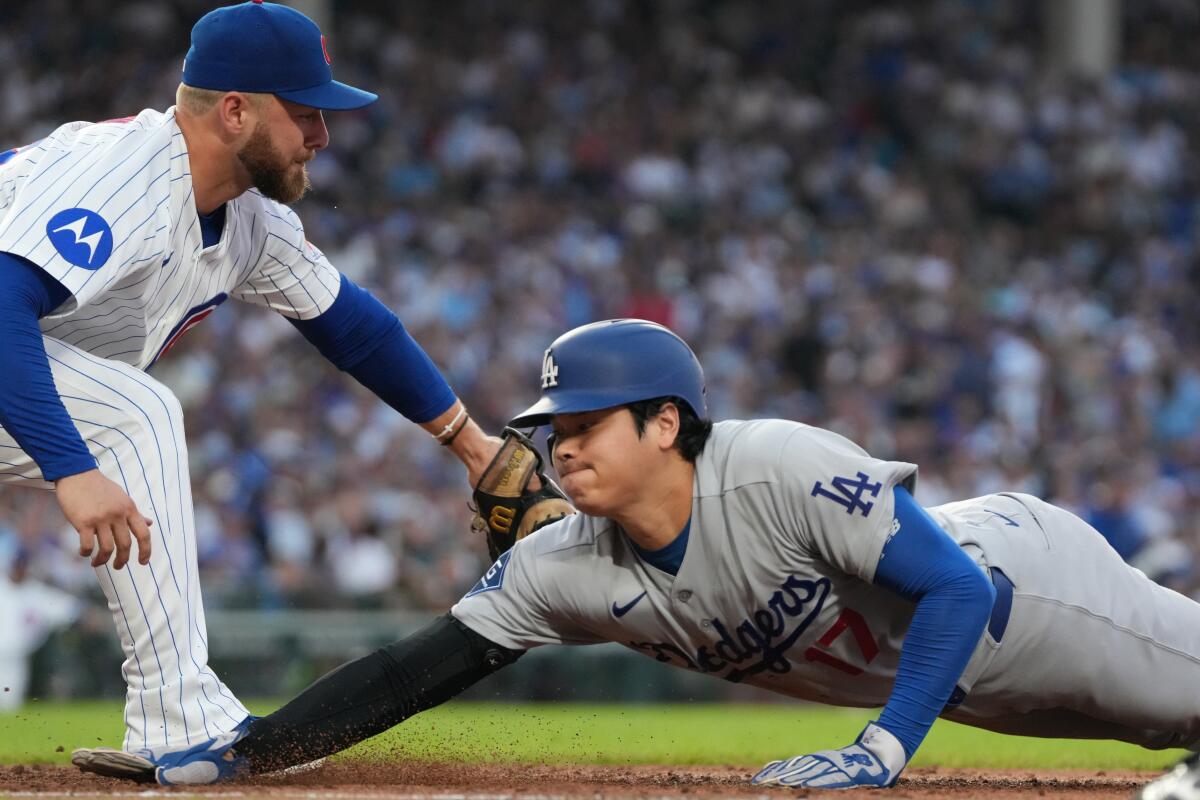
Dodgers star Shohei Ohtani, right, is tagged out by Chicago Cubs first baseman Michael Busch.

Dodgers star Shohei Ohtani, right, is tagged out by Chicago Cubs first baseman Michael Busch, left, on a pickoff at first base in the second inning Monday.

(David Banks / Associated Press)

Wrobleski finally threw a hitless fourth, working around a leadoff walk to briefly stymie the Cubs’ offensive push. Then in the fifth, he threw a sinker down the middle to left-handed hitter Michael Busch, who drove it out for a solo homer.

Busch, a former Dodger, coincidentally is part of the Skubal trade tree. The Cubs acquired him and reliever Yency Almonte for pitching prospect Jackson Ferris and outfield prospect Zyhir Hope. Hope was part of the trade package for Skubal.

Roberts pulled Wrobleski after Busch’s home run. The seven earned runs he gave up tied a season high. But this time, he only pitched 4⅓ innings, compared to the 8⅔ innings he threw against the Atlanta Braves on May 10.

The Dodgers countered with a one-run rally in the fourth, and Teoscar Hernández hit a solo home run onto Waveland Ave. in the sixth inning.

The Cubs, however, squashed thoughts of a potential comeback with a three-run rally in the sixth against Edgardo Henriquez and Tanner Scott.
Source link

Tarik Skubal trade shows how Dodgers aren’t ruining baseball

Your team could have done this.

Is baseball headed for a lockout this winter? Yes.

Because the Dodgers traded for Tarik Skubal? No.

The Dodgers play a video before each home game, which includes these words from a sinister-sounding voice: “You need teams like us to point your finger and say, ‘That’s the bad guy.’ ”

In this case, “you” means the owners of the other 29 teams. You can hear them wailing now: Baseball is rigged, and only a salary cap can unrig the sport. The Dodgers are the back-to-back champions, and they just picked up the best player on the trade market.

They. Have. Too. Much. Damn. Money.

But here’s the thing: All the money the Dodgers lavish upon their major league roster isn’t what made the trade for Skubal possible.

Oh, all that money helped put them in position to where Skubal could help them in October, but Skubal could have helped the Milwaukee Brewers or the Chicago Cubs or the Tampa Bay Rays or the Atlanta Braves or the New York Yankees or the Philadelphia Phillies.

When the Detroit Tigers took bids for Skubal, they liked the Dodgers’ offer the best. And here is what the Dodgers offered: three prospects, none a first-rounder, none ranked among baseball’s top 20 prospects.

Outfielder Zyhir Hope was drafted in the 11th round, by the Cubs. When the Cubs needed a corner infielder, the Dodgers shipped them a surplus major leaguer, Michael Busch, in exchange for two prospects. One was Hope, whose professional experience was limited to 11 games of rookie ball.

Pitcher River Ryan was drafted in the 11th round, by the San Diego Padres. When the Padres needed a left-handed bat that could play the outfield, the Dodgers shipped them a surplus major leaguer, Matt Beaty, for a prospect that had yet to make his professional debut, Ryan.

Pitcher Brady Smith was drafted in the third round, by the Dodgers. This is his second professional season.

The Dodgers developed Hope and Ryan from minor leaguers into top prospects, and the Tigers hope some of that Dodgers development dust has rubbed off on Smith.

Tarik Skubal delivers during a game between the Detroit Tigers and the Baltimore Orioles on July 29.

Tarik Skubal delivers during a game between the Detroit Tigers and the Baltimore Orioles on July 29.

(Paul Sancya / Associated Press)

For now? The prospect rankings on the league website put Hope at No. 25 and Ryan at No. 68. The Baseball America prospect rankings put Hope at No. 55, with Ryan outside the top 100. Neither ranking includes Smith among the top 100.

As Baseball America editor-in-chief J.J. Cooper wrote, Hope was the third-best outfielder on the Dodgers’ double-A team.

That might be the greatest testament of all to the Dodgers’ player development system, particularly considering all of their winning means they draft at the end of every round, every year.

Maybe the trio of prospects never pans out, at least not the way the Tigers hope. Two of three prospects traded at the deadline never do, according to Baseball America research.

Will money come into play here? Yes, but not yet. Skubal is a free agent at the end of the season, and not every team could afford $300 million or $400 million or so to sign him to a long-term contract.

But, for these final months of the season, the cost to pay Skubal is $9 million. Any team can do that. And, if the owner of your team tells you he could not have done that, the proper response would be to laugh, and then chant “Sell the team!”

And, as the Brewers and Cleveland Guardians and Tampa Bay Rays prove just about every year, any team can afford to build an excellent player development system.

Look, I am not going to try to tell you that every team could sign Shohei Ohtani and Yoshinobu Yamamoto and Freddie Freeman and Mookie Betts and Edwin Díaz and Kyle Tucker.

But the New York Mets, in the largest market in the major leagues, certainly could. Their Saturday was not spent trading for Skubal. It was spent taking trade offers for players on their last-place team and commemorating the 40th anniversary of their 1986 World Series championship team — their last championship team.

In Anaheim, the last-place team in the second-largest market in the major leagues lost to the Brewers, the team in the smallest market in the major leagues — and, as of Saturday, the team with the best record in the majors.

Market size need not be destiny, if you can scout and sign and coach and develop players. The owners could learn from that, but it’s easier to point at the Dodgers and say, “That’s the bad guy.”

Instead, some poor league employee probably stayed up late Saturday night, planning how to splice clips of Skubal wearing a Dodgers uniform into the “Level the Playing Field” ad campaign the owners are running to persuade fans to take their side in collective bargaining. Imagine what they could do with clips of Skubal waving to fans in a championship parade.

Source link