CHICAGO — Edward Cabrera pitched six shutout innings, Ian Happ hit a solo homer and the Chicago Cubs beat the Angels 7-2 on Monday night.
Cabrera gave up one hit and walked one in his Chicago debut, delighting the crowd of 36,702 on a picturesque night at Wrigley Field. The 6-foot-5 right-hander was acquired in a January trade with Miami.
Carson Kelly and Moisés Ballesteros each drove in two runs for the Cubs (2-2) in the opener of a three-game series.
Yoán Moncada hit a two-run homer for the Angels (2-3) in their third consecutive loss. Ryan Johnson (0-1) yielded six runs and seven hits over 3⅓ innings in his first career start.
Angels star Mike Trout went 0 for 4 with two strikeouts after collecting six hits and walking seven times over the first four games of the season.
Johnson struggled with his control in the first, walking the bases loaded. Pete Crow-Armstrong reached on an 11-pitch walk ahead of Nico Hoerner’s sacrifice fly. Kelly made it 3-0 with a two-out fly ball that landed just out of the reach of a lunging Trout in shallow right-center for a two-run single.
The Cubs added three more in the third. Happ extended his homer streak to three games, and Ballesteros grounded a two-run single into right field.
Cabrera (1-0) struck out five while throwing 80 pitches, 49 for strikes. Colin Rea worked three innings for his first save of the season, striking out Moncada with two runners on for the final out.
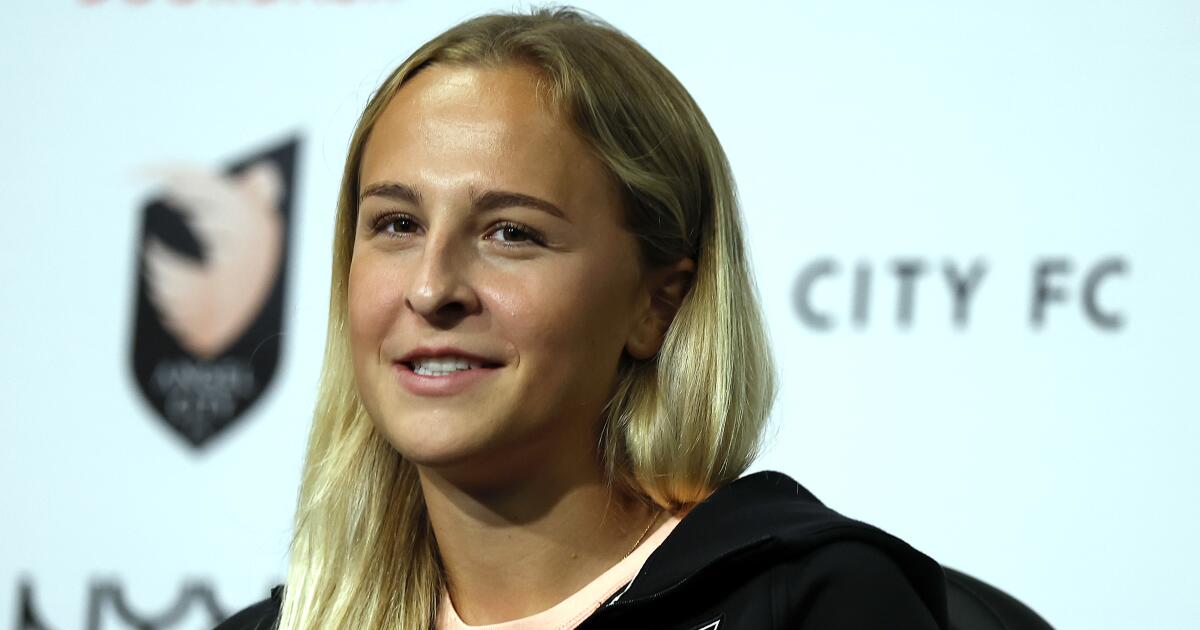
Neither Alexander Straus nor Mark Parsons were around when Angel City played its first NWSL game in 2022. But they didn’t miss much; in four years the team had one winning season and made just one playoff appearance.
So Straus, in his first full season as coach, and Parsons, 15 months into his job as sporting director, decided to raze the club and its sad history and start over. That break from the past couldn’t have been much clearer than it was in the opening game of the team’s fifth season Sunday, one which ended in a 4-0 rout of the Chicago Stars.
Three of the goals — from Evelyn Shores, Ary Borges and Maiara Niehues — came from players who weren’t on the roster at the start of last season. Borges also picked up her first Angel City assist.
The performance was the most dominant in club history and the margin of victory matched Angel City’s largest ever. It was also the team’s first season-opening win since 2022.
“There is a little bit of a new beginning,” Straus said.
“We’re a completely different organization than we were at the end of last year,” Parsons added.
Angel City proved that when teenager Kennedy Fuller opened the scoring in the 33rd minute, dribbling up the right wing and into the box before driving a right-footed shot off Chicago keeper Alyssa Naeher and just inside the near post.
Shores doubled the lead in the 53rd minute, heading in a Fuller corner for her second NWSL goal before Borges, a Brazilian international, made it 3-0 13 minutes later, jumping on a short goal kick by Naeher, then beating the keeper cleanly with a left-footed shot from the center of the box.
Niehues, another Brazilian international, closed the scoring in the 70th minute on a right-footed shot from the center of the box. Iceland’s Sveindis Jonsdottir got the assist on that goal. Of the four goal-scorers for Angel City, only Borges is over 21.
Angel City dominated the match statistically as much as it did on the field, outshooting Chicago 17-7 and putting six of those shots on target. Angel City keeper Angelina Anderson needed to make just two saves to record the clean sheet.
The announced crowd of 16,813 on a beautiful sun-splashed afternoon was the smallest for an Angel City opener.
AUSTIN, Texas — “The Sun Never Sets” is filmmaker Joe Swanberg’s 10th indie to premiere at SXSW but his first to play the event since 2017. The astonishing pace with which he made his early work — loose, idiosyncratic stories that were progenitors of the emergent style known as mumblecore — has slowed significantly, but also given way to a newfound maturity as both a person and an artist.
Introducing “The Sun Never Sets” at its world premiere on Friday night to a sold-out crowd at the Zach Theater, Swanberg called his latest “my favorite film I’ve ever made.” Shot on 35mm in Anchorage, the movie follows a 30-ish woman, Wendy (Dakota Fanning in a vibrant turn), torn between pursuing a fresh romance with a reckless old flame (Cory Michael Smith) or continuing on with the settled-in-his-ways divorced father of two (Jake Johnson) she’s been seeing for a few years.
Dakota Fanning in Joe Swanberg’s “The Sun Never Sets,” filmed in Alaska.
(SXSW)
“I guess this is what they tell you about getting older and doing this job longer,” said a thoughtful Swanberg in a video interview from his home in Chicago shortly before the South by Southwest festival. “You get better at it and you sort of mature and all of this.”
The film marks Swanberg’s fourth collaboration with Johnson, a partnership that goes back to 2013’s “Drinking Buddies.” (The actor partly financed the new project along with his brother.) Following completion of the third season of the Netflix anthology series “Easy” in 2019, for which he wrote and directed all the episodes, Swanberg was planning to take a break. A divorce and the pandemic caused that pause to grow even longer.
In the intervening years Swanberg produced a number of projects for other filmmakers, did some acting and opened a small video store in Chicago. Swanberg knew Anchorage-based producer Ashleigh Snead, who encouraged him to consider shooting something there. The scenic location would give Swanberg the opportunity to expand his visual style from his usual couches, bars and apartments of much of his work. (There still are a surprising number of scenes on couches and in bars.)
“Joe’s a real filmmaker,” says Johnson in a separate interview. “And I think sometimes he doesn’t get that credit because he can make movies with nothing. This is a real adult movie. This is a film about how complicated breakups are and how messy they get. And it’s in beautiful Alaska.”
Swanberg, center, on the set of “The Sun Never Sets.”
(SXSW)
Swanberg has now gone from someone making talky, provocative and at times controversial films about the lives of post-collegiate 20-somethings to exploring the nuances and specifics of being a 44-year-old divorced father of two still trying to figure out his place in the world. His original cohort of SXSW-affiliated filmmakers, many of whom also fell under the rubric of mumblecore — nobody much liked the name, but no one ever came up with anything better, so it stuck — included Greta Gerwig, Lena Dunham, Barry Jenkins, Ti West and others who have gone on to more conventional mainstream success.
But Swanberg doesn’t seem to feel left behind. Rather, he only sees doors opening.
“It’s gone so much better than I thought it was going to go for me,” he says. “I mean, when I was making these really tiny, sexually explicit 71-minute movies, I was like, I’m just grateful to be here. I can’t even believe these festivals are showing this work and it’s so cool that there’s a space for me in this ecosystem.
“And so to watch my friends go off to do these giant movies, to see Greta doing ‘Barbie’ and stuff like that, to me it just opens up the possibilities,” he adds. “Each time a friend of mine sets some new record or moves into some new space, I’m kind of like: Oh, that just opened up for all of us now.”
His earlier work often featured raw sex scenes, sometimes featuring Swanberg himself. From practically the start of his career, well predating the #MeToo-era reckoning that began in 2017, Swanberg weathered accusations that he was exploitative and manipulative of his female performers. His stepback from productivity coincided with a moment when his explorations of sexual power dynamics fell out of favor. It would be easy to interpret that Swanberg preemptively soft-canceled himself to avoid a broader scandal. He doesn’t see it that way.
“Certainly in Chicago, where I’ve spent the last five years, I’m not unwelcome places,” he says, drawing a distinction between himself and “people who lose jobs or are capital-C canceled. But also my work has always pushed those boundaries and always attracted some amount of positive and negative attention.”
Though “The Sun Never Sets” has numerous kissing scenes, it doesn’t go too much further than that.
“I won’t do it,” Johnson says of more graphic scenes. “When I worked with Joe early on, I was like, ‘I love you, man — I’m not doing this.’”
For her part, Fanning had no reservations about working with Swanberg. He offered both Fanning and Smith the opportunity to work with an intimacy coordinator, but neither felt it was necessary.
“There was no planet where you’d ever be asked to do anything you were uncomfortable with,” Fanning says. “If there was ever a moment like, ‘I don’t want to do that,’ he’d be like, ‘Oh, then let’s not.’ There was a day where there was a scene and it was pouring rain outside. And we both looked at each other and he was like, ‘We’re not going to do it. The scene’s cut.’ He’s just open. And I just trusted him implicitly.”
Jake Johnson and Dakota Fanning in the movie “The Sun Never Sets.”
(SXSW)
Swanberg has long worked in an unusual style in which the script is essentially a detailed outline and the actors work to come up with their own dialogue during rehearsals. For “The Sun Never Sets,” Swanberg and Johnson developed the longest, most complete outline Swanberg has ever used, including some dialogue exchanges. Then the actors were allowed to make it their own.
Fanning recalled an early Zoom call with Swanberg and Johnson on which they explained the process.
“It’s still made like a real film,” Fanning says. “And Jake and Joe promised it’s not like we’re just flying by the seat of our pants: ‘You will know what to say, I promise.’ And then friends that know me asked, ‘Are you so nervous?’ And I was, but for some reason, I don’t know why, I just knew that it was going to be fine. And that just proved to be true.”
Even though it takes places in Anchorage, Swanberg calls “The Sun Never Sets” “extremely personal.”
“I was definitely writing a movie about a divorced mid-40s guy dating a younger person,” he says. “The questions of marriage and having children were sort of an amalgam of two real relationships that I merged into one onscreen.” He describes the material as “questions that I had and have about what my own relationships are going to look like post-divorce.”
That comes through in Fanning’s rich, layered performance, which might rank among the best of her already lengthy career. Swanberg’s style draws both an ease and an intensity from Fanning, who captures a woman at a pivotal moment of figuring out what she wants amid the emotional whirlwind she is going through. (At the film’s premiere, Fanning said, “I’ve never put so much of myself into a role before.”)
“I think the goal of Joe’s films, and I think at least my goal with this film, is trying to make everything feel real,” she says. “Things are just a mess some of the time.”
Dakota Fanning and Cory Michael Smith in “The Sun Never Sets.”
(SXSW)
Swanberg himself appears in a small role as the new husband of the ex-wife of Johnson’s character. And the characters of the two kids in the movie are named after the director’s own children. With a newfound maturity and emotional depth, Swanberg is continuing to make movies that are part diary, part generational markers.
“It’d be really cool in my 40s to make movies about characters in their 40s,” he says, “and in my 50s, 60s and 70s. It’d be neat to be making sexually explicit movies about 70-year-olds in their dating lives and sex lives and stuff. It’s really exciting to have movies about characters at this phase of their life, whether they’re finally settling down in their 40s or whether they’re getting out of relationships and reexamining their life. It’s where my head is at.” .