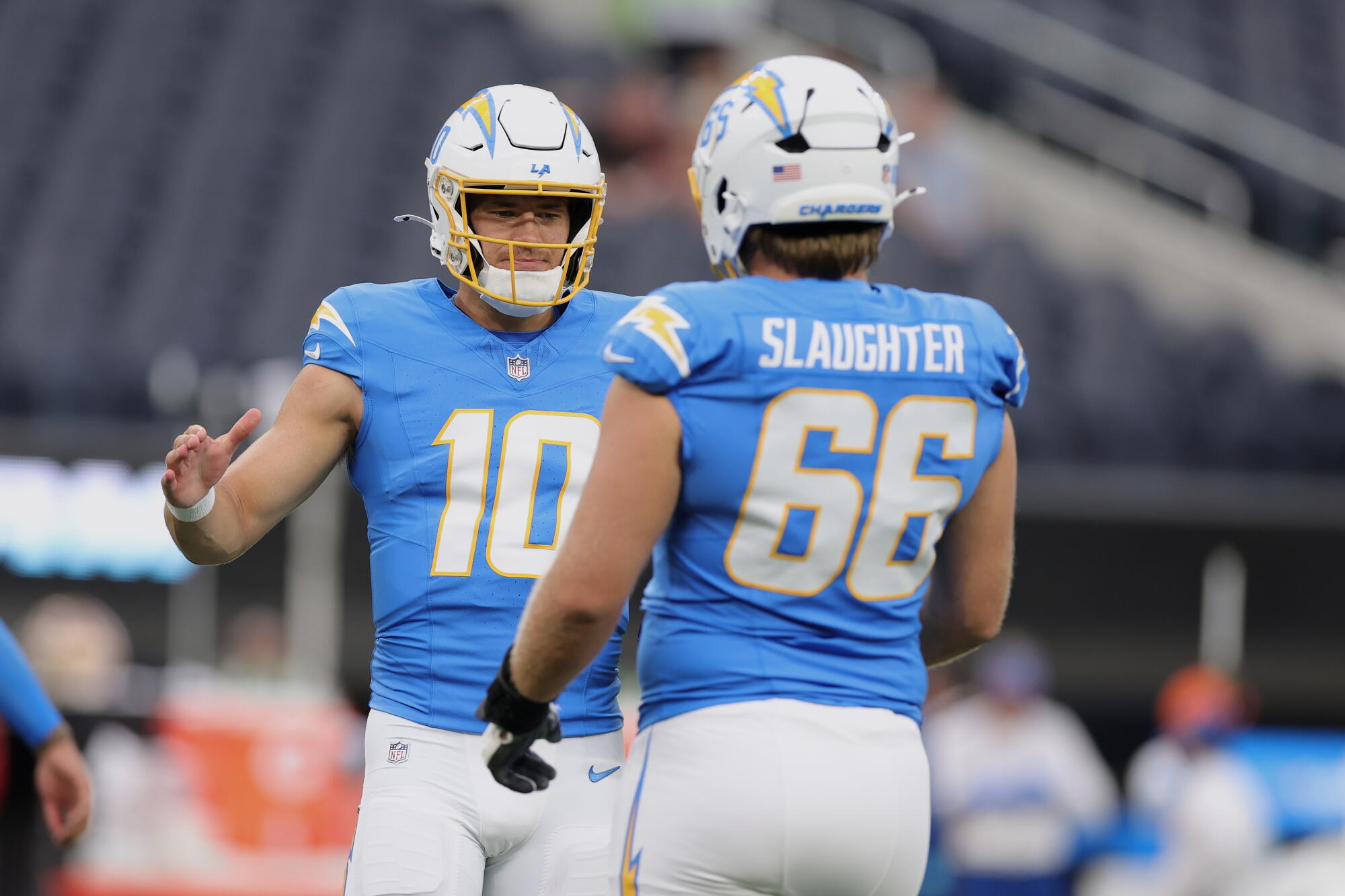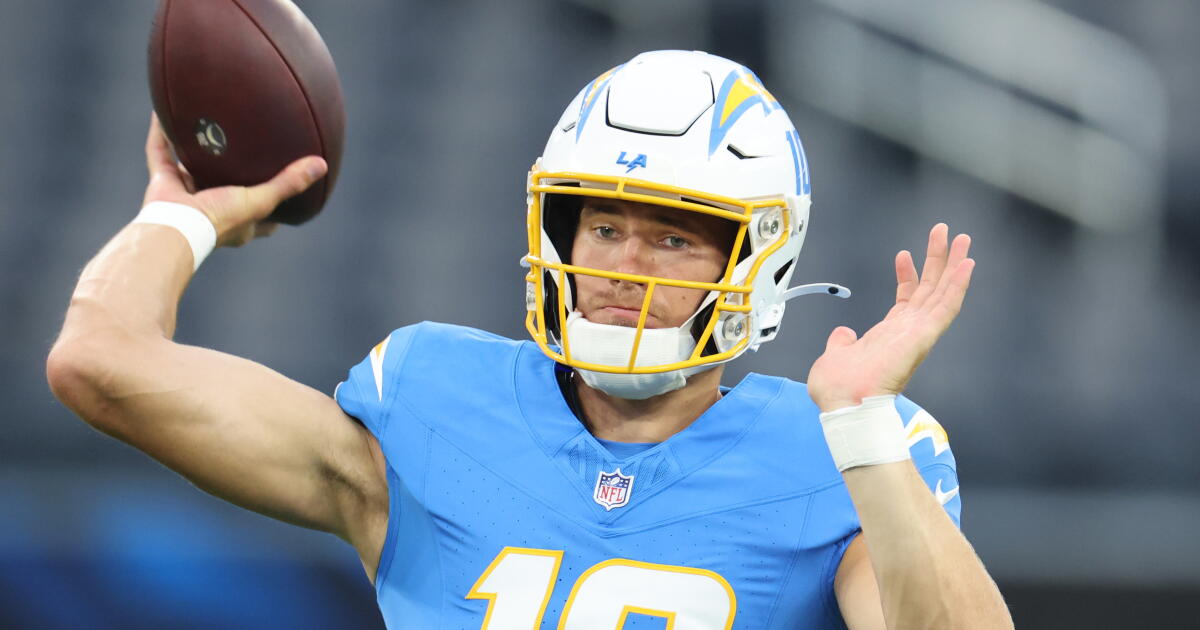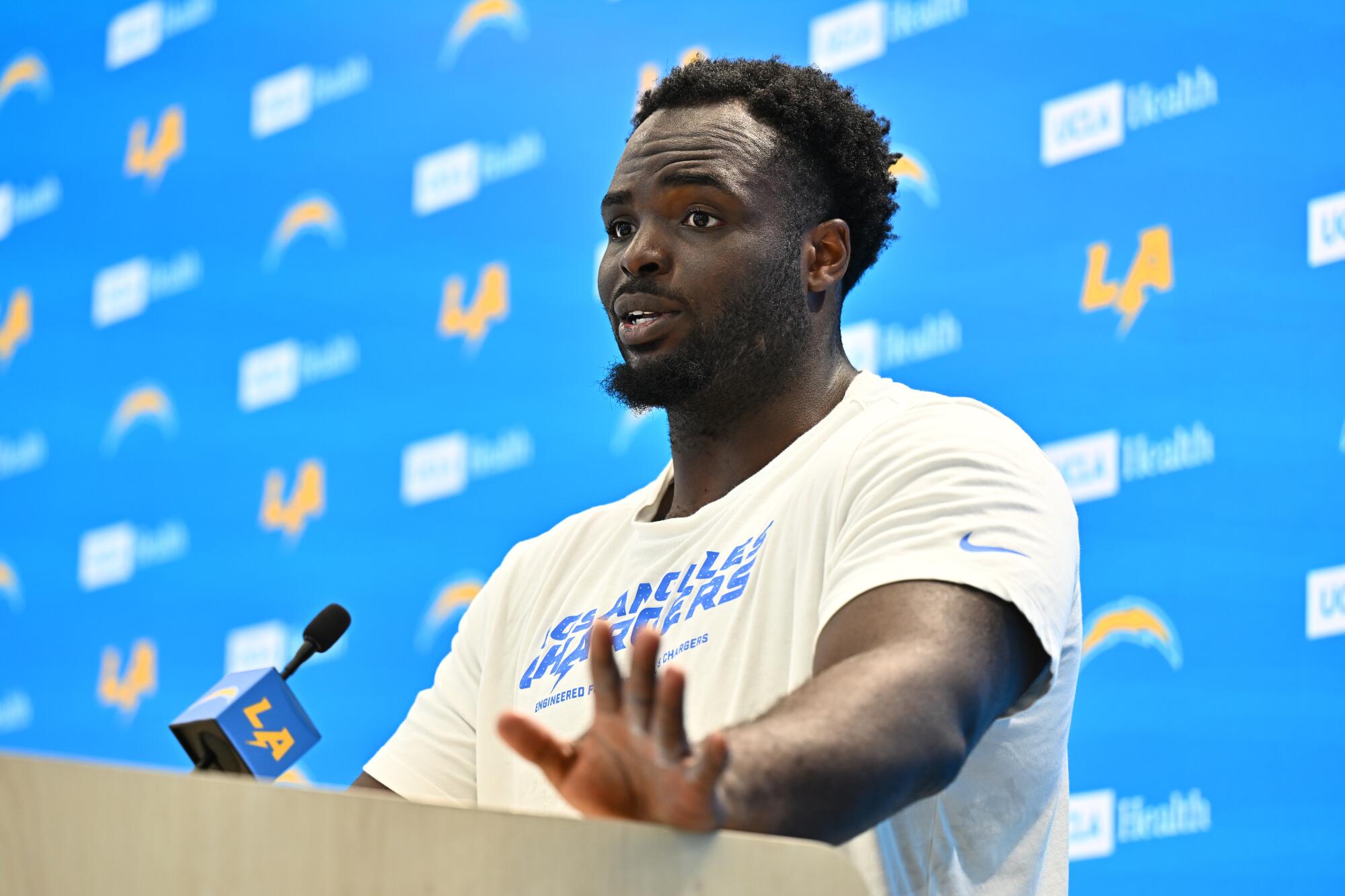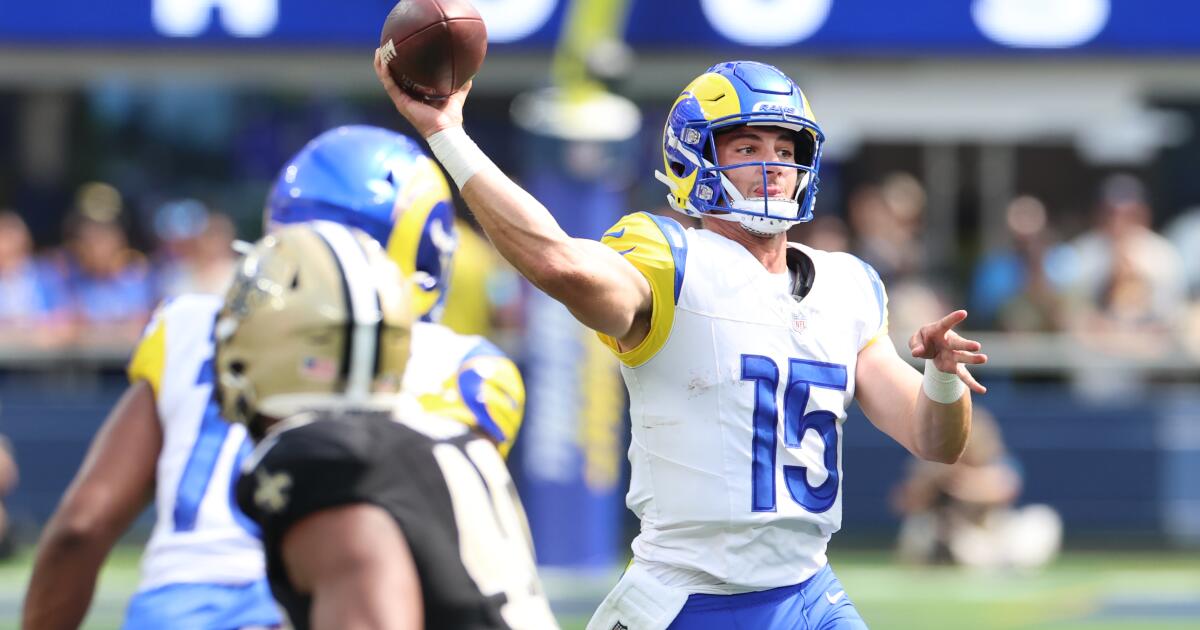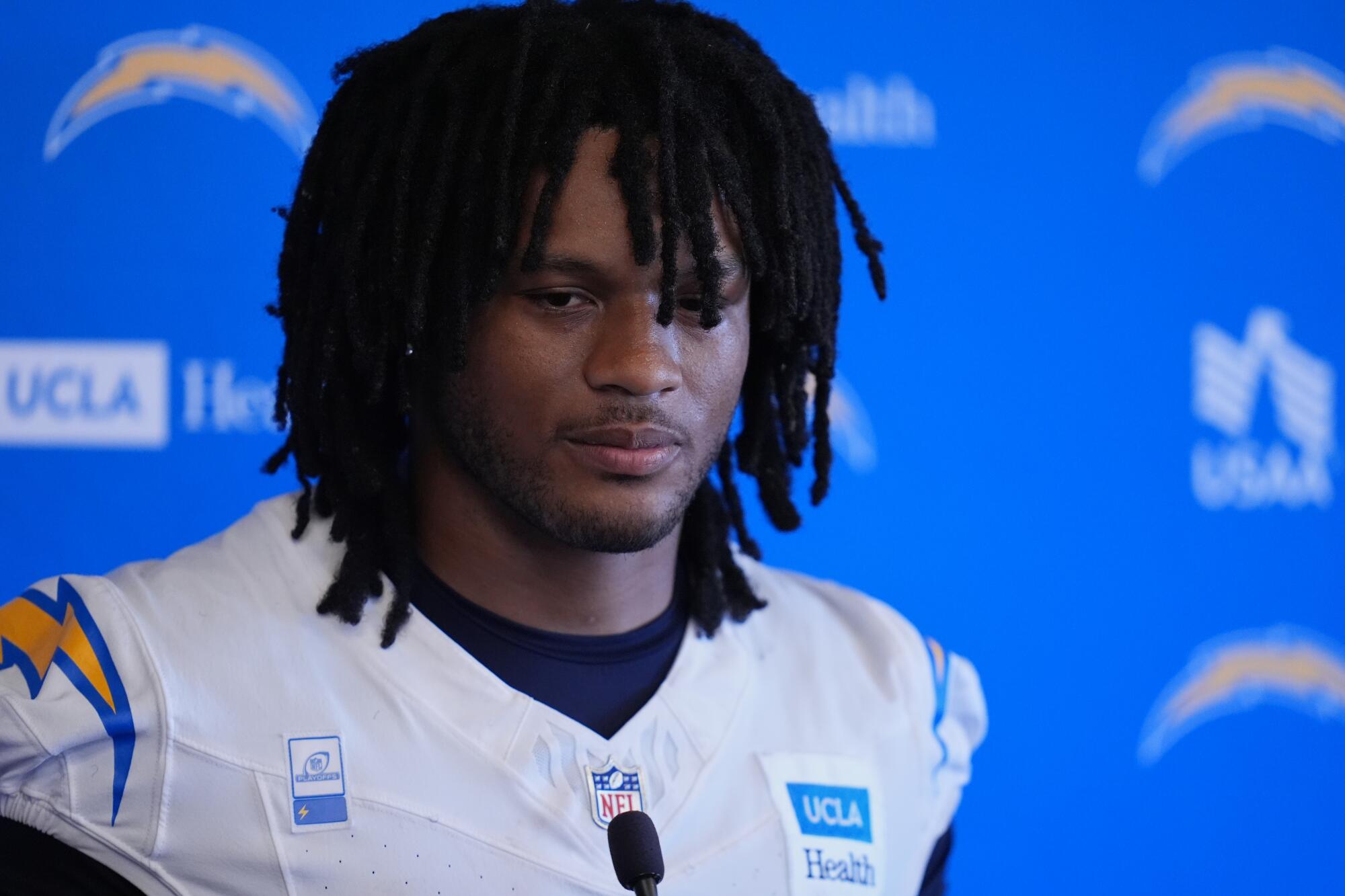
Florida center Jake Slaughter gets set during a game against Kentucky in 2024.
(Gary McCullough / Associated Press)
6-4, 303 pounds | Florida | Round 2, Pick 63
Notable: Slaughter was a finalist for the 2025 Rimington Trophy, awarded to the top center in college football. He was a two-time All-American and three-year starter at Florida.
Last season: Slaughter, 23, ranked 18th among FBS centers in pass block grade (84.1) and third in run block grade (80.2) in 2025, per Pro Football Focus. Over 748 snaps last season, he allowed four total pressures, one sack and one hit on his way to earning All-Southeastern conference honors.
Why the Chargers drafted him: Despite Slaughter playing as a center in college, the Chargers are confident he can compete with Trevor Penning for a starting job at left guard. The Chargers like his versatility at both guard positions and center, offering them a potential starter at either position and much-needed depth. After last season’s struggles to protect quarterback Justin Herbert in the wake of injuries to Rashawn Slater and Joe Alt, it makes perfect sense Harbaugh and general manager Joe Hortiz would use a Day 2 pick to extend their flexibility on the offensive line.
It was no secret the Chargers were searching for a pass rusher in the first round of the NFL draft on Thursday night — and they found one.
The Chargers selected former Miami edge rusher Akheem Mesidor at No. 22 overall, making him the heir apparent for Khalil Mack in a pass-rushing unit that was hit hard by Odafe Oweh leaving in free agency.
“He has a relentless motor, a highly productive pass rusher, physical player versus the run,” said Chargers general manager Joe Hortiz, who added he was convinced Mesidor would not be available at No. 22. “Just a guy whose motor never turns off when you put the film on.
“He was on a heater all year and played some of his best ball down the stretch in the playoffs. Just really fired up to get him.”
The 6-foot-3, 259-pound Mesidor should provide immediate depth to a edge-rushing unit that needs to recoup some of the production Oweh took to Washington. And with Mack’s career being renewed on a year-to-year basis, Mesidor will get the chance to learn from Mack, Tuli Tuipulotu and Bud Dupree before seeing a likely starting role in the seasons ahead.
“I finally know where I’m going and I can’t wait to get there and move all my stuff out to the West Coast,” Mesidor said in a conference call with reporters. “I want people to look at me like, man, this guy came to work.
“I am ready to play right now. I have the motor and relentless effort.”
Chargers coach Jim Harbaugh was excited about Mesidor joining Tuipulotu and Mack on the field: “That’s fire, as the young people would say.”
The Chargers will be hoping Mesidor is a quick learner — at 25 years old, the Canadian-born Mesidor is older than a typical first-round pick.
Hortiz wasn’t concerned about Mesidor’s age being an issue.
“Age is just a number. He is very experienced,” Hortiz told reporters. “We got a guy who is 35 years old [Mack] who is still kicking ass.”
Still, Mesidor has intimidating credentials. He had 35½ career sacks and posted 12½ sacks with Miami last season in its run to the national championship game. He also had 17½ tackles for loss last season. He finished 2025 with the sixth-best defense grade (92.5) by Pro Football Focus and had the third-best run defense grade (88.3) among FBS edge rushers.
The one concern with Mesidor are the injury issues that lengthened his stay in the college ranks to six years. He underwent shoulder surgery in 2021 and in 2022 had surgery to repair ligaments in both feet. In 2025, however, he played in 15 of 16 games for the Hurricanes.
The Chargers had plenty of options for a pass rusher at No. 22 — Malachi Lawrence, T.J. Parker, Keldric Faulk and Dillon Thieneman were still available — but Mesidor was the player they wanted. Hortiz said Mesidor’s standout play in the postseason with Miami coupled with how he impressed them at the NFL scouting combine ultimately played big factors in their decision to draft him.
“[People] talked about how much of a worker he is, how great of a person he is, focused,” Hortiz said. “We interviewed him in Indy and you just felt that in the room, he’s a football player.
“Mature, driven, intelligent, wants to work. He’s going to fit right in here.”
Chargers pick Jake Slaughter in second round
Florida center Jake Slaughter gets set during a game against Kentucky in 2024.
(Gary McCullough / Associated Press)
The Chargers bolstered their offensive line by selecting former Florida center Jake Slaughter at No. 63 overall in the second round of the draft on Friday.
Hortiz said the Chargers intend to play the 6-foot-4, 303-pound Slaughter primarily at guard as they look to replace Zion Johnson, who left in free agency. Slaughter, 23, ranked 18th among FBS centers in pass block grade (84.1) and third in run block grade (80.2) in 2025, per Pro Football Focus. Over 748 snaps last season, he allowed four total pressures, one sack and one hit.
A three-year starter at Florida, Slaughter is expected to compete with Trevor Penning for a starting role at left guard. He also could be a backup for right guard Cole Strange and center Tyler Biadasz, Harbaugh said.
“We feel like he fits the bill at both positions,” Hortiz said.
Chargers quarterback Justin Herbert was sacked 54 times in 2025, third most in the NFL, and finding offensive line depth was among the team’s priorities entering the draft.
The Chargers picked Slaughter after they traded the No. 55 pick to the New England Patriots for the 63rd, 131st and 202nd picks in this year’s draft. They later traded out of the third round, sending their No. 86 pick to the Cleveland Browns in exchange for the 105th (fourth round), 145th (fourth) and 206th (sixth) picks. The Chargers also have the Nos. 123 (fourth) and 204 (sixth) picks, giving them seven selections heading into Day 3.
It was not just a nation of sports fans and media that became entranced when former Chargers great Philip Rivers, like a soldier, answered the call to duty and joined another one of his former teams, the Indianapolis Colts, at age 44, five years after his last game. (Five years after! No misprint). Former players, like me, were curious and envious.
This was a selfless, noble act by Phil. A player is not eligible for the Hall of Fame until five years after his last season. Thus, Phil has delayed his consideration as a candidate by another five years.
The winter is not merely a matter of age; it is long after the time when the pro football player lived a life at full throttle, doing what years of unromantic labor crafted his mind and body to do.
Jim Porter, the president and chief executive officer of the Pro Football Hall of Fame, reported that about 35 million males, from youth leagues to high schools to colleges, have played organized football. Of that total, only about 22,000 have played in a professional game. Shameful pride compels me to say there are only about 300 players in the Hall of Fame.
Colts quarterback Philip Rivers throws the ball during a game against the San Francisco 49ers on Dec. 22 in Indianapolis.
(Zach Bolinger / Associated Press)
Now, at 88 years old, I am in that winter of life; a time long after leaving that locker room, a place that was alive with bravado and bonds with teammates, each knowing the devastating work it took to, not only get there, but to stay there, because each year the team would bring in a fresh group of draftees and players acquired by trade who wanted your spot. As teammates, we had an unspoken contract to do the drills to the extent that the movements become instinct, to do the work, to play injured, to show up.
The memories of teammates stay fresh. I will share a few stories that stick with me about players early Charger fans will recall:
Power of Alworth
San Diego Chargers wide receiver Lance Alworth poses for a photo in 1970.
(Associated Press)
Lance Alworth is in the Pro Football Hall of Fame. Our team in the ‘60s had many players that deserve to be called great; however, we all held Lance in special regard because he encompassed high levels of skill and character. He had speed, elusiveness, and he blocked (something of a dirty word to many wide receivers). The best way to describe how I felt about Lance is to relate an incident that took place when our plane was returning from an East Coast game. The plane hit a long stretch of weather so bad that it caused the plane to rise and drop and shake to such an extent that I knew it was going to crash and kill us all. I truly felt it was all over. Then I remembered that Lance was on board and I relaxed, thinking we are safe because God would not kill Lance. I am still amused that I actually thought that.
A formidable man
Ernie Ladd, seen here in action for the San Diego Chargers, on Oct. 29, 1963.
(Associated Press)
Ernie Ladd was a 6-foot-9, 325-pound defensive tackle who played the position with skill and fury and, for four seasons, before severe knee injuries reduced him from great to good, was as skilled as anyone who ever played the position. And strong. Ernie joined the Chargers in 1961. In 1963, coach Sid Gilman made the Chargers the first team in professional football to employ a strength coach and direct that all players begin a weight-training program. At that time, I was one of only a few players in professional football that lifted year-round because coaches, at all levels of football, discouraged weightlifting, believing it tied up an athlete’s muscles. Ernie had never lifted weights. During our first training session with our strength coach, Alvin Roy, Ernie lifted 300 pounds over his head. I had trained for years and my best lift at that time was a military press of 325 pounds.
He demonstrated strength and restraint when a dispute arose between him and a teammate, who I will refer to as X, a defensive lineman whose play fell far below expectations when he was a high draft choice. Ernie was given to fun-loving razzing of others in the locker room. X took offense and swung his fist at Ernie. Ernie caught the fist in his big right hand, then grabbed X’s forearm and bent the wrist up, forcing X to the ground. Ernie then said, “X, if I let you up, are we done?” X, red with embarrassment, said it was over and Ernie released him.
The reason this stuck with me was because it reminded of an incident in the John Steinbeck novel, “Of Mice and Men,” in which Lennie, a slow-witted worker on a ranch, was being repeatedly struck by the ranch foreman until Lennie caught the foreman’s fist in the air and crushed his hand. The reference is a bit strained because Ernie was extremely bright.
Ernie was the most joyful game participant I had ever seen, bright and quick-witted, laughing before a game, getting energy from the thrill of what was about to take place. Before one of our games, he said to me in a mockingly serious voice, “Ronnie Jack, I hope I don’t kill anyone out there today. If I do, I want you to represent me and plead self-defense.” At the time, I was going to law school at night.
Surprising Wright
Ernie Wright left college early and joined the team at age of 20, the same year I signed up for the Chargers — 1960. He played offensive left tackle, making All-Pro several times. He was extremely bright, great work ethic, and proved it by having a very successful post-football business career.
Different players have different game-day, pre-event routines. I tried to stay calm and collected no matter how big the moment. I believed that if I allowed myself to get charged up by adrenaline rushes before the game started, I would use up energy I needed for the entire game.
My pregame ritual became a curious thing for Ernie. After one of our games, Ernie approached me, and the following conversation took place:
Ernie: I have been watching you before games and seeing your lips moving and I thought you were praying. I finally decided today to get closer so that I could hear what you were praying for. Was it for a team to win, was it to kick butt. You were singing to yourself! You were singing “Fly Me to the Moon.” Is that what you have been doing before all these games?
Me: That’s it. It is my way of staying calm.
Ernie (laughing): And here I thought you were deeply religious, and I have been careful not to swear around you.
A mind for politics
Republican vice presidential candidate Jack Kemp accepts a jersey from football players at Fairfax High in 1996.
(John Hayes / Associated Press)
Jack Kemp was the Chargers’ first quarterback. After an injury in his third year, he played for the Buffalo Bills. After football, he became a congressman in the Buffalo area and, later, presidential candidate Bob Dole’s choice to join his Republican ticket as his vice presidential running mate. Jack and I were training camp roommates during our first year with the Chargers. We became close friends. Jack was constantly thinking about politics and the relationship between government and the public and how power and policy shape everyday life and collective freedom.
Jack’s early political beliefs embraced the John Birch Society, a movement that felt expansive federal power is a threat to individual liberty. Among the Birch beliefs that Jack embraced was that there should not be Social Security, that if it was absent, people would then accept the responsibility of regularly putting away funds for their retirement.
During the week before a game in San Diego, I told Jack that Social Security is earned insurance, not welfare, that it spreads the risks across society, and keeps seniors out of poverty. I gave as an example my mother, who was a first-generation American with only a fifth-grade education who, prior to my retiring her when I signed with the Chargers, held minimum wage jobs that barely covered monthly expenses of her raising my brother and me by herself. I told Jack that her, and likely millions like her, given the choice of setting aside a dollar a month for retirement or spending it to care for her family, would place family first.
The depth of Jack’s constant thinking of politics became clear to me the Sunday of that week. I have forgotten the name of our opponent, but I do remember that it was a brutally contested game on a very hot day and we were ahead by only three points. At halftime, our team was walking toward the locker room when I heard Jack call out to me: “Ron, Ron, wait up.” I thought he was going to ask my opinion on what run plays would be best to call. Nope. Jack said: “I’ve been thinking about what you said about Social Security and people like your mother. I agree with you. Social Security must stay.” Then he was back to football: “OK, then, let’s get ‘em.”
I was surprised. It was a, “Wait … did that just happen?” moment. We were in the middle of a football game!
Being a part of something special
Athletes, as a group, have always been ahead of the country in improving racial and religious relations among the population. I am reminded of my senior year at the University of Southern California in 1959 when Willie Wood and I were elected co-captains of the football team. That was done at a time when 99% of the fraternities at the school barred us from membership because Willie was Black and I was Jewish. That sentiment in America meant nothing to our predominately white Christian teammates who, true to the nature of sports, judged teammates only on their character, work ethic and production.
Missing the demands of the game
And then there were the opponents. How deeply they are missed, those men across the line who made excellence necessary. While it is true that some opponents were less skilled than others, the collisions with all of them were just as real.
Playing against greatness was a measurement of who you were. I had the, yes, the pleasure of playing directly against fellow Hall members such as Deacon Jones, Buck Buchanon, Bobby Bell and Claude Humphrey, and a slew of other notable defensive linemen. They, and others, were equally committed to stopping me from doing my job.
It has now been 54 years since I left the game and I still miss it.
Mix was inducted into the Pro Football Hall of Fame in 1979.
Baltimore Ravens tight end Charlie Kolar warms up before a game against the Rams on Oct. 12.
(Nick Wass / Associated Press)
The Chargers didn’t hesitate to bolster their run-blocking options for new offensive coordinator Mike McDaniel, agreeing to terms with former Baltimore Ravens tight end Charlie Kolar.
Kolar and the Chargers agreed to a three-year, $24.3-million deal that includes $17 million in guarantees, NFL Media reported.
Widely considered the best run-blocking tight end available ahead of free agency, Kolar should help an uneven Chargers running attack that forced coach Jim Harbaugh to often rely too much on quarterback Justin Herbert — even when his running backs were healthy.
Kolar can also help complement tight end Oronde Gadsden II in the passing game when necessary, but he should mostly serve as a replacement for Will Dissly, who was released by the team last week. It’s also no coincidence that Kolar played for Harbaugh’s brother, John, in Baltimore and was drafted in 2022 when Chargers general manager Joe Hortiz was the director of player personnel for the Ravens.
Kolar, 27, had 10 catches for 142 yards and two touchdowns last season. In four seasons with the Ravens, he had 30 catches for 409 yards and four touchdowns.
Like most Chargers offseasons, it’s clear Hortiz is prioritizing ways to add to the Chargers’ offense while also bolstering its protection options. On Sunday, the team agreed to terms with Alec Ingold, reuniting the former Miami Dolphins fullback with McDaniel.