
charge

ICE officer wanted for shooting a man during the Minneapolis crackdown is arrested in Texas

A federal immigration officer wanted for shooting a Venezuelan man during the Trump administration’s Minnesota crackdown was arrested Friday in Texas, authorities said.

Christian Castro, of the Immigration and Customs Enforcement agency, was taken into custody 11 days after Minneapolis prosecutors charged him with assault and falsely reporting a crime in the Jan. 14 nonfatal shooting of Julio Cesar Sosa-Celis.

Hennepin County, Minnesota prosecutors said the state’s Bureau of Criminal Apprehension located Castro, 52, in Texas and worked with agents from the Department of Homeland Security’s Inspector General’s Office and the Texas Rangers to arrest him.

“Today’s arrest is a critical step forward in our prosecution of Mr. Castro,” Hennepin County Attorney Mary Moriarty said.

Online court records do not list an attorney for Castro and it wasn’t immediately clear if he has one. Messages seeking comment were left with ICE, the Homeland Security Inspector General’s Office and the Texas Rangers.

Castro is the second federal agent to be charged over their conduct during the Minnesota crackdown, which was known as Operation Metro Surge. He is one of two agents that ICE Director Todd Lyons said lied about the circumstances of the incident.

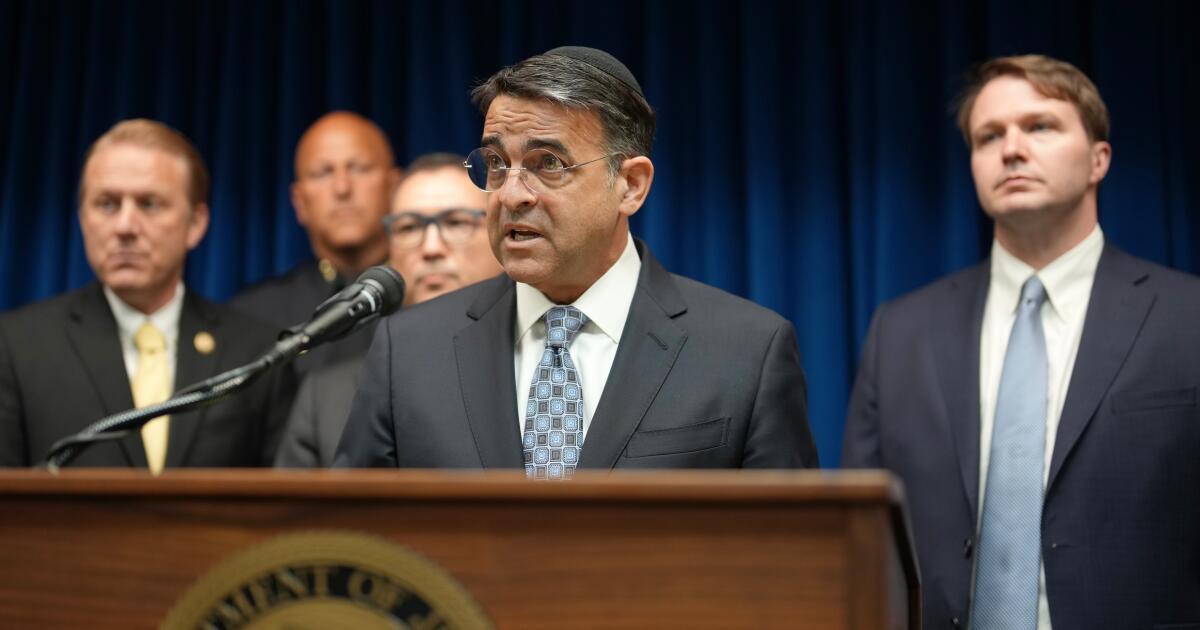
Hennepin County attorney Mary Moriarty holds up a document containing charges

Hennepin County attorney Mary Moriarty holds up a document containing charges against ICE agent Christian Castro during a news conference at the Hennepin County Government Center in Minneapolis, on Monday, May 18, 2026.

(Renée Jones Schneider/Minnesota Star Tribune Via Associated Press)

According to prosecutors, Castro fired through a home’s front door and shot Sosa-Celis in the thigh after Castro and another officer chased a different man, Alfredo Alejandro Aljorna, to the Minneapolis apartment duplex where he and Sosa-Celis lived. Sosa-Celis and Aljorna were legally in the U.S., Moriarty said.

Federal authorities initially accused Sosa-Celis and Aljorna of beating an officer with a broom handle and a snow shovel. A federal judge later dismissed the charges, and ICE and the Justice Department opened an investigation into whether officers lied about what happened.

In a statement after the charges were announced, ICE said the U.S. attorney’s office was investigating statements made by officers, who could face disciplinary action including being fired and prosecuted. ICE called the Hennepin County attorney’s action “unlawful and nothing more than a political stunt.” DHS’s Inspector General’s Office, which Moriarty credited with assisting in the arrest, is separate from ICE and is meant to serve as a watchdog for DHS agencies, including ICE.

Minneapolis last month released video showing the moments before Sosa-Celis’s shooting, captured from a distance by a city-owned security camera.

The video appears to show a person standing with a snow shovel outside the house, near the street, then retreating toward the house and tossing the shovel into the yard. This happens as a person being chased by another person runs up from the street, falls on the sidewalk, gets up, and keeps heading toward the house.

The three appear to scuffle near the front steps for about 10 seconds. The exact moment when Sosa-Celis is shot isn’t clear. A car with flashing lights pulls up, and another person walks up.

The Trump administration sent thousands of officers to the Minneapolis and St. Paul area as part of President Trump’s national deportation campaign and considered Operation Metro Surge a success.

But tensions mounted during the weekslong campaign, and the shooting deaths of U.S. citizens Renee Good and Alex Pretti by federal officers sparked mass unrest and raised questions about officers’ conduct.

Minnesota leaders and the Trump administration have clashed over who has the authority to investigate and prosecute federal officers for on-duty conduct.

Moriarty’s office last month charged immigration agent Gregory Donnell Morgan Jr. with assault for allegedly pointing his gun at people in a car on a highway. He turned himself in last week and his lawyer disputes the charges.

The county is also investigating Good’s and Pretti’s killings and sued the Trump administration in March to gain access to evidence in those cases and the Sosa-Celis shooting.

Source link

Packers’ Josh Jacobs released from jail but still might face charges

Green Bay Packers running back Josh Jacobs has been released from a Wisconsin jail a day after being arrested in relation to an alleged incident over the weekend. He still faces the possibility of being charged with several crimes, including some related to domestic abuse, pending further investigation.

“After reviewing the available evidence in this case, the Brown County District Attorney’s Office is not yet prepared to make a formal charging decision,” Dist. Atty. David Lasee said Wednesday in a news release. “Our office has requested additional investigation, as there is reason to believe that additional evidence may exist that would impact whether criminal charges are appropriate, and what charges would be issued.

“Mr. Jacobs will be released from custody at this time, and a final charging decision will be made by our office at a later date.”

Jail records show that Jacobs, 28, was released at 12:20 p.m.

Jacobs’ lawyers — David Chesnoff, Richard Schonfeld, and Clarence Duchac — said in a joint statement Wednesday that they remain confident their client ultimately will not be charged in the matter.

“We are extremely pleased that Josh has been released from custody and that no criminal charges have been filed against him,” they said. “As we previously stated, we encourage everyone to keep an open mind while the matter is fully reviewed. We remain confident that, once all of the evidence is gathered and evaluated, it will confirm that no charges should be brought against Josh in the future.”

According to the Hobart/Lawrence Police Department, officers were dispatched to a complaint involving Jacobs on Saturday at 8:37 a.m. He was arrested Tuesday on allegations that included strangulation and suffocation, battery-domestic abuse, criminal damage to property-domestic abuse, disorderly conduct-domestic abuse and intimidation of a victim.

Jacobs’ lawyers said in a statement Tuesday that he “vehemently denies the allegations.”

A three-time Pro Bowl selection, Jacobs spent the first five years of his NFL career with the Raiders, leading the league with 1,653 rushing yards in 2022, and the previous two seasons with the Packers.

“We are aware of the matter involving Josh Jacobs,” a Packers spokesman said Tuesday. “As it is an ongoing legal situation, we will withhold further comment.”

Speaking to reporters Wednesday at the team’s voluntary workouts, Coach Matt LaFleur said, “I know there’s going to be a lot of questions about Josh. I’m going to stick with the statement that we put out as an organization and just let the process play out.”

NFL spokesman Brian McCarthy said Tuesday that the league is “aware of the report and have been in contact with the club.”

The Associated Press contributed to this report.

Source link

Southern Poverty Law Center seeks dismissal of ‘vindictive’ indictment

A Justice Department indictment against the Southern Poverty Law Center is part of a “top-down” campaign of retribution against President Trump’s perceived political enemies and constitutes a vindictive prosecution that must be dismissed, lawyers for the nonprofit argued Tuesday in urging a judge to toss out the case.

The Alabama-based nonprofit was indicted in April on fraud and money laundering charges that accuse it of misleading donors by paying informants inside white supremacist and other extremist organizations to obtain inside information about their activities.

Lawyers for the SPLC already argued that law enforcement agencies have long known that the nonprofit paid informants to report on the movements of hate groups. They also said acting Atty. Gen. Todd Blanche made a false statement at a news conference and in interviews when he said the organization had not shared with law enforcement information it learned from informants. Blanche later appeared to walk back that claim in a television interview, saying it was true that the SPLC “selectively” shared information with law enforcement over the years.

The attorneys for the center expanded on those arguments Tuesday, saying in a motion to dismiss the case that the prosecution was the “culmination of a top-down, retributive campaign” in which Trump pushed the Justice Department “to go after those individuals and groups he deemed his political enemies, including the SPLC.”

Defense says indictment fits broader retaliation campaign

The motion was filed against the backdrop of other politically charged prosecutions that have raised concerns that the Justice Department is operating as a weapon to target Trump’s opponents. It aims to draw a parallel between the SPLC indictment and the human smuggling prosecution of Kilmar Abrego Garcia, which was dismissed Friday on similar vindictive prosecution grounds by a judge who called the case an “abuse of prosecuting power.”

The SPLC has said its now-defunct program of paying informants to infiltrate hate groups was developed to glean key insights into their activities so that potential victims could be protected. An earlier federal investigation into the practice was closed without charges, but the motion paints the current Justice Department as pursuing the case with renewed — and rushed — vigor.

The department decided to pursue the indictment without interviewing any current SPLC employees and did not seek any documents from the group until after it told defense lawyers that criminal charges were coming, the defense motion states. During a meeting requested by defense lawyers who hoped to avert to indictment, Justice Department officials informed them that the decision already had been made to pursue charges, according to the motion.

“These procedural irregularities show that the charges against the SPLC were a foregone conclusion based on prosecutorial vindictiveness — driven by the White House and FBI leadership’s retribution campaign — rather than the result of a good faith examination of the evidence,” the motion states, saying the indictment was “premised on conclusory accusations but devoid of provable facts or a proper statement of the law.”

The motion also cites whistleblower accounts that accused top Justice Department officials of rushing forward with an indictment despite internal concerns about the merits of the case and the strength of the evidence.

“For weeks, we have been arguing against these false allegations levied against the SPLC — an organization that for 55 years has stood as a beacon of hope fighting white supremacy and various forms of injustice to create a multiracial democracy where we can all live and thrive,” Bryan Fair, the interim president and chief executive officer of SPLC, said in a statement. “The government can’t prosecute the SPLC as payback for its protected speech — it violates basic constitutional rights.”

The administration has painted SPLC as partisan

Founded in 1971 as a civil rights organization, the SPLC over the decades has used litigation to fight white supremacist groups. It also tracks the activities and locations of domestic extremists. But its work has made it a popular target among Republicans who see it as overly leftist and partisan.

The center, for instance, received fresh attention last year after the assassination of conservative activist Charlie Kirk because the SPLC had included a section on the group that Kirk founded and led, Turning Point USA, in a report titled “The Year in Hate and Extremism 2024.”

FBI Director Kash Patel announced in October that the bureau would be severing its relationship with the SPLC, saying it had turned into a “partisan smear machine,” and he accused it of defaming “mainstream Americans” with its “hate map” that documents alleged antigovernment and hate groups inside the United States.

The defense motion says “animus” from senior levels of the administration helped shape the indictment.

It cites, among other comments, a statement from Trump deriding the SPLC as “a total scam run by the Democrats,” as well as a news media interview in which Harmeet Dhillon, the Justice Department’s top civil rights official, said the indictment was “personal” to her because she had “a lot of journalist friends … and groups that I’ve represented who have been targeted by the Southern Poverty Law Center.”

Tucker writes for the Associated Press.

Source link

‘Housewives’ star Erika Girardi settles $25-million civil lawsuit

Pop crooner and “Real Housewives of Beverly Hills” star Erika Girardi quietly put an end to a long and splashy legal battle over her ex-husband’s now-defunct law firm on Thursday, settling a $25-million bankruptcy lawsuit in Los Angeles federal court.

The suit alleged the singer should have known she was profiting off embezzled funds linked to the sprawling case against her ex-husband, former L.A. legal heavyweight Tom Girardi, and his firm Girardi Keese. The couple was accused of funneling millions from the law firm to prop up Erika’s music career.

Performing as Erika Jayne, she topped the charts in the 2010s with a series of raunchy dance club hits. But court records show she spent millions more than she made as a musician.

Larry W. Gabriel, an attorney for the plaintiffs in the case, wrote in a pretrial filing Monday that Erika and a company associated with her “received the benefit of [Tom] Girardi’s massive fraudulent scheme.”

Tom Girardi is currently serving a seven-year sentence in federal prison after he was convicted of wire fraud for bilking his personal-injury clients in 2024. The disgraced former attorney was found to have stolen tens of millions from his firm.

His wife’s pop hits mixed boasts about luxury brands and explicit sex acts with pulsing dance beats and a bratty falsetto, a tone actress Lake Bell famously dubbed “sexy baby voice.

In depositions taken as part of the suit, Erika said she had no knowledge of her husband’s crimes. She claimed to be ignorant about where the millions she spent on recording, merchandise, tours and “fun, playful, and sparkly outfits” were drawn from.

“I did not know how much I spent per month or per year,” she said in one exchange. “Girardi Keese paid my Amex credit card bill every month.”

Monday’s filings show Girardi Keese paid at least $14 million in charges to her American Express account between 2008 and 2020.

The payouts began in the late 2000s when Erika, then a stay-at-home mom, sought to relaunch herself as a performer. In 2016, near the height of her pop fame, her husband began to complain she was charging too much on the credit card account. After repeated entreaties to tamp down her spending, Girardi tried for the first time to look at her balance.

Soon after, Girardi grew suspicious of charges being made to her card by a Hollywood costumer — worries she reported to one of Girardi Keese’s clients, an agent in the Secret Service, records show.

On the advice of the agent’s Secret Service colleagues, she said she disputed the AMEX charges and was ultimately refunded more than half a million dollars to her personal account, despite the original payments having come from the law firm.

Erika Girardi’s attorney did not immediately respond to requests for comment Friday.

Source link

New ‘Michael Jackson: The Verdict’ documentary dives into 2005 trial

Netflix is dropping a three-part docuseries that revisits Michael Jackson’s 2005 trial in which he was acquitted on charges of child molestation.

“Michael Jackson: The Verdict” drops June 3 and features archival footage and interviews with key players involved in the trial including jurors, figures from both the defense and the prosecution, journalists who were inside the courtroom and other eyewitnesses who saw the events unfold firsthand.

“It has been 20 years since the trial of Michael Jackson in which he was found not guilty. Yet, to this day, controversy still rages,” the filmmakers said. “No cameras were allowed in court, and so the public’s view of the facts at the time were filtered by commentators and presented piecemeal. It was time to take a forensic look at the trial as a whole.

“Anyone interested in the Michael Jackson story should feel this documentary gives them a window into what was largely a closed event and a chance to feel closer to what happened.”

The Santa Barbara Superior Court trial lasted 14 weeks, and the jury, which included eight women and four men, deliberated for more than 30 hours across seven days.

Jackson was acquitted on 10 felony charges: four counts of child molestation, four counts of plying a minor with alcohol in order to molest him, one count of attempted child molestation and one count of conspiracy to hold the boy and his family captive at the Neverland Ranch. He faced more than 20 years in prison.

Produced by Candle True Stories, the production company behind Netflix’s “Untold: The Liver King,” and directed by Nick Green, “Michael Jackson: The Verdict,” comes at a time of renewed interest in the “King of Pop.”

The Jackson-estate-approved biopic “Michael” hit theaters last month, and depicts the origin story of the hitmaker from childhood through his upward trajectory to superstar status in the 1980s. Notably, the movie omitted the slew of allegations that followed Jackson from the ’90s until his death in 2009.

Source link

U.S. announces criminal case against former Cuban President Raúl Castro

Federal prosecutors on Wednesday announced charges against former Cuban President Raúl Castro in the 1996 downing of civilian planes operated by Miami-based exiles as the Trump administration escalated pressure on the socialist government.

The indictment was related to Castro’s alleged role in the shootdown of two small planes operated by the exile group Brothers to the Rescue. Castro, now 94, was Cuba’s defense minister at the time. The charges included murder and destruction of an airplane.

Acting Atty. Gen. Todd Blanche and other top Justice Department officials made the announcement in Miami at a ceremony to honor those killed in the shootdown.

President Trump has been threatening military action in Cuba ever since U.S. forces captured the Cuban government’s longtime patron, Venezuelan President Nicolás Maduro. After ousting Maduro, the White House ordered a blockade that choked off fuel shipments to Cuba, leading to severe blackouts, food shortages and an economic collapse across the island.

Since Maduro’s capture, Trump has ratcheted up talk of regime change in Cuba after pledging earlier this year to conduct a “friendly takeover” of the country if its leadership did not open its economy to American investment and kick out U.S. adversaries.

Trump’s first administration indicted Maduro on drug-trafficking charges and used that to justify removing him from power during a surprise military raid in January that whisked the Venezuelan leader to New York to face trial.

Secretary of State Marco Rubio on Wednesday urged the Cuban people to demand a free-market economy with new leadership that he said will chart a new course in relations with the U.S.

“In the U.S., we are ready to open a new chapter in the relationship between our people,” Rubio, the son of Cuban immigrants, said in a Spanish-language video message. “Currently, the only thing standing in the way of a better future are those who control your country.”

Cuba’s deputy foreign minister, Carlos F. de Cossío lashed out at Rubio on X, saying he “lies so repeatedly and unscrupulously about Cuba and tries to justify the aggression he inflicts on the Cuban people.” Rubio “knows full well that there is no excuse for such cruel and ruthless aggression.”

Raúl Castro believed to wield power behind the scenes

There’s no indication Castro will be taken into U.S. custody anytime soon.

He took over as president from his ailing older brother Fidel Castro in 2006 before handing power to a trusted loyalist, Díaz-Canel, in 2018.

While he retired in 2021 as head of the Cuban Communist Party, he is widely believed to wield power behind the scenes, underscored by the prominence of his grandson, Raúl Guillermo Rodríguez Castro, who previously met secretly with Rubio.

Last week, CIA Director John Ratcliffe traveled to Havana for meetings with Cuban officials, including Castro’s grandson. Two other senior State Department officials met with the grandson in April.

“The symbolic nature is absolutely crucial,” said Lindsey Lazopoulos Friedman, a former prosecutor at the U.S. attorney’s office in Miami who handled national security cases and crimes involving Cubans.

“Even though Raúl Castro will likely stay and die in Cuba, you can use the indictment as a pressure point, a tactical advantage, to extract other concessions like the release of prisoners or to keep Russia out,” she added.

The investigation into Castro stretches back to the 1990s

Starting in 1995, planes flown by members of Brothers to the Rescue, a group founded by Cuban exiles, buzzed over Havana dropping leaflets urging Cubans to rise up against the Castro government.

The Cubans protested to the U.S. government, warning that they would defend their airspace. Federal Aviation Administration officials also opened an investigation and met with the group’s leaders to urge them to ground the flights, according to declassified government records obtained by George Washington University’s National Security Archive.

“This latest overflight can only be seen as further taunting of the Cuban Government,” an FAA official wrote in an email to her superiors after one intrusion in January 1996. “Worst case scenario is that one of these days the Cubans will shoot down one of these planes.”

But those calls went unheeded and on Feb. 24, 1996, missiles fired by Russian-made MiG-29 fighter jets downed two unarmed civilian Cessna planes a short distance north of Havana just beyond Cuba’s airspace. All four men aboard were killed.

Raúl Castro faced earlier indictment

Guy Lewis, who was a federal prosecutor, uncovered evidence linking senior Cuban military officials to cocaine trafficking by Colombia’s Medellin cartel. Following the shootdown, the investigation expanded, and prosecutors pursued charges against Raúl Castro for leading a vast racketeering conspiracy by Cuba’s armed forces.

“The evidence was strong,” Lewis said in an interview.

In the end, the Clinton administration indicted four individuals, including the MiG pilots, the head of the Cuban air force and the head of a Cuban spy network in Miami — the only one to see the inside of a U.S. prison — for providing valuable intelligence about the flights.

The incident led the U.S. to harden its position against Cuba, even though the Cold War had ended and the Castros’ support for revolution across Latin America was a fading memory.

But Castro himself was spared as the Clinton administration — which had quietly sought to expand relations with Cuba prior to the incident — raised foreign policy concerns about such a high-profile indictment.

“Raúl was definitely one who slipped through the noose,” Lewis said. “The crime is notorious. Three U.S. citizens and one legal permanent resident were killed in a premeditated orchestrated murder. That should never be forgotten.”

Goodman and Richer write for the Associated Press. Richer reported from Washington.

Source link

Shakira’s eight-year tax fraud nightmare ends with acquittal in Spain

Shakira’s long tax-fraud nightmare has ended with the government of Spain on the hook to refund nearly $70 million to the Colombian-born singer after prosecutors failed to prove she spent enough time in that country to owe it a chunk of her earnings.

Since 2018, the singer has been accused of defrauding the Spanish government in three cases, for the tax years 2011, 2012-2014 and 2018. Over the years, deals were offered, rejected and accepted; charges were dropped, other charges were filed; and an eight-year prison sentence was threatened.

Shakira maintained her innocence, saying in 2022 that “Spanish tax authorities saw that I was dating a Spanish citizen and started to salivate,” referring to her relationship with Barcelona-born footballer Gerard Piqué, the father of their sons Milan and Sasha. Piqué and the singer, who met in 2010 when she did “Waka Waka,” the official song of that year’s FIFA World Cup, separated in 2022.

A representative for the singer, whose full name is Shakira Isabel Mebarak Ripoll, did not respond immediately to The Times’ request for comment on the court decision.

However, despite there being no fraud, Shakira told People on Monday in a statement that “for nearly a decade, I was treated as guilty. Every step of the process was leaked, distorted, and amplified, using my name and public image to send a threatening message to the rest of the taxpayers.”

She added, “Today, that narrative crumbles, and it does so with the full force of a court ruling.”

Everything revolved around how many days Shakira spent in Spain in the years in question. With her legal residence in the Bahamas before she declared Spain her fiscal home in 2014, she had to spend more than half the year outside of her beau’s home country to avoid paying taxes there.

“They knew I wasn’t in Spain the required time, that Spain wasn’t my place of work or my source of income, but they still came after me, with their eyes on the prize,” Shakira told Elle in 2022, adding that she was confident that justice would prevail in her favor at trial. “I have enough proof.”

The amount the Spanish government owes her includes fines and interest in addition to the money she handed over, despite having no legal obligation to pay it.

In other Shakira news, she and Burna Boy just released the 2026 FIFA World Cup song, titled “Dai Dai.”

Source link

Maduro ally Alex Saab appears in U.S. court on laundering charge

People look at a mural depicting Colombian-Venezuelan businessman Alex Saab in Caracas, Venezuela, on Sunday, a day after he was extradited to the United States. On Monday, Saab made his initial appearance in a Miami courtroom. Photo by Miguel Gutierrez/EPA

May 18 (UPI) — Alex Saab, a billionaire Colombian businessman and longtime ally of ousted Venezuelan leader Nicolas Maduro, appeared in a Miami federal courtroom on Monday, days after he was extradited to the United States.

Saab, 54, made his initial court appearance in the Southern District of Florida, where a federal indictment was unsealed, charging him with conspiracy to launder money through U.S. banks.

U.S. authorities have long accused Saab of corruption, specifically of using his connections to the Maduro regime to skim money from government programs intended to benefit Venezuela’s poor and of helping Maduro evade sanctions.

The case is centered on the Venezuelan government program Local Committees for Supply and Production, known as CLAP, an acronym of its Spanish name. Created in 2016 in response to the collapse of Venezuela’s economy, CLAP was intended to provide subsidized food to the country’s poor.

Federal prosecutors allege that Saab and his unnamed co-conspirators paid bribes to Venezuelan government officials to be awarded the CLAP contracts to import food, but instead enriched themselves by siphoning hundreds of millions of dollars from the program.

The charging document further accuses Saab and others of expanding the scheme to include the illegal sale of Venezuelan oil, starting in at least 2019 and continuing until the return of the indictment, which is dated Jan. 14.

The U.S. charges stem from the accusation that at least some of the allegedly ill-gotten money was transferred through U.S.-based bank accounts. If convicted, Saab faces a maximum penalty of 20 years in prison.

“When illicit proceeds are moved through the United States financial system, our courts have jurisdiction and our prosecutors will act,” U.S. Attorney Jason Reding Quinones of the Southern District of Florida said in a statement.

The indictment announced Monday is the second a Trump administration has brought against Saab, and his extradition on Saturday is the second time he has been sent to the United States to face criminal charges.

Maduro’s government has been a target of President Donald Trump since his first administration, which sought to oust the authoritarian leader through a so-called maximum pressure campaign of sanctions, including designating Saab in 2019 over the alleged CLAP scheme.

Saab was then arrested in June 2020 in Cape Verde at the request of the United States and was extradited.

But he was returned to Venezuela by the Biden administration in 2023 in exchange for 10 detained Americans. As part of the prisoner exchange, Saab was issued a full pardon for charges included in the first indictment.

After his re-election in 2025, Trump ousted Maduro and brought him to the United States to face narco-terrorism charges in a clandestine early January military operation.

Then in February, under the government of Maduro’s former vice president, Delcy Rodriguez, who was elevated to president following her predecessor’s U.S. arrest, Venezuelan authorities detained Saab at the request of the United States.

Saab’s return to U.S. custody now raises speculation that he could be used in the federal prosecution’s case against Maduro, given his former proximity to Maduro and members of Maduro’s family.

“Saab would be a powerful witness in the prosecution of Maduro — and could offer insights into Delcy’s role in building South America’s prototypical kleptocracy,” Benjamin Gedan, a foreign policy scholar and director of the Stimson Center’s Latin America Program, said in a social media statement.

Source link

Minnesota county charges ICE officer in nonfatal shooting during Trump’s immigration crackdown

A Minnesota prosecutor on Monday announced charges against an Immigration and Customs Enforcement officer in the nonfatal shooting of a Venezuelan man during the Trump administration’s crackdown in the state.

The officer, Christian Castro, is charged with four counts of second-degree assault and one count of falsely reporting a crime in the Jan. 14 shooting of Julio Cesar Sosa-Celis, Hennepin County Atty. Mary Moriarty said at a news conference. A warrant was issued for his arrest.

“Mr. Castro is an ICE agent, but his federal badge does not make him immune from state charges for his criminal conduct in Minnesota,” Moriarty said, adding that Sosa-Celis never posed a threat. “There is no such thing as absolute immunity for federal officers who commit crimes in this state or any other.”

A federal officer shot Sosa-Celis in the thigh after he and another officer chased a different man to the apartment duplex where the man and Sosa-Celis lived. Moriarty said both Sosa-Celis and the other man were legally in the U.S.

Federal authorities initially accused Sosa-Celis and Alfredo Alejandro Aljorna of beating an officer with a broom handle and a snow shovel during the incident. But a federal judge later dismissed the charges, and federal officials opened an investigation into whether two immigration officers lied under oath about what happened.

Minneapolis last month released video of the incident captured from a distance by a city-owned security camera.

Department of Homeland Security and Justice Department officials didn’t immediately respond to emails seeking comment. Homeland Security previously said that lying under oath is a “serious federal offense” and that making false statements could result in an officer being fired or prosecuted.

The administration sent thousands of officers to the Minneapolis and St. Paul area as part of President Trump’s national deportation campaign. Homeland Security, which oversees ICE, called Operation Metro Surge its largest immigration enforcement operation ever and deemed it a success.

But tensions mounted during the weekslong campaign, and the shooting deaths of U.S. citizens Renee Good and Alex Pretti by federal officers provoked mass unrest and questions about officers’ conduct.

Hennepin County, which includes Minneapolis, has been conducting investigations into multiple incidents and filed charges last month against an ICE agent for alleged actions while on duty.

Minnesota leaders and the Trump administration have since clashed over which has the authority to investigate and prosecute officers for conduct while on duty. The Trump administration has suggested that Minnesota officials don’t have jurisdiction.

State officials have said they don’t trust the federal government to investigate itself or hold officers accountable.

“There’s no modern precedent for what happened to the people here in Minnesota,” Moriarty said Monday. “So it requires a lot of us to dig in and look at ways to hold people accountable that we probably never thought we would be looking at in our careers.”

Hennepin County continues to investigate Good’s and Pretti’s killings and sued the administration in March over access to evidence in the two cases, as well as in the case involving Sosa-Celis. Although Moriarty hasn’t charged anyone in either killing, she has said she’s confident her office’s investigations will bring transparency, even if not criminal prosecution.

Fingerhut and Sullivan write for the Associated Press. Fingerhut reported from Des Moines, Iowa.

Source link

Thousands of drivers & passengers at major Scots airport face new £8.50 charge from TODAY

SCORES of drivers face a new charge at a major Scottish airport as a price increase begins today.

New drop-off charges have been rolled out at Edinburgh Airport, Scotland‘s busiest air hub which was used by 17 million passengers last year.

The Edinburgh Airport drop-off zone with signs for drop-off and authorized taxis.
Drop off fees at Edinburgh Airport have increased from today Credit: Andrew Barr – The Sun Glasgow
Passengers walking under a covered walkway past a "Departures" sign with a tram on tracks nearby.
The fees were blamed on surging business rates Credit: Andrew Barr – The Sun Glasgow

It will now cost £8.50 for a ten-minute slot to either drop-off or pick someone up near the main terminal.

The fees have been hiked by £2.50 and were rolled out today.

Bosses have also scrapped a 50 per cent discount for people driving electric vehicles to the airport.

Instead, more spaces have been added to the free drop-off area – where motorists can park for free for 30 minutes.

The price hike has been blamed on a surge in business rates.

Airport chiefs claim they have been hit by a hit by a 142 per cent rise – an £8million increase – which was branded “simply unacceptable”.

Edinburgh Airport’s chief executive Gordon Dewar said: “This decision to impose an unplanned and wholly disproportionate £8million rates increase has an immediate and negative impact on our business.

“We made this clear in correspondence with the Lothians Assessor, who set the increase, and in discussions with the Scottish Government, which has endorsed it.

“A 142% increase reduces our ability to invest, grow and compete. In practical terms, it equates to funding around 200 jobs, two aircraft stands, or five new security lanes. It is not a cost that can be absorbed; it must be covered, and trade-offs like this are unfortunately unavoidable.

“Like many across the hospitality and tourism sectors who have seen business rates soar, we have no choice but to pass part of this cost on to passengers.

“We had not planned to raise fees this year, but the absence of a transitional relief scheme – equivalent to that available in England and Wales – leaves us with no alternative.

“We have always accepted that, given our size, we should pay more, but the scale of this increase is simply unacceptable.”

Bosses previously wrote to the Convenor of the Lothian Valuation Joint Board, which sets non-domestic rates, as well as the First Minister and the Public Finance Minister, to outline their concerns.

Mr Dewar added: “We have made clear to both the Assessor and the Scottish Government that a system which produces such markedly different outcomes for comparable assets operating within the same national economy cannot credibly be described as fair, proportionate or fit for a modern Scotland. This systemic inconsistency lies at the heart of our concern.”

It comes just months after Glasgow and Aberdeen airports – both owned by AGS – increased their drop off fees.

It costs £7 for people to park for up to 15 minutes at both of the sites.

A Scottish Government spokesperson said: “The valuation of all non-domestic property is a matter for the Scottish Assessors who are independent of central and local government.
 
“The Scottish Government estimates Edinburgh Airport will, with Transitional Relief,  have a net non-domestic rates bill of around £8.1 million for 2026-27, compared to £5.4 million before revaluation.
 
“The Scottish Government’s Revaluation Transitional Relief protects those most affected at revaluation – including airports – and will cap increases in gross liabilities up to the next revaluation in 2029.”

Source link