CFP

Notre Dame leaders are cowards for backing out of USC rivalry

The world of college football may be awash in uncertainty, but the last several weeks have proven one thing beyond a shadow of a doubt.

Nobody runs like Notre Dame.

When the Irish got jobbed by the College Football Playoff committee and insanely were left out of the CFP, they refused to play another game this season.

Notre Dame ran from the Pop Tarts Bowl.

Then came Monday’s announcement that Notre Dame no longer will regularly play USC, essentially ending a 100-year-old rivalry because the Irish didn’t want to change the dates of the game.

Notre Dame ran from the Trojans.

Call them the Fightin’ Chickens, a once-proud Irish program that demands acquiescence or it will take its ball and go home.

The Irish could have played USC at the beginning of the season, but refused. The Irish could have kept the rivalry alive with a scheduling tweak that would have helped both teams, but refused.

Lots of folks are going to blame USC and coach Lincoln Riley for butchering a Knute Rockne-born tradition that accounted for 78 straight games, not counting 2020, the COVID-19 year. That’s wrong. Nobody has been more critical of Riley than this space, but he’s not the bad guy here.

Anybody who felt the buzz around the CFP first-round games last weekend would attest, this is where USC needs to be playing. If the Trojans truly want to return to greatness, being selected for the CFP is the goal. Not beating Notre Dame. Not even beating UCLA. It’s all about the tournament.

USC needs to put itself in the best possible position to be playing on a mid-December weekend, and that means no longer being the only Big Ten school to play a major nonconference game in the middle of the season or later.

The schedule has become tough enough. The Trojans don’t need to make it tougher with the kind of game nobody else in their conference is playing.

They need Notre Dame in August, not in late October or mid-November.

But, as it turns out, Notre Dame believes it doesn’t need USC at all.

The Irish signed a deal with the CFP that stipulates, beginning next year, if they are ranked in the top 12, they are guaranteed a playoff berth. They can get in the playoffs without risking a loss to the Trojans. They can play it safe and schedule easy and back right in.

USC doesn’t have that luxury. USC isn’t guaranteed squat. USC has a 2026 schedule that even without Notre Dame is a nightmare.

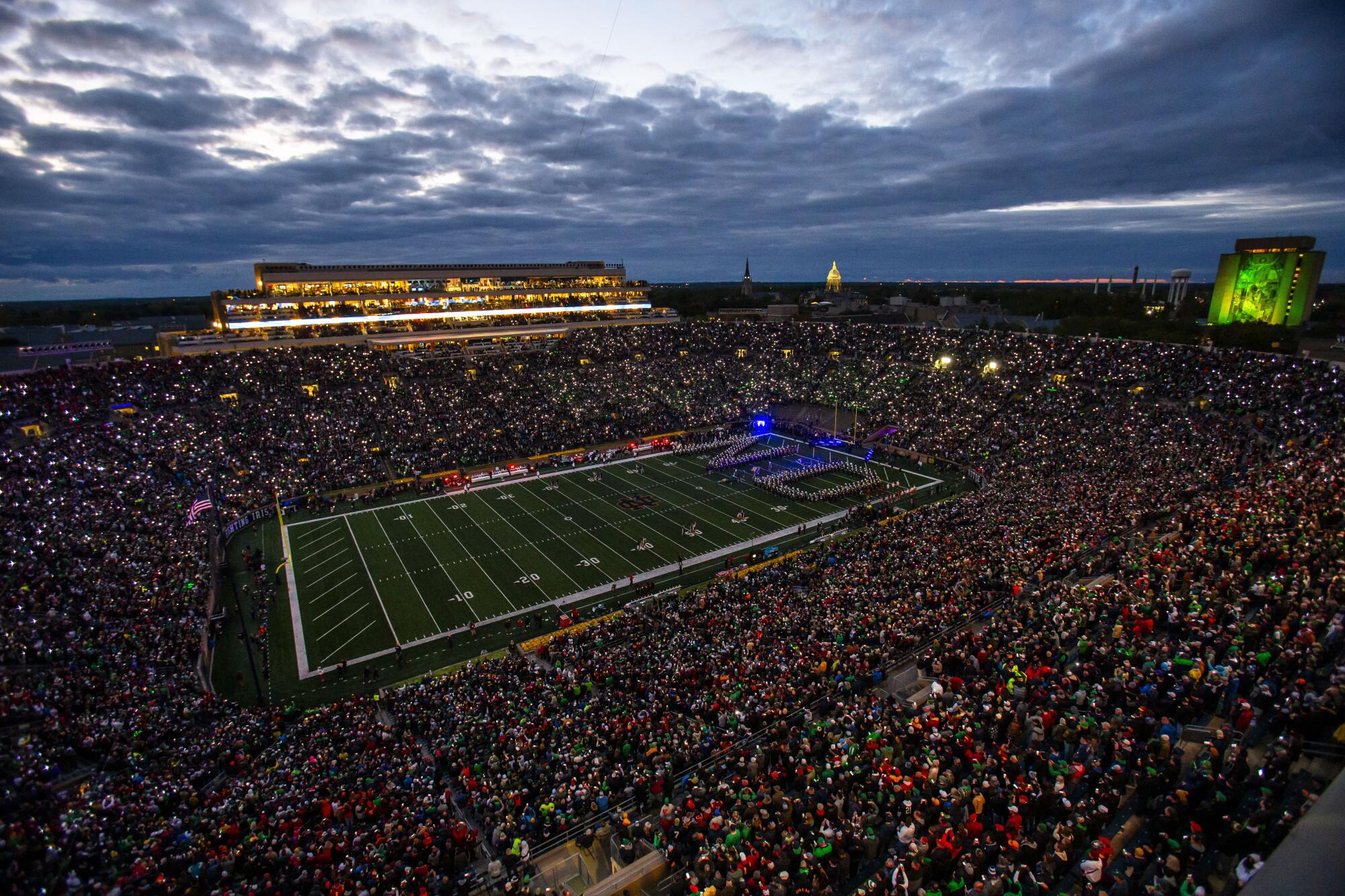
USC and Notre Dame prepare to play in a packed Notre Dame Stadium in October 2023.

USC and Notre Dame prepare to play in a packed Notre Dame Stadium in October 2023.

(Michael Caterina / Associated Press)

Home games against Ohio State and Oregon. Road games at Indiana and Penn State.

USC doesn’t need a midseason game against Notre Dame making that road even harder.

Jennifer Cohen, the USC athletic director, said as much in a recently posted open letter to the Trojans community.

“USC is the only team in the Big Ten to play a nonconference road game after Week 4 in either of the past two seasons,” she wrote. “USC is also the only team to play a nonconference game after Week 4 in both seasons.”

Trojans fans love the rivalry. The college football world loves the rivalry. It’s Anthony Davis, it’s Carson Palmer, it’s the Bush Push, it has won Heismans and cemented championships.

But times have changed. The landscape is evolving. Everything that college football once represented is up for debate. Even the most venerable of traditions is subject to adjustments.

That’s what the Trojans wanted to do. Not eliminate, but adjust. But Notre Dame football adjusts for no one.

It was indeed a travesty that the two-loss Irish, winners of their last 10 games by double digits, did not get a spot in the national tournament. By the end of the season they were arguably one of the four best teams in the country. They easily could have captured the crown.

Tulane? James Madison? Are you kidding me? As the opening games revealed — the two AAA teams were outscored 92-44 — there is no place for Cinderellas in the CFP.

But that was no reason for Notre Dame to back out of the bowls completely, sacrificing the final game in the careers of the Irish players who will not be going to the NFL just to make a whining point that resonated with nobody.

And, besides, there’s another way Notre Dame could have been a lock for the playoffs.

Join a conference, fool!

By keeping the football team out of the otherwise Irish-infected Atlantic Coast Conference, Notre Dame is raking in big TV bucks that it doesn’t have to share. But this means the Irish are subject to the whims of a committee that could, and did, unconscionably leave them out.

Notre Dame always wants it both ways. It wants its independence, but also wants to dictate a schedule filled with conference-affiliated teams.

In demanding that their game be played in August or not at all, USC finally called Notre Dame’s bluff.

And the Irish did what they recently have done best.

They ran.

The team that initially will replace USC on the Notre Dame schedule?

It’s Brigham Young, the same team that Notre Dame snubbed in the Pop Tarts Bowl.

Put that in your toaster and cook it.

Source link

James Madison fights, but Group of Five teams still struggle in CFP

Perhaps it was James Madison going for it twice on fourth down on its first drive of the game.

Or, maybe it was coach Bob Chesney calling for a wide receiver pass on the Dukes’ second series of the evening. Even 12th-ranked James Madison successfully pulling off a fake punt could have adequately explained what the scoreboard failed to convey.

It was clear that the fifth-ranked Oregon Ducks were in a different class than their visitors in a 51-34 win in a College Football Playoff first round matchup Saturday at Autzen Stadium. Oregon led 48-13 midway through the third quarter before the Dukes added three late touchdowns to make the final score appear closer than the game really was.

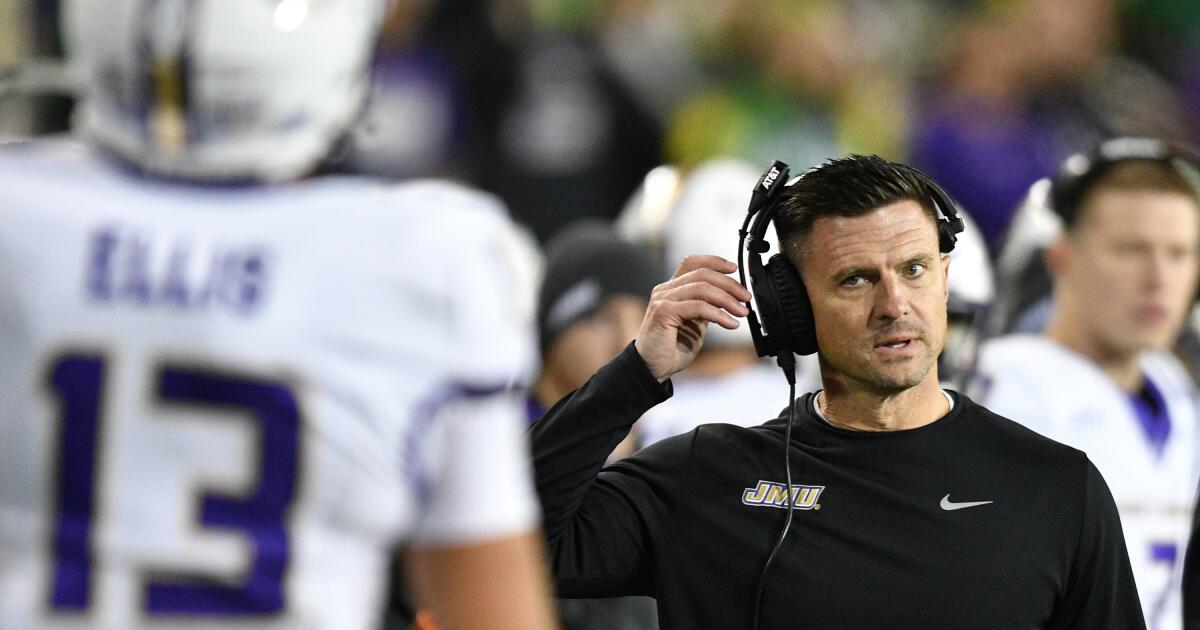
“I think the scoreboard itself, every time we got down there we kind of shot ourselves in the foot,” said Chesney, who takes over as UCLA’s head coach after the JMU loss. “If we did not do that, if we did not end with 13 penalties, is this a little bit of a different game? Maybe. But at the same point in time, that’s a tough offense to stop, and I think it’s tough for a lot of teams in the entire country to stop.”

With James Madison’s loss, Group of Five teams fell to 0-4 all-time in CFP games. No. 17 Tulane fell 41-10 to No. 6 Mississippi on Saturday, too, while Penn State beat Boise State 31-14 in last year’s Fiesta Bowl. Alabama topped Cincinnati 27-6 in a 2022 CFP semifinal at the Cotton Bowl.

Following their loss to Ole Miss, Green Wave head coach Jon Sumrall brushed aside any notion of his team not belonging among the last 12 standing.

“We’re our conference champion and the rules are what they were, and I think there should be access for at least one G5 team moving forward,” Sumrall said. “I do. I think you should have given the American champion an opportunity before the ACC champion this year because we beat the ACC champion. So Duke won the ACC Championship; we beat them.”

To Sumrall’s point, Tulane beat a pair of Power Four teams in Northwestern and Duke, but those schools combined to go 14-11 in 2025.

James Madison, meanwhile, lost to its only Power Four opponent this season, with Louisville beating it 28-14 in a game in which the Dukes mustered just 263 yards of total offense. Most of the season, James Madison ran with the ball with ease against its opponents, rushing for over 300 yards in a game five times and over 200 yards in a game nine times.

But on Saturday, the Dukes mostly abandoned the run after quickly falling behind, and instead often turned to Sun Belt player of the year and quarterback Alonza Barnett III, who attempted a career-high 48 passes in the contest. Even so, Barnett was confident his team belonged in the CFP over other Power Four schools.

“I believe people saw that we were meant to be on this level. When you look at the Power Four teams and whatever, the destiny is really — the ball is in your court. You control your own destiny,” Barnett said. “Most of those teams that didn’t make it, they controlled their own destiny, and we handled what we could handle and we didn’t give into outside noise.”

Among Group of Five schools, James Madison did fare the best of any of them on offense in the CFP. The other three programs scored a combined 30 points in their respective playoff games, a total James Madison eclipsed against the nation’s eighth-ranked scoring defense.

But where the Dukes fell flat was slowing down the Ducks’ ninth-ranked scoring offense. Oregon ran the ball with ease, averaging more than 7.7 yards per attempt against James Madison’s run defense that entered the contest allowing the second-fewest yards per game in the country.

As has often been the case in matchups between Power Four and Group of Five teams, the greatest discrepancies existed in the trenches. To a man, James Madison could not adequately match up with Oregon, just as Tulane couldn’t with Ole Miss and many other Group of Five programs before them both failed to do.

“I think there were moments today where I feel like we could play with them,” Chesney said. “ And I think that today, the complimentary football, and us playing in the way we needed to just did not exist.”

Destin writes for the Associated Press.

Source link