‘Trespasses’ review: Come for the romance, stay for the historical drama
Premiering Sunday on PBS, “Trespasses,” a four-part adaptation of Louise Kennedy’s 2022 debut novel, is a story of love in a time of choler. Set outside of Belfast in 1975 during the Troubles, it follows a clandestine affair between Cushla Lavery (Lola Petticrew, the serial killer in “Furious”), a 24-year-old Catholic elementary school teacher, and Michael Agnew (Tom Cullen), an older, married Protestant barrister known for defending stone-throwing Catholic youth with an eye to keeping them out of the IRA.
Emptying the thesaurus, press materials stress the hot stuff — “scandalous,” “risqué,” “racy,” “torrid,” “titillating” and “steamy” — and while there is more than a modicum of modest sex scenes, the actual tone of the limited series, as adapted by Ailbhe Keogan and directed by Dawn Shadforth, is quite measured; it runs on talk. That’s not to say, given the setting and the setup, which betokens tragedy as surely as Romeo meeting Juliet, it doesn’t throb with tension, let’s say, three-quarters of the time.
Along with teaching, Cushla works for her brother Eamonn (Martin McCann) at the family bar. The clientele includes Catholics and Protestants, united in their love of whiskey, lately including Michael — whose opposition to extremism grants him the honor of being disliked by both sides — seemingly there expressly, even too expressly, to gaze upon Cushla while he pretends to do crosswords. And she gazes back. Moving through discussions of Malcolm McDowell’s typecasting and group lessons in Irish, led by Cushla, they will go beyond gazing.
She’s a ray of light; he’s magnetically mature. You may or may not buy the mutual attraction the series insists upon, or for that matter, trust the lovers’ motivations. (I think we’re meant at least not to wholly trust Michael, as the older party, with a reputation as a womanizer — I didn’t, anyway.) But you will also be invited to change your mind. Because the camera never leaves Cushla’s side, anything there is to learn we learn along with her, which pays some dramatic dividends and means we’ll be forced to revise earlier judgments, usually for the better.
It’s a dangerous liaison. Michael, who is given to speechifying (and actual speechmaking), declares, “We cannot let the old bigots and the boys with guns tell us how to live … Otherwise nothing will ever change. Hate wins” and, in a favorite refrain, “We must find the bravery to choose freedom over fear.” Cushla, however notes that she comes “from a long line of Catholics that have survived by keeping their heads down and their mouths shut. Having a big opinion like yours, it’s a luxury I don’t have.”

Gerry Harkin (Oisin Thompson), left, Cushla’s colleague and confidant.
(Peter Marley / Channel 4)
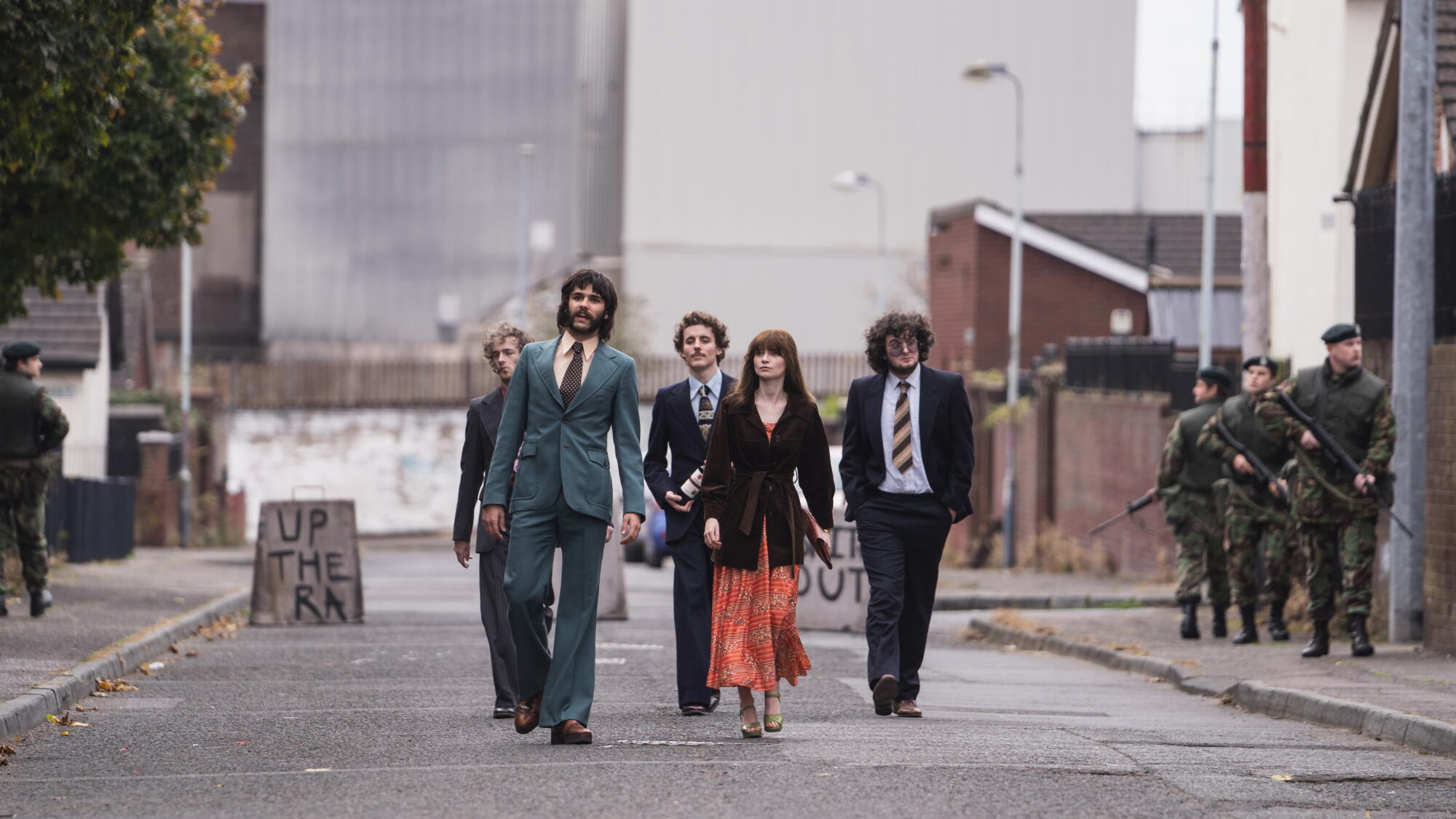
Many shots are framed as if Cushla and Michael are being watched, whether or not they are, though sometimes they are, including by each other. (“They like to let me know they know where I am,” Michael says, when Cushla mentions seeing a patrol car outside his flat.) We’re shown the oppressive presence of loyalist troops, and some anti-Catholic vandalism, and a neighbor reflexively checking his car for a bomb, but the greater violence comes through as background noise on the radio or TV news, or reported by Cushla’s young students.
Fortunately, if no less terribly, there is more to the story, and many of the most compelling scenes have little or nothing to do with Michael. (Every scene is a Cushla scene.) She’s wonderful with her class, and her colleague and confidant Gerry Harkin (Oisin Thompson), who will jump onstage at a school assembly to interrupt a strident, bigoted superior, leading the students in a peace song — “Take away the hate and the violence / Bring love into our hearts.” Viewers will consider his bowl haircut a romantic nonstarter, but there are levels to be revealed.
Cushla may not have the luxury of big opinions, but as an obviously good person, whatever one thinks of adultery, she’s unafraid to go against the grain in support of her student Davy McGeown (Daithi Ó Haragain), whose mother (Emily Taaffe) is Protestant and whose Catholic father, in the child’s words, has been “beat up for loving my mummy.” She’s also supportive of Davy’s bright older brother Tommy (Conlaoch Gough-Cunningham), teetering on the edge after the attack on his father.
Above all, there is Cushla’s mother, Gina, played by Gillian Anderson, in a downward spiral since the death of her husband, some two years earlier. Introduced in a state of drunken collapse, Anderson — fearful, bitter, despairing, protective — is quite magnificent limning different levels of intoxication. But she’s even more impressive in her sober scenes, participating in the world beyond her couch, bringing food to the McGeowns and, finally, acting as a mother to Gina.
Michael’s declarations not even aside, Keoghan has a gift for writing dialogue that feels native to the speaker and doesn’t land heavily on a point, and apart from the lovemaking interludes and a gauzy montage of a romantic trip to Dublin, Shadforth’s naturalistic direction enhances the drama by not underscoring it. She has an especially convincing way with party scenes — a school disco, a wedding, an art opening, a birthday party (at which Michael performs a soulful, foreshadowing version of the Carter Family’s “The Last Move For Me”) — where so many productions fall down.
Come for the promised steaminess. Stay for the rest of it.