Is This China’s Truck-Mounted Electromagnetic Catapult?
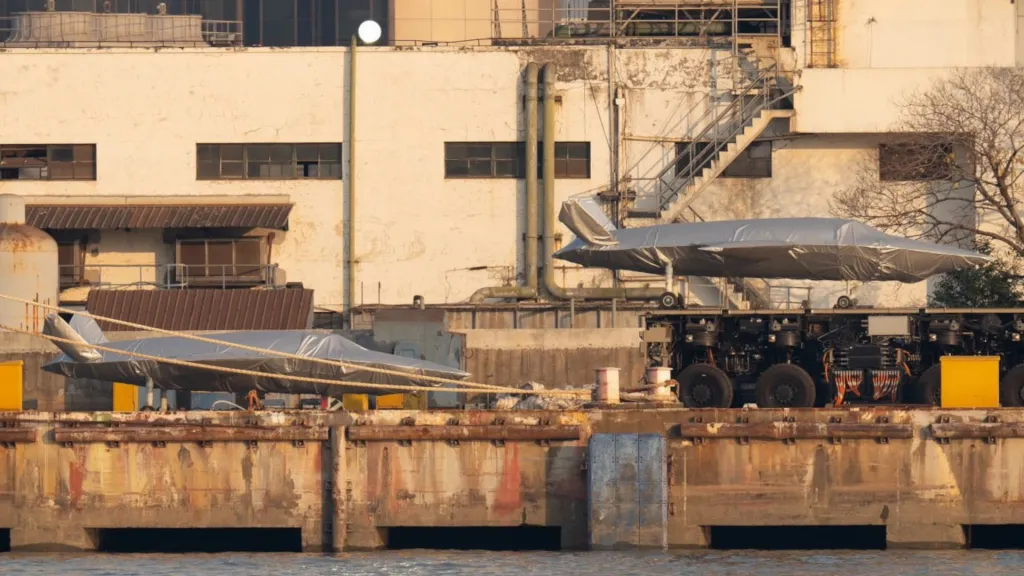
New imagery of Chinese catapult-capable low-observable combat drones, or possibly mockups thereof, together with some unusual trucks, may point to plans to launch them from the ground, as well as ships. A modular, truck-mounted electromagnetic catapult system would offer a valuable additional way to launch larger drones, especially in areas with limited access to traditional runways. General Atomics in the United States has proposed a roughly similar concept in the past, leveraging technology developed for the U.S. Navy’s Ford class aircraft carriers.
Pictures of the drones sitting dockside at Hudong-Zhonghua shipyard in Shanghai first began circulating online late last week. The presence of the super-sized Type 076 amphibious assault ship Sichuan in drydock nearby still raises the possibility of plans for trials aboard that ship, which features a single electromagnetic catapult, as was discussed in TWZ‘s initial reporting here. A medium-sized cargo ship loaded with containerized vertical launchers, as well as sensors and close-in defense systems, which emerged last week, has also been moored at this yard recently.


Though the drones are still under wraps in the new images, we do now have a better look at their overall design. This includes nose landing gear with bars that clearly show the design is intended for catapult launch. There is also a notable outline of a fairing under the nose, though no further details about that feature can be discerned at present.

It is interesting to note that a mockup of a drone called the FH-97, shown at China’s Zhuhai Airshow in 2021, was depicted with an electro-optical sensor in a stealthy gold-plated windowed enclosure installed under its nose. The overall design of the FH-97, which is at least heavily inspired by the XQ-58A Valkyrie from U.S. drone maker Kratos, is similar in many other respects, at least in broad strokes, to what has now been seen at the Hudong-Zhonghua shipyard. The XQ-58 and FH-97 are both notably smaller designs. There are also similarities to two Chinese ‘loyal wingman’ type drone designs, commonly referred to presently as the Type C and Type E, which emerged around a huge military parade in Beijing back in September.

More interestingly, the new pictures from Hudong-Zhonghua shipyard show at least three eight-wheeled trucks that look designed to lock together seamlessly in a chain. Doing so also appears to form a continuous flat surface across the top. One of the drones is seen loaded at the rear of one of the trucks with its nose gear bar locked into what looks to be a catapult shuttle.


Besides the cabs in front, the sides of the trucks are largely open, showing elaborate electrical systems and large amounts of heavy exposed wiring. There is a cylindrical drum above each wheel, which could be part of an independent articulating suspension system capable of self-leveling. They might also serve another purpose, which we will come back to later on.

A satellite image taken yesterday, which TWZ obtained from Planet Labs, shows what looks to be at least four of the trucks parked close together in a line along one of the piers at Hudong-Zhonghua shipyard. Despite the low resolution, a drone is plainly seen loaded on one of the trucks. Another one of the ‘loyal wingman’ drones is visible immediately behind the row of trucks, in line with what is seen in the pictures taken at ground level. Four more of the swept-wing drones are also visible further down the pier. A Wing Loong-type drone, similar to the Q-1/Q-9 Predator/Reaper series, is also present.

Altogether, there is the potential that these trucks could be part of a mobile ground-based electromagnetic catapult system. The cylinders and wiring seen on the trucks might be electromagnets and/or other supporting components. Any such system would also need to be self-leveling to help ensure a clean launch.
At the same time, they could still just be transporters, though the design looks far more elaborate than would be required for that purpose alone. The trucks could possibly be designed to serve both functions.
There is the additional question of why, if this is indeed a ground-based electromagnetic catapult system, it has been brought down to Hudong-Zhonghua shipyard at all. This is not the environment in which one would expect such a system to be employed, and there are no clear signs as of yet that it is there as part of a larger display.
Regardless, the basic idea of employing an aircraft carrier-type catapult launch system on land is not new. China itself, as well as the United States, has built steam and electromagnetic-powered catapults at land-based test sites for test, evaluation, and training purposes. The U.S. Marine Corps actually employed an ‘aircraft carrier on land’ with catapults and arresting gear, called the Short Airfield for Tactical Support (SATS) system, operationally during the Vietnam War, which you can read more about here.

CE-2 TRACKLESS AIRCRAFT LAUNCHER 1966 MARINE CORPS SHORT AIRFIELD FOR TACTICAL SUPPORT FILM 81190
At least one company in China, Tiantao Technology, has been openly talking about plans for a ground-based electromagnetic catapult system made up of modular wheeled segments since at least August of this year. Renderings have shown 10-wheeled sections that do have some broad similarities to, but that also are distinctly different from the eight-wheeled trucks seen at Hudong-Zhonghua shipyard. The eight-wheeled trucks, if they are part of a mobile electromagnetic catapult system, could also reflect an early developmental iteration.


Tiantao Technology has also reportedly said the system will be capable of launching uncrewed aircraft weighing up to around 2.2 tons (two metric tons). This is lighter than the expected takeoff weights of ‘loyal wingman’ type drones China has shown to date, based on the known specifications of comparably-sized Western designs. For example, the stated maximum launch weight of the XQ-58 is three tons, according to Kratos. As another point of comparison, the Chinese GJ-11, a larger flying-wing uncrewed combat air vehicle (UCAV), a catapult-capable version of which is now in development, reportedly has a payload capacity of around two tons. China’s J-15 family of crewed carrier-based fighters, derived from the Su-33 Flanker, each weighs around 19 tons (17.5 metric tons) empty without any fuel or ordnance, as well.
It is possible that the modular design of Tiantao Technology’s ground-based catapult system could allow for configurations capable of launching heavier designs. A core benefit of electromagnetic catapults over steam-powered ones, in general, is their ability to be more fine-tuned in terms of the forces they exert on any aircraft during launch. The capabilities of a modular system would also be dependent on its exact configuration, including how long the catapult track is overall. Tiantao Technology has said the total length of its system could be scaled between roughly 65 and 196 feet (20 and 60 meters). What limitations there might be on simply adding more segments to increase launch capacity are unknown.
Tiantao Technology has also shown models and renderings of truck and trailer-mounted electromagnetic catapults for launching even smaller drones. How much progress it has made in the actual development of any of the systems to date is unclear. Other firms in China could very well be working along similar lines, too.


All this being said, a ground-based electromagnetic catapult system capable of launching even two-ton drones still opens doors to new operational possibilities. This is a capability that could be especially valuable in expeditionary scenarios or other contexts in which access to traditional runways is limited. A mobile system would also offer a new way to push at least a certain tier of airpower closer to the front lines, and help keep it in close proximity where it could be more responsive, even as the dimensions of the battlefield evolve. Less transit time would translate to more on-station endurance even for smaller, shorter-range drones.
Another general benefit of electromagnetic catapults over steam-powered types is the shorter reset time, which, by extension, increases sortie generation rates. How Tiantao Technology envisions drones being loaded on its ground-based system is unclear. It is possible that a truck preloaded with a drone could drive up, lock into the rear of the track, launch, and then detach to make way for the next one, offering additional benefits when it comes to operational tempo. Being able to break the launch system into multiple parts and disperse it when not in use would create targeting challenges for enemies and help increase survivability, as well.
As TWZ regularly notes, China’s People’s Liberation Army (PLA) has major standing requirements to be able to conduct island-hopping campaigns against various potential opponents in the Pacific, where a shore-based electromagnetic catapult system could be particularly relevant. The PLA is also postured to fight in highly remote and high-altitude areas along its disputed western border with India, where access to established runways is also often limited.
These kinds of operational scenarios are driving the pursuit of aircraft, especially uncrewed types, with reduced runway requirements or entirely runway-independent designs by many armed forces globally. This includes the U.S. military. A ground-based electromagnetic catapult is just one way of approaching this operational need. There are runway-independent drones already on the market today that are launched with the help of expendable rocket motors or pneumatic catapults. However, these methods impose their own limitations, especially when it comes to launch weight and payload capacity. Rocket-assisted takeoffs come along with the additional risks associated with using that kind of propellant, as well as the stresses that are imparted on the aircraft being launched. The rockets are also consumed on launch, requiring a steady supply of them at any operating location. Kratos has notably demonstrated a special launch trolley for its primarily rocket-launched XQ-58 that allows for traditional runway takeoffs. The company is also developing a version of that design with built-in landing gear, to offer increased flexibility.

In the context of what may now be in development in China, there is the additional question about how drones might be recovered after launch from a ground-based electromagnetic catapult. Tiantao Technology does not appear to have elaborated yet on this part of the expected concept of operations for its system. The aforementioned concept that General Atomics put forward paired an electromagnetic catapult with a separate arrested landing system, also based on technology developed for the U.S. Navy’s Ford class aircraft carriers. As noted, the Vietnam War-era SATS system also included arresting gear. The U.S. military and other armed forces globally already employ deployable arresting gear, especially to enable crewed tactical jet operations from far-flung locations with shorter runways. Drones could recover at tertiary bases, or be designed to land via parachute or some other runway-independent method, as well. The system could also be used to launch long-range one-way attack drones that would not be designed for recovery at all.

There is also a question of power and other logistical requirements. However, a ground-based electromagnetic catapult system that is not required to support all of the different types in a full carrier air wing, especially larger crewed aircraft, would inherently require far less capability.
It is also worth noting that a modular electromagnetic catapult system might be usable on ships that do not have this capability built into their design. As mentioned, the drones and trucks seen at Hudong-Zhonghua shipyard were spotted near a cargo ship loaded with various containerized weapons and other systems. A drone launch capability of some kind would be a logical addition to a vessel with that configuration. At the same time, whether or not any catapult system made up of multiple segmented components would be stable enough for use on a ship rocking back and forth at sea is unclear.

As a general note, major new military capabilities often emerge in China during the time between Christmas and New Year’s. This is also something that happens with the clear acquiescence of authorities in Beijing if they are not outright announced through official channels. Hudong-Zhonghua shipyard is an obvious area of interest for observers, and Chinese authorities do not appear to have taken any special steps to conceal the recent appearance of the drone mockups or the trucks.
More details about the trucks, and their exact function, as well as the drones, may now begin to emerge.
Contact the author: joe@twz.com