carry

USMC Says It Needs Nine More Amphibious Warships To Carry Out Its Missions

Navy and Marine Corps leaders have recently come to the agreement that the Corps needs 40 amphibious ships to meet its goal of keeping three Marine Expeditionary Units (MEU) deployed at the same time. However, at the moment, the Navy has only 31 of these vessels, a minimum mandated by Congress, and now an effort is underway to convince lawmakers to increase the fleet.

MEUs, made up of about 2,200 Marines, are typically embarked on Amphibious Ready Groups (ARGs), which usually consist of an assault ship, two transport docks or dock landing ships. Support vessels, surface combatants and in some cases a nuclear fast attack submarine can make up the larger Expeditionary Strike Group.

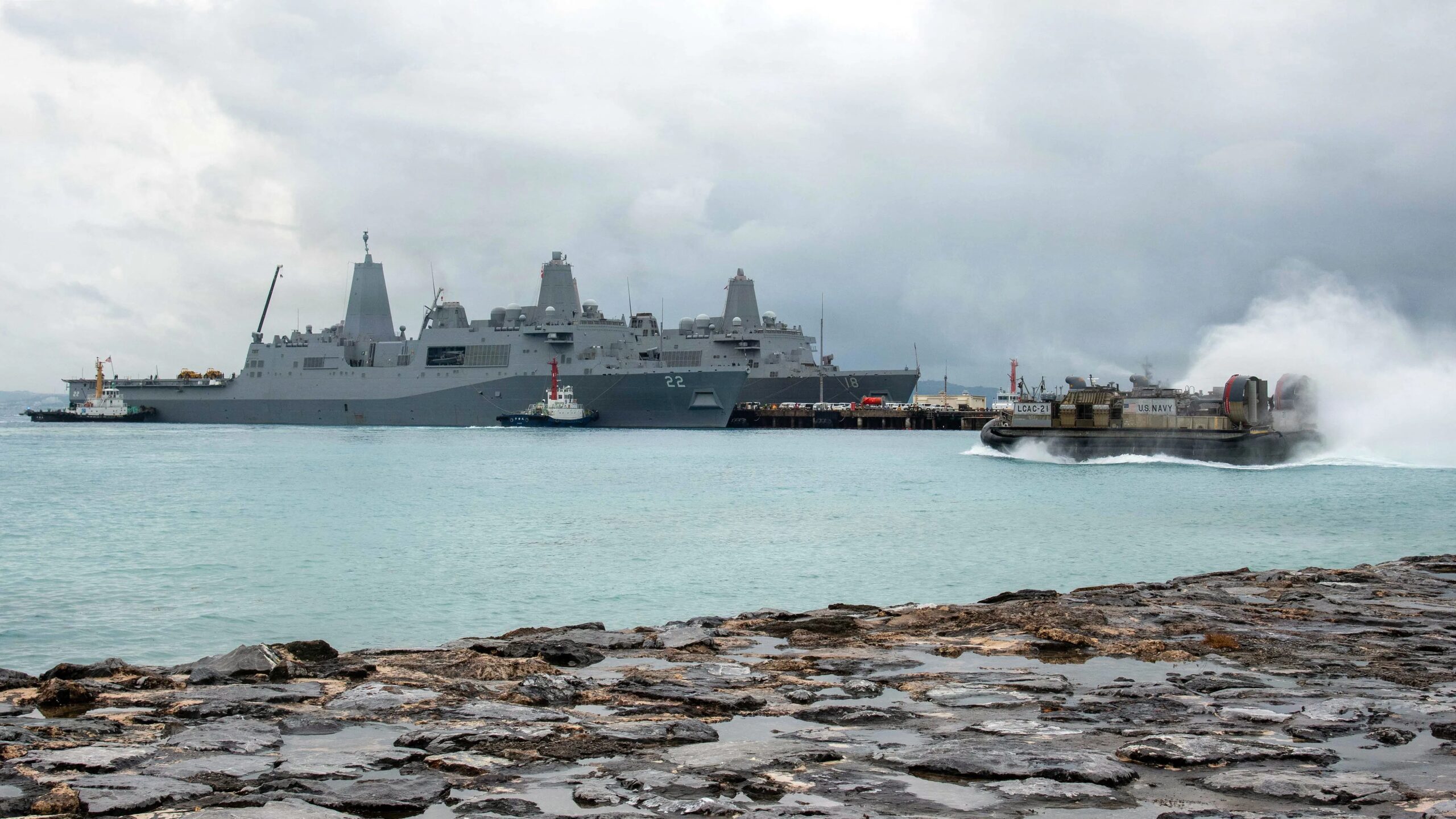
260127-N-UX839-1063 OKINAWA, Japan (January 27, 2026) U.S. Navy Landing Craft, Air Cushion 21, attached to Naval Beach Unit (NBU) 7, operates near San Antonio-class amphibious transport dock ships USS San Diego (LPD 22), left, and USS New Orleans (LPD 18) during a port visit to White Beach Naval Facility, Okinawa, Japan, Jan. 27, 2026. Within the U.S. 7th Fleet area of operations, Commander, Task Force (CTF) 76 is responsible for conducting expeditionary warfare operations with Navy and Marine Corps capabilities to support theater contingencies that range from crisis response to full combat operations. (U.S. Navy photo by Lt. Cmdr. John J. Mike)
U.S. Navy Landing Craft, Air Cushion 21, attached to Naval Beach Unit (NBU) 7, operates near San Antonio-class amphibious transport dock ships USS San Diego (LPD 22), left, and USS New Orleans (LPD 18) during a port visit to White Beach Naval Facility, Okinawa, Japan, Jan. 27, 2026. (U.S. Navy photo by Lt. Cmdr. John J. Mike) Lt.Cmdr. John Mike

Marine Corps Commandant Gen. Eric Smith’s top priority is meeting what is called the 3.0 ARG/MEU presence, said Shon Brodie, director of Maritime Expeditionary Warfare at the Corps’ Combat Development and Integration (CD&I) Directorate tasked with modernizing the Marines. 

Smith “believes that the best thing that we as a service can do for the nation is provide the highly trained Marine Expeditionary Units, one from the East Coast, one from the West Coast, and that one in Japan, persistently,” Brodie told a small group of reporters, including from TWZ, on Wednesday.

To ensure that happens, Vice Chief of Naval Operations (VCNO) Adm. James W. Kilby and the Assistant Commandant of the Marine Corps (ACMC) Gen. Bradford J. Gering “have worked really close together to try to understand the number of ships it would require to achieve 3.0 based on current readiness,” Brodie noted.

 “The two analytical arms of both services have come to the conclusion that it takes 40 ships. That’s 13 big decks and 27 LPDs,” the Maritime Expeditionary Warfare director explained.

Big decks are the Navy’s Wasp class (LHD) and America class (LHA) amphibious assault ships. Their embarked Aviation Combat Elements (ACEs) can include F-35B Joint Strike Fighters, MV-22 tiltrotor aircraft, UH-1, AH-1 and CH-53 helicopters, as well as Navy Seahawk helicopters. The LPDs are smaller [Amphibious Transport Dock ships], which also embark MV-22s and helicopters.

The capabilities of MEUs have grown over the past decade, allowing them, in limited cases, to take on tasks that once required an aircraft carrier strike group. MV-22 tiltrotors, and, more recently, F-35Bs, which can be embarked in large numbers in the so-called “Lightning carrier” configuration, have boosted the utility of these fighting units.

Two U.S. Marine Corps F-35B Lighting II, attached to Fixed-Wing Marine Fighter Attack Squadron (VMFA) 211, land on the flight deck of Wasp-class amphibious assault ship USS Makin Island (LHD 8), Sept. 29, 2026. Makin Island, flagship of the Makin Island Amphibious Ready Group is underway with the 13th Marine Expeditionary Unit in the U.S. 3rd Fleet area of operations demonstrating the U.S. Navy’s long-term commitment to a free and open Indo-Pacific. (U.S. Navy photo by Mass Communication Specialist Seaman Apprentice Tomas Zuelke)
Two U.S. Marine Corps F-35B Lightning II, attached to Fixed-Wing Marine Fighter Attack Squadron (VMFA) 211, land on the flight deck of Wasp class amphibious assault ship USS Makin Island (LHD 8), Sept. 29, 2026. (U.S. Navy photo by Mass Communication Specialist Seaman Apprentice Tomas Zuelke) Seaman Apprentice Tomas Zuelke

The amphibious ship requirements, which had been in discussion for a while, were finally hammered out over the past few months by the new Amphibious Force Readiness Board (AFRB), stated Brodie. The AFRB is a joint Navy-Marine Corps effort created to better track the readiness of the amphibious fleet, which has been a huge issue as we have frequently noted.

“Right now, I have 31 amphibious warfare ships,” stated Brodie. The biggest need at the moment, he added, is for additional amphibious assault ships.

The law calls for the service to have 10, but currently it has only nine. That’s because the USS Bonhomme Richard (LHD-6) was sent to the scrapyard in 2021 after being ravaged by a fire in 2020.

Brodie said the Marines want to increase the number of mandated amphibious assault ships from 10 to 13.

“When I have a problem generating this force, it really revolves around the big deck,” he stated.

PHILIPPINE SEA (June 13, 2021) The America Amphibious Ready Group (ARG) sail in formation. Clockwise from right: USS America (LHA 6), USS New Orleans (LPD 18), USS Germantown (LSD 42). The America ARG, along with the 31st Marine Expeditionary Unit, is operating in the U.S. 7th Fleet area of operations to enhance interoperability with allies and partners and serve as a ready response force to defend peace and stability in the Indo-Pacific region. (U.S. Navy photo by Mass Communication Specialist 3rd Class Jomark A. Almazan)
PHILIPPINE SEA (June 13, 2021) The America Amphibious Ready Group (ARG) sail in formation. Clockwise from right: USS America (LHA 6), USS New Orleans (LPD 18), USS Germantown (LSD 42). (U.S. Navy photo by Mass Communication Specialist 3rd Class Jomark A. Almazan) Petty Officer 1st Class Jomark Almazan

The call for a fleet of 40 amphibious ships, and especially 13 big decks, is a sharp departure from the guidance former Commandant Gen. David Berger introduced in 2019 that led to his Force Design 2030 plan. In these documents, Berger called for fewer amphibious assault ships and more smaller vessels. Berger was concerned about the growing array of threats to these large, slow-moving vessels from anti-ship cruise and ballistic missiles, and that was before one-way attack drones became such ubiquitous weapons of war. This strategy was seen as better suited for fighting in the Pacific in a modern context, not large scale beach landings of the past.

He also wanted to return the Corps to its naval roots; small, dispersed stand-in forces working inside an adversary’s weapons engagement zone after two decades of ground pounding in Afghanistan and Iraq.

A Marine holding a Stinger missile launcher stands in front of a Combat Rubber Raiding Craft on Ukibaru Island off the coast of Okinawa during Exercise Hagatna Fury 21. USMC

Given how much of a sea-change this new plan represents, reaching a 40 amphibious ship fleet that includes 13 big decks is no small task. 

“I’ve got a sheet sitting right here in front of me that tells me how we get there,” Brodie added. “You can’t get there tomorrow, right? The only way for me to realistically increase that inventory is for me to build new ships and do a service-life extension on some of the selective ships that I currently have in the inventory.”

Brodie said that Kilby and Gering are going to approach Congress later this month to convey the need for more ships.

There is no set timeline to reach the 40-ship goal, the Marines told TWZ.

“We will have to await future congressional funding for these,” Lt. Col. Eric D. Flanagan, a USMC spokesman, told us, adding that there is a multi-ship procurement contract underway for several amphibious vessels. He was referring to HII being awarded a $9.6 billion multi-ship procurement contract in 2024 for the construction of three San Antonio class amphibious ships and a contract modification for the next America class large-deck amphibious ship. 

“This combined procurement — the first of its kind for amphibious ships — begins the journey for the construction of LPDs 33, 34, 35 and LHA 10 for the U.S. Navy,” HII stated at the time.

Aerial view of HII’s Ingalls Shipbuilding division taken on Aug. 22, 2024 as USS Richard M. McCool, Jr. (LPD 29) departed from Ingalls to its commissioning site in Pensacola, Florida, while Bougainville (LHA 8) is shown under construction in the background. (HII)

The request for additional shipbuilding funds will likely face far stiffer headwinds now that the Democrats have won control of both the Senate and the House.

While the Trump administration continues to pursue a roughly $1.5 trillion defense budget for Fiscal Year 2027, which includes some $350 billion that would come from outside normal defense spending streams via the reconciliation process, a letter leaked yesterday from a top Democrat offers a glimpse into the challenges the new amphibious ship plan may face.

The letter from Rep. Adam Smith, a Washington state Democrat who is in line to become chairman of the House Armed Services Committee, makes clear that many programs and policy issues, as well as defense spending writ large, are set to be put under the microscope when the Democrats take control of Congress in the new year. 

“We must thoroughly review our national defense strategy and develop a more realistic and sustainable approach that does not require a defense budget in excess of $1 trillion or paid for through draconian cuts to critical domestic programs,” Smith wrote in his ‘dear colleagues’ letter.

All of this comes at a time when the Navy has been struggling to meet operational demands for surface combatants with its existing fleet. This has been further exacerbated by shakeups in separate plans to acquire new frigates and larger uncrewed surface vessels (USVs), as well as rising costs associated with its workhorse Arleigh Burke class destroyers.

On top of everything, conflicts in the Middle East have taken a toll on the Navy, incurring costs that need to be paid for.

In August, Chief of Naval Operations Adm. Daryl Caudle estimated as a result of the Operation Epic Fury fight against Iran, the Navy needed between $6 billion and $8 billion more than what was budgeted for in the 2026 fiscal year “to be whole and solvent for [Fiscal Year] 26,” Navy Times reported.

Overall, the U.S. military “has spent over $47 billion so far to prosecute the war in Iran, more than 25% higher than the Defense Department’s estimate in July,” according to Pentagon data obtained by Reuters last month.

An F/A-18E Super Hornet, attached to Strike Fighter Squadron (VFA) 151, launches from the flight deck of Nimitz-class aircraft carrier USS Abraham Lincoln (CVN 72) during Operation Epic Fury, April 1, 2026. (U.S. Navy photo)
An F/A-18E Super Hornet, attached to Strike Fighter Squadron (VFA) 151, launches from the flight deck of Nimitz class aircraft carrier USS Abraham Lincoln (CVN 72) during Operation Epic Fury, April 1, 2026. (U.S. Navy photo) NAVCENT Public Affairs

In addition to not having enough ships to fulfill the mission, there is a big problem keeping the existing ones available. The Navy’s amphibious ship fleet had just a 47% combat surge readiness rate as of April, according to Kilby’s Fiscal Year 2027 budget request statement. As we have pointed out previously, chronic maintenance delays, competing budget priorities, ill-planned early-retirement efforts that went forward without required congressional approval, scarce spare parts, shoddy contractor oversight and other issues have contributed to these problems.

The Navy and Marines are working to change that and meet the requirements set out by the commandant, Brodie stated. This has involved getting a better handle on how long and how often ships need to be deployed and improving maintenance once underway.

“We’re at the very beginning stage of that, but the indications are, and the models tell us, that we will actually be able to shrink the days in maintenance and improve force generation by some percentage that will be helpful,” Brodie explained. “Without getting into numbers that are probably sensitive, but we’re marginally better than we were before, and the expectation is that we can increase beyond marginally better here over the next couple of maintenance cycles.”

From right, Boatswain’s Mate 3rd Class Omari Packard and Seaman Braden McLelland, Sailors assigned to the Wasp-class amphibious assault ship USS Bataan (LHD 5), perform shipboard maintenance by painting around a fueling station along the starboard side of the ship’s superstructure, Sept. 24, 2026. Bataan is currently undergoing regularly scheduled maintenance in the General Dynamics National Steel and Shipbuilding Company (NASSCO) shipyard in Norfolk, Virginia. (U.S. Navy photo by Mass Communication Specialist Seaman Apprentice Jackson C. Rott)
From right, Boatswain’s Mate 3rd Class Omari Packard and Seaman Braden McLelland, sailors assigned to the Wasp class amphibious assault ship USS Bataan (LHD 5), perform shipboard maintenance by painting around a fueling station along the starboard side of the ship’s superstructure, Sept. 24, 2026. (U.S. Navy photo by Mass Communication Specialist Seaman Apprentice Jackson C. Rott) Seaman Apprentice Jackson Rott

“There’s another factor here that sort of you can’t model in your framework, and that’s extended deployment,” Brodie added. “You’ve got to bring the ship back on time, get it in maintenance on time. If you extend the deployments — and you’ll find that’s true with the whole Navy fleet — if you extend the deployment, and you miss a maintenance cycle, it sort of blows that forecast that you had.”

The problems created by extended deployments are something TWZ frequently highlights.

When regular maintenance doesn’t happen, it creates a cascading series of problems that affect not just the ships and crews, but the facilities that have scheduled repairs and lined up workers to make them happen.

The bottom line is that the longer these vessels stay out on cruise, the longer they have to stay in on deep maintenance, and past a certain point, the magnitude of this relationship skyrockets. Extra days out can turn into extra weeks in the yard, and so on. With yard facilities at a premium, especially those capable of dealing with a supercarrier and big deck amphibious vessels, critical schedules can quickly implode, with work stacking up across multiple vessels, resulting in them being sidelined much longer than planned. This is something we have discussed in great detail when it comes to aircraft carriers.

While the Marines and Navy say they need 40 amphibious ships, whether they reach that level is still an open question that will have to be addressed in future budget cycles. There are a lot of competing needs and only so much money that can be allocated.

Contact the author: howard@twz.com
Howard is a Senior Staff Writer for TWZ. He writes frequently about conflict, focusing heavily on the Middle East and Ukraine, and interviews with military and intelligence officials and industry leaders from around the globe. He lives near Tampa, Florida, home of U.S. Central Command, U.S. Special Operations Command.


Source link

USC knows it must re-establish the run against No. 2 Ohio State

p]:text-cms-story-body-color-text”>

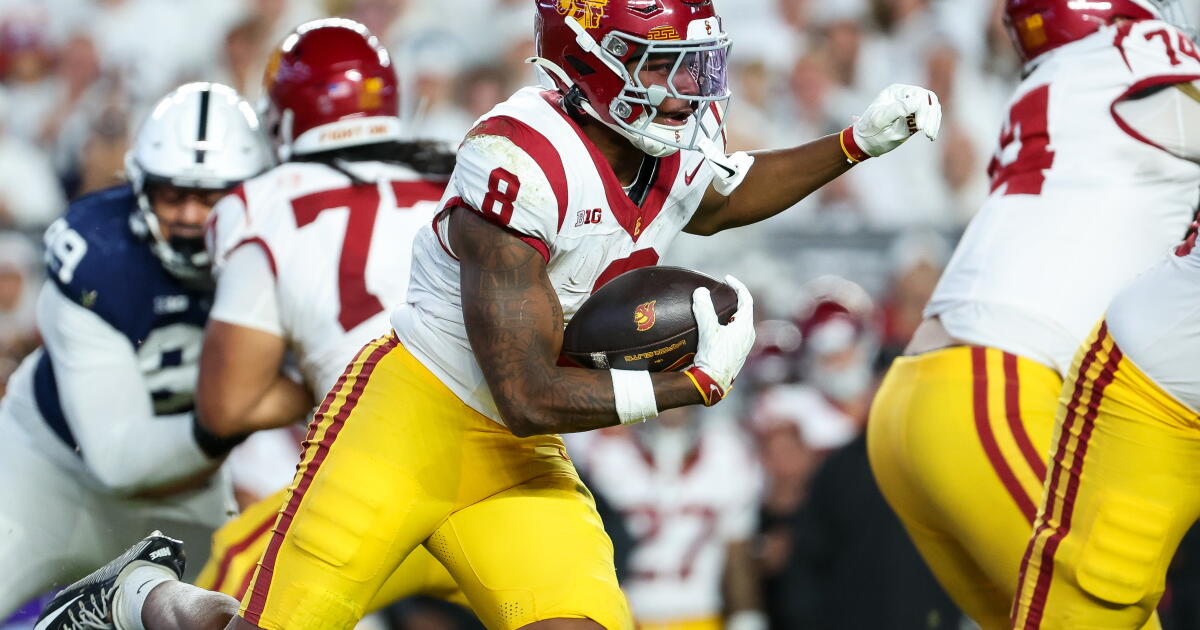
Ahead of the Wisconsin game, USC got back two key offensive linemen from injury, left guard Hayden Treter and Paige.

However, the line still struggled against Wisconsin, allowing quarterback Jayden Maiava to get sacked five times and playing a factor in the Trojans’ limited run game.

Paige said the group needed to do “a little bit of everything” better in the run game. Raymond told reporters that factors like communication and physicality were among the causes of the line’s struggles.

“It wasn’t good enough,” Raymond said Wednesday.

Treter, who previously missed two games because of injury, was listed as out on Thursday’s availability report after exiting the loss to Wisconsin early.

Alston, freshman tight end Mark Bowman and defensive tackle Jahkeem Stewart were among the notable USC players listed as questionable Thursday. Bowman, who racked up two touchdowns and more than 200 receiving yards in his first five collegiate games, hasn’t played since the Oregon loss in late September.

Stewart, who has been listed on the availability report and then played in each of the last four games, said he feels “great.”

“Just slowly getting better for the team,” Stewart said. “Can’t wait to go out there and perform.”

While the Trojans are dealing with some injuries, the highest-profile injury is on the other side as the Buckeyes will be without their star quarterback Julian Sayin, who was injured during Ohio State’s win over No. 4 Indiana on Oct. 17.

Sayin, who is expected to miss the rest of the season, had the second-most passing yards in the Big Ten (2,007), tied for the most passing touchdowns (19) and the highest passer rating (184.9).

Since Ohio State had a bye last week, coach Ryan Day hasn’t had to announce whether freshman Luke Fahey or sophomore Tavien St. Clair will get the start in Sayin’s stead. Riley and defensive tackle Jide Abasiri both told reporters that the team is preparing for both and will be ready to adjust during the game.

“There’s an expectation that there will probably be some sort of adjustment in some way, and we’ll have to do a good job handling that,” Riley said of planning for two quarterbacks. “I think that’ll be one of the keys, I’m sure, to this matchup.”

The Trojans are set to kick off their high-stakes Halloween-homecoming matchup with the Buckeyes at 4:30 p.m. Saturday.

Source link

UCLA defense overwhelms Michigan State to keep Bruins unbeaten

It was always going to be the Bruin Bullies’ day.

No. 9 UCLA was hosting a Michigan State team with one of the least productive offenses in the country led by freshman quarterback Kayd Coffman, who was taking his first college snaps after the Spartans’ top two quarterbacks were injured.

After forcing three turnovers and four sacks, UCLA trounced Michigan State 28-10 Saturday afternoon at the Rose Bowl. The Bruins improved to 7-0 for the first time since 2005 after winning just three games last season.

UCLA’s defense carried it after the offense was flat in the first half, dropping two passes, drawing drive-killing penalties and fumbling twice in Michigan State territory. Both fumbles were forced by Spartans safety Devin Vaught and returned 50-plus yards to the red zone.

While UCLA conceded a touchdown after the first giveaway, allowing Michigan State (2-6, 0-5) to score in two plays, the Bruins avenged the second fumble with an interception from linebacker Donavyn Pellot.

Pellot returned his first career interception 67 yards. Wayne Knight scored on a one-yard run five plays later for his 13th touchdown of the season. The score gave UCLA a lead it would never relinquish.

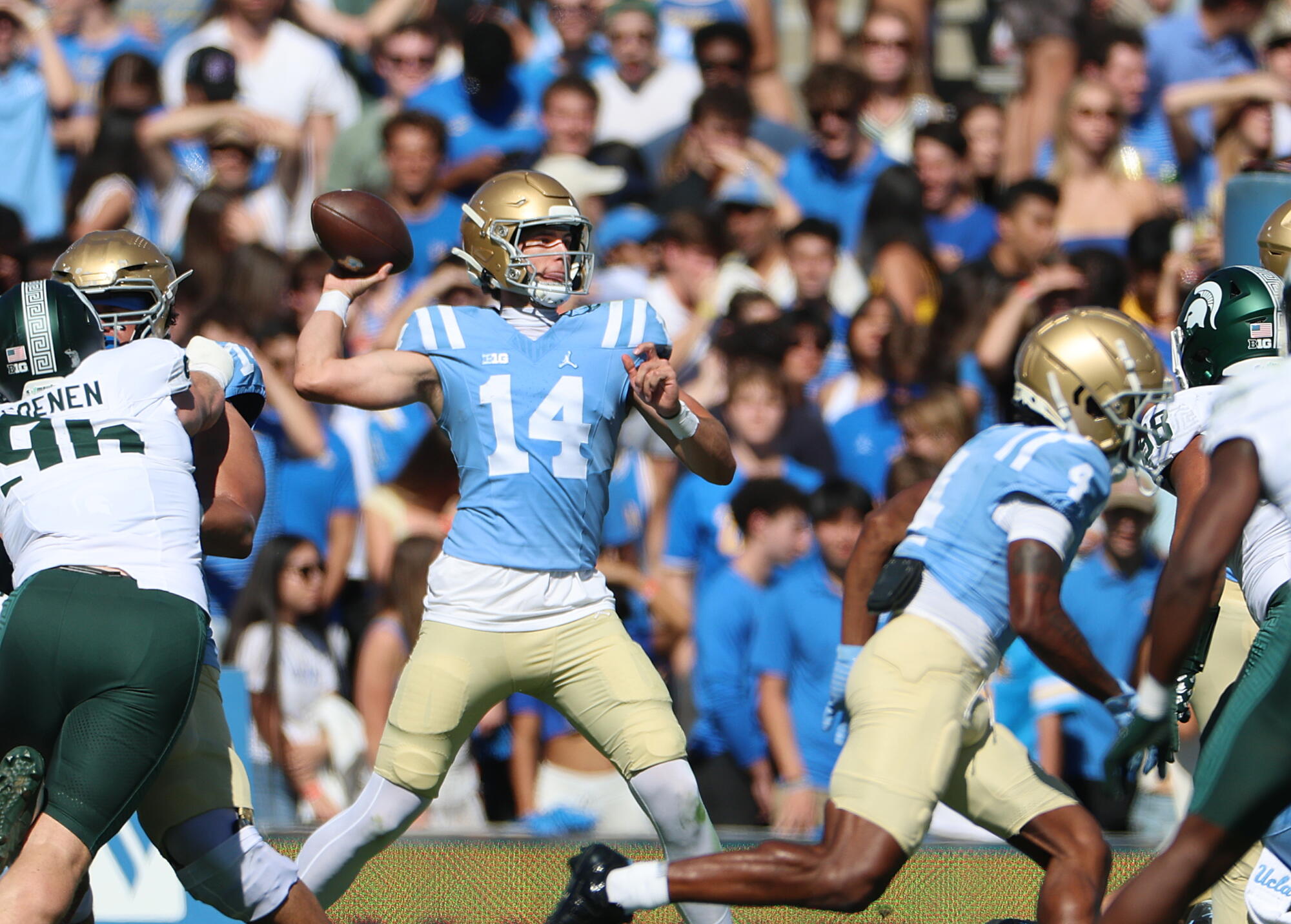
UCLA quarterback Ty Dieffenbach passes in the first quarter against Michigan State at the Rose Bowl.

UCLA quarterback Ty Dieffenbach passes in the first quarter against Michigan State at the Rose Bowl on Saturday.

(Allen J. Schaben / Los Angeles Times)

“Second half [was] much, much better than the first half,” UCLA coach Bob Chesney told CBS immediately after the game. “Mistakes in there and uncharacteristic things that we cannot allow to happen at this point in the year.

“So a little bit disappointed in moments, but at the same point in time we did what we had to do.”

Once the offense found its footing, it did not step off the gas.

The Bruins leaned heavily on their running game as they returned to its usual form after being limited to 3.5 yards per carry and failing to surpass 150 yards the past two weeks. All three starting running backs reached the end zone for the third time this season, as UCLA finished with 245 rushing yards at 5.1 yards per carry. Anthony Woods led the UCLA rushing attack with 112 yards and a touchdown in 14 carries.

The running game loosened up the Michigan State defense, and UCLA quarterback Ty Dieffenbach took advantage of an already depleted secondary on the first drive of the second half, unloading a 63-yard pass to sophomore wide receiver Brian Rowe Jr. for his first touchdown of the season.

Dieffenbach made the big play after sustaining an apparent leg injury on a hard hit late in the first half.

With the defense holding the Spartans to just 156 total yards of offense — 73 of which came in the fourth quarter with UCLA in control — Dieffenbach didn’t have to be perfect to secure the win. He completed 18 of 31 passes for 198 yards and a touchdown.

Defensively, UCLA refused to allow a forward push at the line of scrimmage, flying into the backfield and holding Michigan State to 1.6 yards per carry.

UCLA running back Wayne Knight scores a touchdown in the second quarter against Michigan State on Saturday.

UCLA running back Wayne Knight scores a touchdown in the second quarter against Michigan State on Saturday.

(Allen J. Schaben / Los Angeles Times)

And when the Spartans tried to pass, the Bruins dug deeper, making it a nightmare for Coffman until Michigan State coach Pat Fitzgerald turned to fourth-string quarterback Leo Hannan. UCLA finished with four sacks, six tackles for a loss and five quarterback hurries, essentially living in the Spartans’ backfield.

The Bruins sealed their seventh consecutive victory with an interception from safety Malik Hartford, his second forced turnover of the game.

The UCLA defense was one of the team’s biggest liabilities during the past decade, stretching from the Chip Kelly era to last season’s three-win effort.

This season, UCLA hasn’t allowed an opponent to score more than 15 points since Sept. 19.

Source link

Ty Dieffenbach shines for No. 12 UCLA in win over Wisconsin

Behind a standout performance from quarterback Ty Dieffenbach in his first UCLA start, the No. 12 Bruins defeated Wisconsin 17-7 at the Rose Bowl on Saturday.

Dieffenbach orchestrated a six-play, 89-yard drive in the fourth quarter to help seal the win for the Bruins, who clinched bowl eligibility by improving to 6-0 under coach Bob Chesney. UCLA is the only undefeated team in the Big Ten.

Although UCLA (6-0, 4-0) entered with one of the most potent ground attacks in the nation, the Badgers’ (4-2, 2-1) stalwart defense — a unit that ranked No. 15 in total defense and ninth in passing yards allowed heading into the game — held UCLA to just 3.2 yards per carry. Heisman Trophy contender Wayne Knight was limited to just 29 all-purpose yards, though he scored his 12th touchdown of the season.

With UCLA struggling to get a push at the point of attack and the Wisconsin defense sealing the edge, the Bruins put their trust in Dieffenbach, who started in his first Football Bowl Subdivision game following Nico Iamaleava sustaining a knee injury against Oregon last week that could keep the senior out for the remainder of the season.

The understudy shined in the spotlight.

Even though expectations were tempered for Dieffenbach, he largely did not miss a beat, completing 22 of 33 passes for 264 yards — better than any single-game passing yards total Iamaleava has produced at UCLA.

Dieffenbach set up UCLA’s first touchdown in the second quarter when he completed a 21-yard pass to Jalen Saint Paul one play before Knight scored on a one-yard carry.

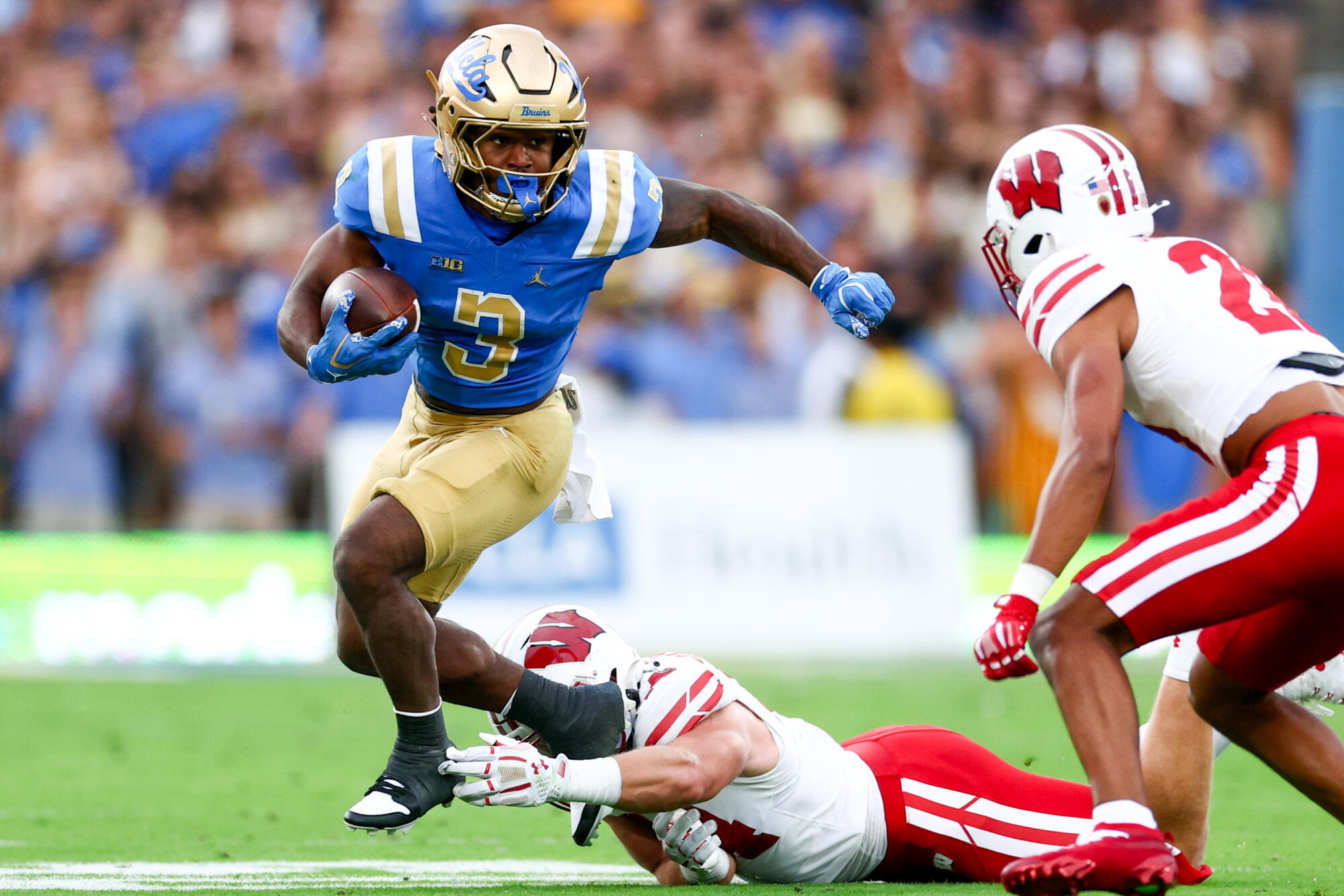
UCLA running back Wayne Knight breaks a tackle from Wisconsin safety Marvin Burks Jr. during the second quarter Saturday.

UCLA running back Wayne Knight breaks a tackle from Wisconsin safety Marvin Burks Jr. during the second quarter Saturday.

(Ronaldo Bolanos / Los Angeles Times)

UCLA’s second score — a touchdown that put the Bruins up 10 points in the fourth quarter — capped Dieffenbach’s most impressive drive. Starting at the UCLA 11, Dieffenbach connected on passes of 28 and 33 yards on a drive that culminated with Anthony Woods scoring on a three-yard run.

Dieffenbach looked poised in the pocket as he made passes under pressure. He excelled on third down, with UCLA converting on 13 of 20 tries. He threw one interception, which came on a Hail Mary as expired in the second quarter, and took just one sack.

Giving Dieffenbach some breathing room, UCLA’s defense dominated again, holding Wisconsin to 214 total yards. Even without UCLA starting outside cornerback Rodrick Pleasant, the Bruins’ secondary blanketed the Badgers in coverage, giving up just 66 passing yards, with Wisconsin’s top receiver Jaylon Domingeaux finishing with 26 yards.

Wisconsin running back Darrion Dupree is tackled by UCLA defensive lineman Sahir West during the second quarter.

Wisconsin running back Darrion Dupree is tackled by UCLA defensive lineman Sahir West during the second quarter.

(Ronaldo Bolanos / Los Angeles Times)

And while the “Bruin Bullies” held up at the line of scrimmage against the Badgers’ tailbacks, Wisconsin quarterback Colton Joseph ran for 71 yards and one touchdown, using various formations and fakes to confuse the Bruins’ stacked box.

While UCLA failed to produce a takeaway for the first time this season — despite forcing two fumbles, both of which were recovered by Wisconsin — the Bruins made several key stops to help UCLA stay in control.

A 10-yard sack from fifth-year linebacker Jalen Woods on third down late in the second quarter led to an unsuccessful 46-yard field-goal attempt by Gavin Lahm, leaving Wisconsin scoreless at halftime.

UCLA wide receiver Brian Rowe Jr. celebrates after making a catch against Wisconsin.

UCLA wide receiver Brian Rowe Jr. celebrates after making a catch in the second quarter Saturday against Wisconsin.

(Ronaldo Bolanos / Los Angeles Times)

After Wisconsin scored its only touchdown and subsequently forced UCLA into a three-and-out late in the third quarter, the Badgers had the ball with a chance to take the lead. But the Bruins forced two incomplete passes and stuffed Joseph at the line to force a punt.

In the fourth quarter, UCLA stopped running back Darrion Dupree short of a first down on fourth-and-two at the Bruins’ 48 to all but end the Badgers’ hopes of a comeback.

Source link

Andy Pages’ clutch hit, sturdy bullpen carry Dodgers back to NLCS

Without Andy Pages, the Dodgers wouldn’t have popped champagne in the Truist Park visiting clubhouse Wednesday night.

His October track record suggested he was an unlikely hero. He entered Wednesday with a .123 playoff batting average. He was benched in Game 5 of the World Series last year. He’d even started this postseason hitless in the first two games of the National League Division Series against the Atlanta Braves, and was given the red light on ABS challenges.

He didn’t carry any of that up to the plate with him in the seventh inning, with the score tied, the bases loaded and hard-throwing Braves reliever Robert Suarez entering the game to face him.

“I like being in those at-bats,” Pages said in Spanish after the Dodgers’ 4-1 win in Game 4 of the NLDS. “There are times the result comes, sometimes not, but I prepare to be in those spots. And today I was able to get the result.”

He was patient, working a full count as he fouled off and then foul-tipped a pair of fastballs in the zone.

The next one, he sent through the middle of the infield for a two-run single to finally give the Dodgers the lead in the deciding moment of the series.

The Dodgers are headed to the NL Championship Series for the ninth time in 14 seasons. They will play the Milwaukee Brewers, who finished off the San Diego Padres in four games, starting Sunday. And they came one step closer to their goal of winning a third straight World Series.

Pages has contributed to the last two titles with his regular-season play and his glove. The game-saving catch he made in Game 7 of the World Series last year, trampling Kiké Hernández in the process, has been immortalized in bobblehead form. But now, he has a big moment with his bat.

“There’s never been a doubt about him, his talent,” Hernández said. “You can’t carry previous postseasons into this postseason. Everything is a new chapter. Every time you take the field in October, you get an opportunity to rewrite your story. So the fact that he struggled in the previous couple postseasons doesn’t mean that was going to happen again this year.

“I mean, during the regular season, you have two bad games and nobody freaks out about it, but because people are adding up previous postseasons, they’re going to freak out. But nobody doubted him. That’s why he stayed in the lineup. And I’m really happy that he was the one that won us a series.”

The signs of a potential breakout were there. When Pages came back from a fractured left hand for the final week of the season, he didn’t miss a beat.

Then he went 0 for 7 in the first two games of the NLDS, and manager Dave Roberts said he wanted to see him “slow down a little bit.”

“I’m going to continue to give Andy leash,” Roberts said. “I believe in him. I feel that for us to win the World Series this year, we’re gonna need him to be an active part of our team.”

Pages recorded two hits in Game 3 and logged another single in his first at-bat Wednesday.

“Everybody really forgets how young Andy Pages is, you know?” veteran infielder Miguel Rojas said of the 25-year-old. “He’s just starting his career. He’s still like a rookie in this clubhouse for us, because he’s one of the youngest. But at the same time, we see his potential, we see what he can do on the field and we feel so proud of him because … whenever he has the opportunity to contribute to this team, he does it in different ways. Defensively, offensively and on the bases.”

On Wednesday, Pages already had showed off his range in center field when he tracked down a fly ball off Matt Olson’s bat in the left-field gap. But the Dodgers desperately needed someone to contribute with runners in scoring position.

The game had been tied at one run apiece since the second inning.

The lone run Dodgers starting pitcher Tyler Glasnow gave up was made possible by Braves leadoff hitter Michael Harris II’s speed. He got on top of Glasnow’s first pitch, a fastball up and out of the strike zone, to shoot a single through the right side.

Harris then stole second and advanced on a groundout. Then, in an 0-and-2 count to Ozzie Albies, Glasnow spiked a curveball in front of the plate. Catcher Will Smith managed to block the ball, despite the high bounce, but it rolled back toward the mound, giving Harris time to dash home.

Glasnow limited the Braves to one hit in 4-2/3 innings. But five walks prevented him from pitching deeper into the game.

The Dodgers couldn’t get anything going against Braves starter Tyler Mahle, either.

They hadn’t faced Mahle since April, when he was with the San Francisco Giants and racking up a 5.13 ERA. But he’d been lights out since the Braves acquired him, authoring a 1.99 ERA. In his postseason debut, he limited the Philadelphia Phillies to one run in seven innings.

The Dodgers saw that new and improved version of him on Wednesday.

The one run the Dodgers scored against him was something of a fluke.

In the second inning, Shohei Ohtani, who moved up to the cleanup spot after hitting fifth the day before, drew a five-pitch walk without taking a swing. He then stole second base, drawing an errant throw that allowed him to advance to third. So, he was in position to score the tying run when Braves shortstop Mauricio Dubón, who robbed Freddie Freeman of a home run as the left fielder the day before, dropped a popup in shallow left.

The Dodgers recorded only three hits against Mahle in 6⅓ innings. So, the game would come down to the bullpens.

In the seventh, the Dodgers loaded the bases with a single from Teoscar Hernández, a walk from pinch-hitting rookie Josue De Paula, and a five-pitch walk from Kyle Tucker.

The Dodgers had gone 0 for 15 with runners in scoring position for the series when Pages stepped to the plate.

“It’s been incredible, especially the way he’s working, just to be ready for these big moments,” Teoscar Hernández said. “I think he was a little bit off his timing at the beginning of the series. Now that he understands he doesn’t have to do too much to help this team win games, I think everything is coming back to the way it was before he got hurt.

“He’s one of the best on the team. We get to this point because of him, the regular season he had. This is not a surprise for me that he’s having this kind of moment in the playoffs.”

Pages didn’t seem surprised, either.

“What happened last year, happened,” he said. “It’s in the past now. All I can do now is be in the moment. And being in the moment today, I was able to get the result.”

Source link