Brazilian police say they will reopen dozens of cases after they arrested a self-confessed serial killer disguised as a woman. Jorlan Lopes da Silva, 33, confessed to 80 murders after he was arrested in Paraiba State in the country’s north east, trying to flee in a wig and holding a baby.
Tehran, Iran – Iranian authorities and state media have praised the Houthis’ capture of Yemen’s Red Sea coast, which some see as giving Tehran more leverage against the United States.
The Houthis, a political and armed group dominated by Zaidi Shia Muslims, have been fighting against the Western-backed Yemeni government since capturing the capital, Sanaa, in 2014.
The Houthis captured a series of Red Sea coastal cities and islands this week, essentially giving them control over the vital Bab al-Mandeb strait.
The Iran-allied group’s recent victories have been praised in Iran, and are viewed by some as part of Tehran’s wider war against the US, ongoing since February 28.
“The victories of Yemen’s Ansar Allah in the western coast is a narrative of a divine triumph and the fruit of years of steadfastness in the most difficult of battlefields,” Hossein Mohebbi, spokesman of the Islamic Revolutionary Guard Corps (IRGC), wrote on X on Saturday.
Amid the Houthis’ recent battlefield wins against the fragmented Saudi-backed forces, senior Iranian officials have cheered their Yemeni allies on.
The Houthis’ capture of the port city of Mocha on Friday delivered a huge blow for the Yemeni government, which now has no direct access to the Red Sea.
Mohammad Bagher Ghalibaf, Iranian parliament speaker and chief negotiator with Washington, reposted a comment made by slain Supreme Leader Ayatollah Ali Khamenei in 2024, saying the “resistance” of the Houthis will inevitably lead to victory.
“The brave Yemeni people will certainly triumph, by permission of God Almighty,” Ghalibaf added on Thursday, in Arabic.
Iran’s First Vice President Mohammad Reza Aref said the government is happy with the Houthi advances, and urged leaders in the region to pursue “the rationality of liberation from dependency [from the US and the West], and unity under the banner of Islam”.
The “grand victory” of the Houthis once again proved that “security is not a commodity that can be bought,” added Mohammad Mokhber, an adviser to Iran’s Supreme Leader Mojtaba Khamenei.
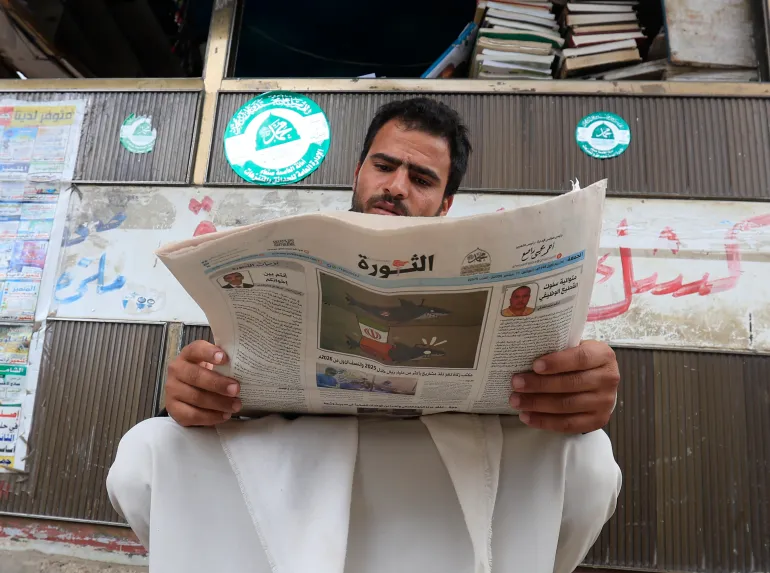
A man reads a local newspaper featuring news of the escalating fighting in the country, in Sanaa, Yemen, September 11, 2026. Yemen’s Houthi group said navigation in the Red Sea and Bab al-Mandeb strait remained safe except for Saudi vessels, which it says remain subject to a blockade, after seizing the port city of Mocha on September 10 and making further gains around the strategic strait the following day [Yahya Arhab/EPA]
How could this benefit Iran?
The Houthis began to attack several vessels in the Red Sea they claimed were linked to Israel in 2023, as part of their stated aim to pressure Israel to end the genocidal war on Gaza.
This prompted bombing campaigns by the US, United Kingdom and Israel against Houthi positions in Sanaa, Hodeidah and other areas.
Saudi Arabia, which joined the war against the Houthis in 2015, has largely stayed out of the current eruption in fighting in Yemen.
After their recent victories, the Yemeni group can now exercise more control over the Red Sea and the Bab al-Mandeb strait.
The Houthis’ control of Yemen’s Red Sea coastline and multiple islands – including the island of Mayun, also known as Perim, sitting about 3km (1.9 miles) off Yemen’s mainland – provides the group with close-range access to the Bab al-Mandeb strait.
A video published on Friday showed a Houthi commander telling soldiers they will no longer need missiles and drones to threaten shipping in the crucial waterway. They could simply position artillery along the coast and fire in all directions at ships, he said.
The Houthis have not declared the strait closed, but the group’s military spokesperson, Yahya Saree, said on Friday that “maritime navigation is safe for all companies except for Saudi vessels.”
Likewise, Iran’s partial control of the Strait of Hormuz on the other side of the Arabian Peninsula has been a key tool of leverage for Tehran in the war against the US.
The prospect of closing down the strait could potentially be used by Tehran in future negotiations over ending the war with the US.
Iranian officials are expected to meet regional Arab representatives on Monday for talks over how to facilitate shipping through the Strait of Hormuz, which Tehran maintains remains closed.
They have said they favour a collective regional approach on passage through the strategic waterway.
A person watches Houthi military spokesman Yahya Saree delivering a televised statement, in Sanaa, Yemen, September 11, 2026 [Yahya Arhab/EPA]
The US, which has continued its naval blockade of Iran’s ports and intensified sanctions on Tehran, reportedly opposes the agreement.
Authorities in Tehran have signalled there will be no talks with Washington under the current circumstances.
“As long as the American side does not accept all of Iran’s conditions, dialogue and negotiation are of no use,” Ebrahim Azizi, head of the hardline Iranian parliament’s national security commission, wrote on X on Saturday.
‘Lord of the straits’
At the start of the working week in Iran on Saturday, hardline and IRGC-linked newspapers and media outlets celebrated the recent Houthi advances.
Keyhan, whose editor-in-chief was appointed by Ali Khamenei, called the advances “the miracle of resistance” and said they had “put the US and Israel in a bind”.
The Quds newspaper, published by the influential Astan-e Quds Razavi in Mashhad, called Iran and the Houthis “the lord of the straits”.
But even though Tehran has repeatedly threatened that Bab al-Mandeb could be further disrupted if the war continues, Iran’s diplomatic apparatus did not immediately link the Houthi advances with the current fight against the US.
As has often been the case, Iran’s Ministry of Foreign Affairs insisted that the Houthis make their decisions independent of Tehran, with their own interests at heart, including ending Saudi Arabia’s blockade on Yemen.
The Iranian Foreign Ministry also called for an end to the Saudi siege on Houthi-controlled areas, an immediate return to negotiations between the group and Riyadh, and respect for Yemen’s sovereignty and territorial integrity.
The ministry also pushed back on the idea that the Houthis act merely as a proxy for Tehran.
“What is happening now in Yemen is the result of the Yemenis losing patience,” Foreign Ministry spokesman Esmaeil Baghaei told state television on Friday night.
“It is not fair to ignore the fact that they were under a cruel blockade for years, and concluded that the United Nations and regional mechanisms could not resolve the issues.”
“It felt like a movie” — that’s what we all said in the days and weeks after Sept. 11, 2001, when a Michael Bay action film slammed uncomfortably into real life. But with the perspective of 25 years, what’s lingered for the most part aren’t the most literal depictions of the day, but oblique dramas that capture something more subtle: the free-floating anxiety of a nightmare. In our list, you’ll find titles that confront Sept. 11 directly, but others that bring to mind a deeper, broader canon of trauma.
‘Donnie Darko’ (2001)
Jake Gyllenhaal in the 2001 movie “Donnie Darko.”
(NewMarket Films)
Going to the movies in the fall of 2001 was a solace and escape for many New Yorkers, though the films themselves often had an eerie, unplanned timeliness that made them resonate in an unshakable way. You could ache for the cozy city of the past in “The Royal Tenenbaums” or grapple with the schism of everything suddenly feeling different in “Mulholland Drive.” Or you could envelop yourself in Richard Kelly’s moody “Donnie Darko,” a teen drama touched by metaphysical doominess in which plane engines fall from the sky and death wears a rabbit costume. The movie has since become an unexplainable piece of comfort for a spooked generation. In its weather, its soundtrack and the haunted stare of Jake Gyllenhaal, it evokes the weeks after 9/11, even if it anticipated them. — Joshua Rothkopf
‘25th Hour’ (2002)
Edward Norton in the movie “25th Hour.”
(David Lee / Touchstone Pictures)
Only months after the attacks, Spike Lee took on 9/11 with a boldness that only 15 years of provocative filmmaking — and a lifetime of loving New York — could sharpen into an artist. This interpersonal drama, about the fallout of a drug dealer (Edward Norton) going to prison, was deep in development when real-life events altered its trajectory. Lee insisted on including the American flags dotting lawns, the general sense of unease and, in a somber touch, a credits sequence featuring the Tribute in Light. Overwhelmingly, one scene takes place in a Tribeca hi-rise with a view of ground zero, and even though the conversation itself concerns a friend in trouble, it quickly shifts onto metaphorical grounds of guilt, responsibility and rage. There still may not be a better 9/11 film than this one. — J. Rothkopf
‘Munich’ (2005)
A scene from the movie “Munich.”
(Karen Ballard / Universal Pictures)
On the surface, Steven Spielberg’s “War of the Worlds,” released earlier in 2005, may seem like his more obviously 9/11-coded film (“Is it the terrorists?” Dakota Fanning’s character asks). But “Munich,” which followed six months later, goes straight to the questions of terrorism and endless cycles of retaliation that hung over the period. Eric Bana plays Avner, a Mossad operative sent to hunt down the Palestinians whom Israel holds responsible for the 1972 Munich Olympics massacre. As the revenge killings mount, the mission begins to eat away at him — and Avner’s belief in closure is shaken. Spielberg makes the contemporary connections hard to ignore. In a final scene, set in mid-’70s New York, after Avner and his handler Ephraim, played by Geoffrey Rush, argue over what they have done, the camera pans across the Manhattan skyline southward, toward the Twin Towers, which Spielberg had digitally added to the shot. — Josh Rottenberg
‘United 93’ (2006)
A scene from the movie “United 93.”
(Jonathan Olley / Universal Pictures)
Five years after 9/11, it still wasn’t clear whether audiences were ready for a Hollywood movie that directly re-created the attacks. Director Paul Greengrass, then most recently of “The Bourne Supremacy,” took on the hijacked flight whose passengers fought back before it crashed in Pennsylvania. He used a largely unknown cast and shot with an almost documentary immediacy, cutting between the plane and air-traffic controllers trying to make sense of what was happening. There’s no movie star to take charge, and Greengrass doesn’t inflate the passengers into larger-than-life heroes. We simply watch as they piece together the situation from phone calls and scraps of information and realize what they have to do. We know from the beginning that none of them will survive. Watching them slowly come to that realization is what makes “United 93” so devastating. — J. Rottenberg
‘The Dark Knight’ (2008)
Christian Bale in the movie “The Dark Knight.”
(Warner Bros. Pictures)
It was probably inevitable that the anxieties of the post-9/11 era would find their way into a Batman movie. In “The Dark Knight,” Christopher Nolan fills Gotham with bombings, acts of mass surveillance and questions about how far is too far. Heath Ledger’s Joker is an enemy who doesn’t play by the rules, attacking the city with no clear political goal beyond creating panic and chaos. Christian Bale’s Batman, meanwhile, builds a Patriot Act-like system that turns every cellphone in Gotham into a tracking device and uses increasingly brutal methods to stop him. Nolan folds all of that into a hugely entertaining superhero movie without turning it into a lecture. — J. Rottenberg
‘Man on Wire’ (2008)
Philippe Petit, as seen in the documentary “Man on Wire.”
(Jean-Louis Blondeau / Polaris)
By the time James Marsh’s Oscar-winning documentary arrived in 2008, the Twin Towers had been gone for seven years. The film recounts French high-wire artist Philippe Petit’s astonishing 1974 stunt, in which he and a small band of co-conspirators secretly rigged a cable between the towers, allowing Petit to walk high above lower Manhattan. The movie never needs to mention 9/11 to feel devastating. We already know what became of those buildings. Watching Petit step onto the wire lets us see them differently, not as the site of catastrophe but as the setting for something beautiful and absurdly daring. A ghostly montage of the Twin Towers being constructed, set to composer Michael Nyman’s “Fish Beach,” brought New Yorkers to tears. For me, that feeling is also personal. I was living in New York on 9/11 and had been at an outdoor concert in the plaza beneath the towers just weeks before the attacks, so there was something especially moving about seeing them again as part of the city’s everyday life. — J. Rottenberg
‘The Hurt Locker’ (2009)
Anthony Mackie, left, and Jeremy Renner in the movie “The Hurt Locker.”
(Jonathan Olley / Summit Entertainment)
Has there ever been a better cinematic metaphor for the War on Terror than Jeremy Renner in a bomb suit, kneeling over a device in a Baghdad street while everyone around him scans the rooftops for danger? Kathryn Bigelow’s film narrows the Iraq War down to the nerve-shredding work of an explosives-disposal unit, with Renner’s Staff Sgt. William James almost eerily comfortable in situations that terrify everyone around him. The suspense often comes down to the simplest question: Is this thing going to blow up? Bigelow, the action expert behind “Point Break” and “Strange Days,” mostly leaves the larger politics offscreen and stays with the men doing the dangerous work, their detachment a survival tactic. Though initially little-seen, “The Hurt Locker” pulled off its own improbable feat, becoming, at the time, the lowest-grossing movie to ever win Oscar’s best picture — while Bigelow became the first woman ever to win best director. — J. Rottenberg
‘Margaret’ (2011)
Anna Paquin and Matt Damon in the movie “Margaret.”
(Myles Aronowitz / 20th Century Fox)
Kenneth Lonergan shot this seething, richly authentic New York City drama in 2005, when the rawness of post-9/11 NYC was already a part of everyday life. But the trauma feels ingrained in every frame, and there are shots of wary street life — an occasional flinch or look upward — that New Yorkers could watch and think: Yes, that’s what it felt like. The plot itself concerns a teenage girl, Lisa (Anna Paquin, never better), whose hyperdramatic tendencies are both recognizable and lovable. She is involved in a bus accident that results in a fatality and, with the crusading passion that so many people felt after 9/11, decides to get involved as a witness and truth-teller. The need to fix things — amid so much that was unfixable — is a marker of all the movies on this list. — J. Rothkopf
‘Zero Dark Thirty’ (2012)
Jessica Chastain, center, in the movie “Zero Dark Thirty.”
(Jonathan Olley / Columbia Pictures)
Perhaps the most explicit film on our list, Kathryn Bigelow’s daring military procedural about the 2011 midnight raid that took out Osama bin Laden was a political hot potato in its moment. Now with distance, it impresses as a skilled piece of political moviemaking, one that captures the era’s sense of moral compromise and queasy vengeance. It contains scenes of torture and goes deeply into the CIA’s planning and execution of the operation — choices that remain provocative. But the movie’s most lingering piece of drama is a silent shot of one woman crying in a cargo plane: a high-level analyst played by Jessica Chastain, who has accomplished the unthinkable but doesn’t feel relief. The fight will not end. Only a filmmaker who had just won Oscars and made history would have been granted the artistic freedom to make this movie, arguably Bigelow’s finest. — J. Rothkopf