Cesar Chavez celebrations canceled over ‘profoundly shocking’ allegations
The United Farm Workers said it would not participate in celebrations of its founder Cesar Chavez amid what the labor union described as “troubling allegations” against the iconic Chicano figure.
The union, in a statement released Tuesday, did not detail the accusations against Chavez but said they were concerning enough for the organization to take action. But several events around the country honoring Chavez including events in Tucson, Houston, Corpus Christi, San Antonio and San Bernardino have been canceled in recent weeks, with little explanation given by organizers.
The claims against Chavez “are incompatible with our organization’s values. Some of the reports are family issues, and not our story to tell or our place to comment on. Far more troubling are allegations involving abuse of young women or minors. Allegations that very young women or girls may have been victimized are crushing. We have not received any direct reports, and we do not have any firsthand knowledge of these allegations,” the union said.
Canceling events, the union said, would “provide space for people who may have been victimized to find support and to share their stories if that is what they choose.”
Chavez is a towering national figure credited with organizing and raising the lives of migrant farmworkers in California and beyond and giving voice to the struggles of Mexican Americans.
Bursting into national prominence in the mid-1960s in the San Joaquin Valley, Chavez galvanized public support on behalf of them after organizing community groups across Central and Southern California. For decades, agricultural laborers had lived in substandard housing and were paid terrible wages. Efforts to organize migrant laborers were usually crushed violently by farmers and local law enforcement.
Chavez and his associates joined a grape pickers’ strike in 1965 launched by Filipino organizers centered around Delano, the heart of California’s table grape crop. Those early years were marked by bitter and sometimes brutal incidents involving picketing farmworkers who screamed “Huelga!” — “Strike!”—and growers who vowed never to give in to Chavez and his movement.

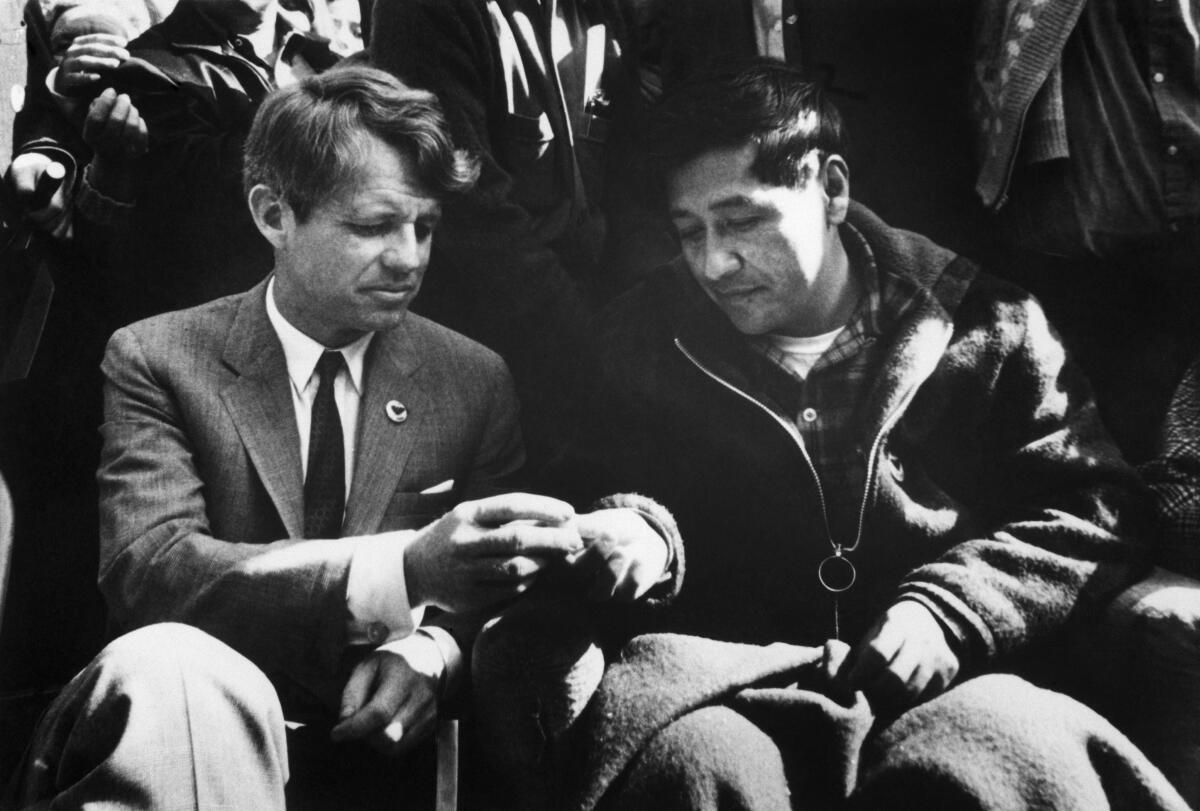
Sen. Robert Kennedy and Cesar Chavez as Chavez ended a 25-day fast.
(Bettmann Archive)
That eventually transformed into a boycott that earned international attention. Chavez, drawing on his Catholic faith, fasted for 25 days in 1968 to draw attention to the violence swirling around the effort, ending it by sharing bread with then-presidential candidate Robert F. Kennedy. Two years later, the UFW was able to secure contracts for more than 10,000 grape pickers.
Those successes made Chavez an almost mythic figure. The UFW flag — a stylized black Aztec eagle against a red background — became synonymous with the Chicano movement that was emerging at the same time. Posters and murals featuring Chavez’s beatific face sprouted in the Southwest and beyond. He traveled across the United States espousing his philosophy of nonviolence, union and dignity for farmworkers.
A 1983 poll of Latinos by The Times found Chavez to be the most admired leader.
But Chavez’s legacy became increasingly tarnished as the years went on. Labor victories became fewer and fewer. His fierce criticism of illegal immigration — Chavez argued that they undercut his unionization efforts — put him at odds with immigration activists. A 2006 Times investigation detailed how dozens of former associates and workers left the UFW because of what they described as Chavez’s increasingly autocratic ways.

Cesar Chavez talks to striking Salinas Valley farmworkers.
(Sakuma / Associated Press )
When the Los Angeles County Board of Supervisors decided to change the name of Brooklyn Avenue in East Los Angeles and Boyle Heights to Cesar Chavez Avenue after the labor leader’s death in 1993, many in the community opposed it, citing the economic burden businesses would undergo to update their addresses and the erasure of the community’s history on the street.
Yet his standing among Latinos nationwide was such that schools, streets and parks were renamed in his honor in the years after his death. In 2012, President Obama went to tiny Keene, Calif. — where Chavez had set up both his home and the operational headquarters of the United Farm Workers — to dedicate the César E. Chávez National Monument.
It’s unclear the source of the new allegations or when they might become public. But there has been rumbling for weeks among activists that something about Chavez was coming.
A Corpus Christi march was called off last week after labor leader Dolores Huerta withdrew, the San Antonio Express-News reported.
Huerta is not commenting on the issue at this time, said Eric Olvera, spokesperson for Huerta.
The news comes two weeks before Cesar Chavez Day, observed March 31.
Local organizers in Los Angeles haven’t announced whether they will cancel their events.
The UFW was vague about the claims but suggested they were serious enough for extreme action.
“These allegations have been profoundly shocking. We need some time to get this right, including to ensure robust, trauma-informed services are available to those who may need it.
“We understand this will be tremendously painful for many and we encourage our community to seek mental health support if they experience distress.”
Tuesday morning, the Cesar Chavez Foundation said in a statement that it had “become aware of disturbing allegations that Cesar Chavez engaged in inappropriate sexual behavior with women and minors during his time as President of the United Farm Workers of America.”
The foundation said it was working with leaders in the farmworker movement to be responsive to these allegations and support the people who might have been harmed.
“In partnership with the UFW, we are establishing a safe and confidential process for those who wish to share their experiences of historic harm, and, if they choose to, participate in efforts toward repair and reconciliation,” the statement said. “In addition, we are investing time and resources to ensure the Foundation promotes and strengthens a workplace culture that is safe and welcoming for all.”
In the 48 hours before the UFW and Cesar Chavez Foundation made their statements, La Unión del Pueblo Entero, a community-based union and nonprofit in the Rio Grande Valley of Texas, which was founded by Huerta and Chavez, erased the names and affiliation with the leaders from its website.
The new allegations could have implications beyond Chavez’s place in history. If he has been accused of sexual abuse, a legal expert said it could spark legal claims against the union he ran for so long.
In California, Assembly Bill 250 opened a two-year window to file sex assault claims beyond a previous statute of limitations. The Catholic Church, Scouting and public school districts, as a result, have been hit hard with lawsuits.
“It is [a] matter [of] who knew what and when,” said John Manly, a sexual abuse attorney, adding that Chavez’s leadership role could create liability for the UFW.