Camouflaged F-15E Painted To Mark F-111’s Libya Raid Blasts Through Mach Loop On First Flight
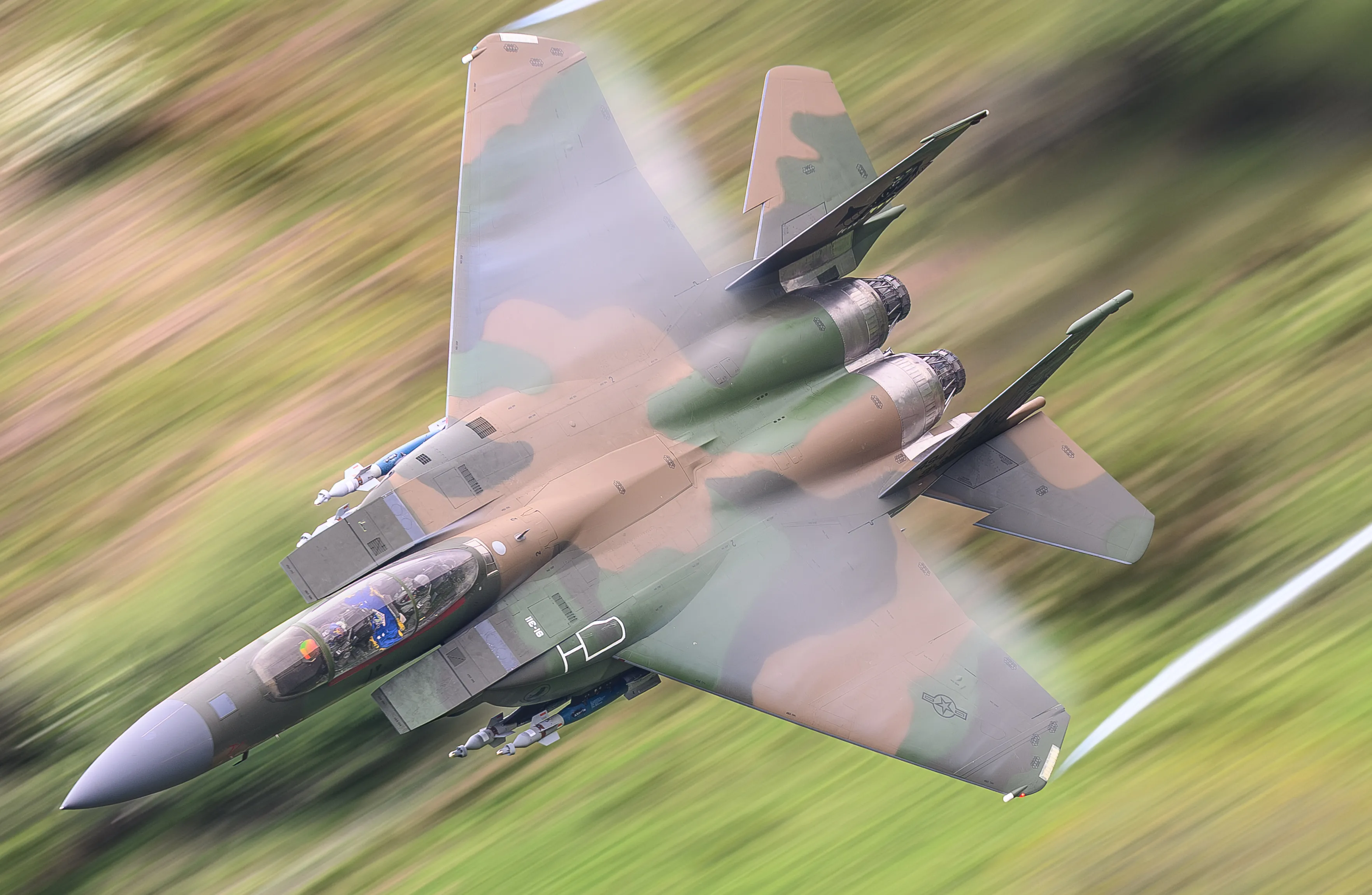
A U.S. Air Force F-15E Strike Eagle, specially painted to mark 40 years since Operation Eldorado Canyon, the U.S. raid on Libya, has taken to the air for the first. Hauling a load of eight inert 500-pound GBU-12 laser-guided bombs, today the jet flew the legendary low-level routes that run through Wales, better known as the Mach Loop. The spectacular accompanying photos of the sortie were kindly shared with TWZ by David Lister and Alec Walker.
With a color scheme recalling an F-111F Aardvark of the same unit, the 48th Fighter Wing F-15E serial 91-0311 had first been unveiled in a ceremony at RAF Lakenheath in England, on April 28. However, it seems its first flight in its new look was recorded today.

The jet departed Lakenheath in the morning as EAGLE 31, accompanied by its wingman, EAGLE 32. After taking on fuel from a KC-135 Stratotanker, the jets headed to North Wales. From there, EAGLE flight went to the Holbeach Air Weapons Range on the coast north of Lakenheath, where the inert bombs were dropped.

Recalling the F-111, the specially painted F-15E has the same camouflage scheme in two shades of green and tan, and the original 494th Tactical Fighter Squadron marking and red band on the tail. The tails of the jet also bear the legend “40 years Eldorado Canyon,” the panther emblem of the 494th, an F-111 silhouette, and the 48th wing’s Statue of Liberty insignia.
Notably, the nose radome is left in its standard gray paint.


Elsewhere on the nose, the Strike Eagle carries another F-111 silhouette and the inscription “Karma 52” in red. This commemorates KARMA 52, the Lakenheath-based F-111F serial 70-2389, which was the only example of the type lost during the Eldorado Canyon raid. The jet, armed with four GBU-10 laser-guided bombs, was flown by pilot Capt. Fernando L. Ribas-Dominicci, and weapons system officer Capt. Paul Lorence. The exact fate of KARMA 52 remains unknown, with the aircraft wreckage never being located after it came down in the Mediterranean.
Capt. Ribas-Dominicci’s body was later washed ashore; the body of Captain Lorence was never recovered. Their mission had been a hazardous one: a single-ship, low-level attack on a heavily defended target at night.

Two dozen F-111s of the 48th Fighter Wing, also based at Lakenheath, were at the forefront of the Air Force’s Eldorado Canyon strikes, conducted in April 1986, together with Navy assets from the aircraft carriers USS America and USS Coral Sea. The raid was launched by U.S. President Ronald Reagan after the bombing of a West Berlin discotheque, in which two U.S. soldiers were killed and over 70 others wounded. Libyan leader Muammar Gaddafi was blamed for the attack.

Ever since, the 48th Fighter Wing at Lakenheath has remained the first choice for a wide variety of critical missions around the globe, most recently Operation Epic Fury over Iran. This campaign has seen four combat losses of the F-15E, three of them to friendly fire. As to the other loss, this led to one of the most dramatic and complex combat search and rescue (CSAR) missions of recent times, before the two crew were safely recovered.


As of 2025, as you can read about here, the Air Force was planning to return its two squadrons of F-15Es from Lakenheath — the only permanently forward-deployed examples of the aircraft — to the United States.
Currently, Lakenheath is home to the 492nd and 494th Fighter Squadrons flying the Strike Eagle. These squadrons each have a primary aircraft assigned (PAA) complement of 26 aircraft, although this is subject to some fluctuation. Under the 48th Fighter Wing, these operate alongside the 493rd and 495th Fighter Squadrons flying the F-35A, the first of the Air Force’s stealth jets to be based in Europe.

As well as being fitted with the more powerful Dash 229 engines, Lakenheath’s F-15Es have been at the front of the queue to receive a sophisticated new radar warning and electronic warfare suite, the AN/ALQ-250 Eagle Passive/Active Warning Survivability System, or EPAWSS.
With the F-35A now firmly embedded at Lakenheath and apparently also provided with forward-deployed B61-12 thermonuclear gravity bombs, these stealthy jets may well take over entirely the F-15E, provided Congress approves consolidating the Strike Eagles in the United States. It is also possible that the decision to significantly boost the planned F-15EX Eagle II buy may see these plans changed.
In the meantime, the F-35A flies alongside the F-15E at Lakenheath, where these jets and their airmen continue the proud traditions of the 48th Fighter Wing.