calfresh

The SNAP-funding mess makes L.A.’s food-insecurity crisis clear

A strange scene unfolded at the Adams/Vermont farmers market near USC last week.

The pomegranates, squash and apples were in season, pink guavas were so ripe you could smell their heady scent from a distance, and nutrient-packed yams were ready for the holidays.

But with federal funding in limbo for the 1.5 million people in Los Angeles County who depend on food aid from the Supplemental Nutrition Assistance Program — or SNAP — the church parking lot hosting the market was largely devoid of customers.

Even though the market accepts payments through CalFresh, the state’s SNAP program, hardly anyone was lined up when gates opened. Vendors mostly idled alone at their produce stands.
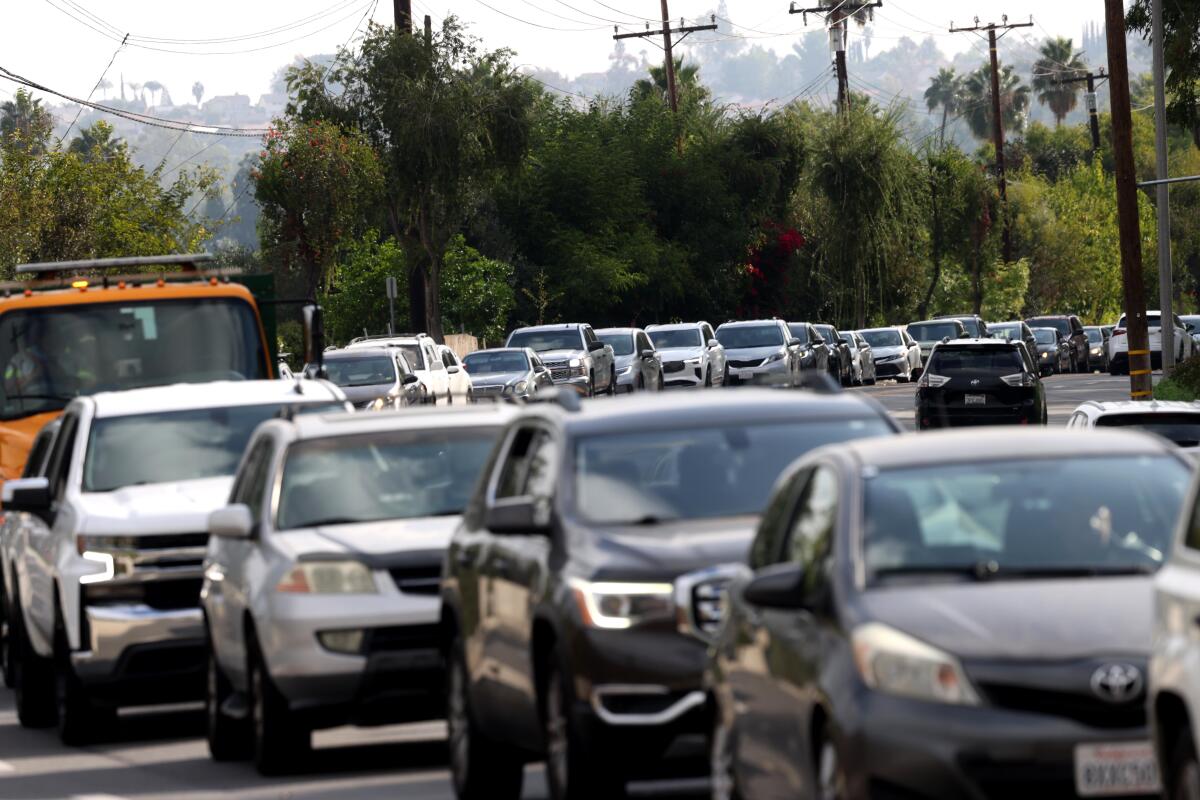
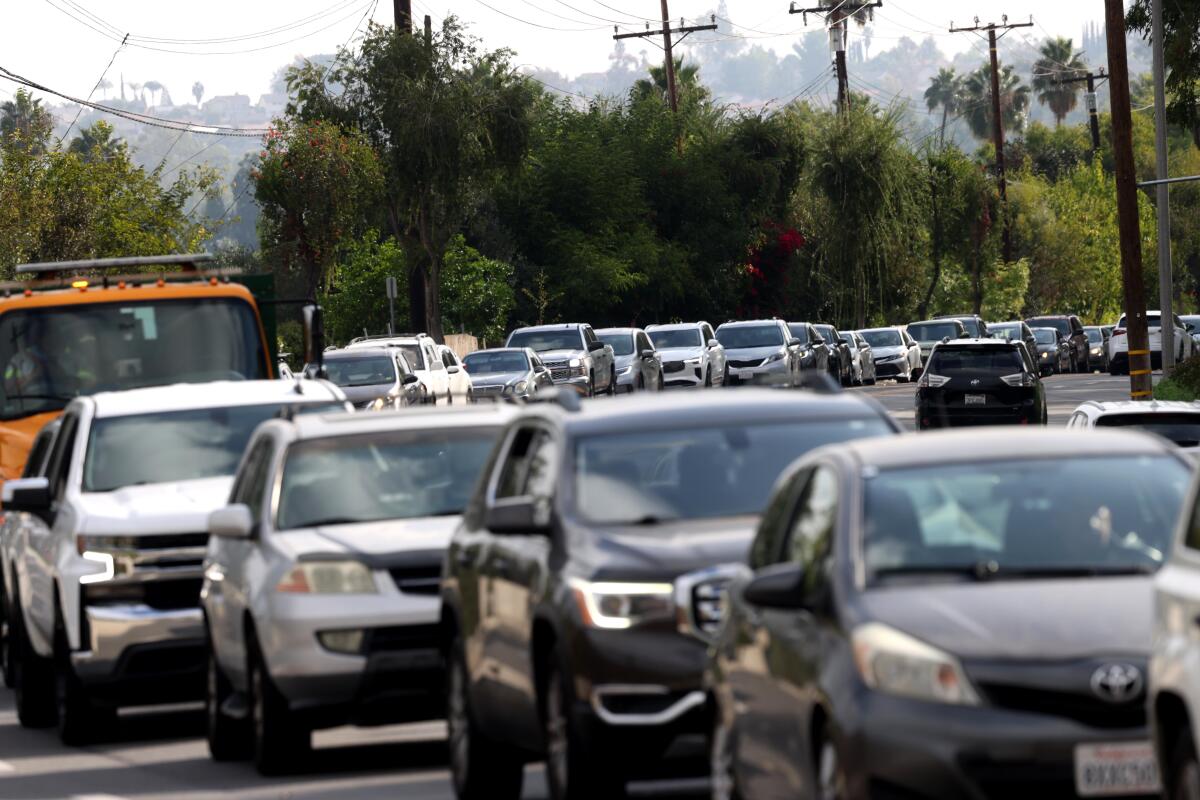
A line of cars in the City of Industry.

A line of cars stretches more than a mile as people wait to receive a box of free food provided by the L.A. Food Bank in the City of Industry on Wednesday.

(Genaro Molina/Los Angeles Times)

As thousands across Southern California lined up at food banks to collect free food, and the fight over delivering the federal allotments sowing uncertainty, fewer people receiving aid seemed to be spending money at outdoor markets like this one.

“So far we’re doing 50% of what we’d normally do — or less,” said Michael Bach, who works with Hunger Action, a food-relief nonprofit that partners with farmers markets across the greater L.A. area, offering “Market Match” deals to customers paying with CalFresh debit cards.

The deal allows shoppers to buy up to $30 worth of fruit produce for only $15. Skimming a ledger on her table, Bach’s colleague Estrellita Echor noted that only a handful of shoppers had taken advantage of the offer.

All week at farmers markets where workers were stationed, the absence was just as glaring, she said. “I was at Pomona on Saturday — we only had six transactions the whole day,” she said. “Zero at La Mirada.”

CalFresh customers looking to double their money on purchases were largely missing at the downtown L.A. market the next day, Echor said.
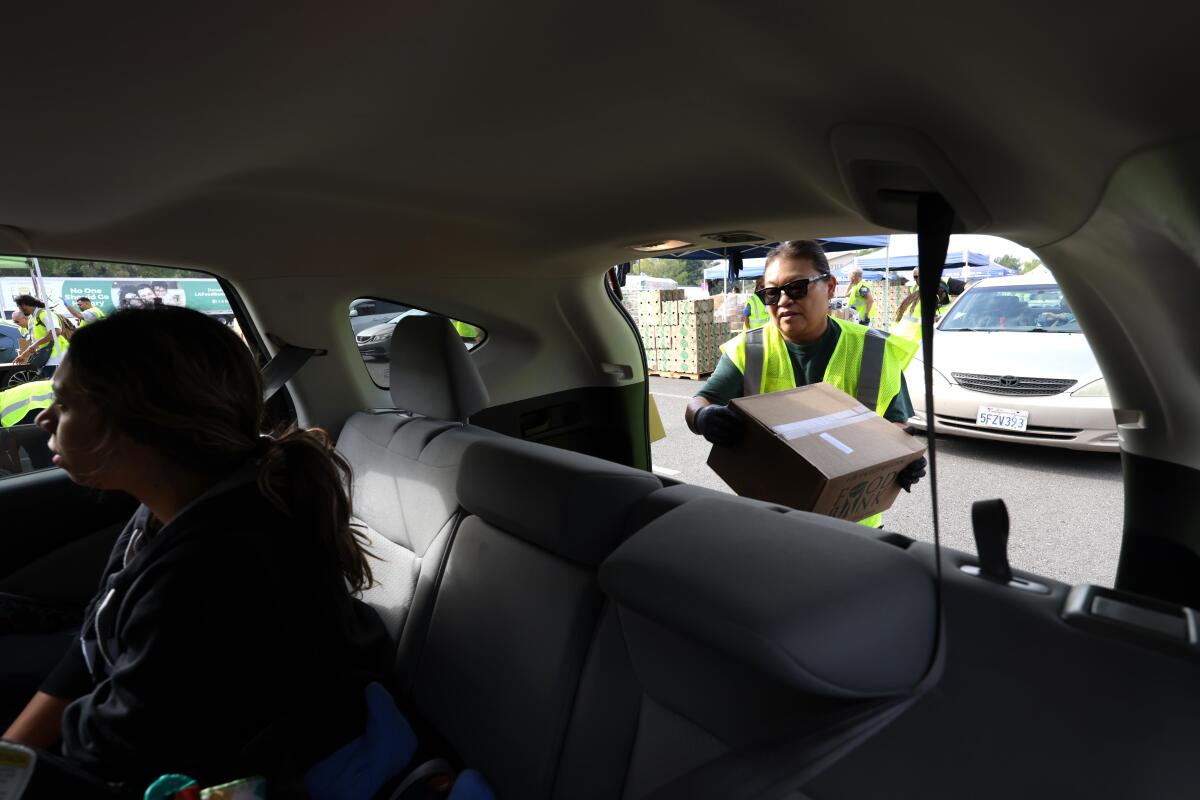
A volunteer loads up a box of free food for a family at a drive-through food distribution site in the City of Industry.

A volunteer loads up a box of free food for a family at a drive-through food distribution site in the City of Industry.

(Genaro Molina/Los Angeles Times)

“This program usually pulls in lots of people, but they are either holding on to what little they have left or they just don’t have anything on their cards,” she said.

The disruption in aid comes as a result of the Trump administration’s decision to deliver only partial SNAP payments to states during the ongoing federal government shutdown, skirting court order to restart funds for November. On Friday night, Supreme Court Associate Justice Ketanji Brown Jackson temporarily blocked the order pending a ruling on the matter by the U.S. Circuit Court of Appeals.

But by then, CalFresh had already started loading 100% of November’s allotments onto users’ debit cards. Even with that reprieve for food-aid recipients in California, lack of access to food is a persistent problem in L.A., said Kayla de la Haye, director of the Institute for Food System Equity at USC.

A study published by her team last year found that 25% of residents in L.A. County — or about 832,000 people — experienced food insecurity, and that among low-income residents, the rate was even higher, 41%. The researchers also found that 29% of county residents experienced nutrition insecurity, meaning they lacked options for getting healthy, nutritious food.

Those figures marked a slight improvement compared to data from 2023, when the end of pandemic-era boosts to state, county and nonprofit aid programs — combined with rising inflation — caused hunger rates to spike just as they did at the start of the pandemic in 2020, de la Haye said.

“That was a big wake-up call — we had 1 in 3 folks in 2020 be food insecure,” de la Haye said. “We had huge lines at food pantries.”

But while the USC study shows the immediate delivery of food assistance through government programs and nonprofits quickly can cut food insecurity rates in an emergency, the researchers discovered many vulnerable Angelenos are not participating in food assistance programs.

Despite the county making strides to enroll more eligible families over the last decade, de la Haye said, only 29% of food insecure households in L.A. County were enrolled in CalFresh, and just 9% in WIC, the federal nutrition program for women, infants and children.

De la Haye said participants in her focus groups shared a mix of reasons why they didn’t enroll: Many didn’t know they qualified, while others said they felt too ashamed to apply for aid, were intimidated by the paperwork involved or feared disclosing their immigration status. Some said they didn’t apply because they earned slightly more than the cutoff amounts for eligibility.

Even many of those those receiving aid struggled: 39% of CalFresh recipients were found to lack an affordable source for food and 45% faced nutrition insecurity.

De la Haye said hunger and problems accessing healthy food have serious short- and long-term health effects — contributing to higher rates of heart disease, diabetes and obesity, as well greater levels of stress, anxiety and depression in adults and children. What’s more, she said, when people feel unsure about their finances, highly perishable items such as fresh, healthy food are often the first things sacrificed because they can be more expensive.

The USC study also revealed stark racial disparities: 31% of Black residents and 32% of Latinos experienced food insecurity, compared to 11% of white residents and 14% of Asians.

De la Haye said her team is analyzing data from this year they will publish in December. That analysis will look at investments L.A. County has made in food system over the last two years, including the allocation of $20 million of federal funding to 80 community organizations working on everything from urban farming to food pantries, and the recent creation of the county’s Office of Food Systems to address challenges to food availability and increase the consumption of healthy foods.

“These things that disrupt people’s ability to get food, including and especially cuts to this key program that is so essential to 1.5 million people in the county — we don’t weather those storms very well,” de la Haye said. “People are just living on the precipice.”

Source link

California women celebrate reprieve on losing SNAP food benefits

For Zuri Crawford, the last several weeks have been an emotional whirlwind — swinging from fears to frustration to now partial relief.

A 20-year-old single mother and Riverside City College student, Crawford depends on the federal Supplemental Nutrition Assistance Program to buy groceries for herself and her young son. Earlier this week, she braced herself for the possibility that — because of the federal shutdown — she would not receive the $445 that typically gets loaded onto her state-issued debit card on the sixth day of every month.

“I really feel like I’m going to be burnt out. I feel like it’s going to be hard on me because I am a single mom,” she said on a recent afternoon. “I have to push through, but I am going to be overwhelmed.”

On Thursday, however, Crawford was surprised to learn that the $445 payment had showed up on her card. Soon after, Gov. Gavin Newsom announced that, because of a court victory, “food benefits are now beginning to flow back to California families” — at least temporarily.

Crawford is one of roughly 5.5 million statewide who depend on this food aid — known in California as CalFresh — and one of 42 million people nationwide. In recent weeks, this group has been caught in the crosshairs of a political battle that has shifted from Congress to courtrooms amid a federal shutdown that has now lasted more than five weeks.

As of early Friday, two federal judges had ordered the U.S. Department of Agriculture to use billions of dollars in contingency funding to continue providing SNAP support — the reason Crawford and many others nationwide received their full benefits Thursday. On Friday the Trump administration asked a federal appeals court to block one of those orders. The appeals court let the order stand, and then late Friday the Trump administration succeeded in persuading the Supreme Court to block the judicial rulings and — at least temporarily — withhold food benefits from millions of Americans.

Many recipients in California already have their payments, but the legal drama late Friday may add to their anxieties. Many were already improvising, and may have to do so again.

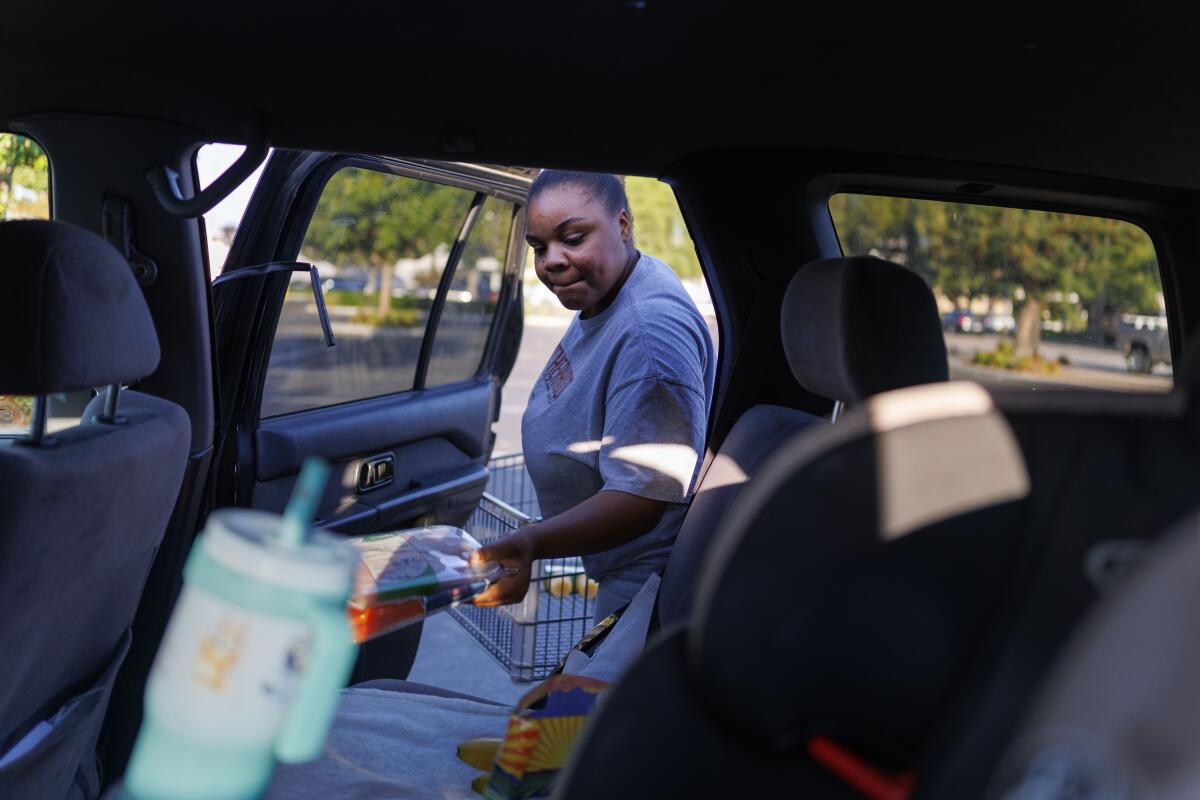
Zuir Crawford, 20, loads essential groceries into the back seat of her car

Zuir Crawford, 20, loads groceries bought using gift cards supplied by Riverside City College.

(Gina Ferazzi / Los Angeles Times)

In Crawford’s case, she already juggles college coursework, picks up shifts as an UberEats driver and cares for her 1-year-old. When she learned her food aid would be delayed this month, she made a plan: She would drop two classes and then pick up additional work as a caregiver so she and her son could afford to eat. She would use that money to supplement the support she is receiving from her school and community.

Even with food aid, she depends on food pantries to help her obtain items such as canned ravioli, Rice-a-Roni and frozen dinners for the last two weeks of the month.

Single parents could be hit especially hard by the delay in food benefits. Nationwide, single-adults make up nearly two-thirds (62%) of all SNAP households with children, according to the USDA. In California, almost a quarter of single working parents (23.2%) are in poverty, according to the Public Policy Institute of California.

Households headed by single mothers are especially vulnerable amid a worsening gender wage gap and rising costs for education, housing and child care, said Jesseca Boyer, vice president of policy and strategic initiatives for the Institute for Women’s Policy Research. “All of those factors require a single mother to stretch their already limited dollars even further,” she said.

In the Bay Area city of Mountain View, Abigail Villavicencio usually gets between $500 and $700 each month loaded onto her CalFresh cards, she said. It depends on her fluctuating income delivering food for apps such as Uber Eats. A single mom with three children, she first qualified for SNAP in 2021, and at that time was able to stretch the money to cover groceries for an entire month.

“But over the last year, it hasn’t been enough. I spend $500 in 2 weeks. I noticed prices were going up,” she said, and her weekly grocery trip often now costs $200 to $300. “I have two weeks when I have to figure out what to do.”

Villavicencio said she augments her benefits by collecting donated food at her son’s school twice a month.

The last few weeks have been particularly hurtful, she said, when she sees commenters on social media deriding food stamp recipients as “lazy.” She notes that she has to show her bank accounts every six months to qualify for CalFresh. For the past three years, she’s been home with her twin daughters as they went through intensive behavior therapy for autism.

News of the delayed SNAP benefits gutted her carefully calibrated food plan. She dipped into her savings for the last grocery trip and bought enough to make meals she could sell to construction workers to earn a few extra dollars.

Now that her twin daughters are in kindergarten, she’s also been searching for more consistent work — but it’s been challenging, she said, to find one that will allow her to drop off and pick up her children from school.

Holding her dog Bear, Zuir Crawford sits on a sofa

Holding her dog Bear, Zuir Crawford, 20 fears losing her SNAP benefits because of the federal government shutdown. “I really feel like I’m going to be burnt out. I feel like it’s going to be hard on me because I am a single mom,” she said on a recent afternoon. “I have to push through, but I am going to be overwhelmed.”

(Gina Ferazzi / Los Angeles Times)

As for Crawford, she said she experienced “trauma after trauma” growing up, bouncing between homes in Los Angeles and Riverside counties. She has sought stability since becoming a teen mom to her son, whom she affectionately calls Baby Z.

She is in her second semester at Riverside City College, where she is taking prerequisite courses to pursue a nursing career. She makes “little to nothing” driving for Uber Eats, she said, “but it’s enough for me to at least put gas in my tank.”

Without the financial support of her family or a partner, she relies on a patchwork of government programs.

Two months ago, she, her son and her fluffy white dog Bear moved into a one-bedroom apartment that she obtained through a county housing program for the homeless. She uses the nearly $900 a month she receives through CalWorks, a state welfare program, to cover her rent, utilities and phone bill. Along with CalFresh, she gets a monthly allotment of healthy food through the Women, Infants and Children program.

She said she’s also sustained by her Christian faith. She attends regular Bible studies and uses a portion of her food budget to make meals for the homeless.

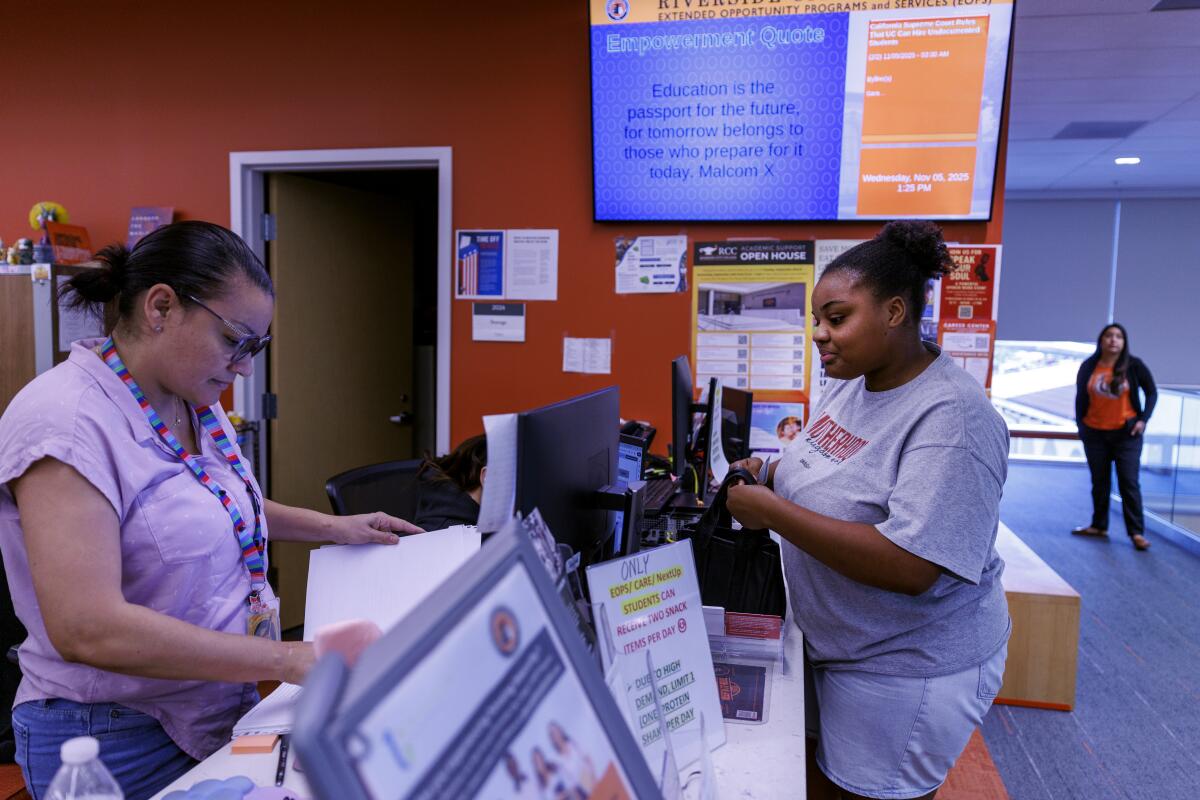
Inside the college’s Basic Needs Resource Center on Wednesday afternoon, Crawford filled a black basket with peanut butter, jelly, oatmeal, a can of pozole and hygiene products. While students can typically access the pantry every two weeks, they can collect staples once a week during the shutdown, a volunteer explained.

Crawford is in her second semester at Riverside City College

Crawford is in her second semester at Riverside City College, where she is taking prerequisite courses to pursue a nursing career.

(Gina Ferazzi / Los Angeles Times)

As a community college student and single parent receiving public assistance, she is also eligible for additional support including meal vouchers and grocery gift cards.

With SNAP beneficiaries becoming pawns in the shutdown fight, she said she’s grateful for the public assistance, which she views as a “stepping stone” to a more financially secure life.

“It’s not my fault that I was born into the family I was born into,” she said later that day, as she sliced and spiced chicken and steamed vegetables for a low-cost meal. “I can’t control that. But what I can control is my outcome. And I know that if I keep on working hard, if I keep on persevering through all the hardships, I’m going to be OK.”

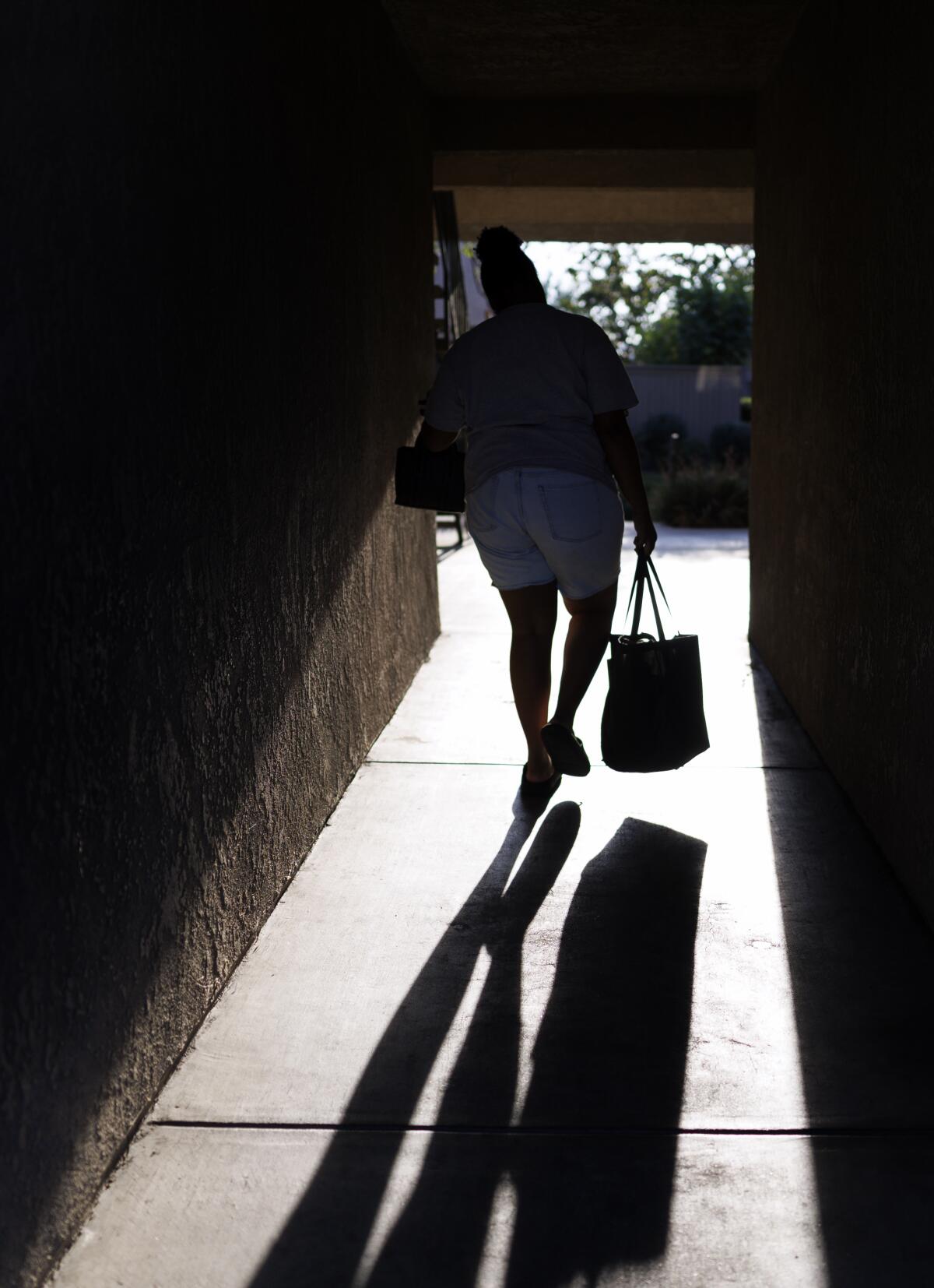
Zuir Crawford, 20, carries groceries from a local market and also from a food pantry to her apartment

Zuir Crawford, 20, carries groceries from a local market and also from a food pantry to her apartment in Riverside.

(Gina Ferazzi / Los Angeles Times)

Up until Thursday, both Villavicencio and Crawford were preparing for hard times. The Mountain View mom was worried about telling her children about a diminished Thanksgiving this year. Crawford was calculating how to further improvise on using her food budget wisely.

Both women were relieved that, on the sixth day of the month, their benefits had fully reloaded.

“I can breathe now,” Villavicencio said Friday.

“I’m super-shocked,” added Crawford with a laugh. “I feel relieved. I just feel happy.”

This article is part of The Times’ equity reporting initiative, funded by the James Irvine Foundation, exploring the challenges facing low-income workers and the efforts being made to address California’s economic divide.

Source link