C17

USAF Assessing Feasibility Of Restarting C-17 Production As Part Of Its Future Airlift Vision

The U.S. Air Force has been taking a new look at the feasibility of restarting production of the C-17 Globemaster III cargo plane as part of its still-evolving next-generation airlift plans. The service also continues to explore a wide range of next-generation aerial refueling concepts, including new stealthy and/or uncrewed tankers, but a firm vision for the way forward there has yet to emerge.

Air Force Lt. Gen. Daniel Tulley, head of Air Mobility Command (AMC), shared new details about future airlift and aerial refueling efforts, with TWZ and other outlets at a roundtable at the Air & Space Forces Association’s (AFA) 2026 Air, Space & Cyber Conference.

On the airlift side, the Air Force’s stated plan to date is to replace both the C-17A and C-5M Galaxy with a single Next-Generation Airlift (NGAL) platform, starting in the mid-2040s. Separately, the service is pursuing what could be a family of future aerial refueling capabilities under what is now called the Advanced Tanker Systems (ATS) program. Very broadly speaking, ATS presents a path toward what might come after the retirement of the aging KC-135 tanker fleet, though those aircraft are still expected to keep flying for years to come. The Air Force is also moving to further expand its fleet of newer KC-46A tankers in the interim, but persistent technical and other issues with that design continue to present hurdles.

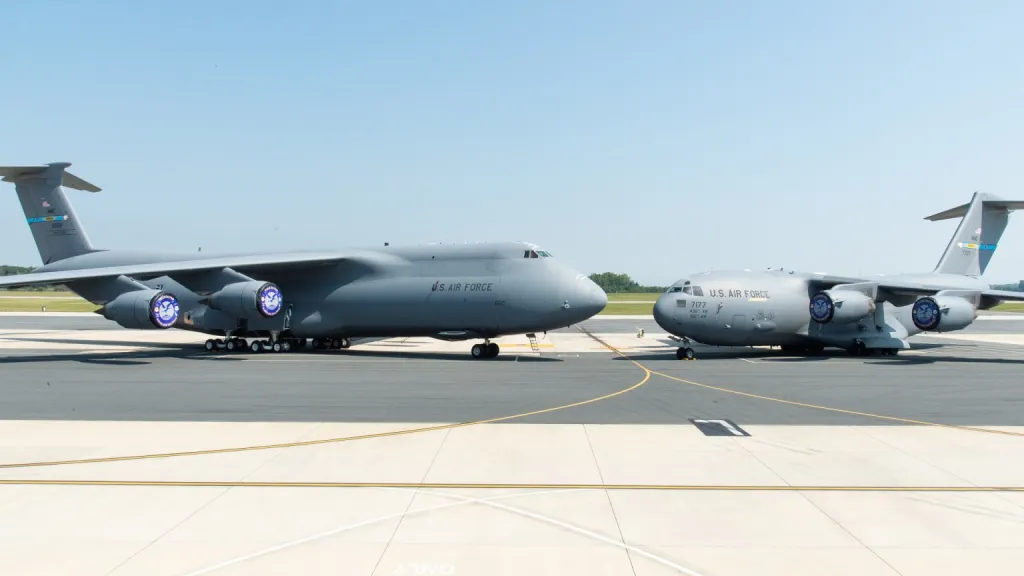
A US Air Force C-5, at left, together with one of the sevice’s C-17s, at right. USAF
A KC-135, at right, prepares to link with a KC-46, at left, during a test. USAF

At the roundtable today, Lt. Gen. Tulley was asked explicitly about restarting C-17 production. The manufacturer of those aircraft, Boeing, shuttered that line in 2015. The company also just marked the 35th anniversary of the design’s first flight yesterday.

“Heck yeah, but with a caveat, right?” Tulley said in response. “So we were just asking this question over the course of last week, and it’s in the context of next-generation airlift. So we are about to embark on the Analysis of Alternatives to replace the C-17 and replace the C-5. All options are on the table.”

“There’s always the option to service life extend the C-17, but the [production restart] question came up,” he continued. “I’ve heard this my entire career. Once we terminate an assembly line, can we ever bring it back? Does somebody store all the machinery and the dies and whatnot, and can you bring that out? So we’re asking that question.”

“But then whatever that answer is from the vendors, what will be the price tag associated with that?” he added. “You have to ask yourself, okay, is rebuilding a C-17 even if you make improvements – and there’s a loose analogy with the C-130J, [a] much more modern, capable variant of the C-130E [author’s note: the C-130J evolved more directly from the C-130H variant] I first learned to fly – if you do that with the C-17, is that the best move? Or are there new technologies that we can incorporate into it so that it can defend itself, so that it’s connected, it’s networked, it does all the things that maybe the current C-17 doesn’t do?”

“We’re looking into it as part of the Analysis of Alternatives. I’m hopeful that we’ll get to answer that question.”

In June, the House Armed Services Committee also directed the U.S. Air Force to prepare a formal briefing on the matter of new C-17 production in a report accompanying a draft of the annual defense policy bill, or National Defense Authorization Act (NDAA), for Fiscal Year 2027.

Boeing Pieces Together the Last C-17 on the Line thumbnail

Boeing Pieces Together the Last C-17 on the Line

The RAND Corporation did conduct a detailed, independent analysis more than a decade ago that assessed the costs and complexities that could come from Boeing building more C-17As, as well as other variants and derivatives of the design. RAND’s conclusion was that any of the courses of action would require billions of dollars of new investment and entail risks, as you can read more about in more detail here.

Foreign participation in a new C-17 production run could help at least defray costs. Australia, Canada, India, Kuwait, Qatar, the United Arab Emirates, and the United Kingdom all currently fly Globemaster IIIs. The Strategic Airlift Capability (SAC) initiative, a multinational arrangement with several European members, as well as the United States, also operates three of these aircraft.

Boeing told TWZ directly in June that unnamed C-17 operators had been reaching out about the prospect of restarting the production line, and that the company was “encouraged” by those discussions.

As Lt. Gen. Tulley stressed, there are significant questions about whether buying new-production C-17s, even with substantial improvements, is not only feasible, but a good use of resources. The Air Force’s Globemaster III fleet today continues to prove itself to be critical to the U.S. military’s ability to project power globally, and is in very high demand right now, especially amid the ongoing conflict with Iran.

The Air Force’s desire to replace both the C-17 and C-5, which are very different aircraft in form and function, could still easily lead the service down a different route. Boeing is not the only one looking at future NGAL opportunities. Another company, Radia, has been very actively pitching a clean-sheet design that is physically bigger than either the C-17 and the C-5, and that is geared toward greater operational flexibility, at the Air Force. Radia is targeting a first flight of its aircraft, called Windrunner, by the end of the decade, but it is still in a very aspirational stage at present.

A rendering of Radia’s Windrunner design. Radia

Many questions also still remain about how the Air Force will ultimately proceed on the next-generation aerial refueling front.

“So thinking beyond the current KC-46 buy and the program extension, whatever that next tanker looks like, our Advanced Tanker System, it’s got to be connected. It’s got to be able to defend itself,” Lt. Gen. Tulley said at the roundtable. “But it begs the question: does it need to be manned? Could it be optionally manned? Could it be autonomous? Or is there a family of solutions maybe that would answer that question? So I do not believe that it has to be manned.”

The AMC head was responding to a specific question about how autonomy could play into the Air Force’s future aerial refueling plans, which included a reference ot the U.S. Navy’s MQ-25 Stingray tanker drone. The Navy just announced its first low-rate initial production contract for MQ-25s on Monday.

“I think you’re seeing that with the MQ-25 and the Navy’s work, but then, how do we, the U.S. Air Force, bring that to bear in scope, scale, and range?” Tulley continued. “An optionally manned or an unmanned tanker, at range, the ranges we need to operate at, it’s a very large aircraft. And we’re not yet to where we’re employing fully autonomous large aircraft, but the technology, I would say, is there and rapidly getting there if it’s not.”

The MQ-25 is another Boeing product, and that company has shown a rendering of a larger, land-based derivative in the past. Lockheed Martin’s Skunk Works has also put forward several advanced tanker concepts in the past, including stealthy and potentially uncrewed designs.

A rendering of a larger, land-based derivative of the MQ-25, depicted refueling from a KC-46 tanker. Boeing
One of the advanced tanker concepts Lockheed Martin’s Skunk Works has shared publicly in recent years. Lockheed Martin Skunk Works

“We will be going after how to make the tanker survive,” William Bailey, the Air Force official currently performing the duties of the Assistant Secretary of the Air Force for Acquisition, Technology and Logistics, had also told TWZ and other outlets at a separate roundtable at the Air, Space & Cyber Conference yesterday. Bailey was responding to a direct question about whether the service was moving away from the idea of a stealthy tanker as part of the ATS plan.

“So, lots of work around what do we do in the future for our tankers, and we spent a pretty dedicated effort to go through and look at what do we think those design solutions could look like,” Bailey also said. “We looked internally. We went out to industry, had those guys come back with their thoughts on how to provide a more survivable aircraft.”

“The stuff that was coming in for me might have been an incremental improvement, but [it was] not clear that that represented the next step, the next phase,” he added. “What you’ll see is we’ll take our efforts, and we’ll look at, hey, if the real question is tanker access, then let’s not constrain ourselves to just the aircraft itself and trying to make a stealthy tanker. We need a tanker to have access, so we’ll talk about all those systems that it would take to protect that tanker.”

Bailey said the question of operational “access” applied to next-generation discussions, as well.

As is the case with the Air Force’s airlift fleets, the service tankers are in high demand due to the conflict with Iran and other current operational requirements. Stress on the existing tanker force, compounded by the ever-advancing age of the KC-135s, has been a steadily growing point of concern for years now. U.S. military officials have long been drawing attention to the limits of available aerial refueling capacity to meet even routine peacetime demands. The Air Force, as well as the U.S. Navy, have also expanded their use of contractor-owned and operated tankers to perform certain non-combat aerial refueling missions to help ease this strain.

This ex-French Air Force KC-135FR tanker, now operated by private contractor Metrea, is an example of the outside aerial refueling capacity the U.S. military has been increasingly leveraging in recent years. Metrea

In the meantime, the Air Force is still pursuing upgrades for its existing airlift and tanker fleets, with heavy focus on increased network connectivity and improved self-protection capabilities.

Greater connectivity “can be a game changer, and it has been a game changer in Operation Epic Fury [against Iran],” Lt. Gen. Tulley said at today’s roundtable. “The ability for air crews to communicate, to coordinate tanker orbits and rendezvous, to pass threat information, to save lives and save aircraft has been everything we expected it to be and more.”

“We have MAF NEXUS that we’re pursuing. The goal is to have this on all mobility aircraft, whether they’re future-built and it’s incorporated, or it’s an add-on capability to existing aircraft,” he continued. “It brings edge compute, the ability to then employ AI [artificial intelligence] and much more computing core power forward on the aircraft, and it does network with the rest of the joint force and the Air Force’s battle management system.”

A picture of a US Air Force KC-135 tanker spotted earlier this year with a new large satellite communications antenna (further highlighted in the inset), underscoring work underway now to improve the network connectivity of those aircraft. Alessandro Ledda

When it comes to new options for protecting existing tankers, “nothing’s off the table,” the AMC boss added. “Whether it’s [in the] electromagnetic spectrum, whether it’s kinetic self-defense, a layered approach, we’re looking at everything to come up with what might be the best system. But it’s got to be a system that we can afford, and it’s got to be one that we can put on all the aircraft we have and the ones we’re about to build.”

Using Collaborative Combat Aircraft (CCA) or other types of drones to help provide localized defense for airlifters and tankers could be another option. The Air Force has already experimented with this, at least to a degree.

The Air Force is otherwise still clearly continuing to shape its future airlift and aerial fueling visions. As part of that work, the service is now at least considering the possibility of rebooting C-17 production.

Contact the author: joe@twz.com
Joseph is TWZ’s Deputy Editor, helping to oversee the site’s highly experienced and dedicated team, while also writing informative and impactful defense and national security content. He lives right in the thick of it in the Washington, D.C. area.


Source link

USAF C-17 Makes Extremely Rare Visit To Moscow (Updated)

A U.S. Air Force C-17 Globemaster III has made a highly unusual visit to Moscow today, landing at Vnukovo Airport after flying from Riga, Latvia, according to publicly available flight-tracking data. The purpose of the flight remains unclear for now. It does come as Ukrainian President Volodymyr Zelensky says he has identified a potential opportunity for new U.S. ​mediation to help end the Russian war in Ukraine.

Flight-tracking data identified the C-17, operating under the callsign RCH4555, departing Riga at approximately 8:50 a.m. Moscow time and arriving at Vnukovo at around 10:04 a.m. Video posted to social media also shows the C-17 on approach to Vnukovo.

RCH4555 had flown from Joint Base McGuire-Dix-Lakehurst, New Jersey, to Joint Base Lindsey Graham (formerly Joint Base Charleston), South Carolina, on August 22. A day later, the aircraft touched down at Joint Base Andrews in Maryland, before departing for Riga. The plane then continued to Moscow two days later.

There are unconfirmed reports, citing observers on the ground, that an aircraft that might have been a U.S. Air Force C-40B was also on the ground at Riga earlier today. The C-40B is a militarized version of the commercial Boeing 737-700 and is often used to shuttle high-ranking government and military leaders.

The earlier stop at Joint Base Andrews is also notable. Situated just outside Washington, D.C., this is not simply an ordinary transport base. It is the home of the 89th Airlift Wing, which operates the Air Force’s Special Air Mission (SAM) fleet and supports senior U.S. officials and foreign dignitaries. The wing’s mission includes providing airlift for the president, vice president, senior executive staff, high-ranking government officials, and foreign dignitaries.

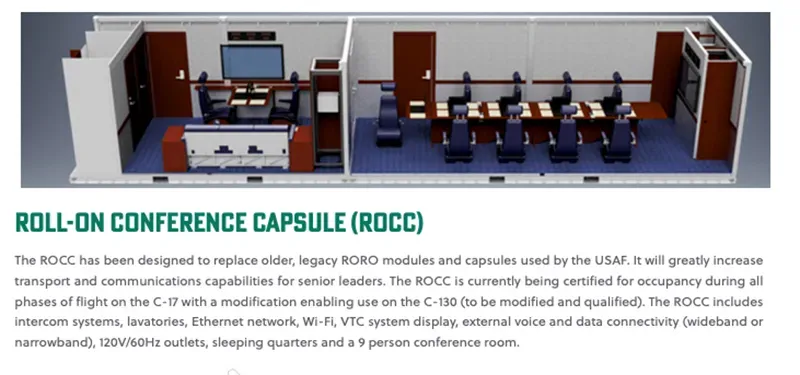
Joint Base Andrews is also where the Air Force’s Roll-On Conference Capsules (ROCC) are kept. The Air Force deploys ROCCs onboard certain C-17s to give senior leaders a secure, quiet place to conduct business in the middle of a noisy, often-crowded cargo aircraft. They serve as a mobile SCIF, office, and apartment all in one. Their extensive communications include multiple options for unsecured and secure voice, data, and video teleconferencing. These capsules replaced the previous Silver Bullet Command and Control Module, a converted Airstream trailer, which was phased out in recent years for reasons you can read more about here.

A graphic showing the Roll-On Conference Capsule from SelecTech. SelecTech

The C-17 is otherwise well-equipped for carrying high-ranking officials on overseas trips, including into potentially hostile areas. The planes have a defensive suite that includes multiple types of expendable decoys and the laser-based Large Aircraft Infrared Countermeasure System (LAIRCM).

The Globemaster III’s primary mission is as a strategic airlifter, and it is typically used for transporting personnel, equipment, and other cargo. With those capabilities, the aircraft are also regularly used to bring advance parties to countries ahead of major state and other diplomatic visits. For presidential visits, this can even include Marine One helicopters and vehicles for the official motorcade.

A U.S. Air Force C-17 Globemaster III from Joint Base Charleston deploys flares as part of a training event over the Atlantic ocean in a military operating area (MOA) outside Charleston, South Carolina, June 5, 2021. The C-17 is capable of rapidly and strategically delivering troops and all types of cargo to MOAs or forward-operating bases in deployment areas. The C-17 aircraft can perform tactical airlift and airdrop missions as well as transport litters and ambulatory patients during aeromedical evacuations. (U.S. Air Force photo by Tech. Sgt. Chris Hibben)
A U.S. Air Force C-17A from Joint Base Charleston deploys flares as part of a training event over the Atlantic in a military operating area outside Charleston, South Carolina, June 5, 2021. Master Sgt. Chris Hibben

The presence of an active-duty U.S. military transport aircraft in the Russian capital is highly unusual and immediately attracted attention from open-source intelligence and aviation observers.

At this stage, the purpose of the Moscow flight and what the aircraft carried are not publicly confirmed. We have reached out to the Office of the Secretary of Defense, Air Mobility Command, and the U.S. Air Forces in Europe for more details about the mission. The Office of the Secretary of Defense directed us to contact the Air Force.

Nevertheless, any kind of U.S. military aircraft traveling from the Washington area via Riga and then into Moscow represents an exceptionally unusual movement based on current relations between Moscow and the West.

Washington and Moscow have maintained official diplomatic channels despite the broader deterioration in relations against the backdrop of the war in Ukraine. Since U.S. President Donald Trump began his second term in 2025, ties between the two countries have both warmed and cooled again at times. Trump notably met with Russian President Vladimir Putin in person at Joint Base Elmendorf-Richardson in Anchorage, Alaska, on August 15, 2025. This was the first summit between leaders of the two nations since Russia launched its full-scale invasion of Ukraine in 2022.

Russian President Vladimir Putin disembarks his presidential aircraft at Joint Base Elmendorf-Richardson, Alaska, Aug. 15, 2025. (Alaska National Guard photo by Seth LaCount)
Russian President Vladimir Putin disembarks his presidential aircraft at Joint Base Elmendorf-Richardson, Alaska, August 15, 2025. Staff Sgt. Seth LaCount

More recent U.S.-mediated peace efforts have largely stalled in recent months, including when Ukraine refused Russian demands to cede more territory. However, over the weekend, Ukraine’s President Volodymyr Zelensky did say he saw a window for new diplomatic efforts, at least to reach a ceasefire until the end of next summer. He has also drafted ‌a page of ideas with U.S. and European officials to be presented to Moscow, according to Reuters.

For its part, Moscow has continued to signal that it is prepared to engage with Washington, while U.S. envoys Steve Witkoff and Jared Kushner have been discussed as potential participants in further talks. Witkoff and Kushner were last in Moscow in ​January.

There have also been reports that FBI Director Kash Patel is planning to visit Russia later this year, although such a trip is not thought to be expected until mid-October.

This is very much a developing story, and we will watch with interest to see when the C-17 departs Moscow, its destination, and any other clues as to the purpose of this mission.

Update, 4:10 p.m., Central European Time (CET) –

Russkaya Pravda reports that the Russian government says it has no information about the C-17 flight, and Kremlin spokesman Dmitry Peskov claimed that Russian officials had no meetings scheduled this week with representatives of the U.S. administration.

Other Russian media outlets reported that this is the first time that a U.S. Air Force C-17 had arrived in Moscow since 2017. Kommersant, meanwhile, noted that another U.S. military aircraft — a Gulfstream C-37B — landed at Vnukovo in February 2025 after departing from Andrews Air Force Base.

That earlier flight carried Russian citizen Alexander Vinnik after his release from a U.S. prison. Vinnik returned to Russia as part of a prisoner exchange that also involved American citizen Marc Fogel.

Potentially, the flight today could be related to a prisoner exchange, although a C-17 would be an unsual choice for this.

Unconfirmed reports out of Russia suggest the C-17 may have arrived in connection with American citizen Charles Wayne Zimmerman, who was sentenced to five years in prison in January after Russian authorities found weapons and ammunition aboard his yacht.

Zimmerman sailed from the U.S. to Sochi on June 19, 2025, reportedly to meet a Russian woman he had met online. He pleaded guilty, saying he was unfamiliar with Russian law and believed weapons kept aboard his yacht for self-defense were permitted.

A source cited by Ostorozhno Media said Zimmerman signed a clemency petition at his prison this summer, which was then sent to Moscow.

For now, there is no official confirmation linking the American aircraft’s arrival to Zimmerman.

A convoy of cars with U.S. diplomatic license plates has been spotted in the capital of the Russian Federation.

Update, 4:15 p.m., Central European Time (CET) –

A remarkable capture of the arrival of the C-17A by an individual on the ground confirms beyond a doubt the location. In the foreground is the distinctive Tupolev Tu-104B jetliner, registration CCCP-42507, that is preserved as a gate-guard monument outside Vnukovo International Airport in Moscow.

Update, 4:20 p.m., Central European Time (CET) –

A video being shared on social media shows what is claimed to be a motorcade with American diplomatic license plates spotted on the streets of Moscow today, with a local police escort.

Update, 4:30 p.m., Central European Time (CET) –

Citing multiple unnamed sources, CBS reports that the C-17 brought CIA Director John Ratcliffe to Moscow for undisclosed meetings. This would be his first known trip to Russia as CIA director, though he has maintained contact with Russian intelligence counterparts.

Update, 4:15 p.m., Central European Time (CET) –

CNN is also now reporting that CIA Director Ratcliffe traveled to Moscow overnight to meet with Russian officials, citing a U.S. official familiar with his travel. The same official declined to share the substance of the meetings or the topics set to be discussed.

Update, 4:45 p.m., Central European Time (CET) –

The Financial Times now reports that the Trump administration last week requested that Kyiv not strike Moscow, St. Petersburg, and northern regions of Russia with its long-range missiles and drones on Monday, Tuesday, and Wednesday of this week. This was due to Washington planning to end an aircraft carrying a senior-level official to the Russian capital, according to people familiar with the request.

Update, 8:45 p.m., Central European Time (CET) –

The Wall Street Journal now reports the possibility that CIA Director Ratcliffe was in Moscow to dissuade Russia from mobilizing and launching an attack on Europe. Given the intense NATO intelligence-gathering activity along the eastern flank over the past week, it seems the situation is indeed quite tense.

The U.S. has collected intelligence showing Russia’s early preparations for a possible military mobilization in Ukraine and plans for testing the North Atlantic Treaty Organization’s resolve, the WSJ has reported.

Flight-tracking data identifies the C-17, again operating under the callsign RCH4555, now departing Moscow for Riga.

Contact the author: thomas@thewarzone.com

Thomas Newdick is a staff writer at TWZ, where he covers military aviation, defense technology, weapons systems, and international security. Based in Berlin, Germany, he reports on conflicts, military modernization efforts, and emerging aerospace technologies around the world, with a particular interest in airpower and its role in contemporary warfare. His reporting is informed by deep expertise in modern and historical airpower, particularly in Europe, with a focus on military aviation, air campaigns, and aerospace developments across the continent and beyond.


Source link