‘Yeaaaaaah!’ How a child’s cheer inspires the surging Lakers
Out of the mouths of babes …
When measuring the furiously growing buzz around the Lakers, one need only heed the hopeful cries of one of their most rabid fans.
A 6-year-old.

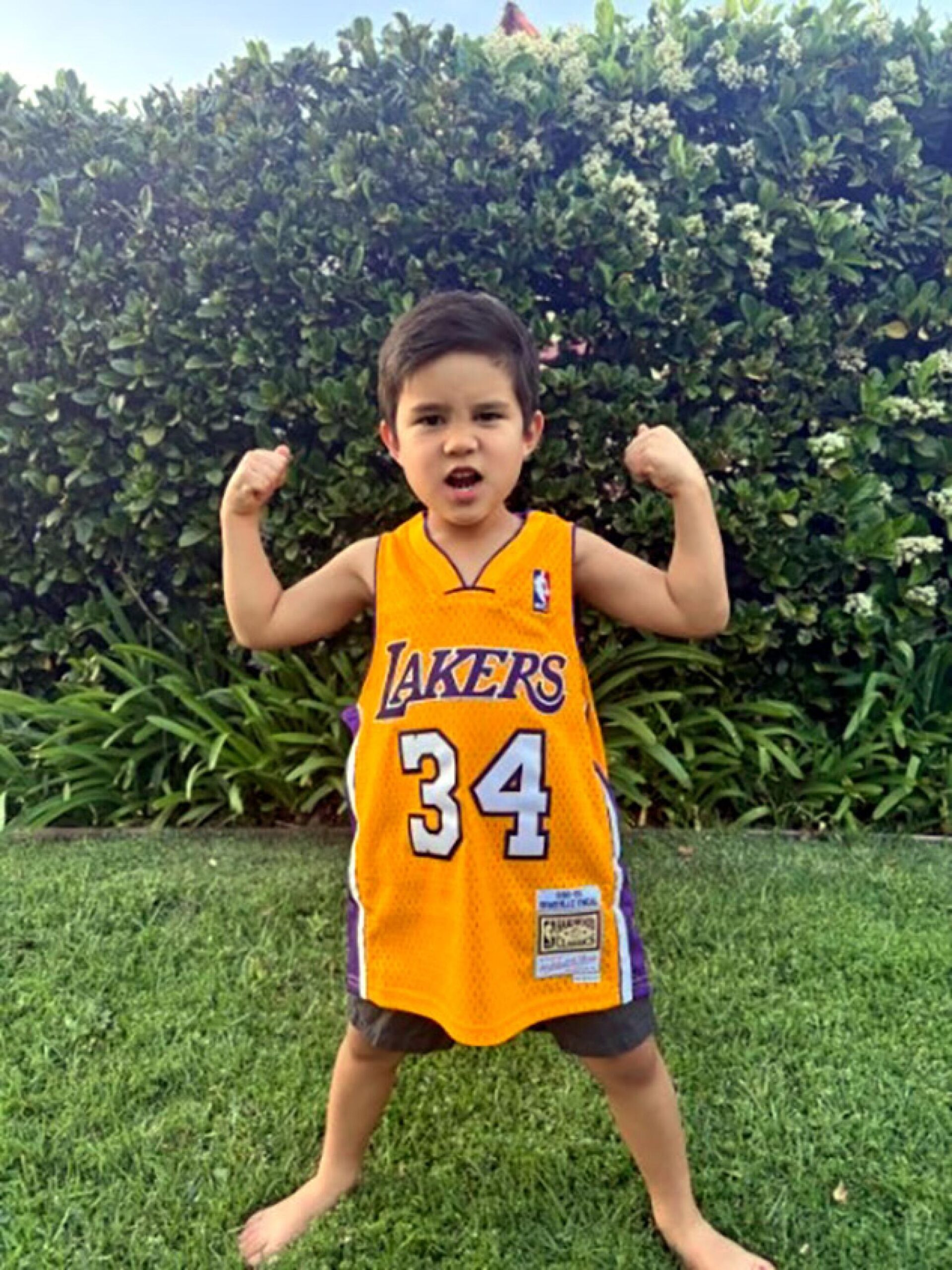
Jackson Tuyay was named the Lakers’ fan of the game when the team beat the Denver Nuggets on Saturday, March 14, 2026. (Courtesy of Tuyay family)
(Courtesy of Tuyay family)
Wearing a Shaquille O’Neal jersey that nearly drapes to his knees.
Leading 20,000 fans in a Saturday night cheer that has swept through a city.
“Yeaaaaaah!,” Jackson Tuyay screamed, and now all of Lakerland screams with him.
It happened in the second half of the Lakers’ steal of a victory against the Denver Nuggets.
The videoboard at Crypto.com Arena announced the regular competition for Fan of the Game, and while searching the stands for the usual dancing fools, the cameras focused on a child who had been cheering the entire night.
Not just cheering, but screaming. Not just rooting, but flexing. Not just clapping, but pounding his fists against his chest.
It was Jackson Tuyay, and he was doing it all with one word in a tiny voice that spoke for a massive fan base.
Yeaaaah indeed. Tuyay was captured on the giant videoboard, he was awarded a $100 gift card for being Fan of the Game, and afterward none other than LeBron James credited him with the comeback win.
“That little kid on the Jumbotron was definitely … I looked up there … I think he’s, yeah, he’s the reason why we won tonight for sure,” James told reporters afterward, and everyone laughed, but there’s something to this.
On what many onlookers credited with being the loudest night of the season, a kindergartner perhaps epitomized what many of this city’s oldest and most die-hard fans are finally feeling.
Everybody is screaming about the Lakers. Everybody is flexing about the Lakers. Everybody is pounding their chest about the Lakers.
They have won nine of the last 10 games, cutting into winning records of the New York Knicks, Minnesota, Denver and Houston in the last 10 days, moving up to third in the West, sprinting toward the potential for greatness.
Did you see them in their fourth quarter comeback win in Houston on Monday night? The Rockets committed nine turnovers, made four baskets and Kevin Durant was held to one garbage-time layup in the entire second half. Once a gaping wound, the Lakers have the league’s sixth-ranked defense during these last 10 games. Combined with its deftly collaborative offense, one can only imagine the heights this team can reach.
They’re playing unselfish basketball, witness James throwing himself through the air while chasing down a loose ball against Denver.
They’re playing tough basketball, witness everything growling Marcus Smart does down the stretch, from steals to treys.
They’re playing redemptive basketball, witness Deandre Ayton finally showing up and proving he is truly the X factor on this team.
And, of course, they’re playing Luka and A.R. basketball, the two best players on this team throwing down one dagger after another, even playing better with James on the court alongside them.
“I think they’re gonna win a lot of games,” predicted Jackson this week, and I think this child genius might be right.
The kid’s impact Saturday night might have been brief, but it’s real, as he received props not just from James, but from Doncic on Instagram.

Lakers center Deandre Ayton blocks a pass to Rockets center Clint Capela during their game Monday.
(David J. Phillip / Associated Press)
“I just wanted the Lakers to win because I thought it would be cool,” Jackson said.
Cooler still is that this was the first Lakers game of Jackson’s young life, as his father, Byron, bought four tickets online for him; his mother, Katherine; and his younger sister, Emilia.
“I saw it on the schedule and just figured it would be a fun afternoon for the kids,” said Byron, a South Pasadena lawyer who grew up during the Shaq-Kobe era and is passing his Laker fandom on to his family.
Like any good Lakers fan, the couple bought souvenirs for the kids before the game, including purchasing a jersey and a foam finger for Jackson. The jersey was the smallest size possible, but appropriately celebrated the biggest man imaginable. Jackson swam in it, but was inspired by it.
“We had to get the Shaq jersey,” said Byron. “We’re old school.”
Once the game started Jackson lived up to a nickname given to him because he runs everywhere, including out of his house in the mornings and around the corner to his nearby school.
A friend’s parent calls him “Turbo,” and he was doing all kinds of turbo things when the cameras caught him in the act.
“He has this crazy aura and energy about him,” said Byron. “He was cheering like that all game.”
Once the fans at Crypto.com Arena saw his flexing and chest beating, they couldn’t get enough. He was not only named Fan of the Game, but he was shown on the videoboard several times during the rest of the game, igniting a huge ovation every time and establishing himself as the team’s new talisman.
After the game ended with the Lakers stunning overtime victory, fans lined up to give him high-fives and cheer for him as his family descended a stairway.
He might be hearing more cheers in the future. He’s already been invited to their next home game by somebody from Doncic’s camp, and future invitations are sure to follow.
C’mon Lakers, get this kid in the building for a playoff game. Show that the sophisticated following of the world’s most glamorous sports franchise is actually rooted in the heart of a child.
After all, Laker fans know a hero when they see one, and the postgame chants for Jackson Tuyay were unmistakable.
“M-V-P … M-V-P … M-V-P!”