Within the first 72 hours of a 26-day game, “Survivor 50,” featuring 24 veteran players, had already delivered feuding, anguish and heartbreak. Legendary rivals Ozzy Lusth and Benjamin “Coach” Wade appeared to bury the hatchet, only for their conflict to reignite soon after. Kyle Fraser was forced out due to injury, and Jenna Lewis-Dougherty, who competed in both the show’s inaugural season and “All-Stars,” was the first person voted out after more than two decades away from the game.
Yet there were also moments of nostalgia, connection and excitement as returning players arrived on the beach, grateful to be part of the show’s landmark 50th season.
This raw display of humanity has kept the show’s torch burning for over 25 years. “‘Survivor’ is built on a timeless idea because human nature doesn’t change,” says Jeff Probst, the host, executive producer and showrunner of the reality competition series. “It’s essentially behavioral psychology in the wild.”
Back in Fiji’s Mamanuca Islands for “Survivor 50: In the Hands of Fans,” the show has added a novel element. Fans were given a say in key decisions, voting online to shape production and game mechanics, from choosing tribe colors to requiring castaways to earn rice and supplies instead of receiving them at the start.
“What a great twist,” says Wade in an interview over Zoom. “‘In the Hands of Fans’ transforms the game. Instead of it being, ‘They are playing,’ it’s ‘We are playing.’”
Though he was disappointed to be deprived of staples upon his arrival, he smiles and says that if he were watching at home rather than competing, he also would have wanted players to start with nothing.
Singer-songwriter and “Survivor” superfan Zac Brown coooked and performed for contestants on the show.(Robert Voets/CBS)
“Survivor” has also leaned into its famous fan base this season, bringing in self-proclaimed superfans, including Grammy-winning singer-songwriter Zac Brown — who appeared in Episode 4 as a reward for a winning tribe for whom he spearfishes, cooks and performs. The show also nods to Billie Eilish via the Billie Eilish Boomerang Idol featured in the season premiere. The game piece was handpicked by the Oscar- and Grammy-winning pop star — whose 2022 song “TV” references “Survivor” — and accompanied by a letter in which she outlined its instructions.
But Mike White, creator of “The White Lotus,” represents the show’s most intertwined cultural crossover. He drew inspiration for his hit HBO series from “Survivor” and cast several former tribemates in cameos. “Survivor 50” also features “The White Lotus” Easter eggs.
Returning to the franchise for the first time since he finished as runner-up in 2018, in the Season 50 premiere he says, tearfully, “There are times in ‘White Lotus’ where I’m so fried … it’s a 129-day shoot, but I look back on my ‘Survivor’ experience, and I’m like, ‘Dude, I did that and I can do this.’” Yet White’s hard-won resilience couldn’t protect him from being voted out in a blindside in Episode 4, proving that fame offers no immunity.
And that is the point. At its core, “Survivor” is about watching people from all walks of life dropped into a remote, unforgiving landscape where they must outwit, outplay and outlast one another for a $1 million prize — hungry, exhausted and sore, roasting in the blazing sun or shivering through rainstorms, and enduring grueling physical competitions. They must cooperate with the very people they’re competing against. And as alliances form and fracture, each day grows more fraught.
Former “Survivor” contestants Mike White, left, and Quintavius “Q” Burdette in Season 50.
(Robert Voets/CBS)
“It’s very simple but very deep,” Probst says. “The goal is not to get voted out, but the strategy in achieving that goal is infinite, so the game’s easy to understand, but it’s impossible to master. That’s why it’s so much fun to watch. You’re constantly asking yourself, ‘What would I do?’”
It’s one thing to ask from the comfort of home, but another to live it out, and on national television to boot, says Wade. Coach “When you step on that beach, the stakes are so much higher,” he explains. “Nobody really thinks about the million dollars. They’re thinking about surviving, not getting voted off.”
“Most people would be able to do it,” he continues. “But what you’d realize is what happens to your character and your facade when you’re deprived of everything — food, comfort, reaching out to your friends and having a support system that you know and trust. When you strip all of that away, this stops being a game, and your character will be forged, revealed or shattered.”
A four-time player, Season 23 runner-up and 2015 Survivor Hall of Fame inductee, Coach is one of the show’s most legendary figures. Known as the Dragon Slayer, he’s often shown meditating, praying, waxing philosophical, and pontificating on nobility, integrity and honor. His grandiose persona rubbed many the wrong way early on, earning him a villain label.
Reflecting on his legacy, Wade partly blames the edit but acknowledges he often took himself too seriously, was arrogant, and tried too hard to be larger than life, yet he stresses his authenticity. “The way I look, dress and talk — I’m polarizing,” he says. “That’s who I am in my real life, so that’s who I am out there.”
Probst affirms that what you see is what you get. “Coach shows up authentically every day,” he says. “He wears his mythology on his sleeve and has it tattooed on his body. When he pulls back his hair into a ponytail and quotes Magellan, that’s Coach: ‘I’m the guy with quotes about war and victory and fearlessness and courage. That’s actually who I am.’”
This season, Wade calls himself “Coach 4.0,” but Probst remains skeptical. “Every time he plays, Coach refers to himself as the new version of Coach,” Probst says. “But the minute he starts talking, everybody thinks the same thing: ‘Coach, you may have some more maturity and life experiences now that you’re married and have kids, but you’re exactly the same.’”
That’s not a critique of Coach. After observing more than 750 players over 25 years, Probst believes, “We are capable of much more than we think we are, and simultaneously, at our core, we generally are who we are. It doesn’t mean you can’t change or become a better version of yourself, but you’re going to have some core instincts.”
Benjamin “Coach” Wade in “Survivor 50.” (Robert Voets/CBS)
Coach in 2011’s “Survivor: South Pacific,” the show’s 23rd season. (Monty Brinton/CBS)
The show’s unflinching exploration of human nature traces back to visionary British television producer Charlie Parsons. He conceived the social experiment based on a combination of his curiosity about people, the influence of “Lord of the Flies” and “Robinson Crusoe,” and his boarding school experience.
“It was an all-boys school and quite a competitive place, so there was an element of survival in that,” Parsons says over Zoom. “It wasn’t a bad experience, but if you’re 13 and you’ve never lived away from home before, it can be quite a wrench to live for a month at a time away from your parents. On one occasion I called my parents and said, ‘Will you rescue me?’ And they didn’t.”
In 1988, Parsons turned his concept into “The Castaways,” a three-part documentary for a magazine-style television program he was showrunning.
Several years later, he was approached by Disney’s Buena Vista Productions to make an American version of a successful British morning show he created. When that didn’t pan out, he pitched what would eventually become “Survivor,” developing it with Buena Vista in hopes of selling it to ABC.
But, he says, the radical concept didn’t fit neatly into existing TV genres, and the network balked. “It’s difficult to imagine, but back in the ‘90s this idea of reality TV basically didn’t exist,” Parsons says. “Television was reasonably siloed … ABC took a long time deciding because they could see that there was something about it, but in the end they passed.”
In 1997, however, the concept found immediate success in Sweden with “Expedition Robinson,” leading to expansion in more Scandinavian countries.
The leap to America required a new alliance. During Parsons’ development process with Buena Vista, he’d met fellow British TV producer Mark Burnett at a party in Los Angeles where he’d told him about the reality competition format he was building. Burnett then called every six months pressing to produce it until Parsons finally agreed to grant him the American licensing rights.
“Mark had an incredible energy and presence, which meant that he could go and sell the s— out of it,” Parsons says. “He could persuade the networks to take a risk on something risky.”
Even so, as Burnett relayed in a comprehensive 2010 Television Academy interview, he faced a difficult pitching process. But after every major network passed, he re-approached CBS, where then-CEO and President Les Moonves was game to try original programming during summertime when reruns caused dwindling viewership. But when Moonves commissioned a pilot, Burnett said a stand-alone episode was too costly and couldn’t capture the show’s slow-burn endgame.
Instead, he proposed a sponsorship model built on integrating products into the game, pitching the value of a castaway using a branded cellphone to call home, or the desperation for a slice of pizza and a beer. After Burnett secured corporate sponsors, Moonves greenlighted “Survivor.”
Though firmly embedded in the culture today, “Survivor” was revolutionary when it debuted May 31, 2000, quickly becoming a cultural phenomenon. The Season 1 finale averaged 51.7 million viewers, surpassing both the Academy Awards and Grammys that year. Time magazine featured Lewis-Dougherty on its late June 2000 cover, and “The Late Show With David Letterman” featured a “Survivor”-themed Top 10 list presented by the show’s 16 castaways.
From its exotic location to the now-iconic buffs, “Survivor” established a world all its own, complete with a unique lexicon of immunity challenges, tribal council and Probst’s signature catchphrase, “The tribe has spoken.” As the enduring face of the show, Probst is central to its legacy, earning four Emmys for his role as host.
But even Probst’s survival wasn’t guaranteed. About 15 years ago, the relentless travel and schedule left him so depleted that he briefly quit the show. A few months of rest, however, allowed him to reevaluate. “It really was, ‘I don’t know if I have anything left in my tank to bring to the game.’ That might be what partly influenced Mark to make me showrunner even faster,” Probst says. “I needed to be more of a storyteller on this show.”
The cast of “Survivor” Season 1, standing from left: Ramona Gray, Dirk Been, Gretchen Cordy, Richard Hatch, Sonja Christopher, Susan Hawk, Kelly Wiglesworth, Sean Kenniff, B.B. Andersen and Rudy Boesch. Seated from left: Gervase Peterson, Jenna Lewis, Joel Klug, Stacey Stillman, Greg Buis and Colleen Haskell.
(Monty Brinton/CBS)
He’s quick to note the show’s collaborative ethos, however. “The term ‘showrunner’ is pretty misleading at this point. We make this as a team,” Probst says. Under his stewardship, “Survivor” is more cinematic, reimagined through the lens of Joseph Campbell’s “The Hero’s Journey,” and family friendly. Probst also notes the necessity of continually evolving game design, creating unexpected twists and advantages to keep players on edge and never knowing whom to trust.
The pandemic brought changes as well. With production shut down amid a world in turmoil, Probst felt “Survivor” needed more levity. When filming resumed, due to the 14-day quarantine requirement, back-to-back seasons were shot and the format was shortened from 39 days to 26. The faster-paced “New Era” that began with Season 41 also coincided with CBS’s 2020 diversity mandate requiring at least 50% of the cast to be nonwhite, and Probst dropped his longtime catchphrase “Come on in, guys” in favor of more inclusive language.
By Season 45, in keeping with Probst’s narrative-driven vision, the previously hourlong episodes expanded to 90 minutes.
Television habits have also changed since viewers once dissected tribal council proceedings at the office the next morning. Streaming breathed new life into “Survivor,” with younger viewers discovering it during the pandemic, while its cross-generational appeal keeps it a broadcast powerhouse. The Season 50 premiere drew 9.1 million viewers across live broadcast and delayed streaming, and in the weeks leading up to the launch, viewers revisited older seasons, boosting streaming numbers ahead of the anniversary.
According to Mitch Graham, CBS executive vice president of alternative programming, “Survivor” ranks No. 1 in the coveted 18 to 49 demographic, and the Season 50 launch generated the biggest social media engagement in the franchise’s history.
Even as the reality TV landscape has grown crowded, Probst remains unfazed. “It’s a show like no other,” he says. “It’s adventure, survival, strategy, interpersonal relationships, social politics. … This multi-layered storytelling gives it durability because any given week you have no idea what you’re going to watch.”
Meanwhile, as Season 50 continues to unfold, no one knows who will be crowned “Sole Survivor” on May 20 in Los Angeles, the show’s first live finale since 2019. But rest assured, by then they’ll have revealed exactly who they are.
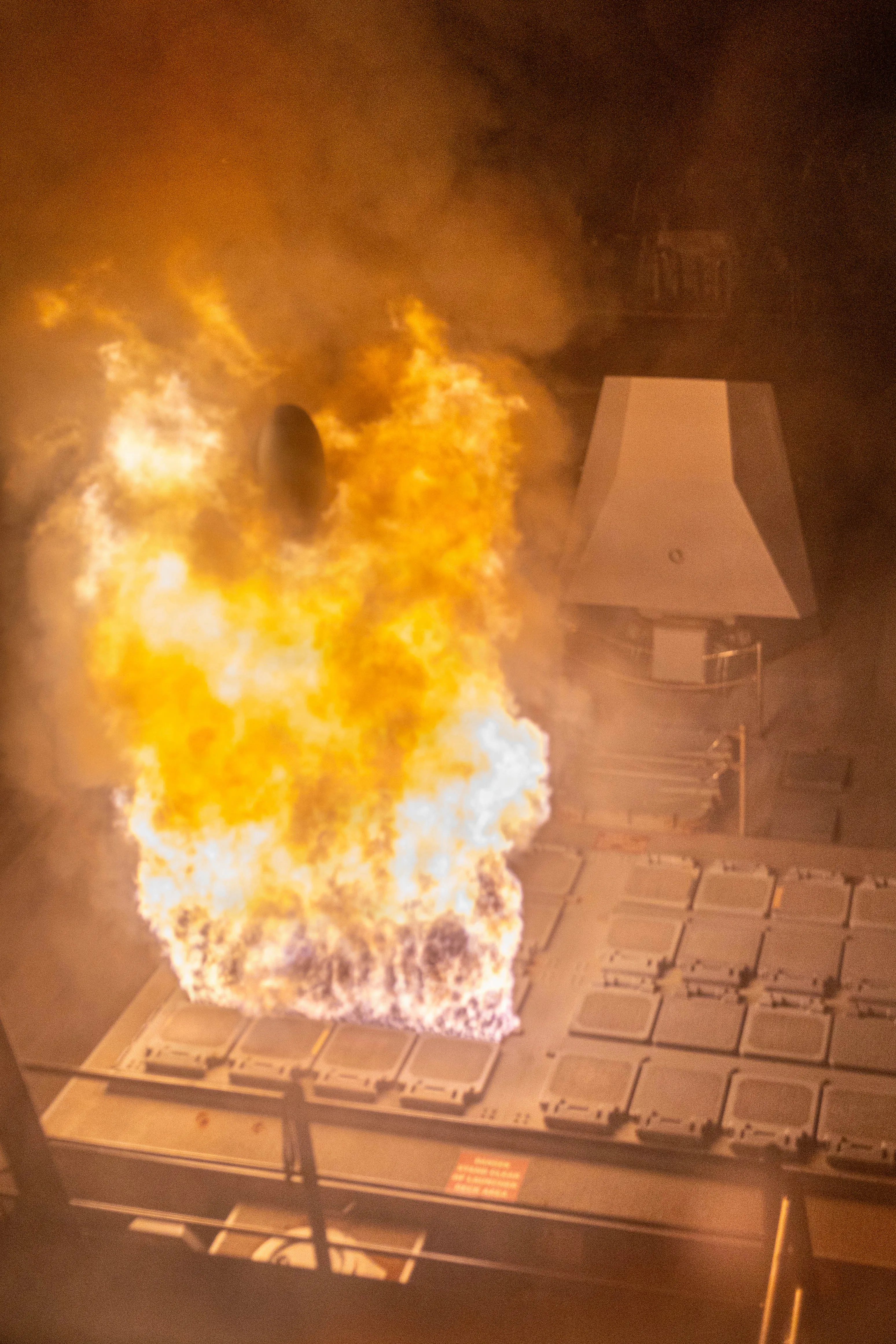
So far, the U.S. Navy has fired more than 850 Tomahawk missiles in the war with Iran, officials familiar with the matter told TheWashington Post. This has prompted discussions about how more missiles could be made available.
The Arleigh Burke class destroyer USS Bainbridge (DDG 96) fires Tomahawk missiles from the forward missile deck while underway in the Eastern Mediterranean Sea, in support of Operation Epic Fury, March 3, 2026. U.S. Navy Photo U.S. Central Command Public Affa
As it stands, only a few hundred examples of the critical long-range strike weapon are manufactured each year, meaning the global supply is limited. The exact number available to the U.S. military at any given time is a closely guarded secret, although the article suggested a higher-end figure of between 4,000 and 4,500 Tomahawk missiles on hand at the start of Epic Fury, and a lower-end figure closer to 3,000 missiles. Again, the Tomahawk would be a primary weapon system used in a conflict with China, where the target sets can range into the tens of thousands, and the country’s anti-access umbrella will require the use of standoff munitions like none other in history.
“The Pentagon has tracked the number of Tomahawks used with an increasing focus on what the burn rate will mean for not only a sustained campaign against Iran but for future military operations as well,” the report states.
I’ve posted nearly every TLAM launch video released by the DOD, major launch salvoes had continued until at least the weekend of the 14th. https://t.co/xYP9yaVySs
One official told TheWashington Post that the number of Tomahawks left in the Middle East was “alarmingly low,” while another said that without intervention, the Pentagon is closing in on “Winchester” — military slang meaning out of ammunition — for its supply of the missiles in the region.
The Tomahawk also comes with a hefty price tag: up to $3.6 million for some of the more recent versions, and each round can require up to two years to build. The Navy also faces a problem in that, in recent years, only small batches have been purchased: just 57 examples were included in last year’s defense budget.
At the same time, the Trump administration has repeatedly claimed that critical munitions stockpiles have not been dangerously depleted in the Iran war.
White House press secretary Karoline Leavitt said earlier this month that the U.S. military “has more than enough munitions, ammo and weapons stockpiles to achieve the goals of Operation Epic Fury laid out by President Trump — and beyond.”
Every indication we have seen is that for some munitions, that is not reality. The war in Ukraine and constant crisis in the Middle East have depleted those stockpiles, and many of the weapons take years to build, with finite caps on how many can be delivered in any given year. This is a story we have been covering for years. The Trump administration is working to greatly expand production of advanced munitions, but even the fruits of those efforts will take years to realize.
UPDATES:
We have concluded updates for the day.
UPDATE: 10:37 PM EST-
A missile and drone attack on Prince Sultan Air Base in Saudi Arabia has led to significant injuries to U.S. personnel. 10 American service members were wounded, two of which were seriously injured. It isn’t clear what damage was done to aircraft, but we have seen at least one tanker destroyed in recent satellite imagery. This is in addition to the attack that damaged multiple tankers and destroyed another earlier in the war.
Ten American service members were wounded in an Iranian drone and missile attack on Prince Sultan Airbase earlier today-Multiple US and Arab officials to the WSJ
“The injured service members were inside a building on the base that was struck in the attack, the officials said…At least one missile struck the base, as well as several unmanned aerial vehicles…The missile strike is at least the second to strike the base during the war… pic.twitter.com/bI5MrwmEDE
Trump is threatening to abandon NATO after member nations did not pitch in with opening the Strait:
NOW – Trump suggests the U.S. may abandon NATO countries: “We would’ve always been there for them [NATO], but now based on their actions I guess we don’t have to be.” pic.twitter.com/NKgO72FUvf
As expected, the USS George Washington and its strike group are deploying to the Middle East:
New: The USS George H.W. Bush aircraft carrier will deploy to U.S. Central Command’s area of responsibility, the major combatant command overseeing American military operations against Iran, sources told @JimLaPorta@ellee_watson and me. @CBSNews
Reuters is reporting that Arab states in the Gulf are urging the United States to ensure that any deal with Tehran should do more than end the war. Instead, it must ensure Iranian missile and drone capabilities are “permanently curbed” and that Iran will never again be able to “weaponize” global energy supplies. The agency cites four unnamed Gulf sources.
Meanwhile, it appears that Qatar, Oman, and Kuwait are prioritizing a quick end to the war, while the UAE, Saudi Arabia, and Bahrain are more willing for the fighting to continue, if their longer-term aims are met in any deal to end the war.
Qatar, Oman and Kuwait are pushing behind closed doors for a swift end to the war. The UAE, Saudi Arabia and Bahrain say they are ready to absorb an escalation of the war and will not accept a post-war Iran that is still able to use the Strait of Hormuz as a bargaining chip. https://t.co/LI26CkM40E
The Iranian foreign minister, Abbas Araghchi, has confirmed that Israel struck two of its most important steel production facilities, as well as nuclear sites — presumably including the Khondab Heavy Water Complex (see previous updates).
Araghchi said that Friday’s strikes contradicted President Donald Trump’s pledge to postpone attacking Iran’s energy infrastructure for 10 days after he claimed talks were “going well.” He further said that Tehran would exact a “heavy price” for the attacks.
Iran’s Foreign Minister Abbas Araghchi:
Israel has hit 2 of Iran’s largest steel factories, a power plant and civilian nuclear sites among other infrastructure. Israel claims it acted in coordination with the U.S.
Attack contradicts POTUS extended deadline for diplomacy.
Saudi Arabia wants the U.S. military to ramp up its attacks on Iran, according to a Saudi intelligence source, and the kingdom is meanwhile reportedly also considering joining the fight directly, alongside the United States and Israel. Whether or not Saudi Arabia also starts launching strikes against Iran remains to be seen, but it is the clearest indication so far that the kingdom might become more deeply involved in the conflict, at least at some level.
A Saudi intelligence source confirmed to The Guardian that Riyadh was urging the United States to both continue and intensify the military campaign against Iran. The same source confirmed similar reporting in The New York Times, which states that Saudi Arabia’s de facto leader, Crown Prince Mohammed bin Salman, had called upon Trump to not curtail Operation Epic Fury, and that the U.S.-Israeli campaign represented a “historic opportunity” to remake the Middle East.
U.S. President Donald Trump meets with Crown Prince and Prime Minister Mohammed bin Salman of Saudi Arabia during a bilateral meeting in the Oval Office of the White House on November 18, 2025. Photo by Win McNamee/Getty Images Win McNamee
Earlier this week, Trump told journalists that the crown prince is “a warrior. He’s fighting with us.”
At this point, however, there are no reports of active Saudi military involvement in the conflict, but the kingdom is now at least weighing up that option, if peace efforts fail.
This week, The Wall Street Journal and Jerusalem Post both reported that Saudi Arabia has decided to open up additional military bases for the use of the U.S. military in its operations against Iran. Reportedly, the facilities include King Fahd Air Base in Taif in western Saudi Arabia.
If Saudi Arabia were to begin strikes on Iran, the powerful Royal Saudi Air Force fleet of F-15 Eagles would likely figure prominently. These examples are taxiing at King Faisal Air Base, in the Kingdom of Saudi Arabia. U.S. Air Force photo by Senior Airman Leala Marquez Senior Airman Leala Marquez
Saudi Arabia has come under direct Iranian attack since the start of Epic Fury, including a drone strike last week on the oil refinery in Yanbu on the Saudi Red Sea coast.
At the same time, Saudi oil exports are not as vulnerable as those of other countries in the region, so it has not suffered to the same degree as other Gulf states. Much of Saudi Arabia’s oil exports are carried by a pipeline to the Red Sea, purposefully avoiding the Strait of Hormuz.
There is also the threat that the Iran-backed Houthis in Yemen, which have long waged a separate war with Saudi Arabia, could be drawn into the current conflict if the Saudi position changes.
Were that to happen, the vital Red Sea oil pipeline could become a very prominent target for Iran and the Houthis.
Iran’s Islamic Revolutionary Guard Corps (IRGC) declared today that shipping “to and from ports of allies and supporters of the Israeli-American enemies” is prohibited through any corridor or to any destination, Iranian state media reported.
The IRGC added that the Strait of Hormuz remains closed and any attempted transit through the strategic waterway will face “harsh measures.”
There have been reports today of three container ships of various nationalities turning back from the Strait of Hormuz, after warnings were issued by the IRGC Navy.
IRGC:
This morning, following the lies of the corrupt president of America regarding the openness of the Strait of Hormuz, three container ships of different nationalities moved toward the designated corridor for the transit of ships with permits, which were turned back with a… pic.twitter.com/uIvDmzpBQJ
Following COSCO’s announcement to resume booking acceptance to Gulf destinations, new developments overnight suggest the situation in the Strait of Hormuz remains highly unstable.
As we reported in our previous rolling coverage, Trump threatened last Saturday that he would destroy Iranian power plants if Tehran did not reopen the Strait of Hormuz within 48 hours.
On Monday, the U.S. leader postponed his threat for five days (until Friday), citing “very good and productive conversations” with Iran on ending the war — something that Tehran has described as “fake news.”
Now, Trump is pushing that deadline back again, pausing his threat to attack Iran’s energy infrastructure for 10 days until April 6, claiming that the request came from Tehran and that talks were going “very well.”
At the same time, there are suggestions that the Iran war, in general, may be of diminishing interest to the U.S. president.
“[Trump] is getting a little bored with Iran,” a senior White House official told Jake Traylor of MS NOW. “Not that he regrets it or something — he’s just bored and wants to move on.”
There are suggestions of something of a rift between Israel and the United States, as to the course the conflict should take.
According to Israeli journalist Barak Ravid, U.S. Vice President JD Vance had a “difficult” call with Israeli Prime Minister Benjamin Netanyahu earlier this week.
Reportedly, Vance said that Israeli assessments for toppling the Iranian regime were not realistic enough, saying, “You were too optimistic in your assessments regarding the overthrow of the regime in Iran.”
According to Barak Ravid, U.S. Vice President JD Vance had a difficult call with Israeli Prime Minister Benjamin Netanyahu on Monday where he said that Israeli assessments for toppling the Iranian regime were not realistic enough, saying “You were too optimistic in your… pic.twitter.com/KfEuGbUkzt
As we reported earlier this week, F-35Cs from the U.S. Marine Corps are the latest fighters poised to deploy to the Middle East region for Operation Epic Fury. The movement of these aircraft to RAF Lakenheath in England signals what is set to be the first land-based combat deployment for the F-35C, the carrier variant of the Joint Strike Fighter flown by both the Navy and Marine Corps. We now have some better imagery of the first visit of these aircraft to a base in the United Kingdom.
🇺🇸 The Tomcats / VMFA-311
Four Lockheed Martin F-35Cs of Marine Fighter Attack Squadron 311 (VMFA-311) based at MCAS Miramar departed RAF Lakenheath on the 26th March as MAZDA 31-34.
This is the first time ever that F-35Cs have visited the United Kingdom.
The United Arab Emirates has told allies that it would participate in a multinational maritime task force intended to reopen the Strait of Hormuz, as it pushes to form a coalition to ensure shipping can pass through the vital waterway, the Financial Timesreports.
According to the FT, the UAE has told the United States and other Western nations that it would take part, and that Abu Dhabi would deploy assets from its own navy.
Like Saudi Arabia, the UAE is taking a harder line on Iran, as it comes under regular attack by Tehran’s retaliation strikes.
The same report also states that the UAE is working on a UN Security Council resolution with Bahrain to provide any future task force with a mandate.
The UAE is pushing to form a multinational naval force to reopen the Strait of Hormuz.
It’s willing to deploy its own navy and is lobbying allies and the UN for support.
Only Bahrain has backed the plan so far, while others remain cautious.
According to an assessment from the Center for Strategic and International Studies (CSIS) in Washington, D.C., the U.S. strike campaign has settled into a “sustainable pace of bombing,” striking between 300 and 500 targets per day. U.S. forces are also now mainly using stand-in weapons, rather than more expensive standoff munitions. As a result of the “munitions transition,” the costs of running the war have been greatly reduced — although not without risk to aircraft and airmen.
“The U.S. strike campaign has settled into a sustainable pace of bombing between 300 and 500 targets per day. U.S. forces also now predominantly use far less expensive, short-range munitions.” https://t.co/iQm636cWwO
The Pentagon is looking at sending up to 10,000 additional ground troops to the Middle East, the Wall Street Journal has reported, quoting Defense Department officials. Having more troops in the region would give Trump more military options and greater bargaining power, as he seeks to bring Tehran to the negotiating table.
House Speaker Mike Johnson has said that “it should not be necessary” for U.S. forces to invade Iran. “I think we can get this resolved without it,” he added.
House Speaker Mike Johnson tells @BretBaier, “It should not be necessary” for U.S. forces to invade Iran. “I think we can get this resolved without it.”
Secretary of State Marco Rubio has also suggested that the U.S. military will not need to deploy ground troops to accomplish U.S. objectives in the war, although he also reflected on the importance of giving Trump “maximum optionality” for any contingency.
NEW: Secretary of State Marco Rubio tells me at the airport before leaving France that the US does NOT need to deploy ground troops to accomplish its objectives in the #IranWar.
But part of the cabinet’s job is to always give President Trump maximum optionality, he adds. pic.twitter.com/oYQrmF6Fdy
So far, it seems that Iran’s new Supreme Leader, Mojtaba Khamenei, has not yet agreed to negotiations.
Should the U.S. military conduct some kind of ground operation, various energy infrastructure within the United Arab Emirates (UAE) would come under Iranian attack, with a target list published by Iran’s state-backed Fars News Agency. Designated targets include desalination plants, nuclear power plants, and other power hubs across the UAE.
Iran’s state-backed Fars News Agency has released a target list of energy infrastructure within the United Arab Emirates (UAE) that they plan to strike if the U.S. conducts a ground operation against the strategically and economically important Kharg Island or any other Iranian… pic.twitter.com/PbwM14SPIZ
The Israel Defense Forces (IDF) say they carried out further strikes on targets in Tehran early on Friday. A brief military statement said Israeli forces “completed a wide-scale wave of strikes targeting infrastructure of the Iranian terror regime in the heart of Tehran.”
In a separate statement, the IDF said that it had also struck “ballistic missiles and aerial defense systems production sites across Iran.” It reported hitting missile launchers and storage sites in western Iran, as well as missile production sites in the capital. Other targets apparently included Iran’s primary facility for the production of naval cruise missiles and sea mines in Yazd, Iran.
“The site was used for the planning, development, assembly, and storage of advanced missiles intended for launch from cruise platforms, submarines, and helicopters toward both mobile and stationary maritime targets,” the IDF said.
🎯🌊 STRUCK: Iranian Regime’s primary facility for the productions of missiles and sea mines in Yazd, Iran
The site was used for the planning, development, assembly, and storage of advanced missiles intended for launch from cruise platforms, submarines, and helicopters toward…
The latest round of U.S.-Israeli strikes hit a heavy water reactor in central Iran, Iranian media reported today.
“The Khondab Heavy Water Complex was targeted in two stages by aggression from the American and Zionist enemy,” the Fars News Agency reported, citing Hassan Ghamari, an official in the central Markazi province. Fars and other media said there were no casualties or radiation leaks from the site.
The facility is intended to produce the heavy water used to cool nuclear reactors. As a byproduct of this process, plants of this kind also produce plutonium, which can potentially be used in nuclear weapons. This would offer another route to procuring a nuclear warhead, other than enriched uranium.
There are reports out of Iran that recent U.S. and Israeli airstrikes targeted key steel production facilities. The semi-official Iranian Mehr news outlet claims that steel plants were hit in the central Iranian city of Isfahan, with separate attacks on the Khuzestan Steel and Mobarakeh Steel factories.
In response to an inquiry from The Jerusalem Post, the Israeli military said that it was not aware of any Israeli strikes on the facilities.
Reports from Iran suggest that all three of Iran’s largest steel production plants were struck in a coordinated targeted strikes.
This could substantially affect the national steel industry and manufacturing pic.twitter.com/mmrnyDS8UX
The U.S. military has deployed uncrewed surface vessels (USVs) for patrols as part of its operations against Iran, the Pentagon has said, according to the Jerusalem Post. The specific type of drone boats that have been deployed was not reported, although this is not the first time that the U.S. military has used USVs in the region, notably in the Persian Gulf and the Strait of Hormuz.
The Iranian foreign minister, Abbas Araghchi, has accused the U.S. military of using Persian Gulf citizens as human shields.
“From outset of this war, U.S. soldiers fled military bases in GCC [Gulf Cooperation Council] to hide in hotels and offices. They use citizens as human shield. Hotels in U.S. deny bookings to officers who may endanger customers. GCC hotels should do same,” Abbas Araghchi said in a post on his X account.
IRGC:
The cowardly American and Zionist forces, who lack the courage and ability to defend their own military bases, are attempting—out of fear of the firepower of Islamic fighters—to use civilian locations and innocent people as human shields.
As we reported yesterday, Iranian bombardment of U.S. military facilities in the wider region does appear to be driving the relocation of soldiers, although there is no suggestion of a human shield policy.
According to a report from The New York Times, citing military personnel and American officials, a significant number of U.S. troops have been forced to relocate from their bases to hotels and office spaces throughout the region.
Iranian Foreign Minister Abbas Araghchi claims that since the start of the war, US troops have left military bases in the GCC to shelter in civilian spaces, effectively using residents as human shields, and urges Gulf hotels to follow US counterparts in denying accommodation to… pic.twitter.com/MJrUht8Di1
Reports in the Lebanese media suggest that an Israeli strike hit Beirut’s southern suburbs early today. Several explosions were heard in the area, which is considered a Hezbollah stronghold. Israel has previously issued evacuation warnings for the area but provided no specific warning in advance of Friday’s strike, AFPsaid.
An Israeli M109 self-propelled howitzer artillery fires rounds towards southern Lebanon from a position in the upper Galilee in northern Israel near the border on March 26, 2026. Photo by Jack GUEZ / AFP JACK GUEZ
Kuwait’s Shuwaikh port was hit by drones, causing material damage with no injuries reported, the Kuwait Ports Authority said today.
The international airport in Kuwait City also appears to have been on the receiving end of recent Iranian attacks, with a significant blaze there today, after a reported drone strike.
🔥 Fire breaks out at fuel tanks at Kuwait International Airport following an Iranian drone attack on Thursday
Iran-linked hackers today claimed they had accessed FBI Director Kash Patel’s personal email inbox, Reutersreports. The group claims to have published photographs of the director and other documents on the internet.
Satellite imagery of the Yazd missile complex, one of the most important in Iran, from earlier this month, reveals the shadow of an apparent Khorramshahr missile before being launched toward Israel. The original Khorramshahr first emerged publicly in 2017, and it is assessed to be derived, at least in part, from a North Korean design. It is a liquid-fuel medium-range ballistic missile (MRBM) with a claimed range of around 1,250 miles (2,000 kilometers).
Recent analysis from ThePrint, an Indian digital news platform, suggests that Iran has launched around 4,300 missiles and drones since the start of the current conflict, with the majority of these targeting Gulf nations, rather than Israel. The analysis states that Tehran has launched at least 1,815 drones and 372 missiles at the UAE since the start of the war. Israel, in comparison, has faced roughly 930 missile and drone attacks in the same period.
Interesting number crunching by my colleague @Keshav_Paddu
4,300 missiles & drones since day 1 of war: Gulf nations, not Israel faced brunt of #Iran’s retaliation#Israel, in comparison, has faced roughly 930 missile, drone attacks in the same period.https://t.co/WLOancpE8z
In related news, Reuters today published an assessment stating that, so far, the Pentagon can only confirm that about a third of the Iranian missile arsenal has been destroyed.
Satellite imagery from yesterday indicates that the aircraft carrier USS Gerald R. Ford has left Naval Support Activity Souda Bay in Crete, Greece, escorted by three patrol boats. The supercarrier went to Souda Bay for repairs after a fire broke out in the laundry area while underway in the Middle East on March 12, injuring two sailors.
Ukrainian President Volodymyr Zelensky says that his country has “reached an important arrangement” with Saudi Arabia on defense cooperation. The agreement between the defense ministries of the two countries is almost certain to involve counter-drone technologies and expertise.
“We are ready to share our expertise and systems with Saudi Arabia and to work together to strengthen the protection of lives,” Zelensky wrote on X. “Now into the fifth year, Ukrainians are resisting the same kind of terrorist attacks — ballistic missiles and drones — that the Iranian regime is currently carrying out in the Middle East and the Gulf region. Saudi Arabia also has capabilities that are of interest to Ukraine, and this cooperation can be mutually beneficial.”
We have reached an important Arrangement between the Ministry of Defense of Ukraine and the Ministry of Defense of the Kingdom of Saudi Arabia on defense cooperation. The document was signed ahead of our meeting with the Crown Prince of Saudi Arabia, Mohammed bin Salman Al Saud.… pic.twitter.com/j3aXzLXSNr
— Volodymyr Zelenskyy / Володимир Зеленський (@ZelenskyyUa) March 27, 2026
Witness videos captured missile interceptors launching and burning debris raining from the sky near the Dubai International Convention and Exhibition Centre.
The hit firefighter TV show, London’s Burning, kept us glued to the safety of our sofas for an incredible 14 years, but where are the beloved cast now? Read on to find out
12:20, 17 Mar 2026Updated 12:30, 17 Mar 2026
London’s Burning: Classic ITV drama teased in throwback trailer
The cast of beloved ITV drama London Burning have endured various fortunes since the popular show came to a demise in 2002. This month, actor John Alford made headlines after it was reported he had been found dead in his prison cell just weeks after being convicted of sex offence charges.
The ITV show had viewers fixed on their sofas during its 14-year run on the network. With emotionally charged storylines and action-packed drama, many wished for more. But the show’s success was down to how much the audience warmed to the Blue Watch team.
London’s Burning began life as a two-hour film in 1986 before becoming the television series we all know and love in 1988. There were a total of 172 blazing episodes before the show was extinguished back in 2002. The firefighter drama was originally shot at Bermondsey’s Dockhead Fire Station, with filming in the first three series taking place in the actual watchroom, mess and bay area – where real-life firefighters leapt at the chance to work shifts as extras. Here, we take a look at the cast now.
Ensure our latest headlines always appear at the top of your Google Search by making us a Preferred Source. Click here to activate or add us as your Preferred Source in your Google search settings.
John Alford
Alford, who appeared on the show for five years, was best known as Billy Ray died this month, aged 54. Earlier this year, following a trial at St Albans Crown Court in September 2025, he was jailed.
The actor, who also appeared in Grange Hill, was convicted of six individual counts. There were two counts of sexual activity with a child, two counts of penetrative sexual activity with a child, one count of assault by penetration and one count of sexual assault.
A Prison Service spokesman told The Mirror: “John Shannon died in prison on 13 March 2026. As with all deaths in custody, the Prisons and Probation Ombudsman will investigate.”
After his arrest, he told police: “This stinks. This is a set-up.” He denied all charges and previously told a trial that he “never touched either of the girls.”
Glen Murphy – George Green
George Green was the show’s longest-serving character and the only one to have appeared in every single series of London’s Burning. This hot-tempered former boxer joined Blue Watch at the start of series one, and enjoyed a steady stream of romances throughout his tenure.
Actor Glen is most well-known as the London’s Burning character, but he has also appeared in British thriller flick Tank Malling and The Bill. Back in 2007, he was awarded an MBE for his charity work after raising more than £1m for good causes. Now 68, Glen got to star with his childhood buddy Ray Winstone in the 2014 thriller Lords of London.
Sean Blowers – John Hallam
Did the immensely likeable but rather uptight John ever get that promotion he was chasing? He never did, did he? The character was left severely traumatised after being buried alive when a wall collapsed on a job in series four.
Five years later, John was brutally killed after falling 80 feet when a gantry gave way amid a warehouse inferno. Actor Sean, now 65, also appeared in EastEnders, Crossroads, Heartbeat and Doctor Who. You may also recognise him for playing Wyman Manderly in the finale of season six of the hugely popular Game of Thrones.
Richard Walsh – Bert ‘Sicknote’ Quigley
Blackwall’s resident hypochondriac, the aptly named ‘Sicknote’ was forever complaining about some malady or another. A wannabe star of the stage, he often made theatre appearances alongside his wife Jean, which his colleagues would begrudgingly go to show their support.
Sicknote bowed out in series 12, when he sadly perished in an explosion at a fireworks factory. Since leaving the series, actor Richard has appeared in daytime TV’s Doctors, the movie Daddy’s Girl, Midsomer Murders and Heartbeat. The now 27-year-old also made a cameo appearance in Netflix series The Crown as Joe Gormley in 2019.
Jerome Flynn – Kenny ‘Rambo’ Baines
“But he wasn’t in London’s Burning!” we hear you cry. Well, he did only feature in the initial TV movie, but we felt actor Jerome was worth a mention as he was just so phenomenally successful post Blackwall.
Jerome of course starred as Paddy Garvey of the King’s Fusiliers alongside Robson Green in hit drama Soldier Soldier. The pals even enjoyed multiple Number Ones in the music charts with their versions of Unchained Melody, I Believe and What Becomes Of The Broken Hearted?
Jerome, now 63, appeared in chilling 19th-century drama Ripper Street and an episode of Charlie Brooker’s disturbing Black Mirror in 2016. Game of Thrones fans will instantly recognise him as loveable rogue Bronn, who featured in countless episodes from 2011 to 2019.
In 2019, he also appeared as Berrada opposite Keanu Reeves and Halle Berry in John Wick: Chapter 3 – Parabellum. In 2022, he starred alongside Harrison Ford and Helen Mirren in Taylor Sheridan’s ‘1923’ – a spin-off from the hit series Yellowstone.
James Hazeldine – Mike ‘Bayleaf’ Wilson
A hugely popular member of the team, Bayleaf was mess manager until he departed the show in series 8. The character was involved in many gripping storylines, such as being knocked unconscious when a wall collapsed and also being buried alive.
Very much a star of stage and screen, actor James was a member of the Royal Shakespeare Company and starred in children’s TV series Chocky as well as Heartbeat. James took on the role of Sigmund Freud in the play The Talking Cure in December 2002, but was shortly taken ill and sadly died a week later. He was 55.
Trevor Nunn, director of the Royal National Theatre, described him as “a leading actor of minutely observed truthfulness, comic brio and emotional daring” who “was also a man of infectious enthusiasm, great warmth and humanity who was universally popular among his colleagues”.
Ben Onwukwe – Stuart ‘Recall’ MacKenzie
Dubbed ‘Recall’ thanks to his unbelievable photographic memory, Stuart joined the team midway through series 4. The firefighter was almost dismissed from the crew when he refused to shave off his beard – something the team rectified by tying him down and shaving it off for him!
Since the show ended, actor Ben, now 68, has been keeping himself busy appearing in Coronation Street, as Clyde Johnson in Holby City and as Dessie Dunn in EastEnders. Back in 2018 he starred as Eric Pratchett in drama Safe, and the following year took on the role of W.E.B Dubois in Hero, inspired by the life and times of the Caribbean war hero, judge and diplomat Ulric Cross.
Ross Boatman – Kevin Medhurst
Renowned as Blue Watch’s resident troublemaker, this wayward firefighter would often scrap with colleagues and question the authority of those above him. The character Kevin came from a broken home and had suffered much sadness in his life before he joined the boys at the station.
Actor Ross is a top poker player and member of the professional playing quartet The Hendon Mob. Now 62, the actor has also enjoyed success in the European Poker Tour and proudly has several poker titles under his belt. He joined the cast of EastEnders in 2021 as Harvey Monroe, for which he won the British Soap Award for Best Newcomer.
Michael Garner – Geoffrey ‘Poison’ Pearce
It wasn’t until series 6 that old Poison joined the watch. He received his unpleasant nickname as he had a penchant for gossip and would overly pander to his seniors. The character wasn’t all bad, however, and could at times be very sensitive.
Post-Blackwall, actor Michael joined many of his co-stars by appearing in Doctors, Holby City and Casualty. Rather unexpectedly, he appeared in pop starletEllie Goulding’s music video for How Long Will I Love You in 2013.
Michael, now 72, is perhaps best known for treading the boards, with far-reaching roles in countless Shakespeare plays, Educating Rita and the less high-brow An Evening With Gary Lineker.
Samantha Beckinsale – Kate Stevens
Kate joined the crew in 1990 and quickly became a much-loved member of the team during her two-year stint. Actress Samantha had previously starred as WPC Martin in an episode of Thames Television’s Never The Twain.
Later in 1994, she landed the role of Gillian in the sitcom Time After Time. Three years later she starred as Jilly Howell in the short-lived sitcom Get Well Soon and in 1998 became Gillian Monroe in the short-lived sitcom Duck Patrol with One Foot in The Grave’s Richard Wilson. Samantha, now 59, has also appeared in Doctors, Holby City and Heartbeat.
Connor Byrne – Rob ‘Hyper’ Sharpe
Emotional scenes ensued in series 12 and 13 when Hyper came out as gay to his colleagues. He was later promoted to Leading Firefighter but never got a proper exit as he left for unknown reasons by the start of the final series.
Actor Connor is perhaps best known for playing Mike Milligan in all three of the Tracy Beaker shows, becoming the programme’s longest-serving cast member. Now 61, he also played Geoff in three episodes of Emmerdale back in 2019 and is appearing on our screens this year as Dale Roberts in Doctors.