bullpen

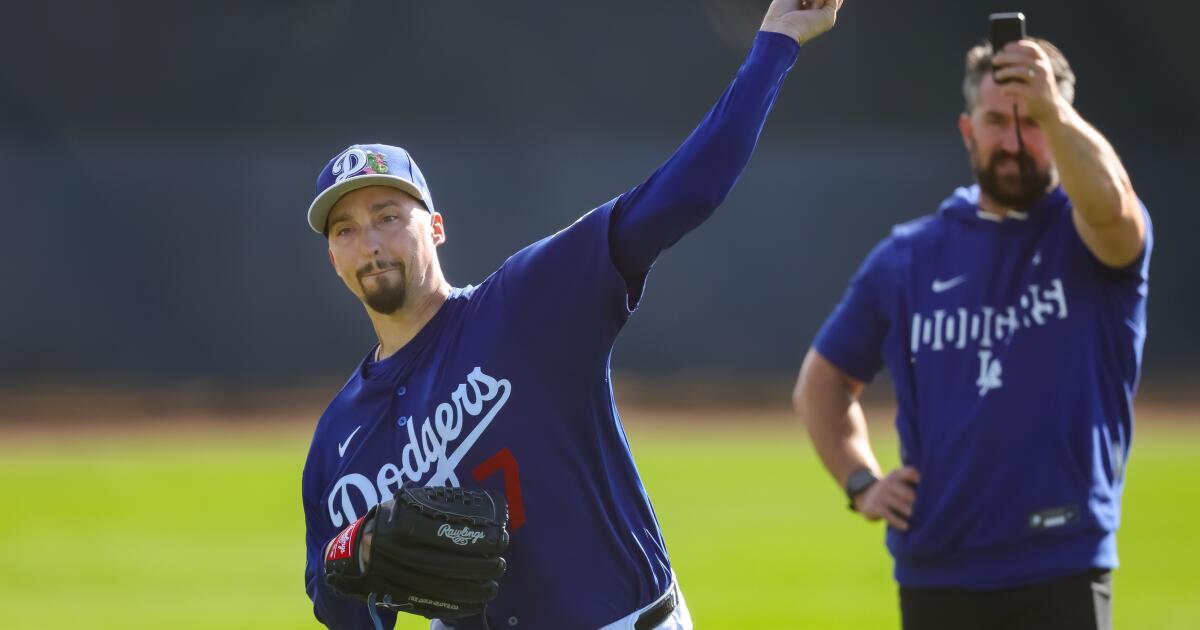
Blake Snell throws his first bullpen session of spring training

p]:text-cms-story-body-color-text clearfix”>

Unable to ramp up through the first month of spring training because of lingering shoulder soreness, Dodgers left-hander Blake Snell took a step toward readiness Thursday, throwing his first bullpen session.

Two hours before Thursday night’s Cactus League game, Snell threw off the mound in front of a group of reporters and fans at Camelback Ranch. Snell threw 15 pitches — all fastballs — sitting between 87 to 89 mph.

“I feel good,” Snell said after his bullpen. “I was very excited to throw off the mound again and pitch. I’ve been looking forward to this for a while. This being like the first one where I actually could have the catcher down. I was still limited to what I could throw. I was throwing 87 to 89 [mph]. It felt effortless, easy, could command the ball, so [I’m] happy with that. [I’m] just happy to continue to grow and get better.”

The two-time Cy Young Award winner says he’s targeting an April return, and that he’s hoping to get back faster than initially expected.

“I want to pitch in April,” Snell said. “That’s my goal. So, I’ve kind of been the one pushing it, and they’re being more cautious. I think we’re just talking a little back and forth, but I think them seeing me throw a pen today, hopefully that just gives them more confidence to keep it going. I think we won’t really know until I throw a live [batting practice], I think that’s when we’ll really know. How do I recover from that? How do I feel? And then that will be like, ‘OK, let’s get him into games.’ That’s what I would envision. I’m not the front office or Dave, but that’s what I would think.”

Dodgers manager Dave Roberts, however, isn’t ready to give a timetable for Snell’s return.

“I think honestly, to think about when he’s going to come back, we’re just a ways away from even really having that conversation,” Roberts said, noting that six weeks is “the floor” when you also account for a potential rehab assignment.

Thanks to the depth of their pitching staff, the Dodgers can afford to be patient with building up Snell. Right-handers Emmet Sheehan and River Ryan, along with left-hander Justin Wrobleski, are all possibilities for starting assignments early in the season.

“We still need him to pitch, and I know he understands that,” Roberts said of Snell. “But we do have the luxury of trying to err on the side of caution. … We are certainly better when he’s pitching for us, when he’s active.”

Snell, for his part, is thankful to be throwing again without shoulder pain.

“The whole offseason, I mean, every throw kind of hurt,” Snell said. “It was just every throw, I could feel my shoulder. It was just cranky and I couldn’t get it going. And I thought I was doing everything I needed to, and I believe I was, and ultimately, I’m feeling better.”

Source link

Will Klein isn’t shocked he saved Dodgers World Series dynasty

The day after he saved the Dodgers’ season, Will Klein was hungry. He ordered from Mod Pizza.

He drove over to pick up his order. The guy that handed him the pizza told him he looked just like Will Klein.

“You should just look at the name on the order,” Klein told him.

Chaos ensued.

“He actually started screaming,” Klein said. “He just started flipping out, which was funny.”

Thing is, if it were two days earlier, the guy would have had no idea what Klein looked like. Neither would you.

On Oct. 26, Klein was the last man in the Dodgers’ bullpen, a wild thing on his fourth organization in two years, a last-minute addition to the World Series roster.

On Oct. 27, the Dodgers played 18 innings, and the last man in the Dodgers’ bullpen delivered the game of his life: four shutout innings, holding the Toronto Blue Jays at bay until Freddie Freeman hit a walk-off home run.

Los Angeles Dodgers pitcher Will Klein celebrates against the Toronto Blue Jays.

Dodgers pitcher Will Klein celebrates during the 16th inning of Game 3 of the World Series against the Toronto Blue Jays at Dodger Stadium on Oct. 27.

(Mark J. Terrill / Associated Press)

When Klein returned to the clubhouse, Sandy Koufax walked over to shake hands and congratulate him.

That was Game 3 of the World Series. The Dodgers, the significantly older team, slogged through the next two games, batting .164 and losing both.

If not for Klein, that would have been the end. The Blue Jays would have won the series in five games, and there would have been no Kiké Hernández launching a game-ending double play on the run in Game 6, no Miguel Rojas tying home run and game-saving throw in Game 7, no Andy Pages game-saving catch and Will Smith winning home run in Game 7, no Yoshinobu Yamamoto winning Game 6 as a starter and Game 7 as a reliever.

There would have been no parade.

When Klein rescued the Dodgers, he had pitched one inning in the previous 30 days.

“You can never take your mind out of it,” he said. “You’ve got to stay prepared. Something might come up, and you don’t want to be the guy that gets thrown in the fire and just burns.”

The Dodgers are not shy about grabbing a minor league pitcher, telling him what he can do better and what he should stop doing, and seeing what sticks. If nothing sticks, the Dodgers are also not shy about spitting out the pitcher and designating him for assignment.

In his minor league career, Klein struck out 13 batters every nine innings, which is tremendous. He walked seven batters every nine innings, which is hideous.

The Dodgers scrapped his slider, mixed in a sweeper, and told him his arm was so good that he should stop trying to make perfect pitches and just let fly.

“A lot of times, pitchers are guilty of giving hitters too much credit, and hitters are guilty of giving pitchers too much credit,” said Andrew Friedman, the Dodgers’ president of baseball operations.

“Part of our job is to show them information that helps instill some confidence. I think that really landed with Will.”

In his four September appearances with the Dodgers — after a minor-league stint to apply the team’s advice — he faced 17 batters, walked one, and did not give up a run. That’s why he isn’t buying the suggestion that something suddenly clicked in the World Series.

“Things were incrementally getting better,” he said, “and then you add that to the atmosphere. It amplifies it to 100. All the prep work and mental stuff that I had been doing, I finally got a chance to shine.”

Said Dodgers manager Dave Roberts: “He’s done it in the highest of leverage. You can’t manufacture that. You’ve got to live it and do it. So, since he’s done it, I think he’s got a real confidence.”

Dodgers pitcher Will Klein speaks during DodgerFest at Dodger Stadium on Jan. 31.

Dodgers pitcher Will Klein speaks during DodgerFest at Dodger Stadium on Jan. 31.

(John McCoy / Getty Images)

Klein last started a game three years ago, at triple A. After making 72 pitches in those four innings of Game 3, did he entertain the thought that maybe, just maybe, he was meant to be a starter after all?

“No,” he said abruptly. “I hate waiting four or five days to pitch and knowing exactly when I’m going to pitch.

“When I did, the anxiety just built. I want to go pitch. I hate sitting there and waiting. That kind of eats at you. I like being able to go out to the bullpen and have a chance to pitch every day.”

The Dodgers are so deep that Klein might not make the team out of spring training. Whatever happens, he’ll always have Game 3.

In the wake of that game, a fan wanted to buy a Klein jersey but could not find one. So the fan made one himself before Game 4, using white electrical tape on the back of a Dodger blue jersey. I showed Klein a picture.

“That’s cool,” Klein said. “That’s pretty funny.”

Dave Wong, a Dodgers fan living in San Francisco Giants territory, also wanted to buy a Klein jersey.

“They didn’t have a jersey for him,” Wong said.

He settled for the Dodger blue T-shirt he found online and wore it to last Friday’s Cactus League game against the Giants, with these words in white letters: “Will Klein Appreciation Shirt.”

This, then, would be a Will Klein Appreciation Column.

Source link

Edwin Díaz is the Dodgers’ closer. How rest of the bullpen shapes up

p]:text-cms-story-body-color-text clearfix”>

By Game 7 of last year’s World Series, the Dodgers’ faulty bullpen issues were apparent even in the midst of dramatic triumph.

Not only did the Dodgers use all four starters in their postseason rotation — Shohei Ohtani, Blake Snell, Tyler Glasnow and Yoshinobu Yamamoto — they also tapped Justin Wrobleski and Emmet Sheehan, who combined to start 14 games in the regular season, to navigate the 5-4, 11-inning win that secured the team’s second consecutive championship.

The Dodgers shored up the bullpen over the winter, signing three-time all-star Edwin Díaz to a three-year, $69-million contract. With the closer role firmly defined for the first time since Kenley Jansen was on the team in 2021, how the rest of the bullpen falls into place remains a work in progress during spring training.

“Obviously, adding Díaz to the back end is huge for us and getting Alex Vesia [back] is going to be good, and also Blake [Treinen],” Dodgers manager Dave Roberts said. “Blake wasn’t right last year, clearly. He’s throwing the baseball really well. Having guys that you trust is everything for the pen. … You’ve got to count on those veteran guys for sure.”

Now included in that veteran group is left-hander Tanner Scott, who joined the Dodgers before last season on a four-year, $72-million deal. Scott struggled to find his footing, primarily as a closer, before a left elbow injury placed him on injured list in mid-July, causing him to miss a month of action. He returned the final week of August, and never looked quite right. Scott posted a 4.74 ERA across 61 appearances and 57.0 IP in his first year with the Dodgers.

On Saturday against the Chicago Cubs in a split-squad game at Camelback Ranch, Scott made his Cactus League debut and pitched a scoreless inning, recording a strikeout and giving up one hit on 17 pitches. With the ninth inning spoken for, Roberts believes this will allow for Scott to bounce back this season.

“I think being able to use Tanner in any inning of leverage, is going to be good for him,” Roberts said. “And it’s going to be good for us.”

Díaz, for his part, has settled in, making his second appearance of the spring on Saturday. He worked around two walks to pitch a scoreless inning, striking out one. Vesia, who missed the World Series due to the death of his newborn daughter, has pitched two scoreless innings while Treinen pitched a perfect inning on Thursday against the Chicago White Sox in his first Cactus League outing.

The 37-year-old Treinen, who’s been on all three of the Dodgers’ recent World Series teams and was a stalwart in the 2024 postseason, struggled last season, going 1-5 with a 9.64 ERA in September.

“You never know what the body throttles back,” Treinen said earlier in camp. “I had a UCL injury, so I don’t know if that’s part of the problem, but something was different. I mean, velocity was there, movements were there, execution wasn’t, and when pitches were in the zone, it was a harder-hit rate. So, that tells me something was different, how to handle hitters. So, just trying to go back and cleaning things up to where the ball does more of what it has done most of my career.”

On the flip side, right-hander Brusdar Graterol — who has not pitched since the 2024 World Series — remains in a holding pattern during spring training as he works his way back from right labrum surgery. And right-hander Evan Phillips is not expected back for several months after Tommy John surgery ended his season last June. But for the most part, the relievers who are healthy have shown glimpses of what it could look like this season.

“I don’t think that there’s one way to manage a pen,” Roberts said. “But when you have a guy like Edwin Díaz as your closer, I do think it frees up other guys. … I think that’s freeing for me and allows for getting the matchups we need in the prior innings.”

Source link