UCLA running backs coach A.J. Steward preaches it and it is the mantra adopted by the Bruins’ prolific running backs.
UCLA’s three-headed backfield, composed of fifth-year players Wayne Knight and Anthony Woods and senior Jaivian Thomas, is hailed for its undeniable impact on the ground, ranking first nationally in rushing touchdowns, third in yards per carry and fifth in yards per game this season.
Steward, who works in tandem with offensive line coach and run game coordinator Chris Smith, said it’s what his tailbacks do without the ball and the group’s commitment to each other that separates the group from the rest of the pack.
UCLA running back Anthony Woods scores against Cal while receiver Mikey Matthews celebrates the touchdown on Sept. 5.
(Godofredo A. Vasquez/For The Times)
“The way we play without the ball in our hands is no different. It should be no different than what we do when we have the ball in our hands in terms of trying to make a play for our offense,” Steward said. “You cut the film on any of these guys, you’ll see they’re downfield making blocks. They’re there at the end of the play in case somebody puts the ball down [on] the ground and that’s because they hear it every day how you do anything’s how you do everything.”
Apart from the group’s buy-in to doing the little things, its commitment to unselfish football keeps one of the most dynamic running games in the country from fracturing.
All three of the Bruins starting running backs could have been the sole starter at another program, with Woods rushing for 1,131 yards and 16 scores at Idaho in 2023, Thomas running for 626 yards and seven touchdowns at California in 2024 and Knight earning AP All-America honors last season at James Madison for his record-breaking 2,039 all-purpose yards.
But, as Steward preaches, the star of the running unit is the running back unit. And that belief is shared by the players, keeping them tightly knit and unbothered by who gets the most touches or scores.
“It goes into their buy-in as a program, as a group, because you’re talking about three dynamic running backs that could have 40 carries, 50 carries, 30 carries, 20, whatever it is,” said offensive coordinator Dean Kennedy. “But the fact that they’re buying into each other, that you could see them on the sideline, genuinely caring about other people’s success, and when you have a group like that, it bleeds to the team.”
The ability to utilize three differently skilled but equally high-impact running backs has dramatically opened Kennedy’s playbook, allowing him to put the tailbacks out on the perimeter and act as receivers, creating headaches for opposing defenses.
But the real value comes in the dying embers of games, when everyone on both sides of the field is exhausted — except the UCLA running backs.
“The ability to when we’re in the fourth quarter, I’m looking at these three guys and none of them are banged up, none of them are gassed and we can just roll,” Steward said. “We have guys that have only played 15 snaps in a game, 20 snaps in a game, that we trust with the game on the line to be able to push the ball forward and get first downs in a four-minute situation. That’s a competitive advantage. That’s part of the method to the madness is to have guys really fresh by the time we get to the fourth quarter.”
The team-first mentality of the running back group stems from the emphasis Steward places on having authentic relationships with his players, a lesson he learned under coach Dave Bailiff, now the special assistant to the head coach at Texas State, when Steward was a graduate assistant at Rice.
After a fellow graduate assistant chewed out one of the scout team players, Bailiff brought all of the young coaches into his office and reprimanded them, highlighting that they should never say or do anything they wouldn’t do to their own son.
UCLA running back Jaivian Thomas weaves through the Purdue defense on Sept. 19 at the Rose Bowl.
(Ronaldo Bolanos/Los Angeles Times)
And Steward has carried that experience from more than a decade ago in Houston, inspiring how he leads his group in Westwood.
“I definitely see them as somebody’s sons. I struggled earlier in my career to be blunt in the moments that they needed me to be blunt, because I didn’t want to ruffle their feathers or strain our relationship momentarily,” Steward said. “But now, I’m addressing it with them because I don’t want them to get hurt from a place of love. It’s been good for them to see me with my family, so they see a lot of the consistency with how I raise my boys, with some of the lessons that I’m trying to teach them.”
That spirit allowed Steward to be one of two coaches — alongside nickels coach Gabe Lynn — to be retained after working for former coach DeShaun Foster.
Soon after he arrived, new UCLA head coach Bob Chesney asked Steward whether he wanted to remain in Westwood.
And the answer was easy.
“I told him how much I really believe in this place and how much I love the players that we have here. I knew it was only a matter of time before we could get this thing going in the direction that I’ve always envisioned it,” Steward said. “I’m blessed that he gave me an opportunity to stay, and we’re seeing the fruit of some of the work that was put in before they got here, but also the success that they brought and the culture they added.”
And Steward’s emphasis on cultivating a genuine connection to his players fit naturally with the culture Chesney vowed to instill in Westwood.
Steward’s three top running backs now praise the coach for who he is as a man and a leader.
“His faith and how he carries himself as a father and off-the-football-field stuff — I admire a lot of that,” Knight said. “He’s a very respectable man.”
On the field, Knight said Steward has made him become more of a pro, by harping on the little things and making sure that no one takes anything for granted. Thomas said Steward knew things about his game that Thomas did not know himself.
UCLA running back Wayne Knight smiles after scoring a touchdown against Purdue at the Rose Bowl on Sept. 19.
(Ronaldo Bolanos/Los Angeles Times)
Woods echoed his teammates’ message, adding that Steward has pushed the group to its limit and held them to the highest standard because he knows the players’ potential.
“If they believe the why behind the things that you do, it opens the door for them to trust your decision making sometimes when it doesn’t necessarily benefit them,” Steward said. “That’s really what’s unlocked our ability to see these guys get closer to their ceiling. Even when I’m giving them coaching points, they understand this comes from a place of love. Love is saying great job when it’s a great job, or telling you that’s not the standard when it’s not the standard.”
Bettiah, India – Neyaz Miya was adjusting a kitchen handle. Mehadi Hassan was fixing a bracket for a bed.
They were at different construction sites – Miya in a half‑constructed home, a little higher up the hill, while Hassan was on the ground floor of Ganesh Hotel, closer to the Trishuli River that flowed through Syafrubesi, a bustling market town near the Nepal‑Tibet border, now wiped off the map by the August 26 flash floods.
More than 1,200 bodies have been recovered since then, at least 4,000 people remain missing, and more than 13,000 have been rescued.
“First came the terrifying loud sound. Then the ground trembled, and dark clouds descended upon us,” recalls 34‑year‑old Miya, who ran further up the hill with his phone and slippers that morning, five or six others running alongside him.
Hassan, lower on the slope, did not wait to reach for his slippers or his phone. He just ran, climbing a narrow, stair‑like path, up the hill, stopping only when he reached roughly 60 metres (200ft) above the road.
At some point, Miya and Hassan found each other. Around them were 60 to 70 other survivors who had also gathered high up on the hill.
A decade earlier, Miya had arrived in Syafrubesi as a carpenter. Three years later, he brought Hassan with him – both men from Bihar’s Bettiah district. Over the years, they built the town’s interiors – sofas, beds, almirahs, and kitchens for hotels and homes.
On that Wednesday morning, they watched all of that washed away. The multi‑storey hotels where they had worked – Red Panda, Garden Hotel, Buddha Hotel, Sunrise Hotel – were all swallowed by the flood.
“The town was gone in a blink,” Miya recounts, now sitting in his home in Turhapatti village of Bihar, India, just across the Nepal border. “There were only three kinds of people who survived that day: Those who were out of town, those who were at work and managed to run, and those who lived a little higher up the hill.”
Based on what he witnessed, Miya says only a few hundred people in Syafrubesi, a town that had a population of 2,271 in the 2011 census, likely survived.
Miya and Hasan are among them. Three of their close friends and colleagues, also migrant workers from Bihar, are not.
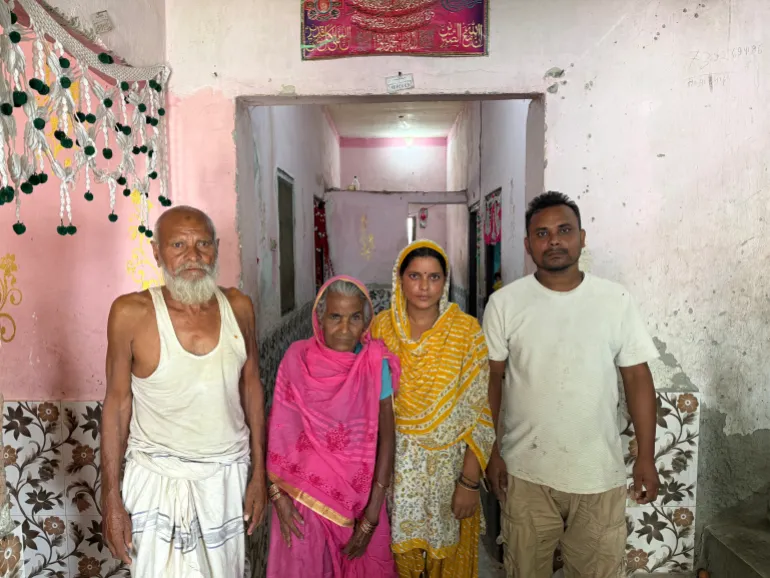
Neyaz Miya (far right), with his wife Rijwana Khatun, his mother Rubaida Khatun, and his father Doshahmad Miya. Neyaz survived the floods, but lost his masonry tools, worth almost $1000 [Jyoti Yadav/Al Jazeera]
A workday like no other
When the floods reached Syafrubesi, the men were already at work: Their shifts began at seven in the morning.
“To start at seven, we would wake up at four or five,” Miya recalls. They would leave with empty stomachs and were fed tea with doughnuts or biscuits at the construction site by building owners. Their first break came at 11am, when they returned to the rented one‑room space (3,500 Nepali rupees or $23 a month) that housed five to seven migrants at a time.
On the morning of August 26, they left for work alongside 34‑year‑old Arman Ansari, 20‑year‑old Samir Ansari, and 52‑year‑old Mukhtar Ansari, all migrants from Miya’s Turhapatti village.
In the rented room, two teenage boys, Arman’s 14‑year‑old son, Salman Alam, and his friend Shibu Alam, 17, remained asleep. They had come a month earlier to visit the hills.
“My father had cooked meat bhaat (rice with meat),” Salman recounts. He was waiting for his father to return at 11am so they could eat together.
Arman, his father, was working beside Hassan on the ground floor, pasting sunmica onto the same bed. Samir and Mukhtar were on the top floor of the Full Moon Hotel.
When Hassan ran out of the under-construction building and up the hill, he believed Arman was behind him. But by the time Hassan and Miya met higher up, there was no sign of the other three: Arman, Samir and Mukhtar.
Miya and Hassan found the boys, Salman and Shibu, terrified, on the hill. “Salman was crying, howling and searching for his father,” Hassan said.
The flood, which came with a high speed, took half an hour to recede. Soon, helicopters started hovering above them, airlifting the critically injured.
The four of them – Miya, Hassan and the boys – walked down the hill on foot to search for the three missing in the debris. They found nothing but sludge. Miya’s furniture-cutting tools and machines, worth 80,000 Nepali rupees ($530), were buried in the debris.
When they got back to their room, perched high on a slope, they found that it had survived.
But the army had taken charge, and soldiers herded survivors away from tenements near the river. “They said it [the flood] might come again,” Miya recalls.
They slept that night in a government school building in a village, he says. “At night, we were given daal bhat (rice and daal), and we wrapped ourselves in tarpaulin and slept.”
The next morning, a helicopter took them to another village. From there, another helicopter carried them to an army compound in a town. In the evening, they teamed up with five other migrants and hired an SUV to reach Nepal’s capital Kathmandu, each paying 3,500 rupees ($23).
The next morning, on August 28, they hired another SUV, which charged them 950 rupees ($6) each for a distance of 290km (180 miles) to Birgunj, a town on the India-Nepal border. They then crossed the border on foot before boarding buses for their villages.
It wasn’t the homecoming Indian migrants who work in Nepal usually plan.
A lane in Turhapatti village, Bihar, India, where the migrant workers are from. It is a village where almost every family has a story of migration [Jyoti Yadav/Al Jazeera]
‘No regular work’ back home
Turhapatti is among thousands of villages tucked along the 1,715km (1,066-mile) stretch of the India-Nepal border, where generations have crossed back and forth in search of work.
The two countries share an open border, and on both sides, especially in Bihar, the bond is known as a roti-beti ka rishta (a relationship of food and daughters), alluding to ties of livelihoods and matrimonial kinship. People live, work, and marry across the border.
Kathmandu is as close to Turhapatti as is Patna, the capital of Bihar. Per its 2021 Population and Housing Census, Nepal had 700,000 foreign-born residents, 97 percent of them from India.
Miya and Hassan say the wages for a carpenter or a mason on the Indian side are between 600-700 rupees, while for the same work in Nepal, wages are about 900 rupees. That drives migrant workers from India over the border into Nepal.
Nepal, for its part, is facing a major out-migration crisis — its per capita income is the lowest in South Asia, barring Afghanistan, and hundreds of thousands of young men and women leave each year to find work elsewhere. This creates a demand for migrant workers from Bihar, India’s poorest state that lies just across the border.
In Turhapatti, Miya owns only 0.03 hectares (0.06 acres), not enough to feed his family of six children, wife and parents. In recent years, he transitioned from being a carpenter to a contractor, which allowed him to bring in more workers from Bihar.
He had been sending 30,000 Indian rupees ($315) back to his family every month.
Hassan has even less back home: He inherited a 6×8-metre (20×25ft) room from his father and no agricultural land. “There is no regular daily work here,” he says. He would send 15,000 Indian rupees ($157) home from Nepal each month for his wife and four children.
Their story echoes in most homes in Turhapatti. The village had a population of 16,000 people in the 2011 census, India’s latest one. In nearly every household, men have left to work in other parts of India and abroad as carpenters, masons, or labourers mixing cement and sand into mortar.
The destinations are Kashmir, where close to 700 men from the village work; Nepal, with nearly 600; and thousands scattered across Indian cities: Chennai, Kolkata, Delhi, Mumbai. About 100 men have migrated to Dubai, Oman and Saudi Arabia.
The houses they built in Turhapatti stand in stark contrast to those of those who remain in India. The marble-fronted and iron-gated homes belong to men working in the Gulf, while semi-permanent dwellings belong to those who stayed behind.
Migrants in Nepal fall in between: Miya has been able to raise a brick house.
Sahrun Khatun, Arman’s wife, with her eldest son Salman (holding the youngest child) who survived, her mother-in-law, and two younger children, outside their home in Turhapatti, Bihar, India [Jyoti Yadav/Al Jazeera]
‘My body shivers at the thought’
This economic reality is what drove Arman Ansari to Syafrubesi. On July 26, Arman left for Nepal with Samir and Mukhtar. Arman’s son and his friend Shubu went with the three adults; the teenagers were on a trip to the hills.
Now, Arman’s brother-in-law. Jameel Miya, a carpenter in Kathmandu, scours the city’s hospitals for Arman’s body, telling authorities that his brother-in-law’s right hand and chest had deep scars, cut by shards of glass when he was young.
Arman’s wife, Sahrun Khatun, has only her last phone call with Arman to hold on to. They spoke two hours before the floods swept him away. “He was about to get his wages on September 1 and return home,” she says.
Salman, who had tagged along with his father to see the hills, hasn’t been able to sleep since the flood.
“The moment I close my eyes, I feel the flood is coming for me,” he says.
Mukhtar’s family lives a few lanes away.
Since the floods, Kasmun Khatun, Mukhtar’s wife, has been glued to the internet for any news of her missing husband. Joining her in that remote search are her daughter Asmana (18) and son Sadre Alam (14).
Her eldest son, Osama, 25, a tailor in Kathmandu, has been busy searching for his father in city hospitals.
“After waiting for a week and watching the videos, I submitted my DNA samples,” he says over a phone call. Osama manages to send home 6,000 rupees ($63), but that is no longer enough – his mother needs eye surgery that has already been delayed and cannot be put off much longer.
“The guardian has gone, all of a sudden,” he says, referring to his father.
At the far edge of Turhapatti stands the home of Samir Ansari, the youngest among the missing migrants and youngest of his five migrant brothers.
The Ganesh Hotel project he was working on was only three days from completion.
“He said he found another site to work on,” recalls his father, Hasmuddin Miya, remembering their last phone call on the evening of August 25.
Samir was a mason who specialised in marble tiles, a skill he had learned in Kashmir while working under his elder brothers at construction sites.
The three families are preparing to host a bhoj, the funeral feast – a custom of feeding hundreds of people – having given up on hope.
Meanwhile, the two survivors, Miya and Hassan, are already making calls to find work again. This time, their search turns towards Nepal’s plains. They pledge never to return to the hills.
“My whole body shivers at the thought of going there,” says Hassan.
The Victorians’ love of seaside resorts inspired a developer to try and build a ‘mega resort’ for the rich and powerful of the time, but many of the plans for this seaside town never came to fruition
The seaside village is a lot smaller than was initially planned(Image: Getty Images)
Victorians loved the seaside. Time at the beach was the perfect antidote to the dirty, smoggy cities that were rapidly expanding, and the sea air was touted as a cure for everything from respiratory problems to exhaustion.
Another thing that was expanding at the time was Britain’s railway lines, and entrepreneurs were quick to build seaside resorts to accommodate Victorians’ love of beaches. One such visionary was Sir Robert Perks, a politician who looked at a stretch of Kent coast and decided it would make an incredible resort for the wealthiest in society at the time.
The spot was given the name Littlestone-on-Sea, named after a nearby headland called Little Stone, and initially it comprised of a home for Robert, accommodation called the Grand Hotel, a church, and some terraced houses. However, the Grand Hotel didn’t turn out nearly as grand as planned, and it was just the first project that didn’t quite live up to the vision.
Robert teamed up with a surveyor named Henry Tubbs to launch Littlestone Golf Course in 1888, which is still open to this day, and at one end there’s a distinctive local building the Littlestone water tower, which was supposed to supply fresh water to the golf course and the impressive seaside town that was envisioned.
Unfortunately, the water from the 120ft tall tower was too salty to use, and over time it was abandoned. However, in the Second World War, the structure found a new purpose. It became a lookout post that protected Kent’s shores, and the addition of platforms meant guards could keep lookout from many levels. Nowadays, it has been turned into a unique home.
Other plans for Littlestone included a large housing development, a lively promenade, and a favourite of Victorians – a pier. However, parts of the design for the pier were eventually used in Eastbourne, so it wasn’t a total waste of time.
Nowadays, Littlestone is far from the bustling resort that was imagined by the Victorian entrepeneurs, but it certainly has its own charm. Its vast shingle beach is lined with colourful beach huts, and the long flat promenade is popular for families and dog walkers.
From the shore you can spot the Mulberry Harbour Phoenix Caisson, a temporary breakwater that was built during the D-Day Normandy landings in World War 2. Few of these structures remain, making it a popular site for those interested in military history.
The town itself has a handful of shops, cafés, and restaurants. There’s a small selection of seaside hotels, as well as a caravan park that’s much loved by families looking for a peaceful break at the seaside.
So, while Littlestone may not have become a playground for the rich, it developed its own character over time and is still much-loved by visitors who want a more low-key seaside experience.
Have a story you want to share? Email us at webtravel@reachplc.com