Brent Crude

Oil drops below $100 per barrel, but gas prices remain high in U.S.

May 25 (UPI) — With the United States and Iran reportedly nearing a peace deal, oil prices fell slightly below $100 per barrel early Monday, suggesting optimism from traders to start the week.

Gas prices also declined slightly in the United States in the last week, but remain above $4.50 per gallon for regular on Memorial Day.

President Donald Trump has indicated that negotiations are “proceeding nicely,” and Iran acknowledged that talks have progressed but that a deal has not been reached, The BBC reported.

In European trading, Brent crude dropped to $95.04 per barrel and WTI futures dropped dropped to $91.02 per barrel — both declines of more than 5% — the Wall Street Journal reported.

Even with gas prices high, The Hill reported that more than 39 million people were projected to travel the roads during Memorial Day weekend, even as gas prices have remained consistently high since the start of the war in Iran.

Regular gas on Monday averaged $4.50 per gallon, which is down $0.01 from one week ago, but still $0.40 higher than one month ago, AAA reported.

Similar, diesel averaged $5.59 per gallon on Monday, which is down $0.03 from one week ago, and $0.40 more than one month ago.

“Memorial Day travel is still reaching record levels, but with the smallest year-over-year increase in more than a decade,” said Tiffany Wright, spokesperson for AAA’s The Auto Club.

“Although travel demand remains strong, higher fuel prices and persistent inflation may cause some travelers to shorten trips, delay plans or stay closer to home.”

The longer that the United States and Iran take to agree on a peace plan and the Strait of Hormuz remains closed, gas prices are unlikely to decrease significantly and energy markets will take a while to get back to normal, Axios reported.

“Gas prices are currently falling, but until we see an agreement signed and a significant amount of ships transit the Strait, the national average prices of gasoline will likely remain well above $4.00 per gallon,” said Patrick De Haan, head of petroleum analysis for Gas Buddy.

Members of the 3rd U.S. Infantry Regiment, or “The Old Guard,” place some 250,000 American flags throughout Arlington National Cemetery in preparation for Memorial Day in Arlington, Va., on May 21, 2026. Photo by Bonnie Cash/UPI | License Photo

Source link

45 million Americans expected to travel for Memorial Day weekend

May 11 (UPI) — AAA estimates that 45 million Americans will be traveling at least 50 miles from home over Memorial Day weekend, a slight uptick over last year.

AAA reported its estimate on Monday, forecasting an uptick in travel between Thursday, May 21 and Monday, May 25. Last year about 44.8 million people traveled for Memorial Day weekend.

About 39.1 million people are estimated to be hitting the road while another 3.66 million will fly and 2.22 million will take other forms of travel.

“Memorial Day marks the unofficial start of summer, and for most Americans, it’s a three-day weekend,” Stacey Barber, AAA vice president, said in a statement. “Travel demand remains strong, and despite higher fuel prices, many people are prioritizing leisure travel during holiday breaks.”

AAA said last year the average gallon of regular gasoline cost $3.17 on Memorial Day.

Fuel prices remain high across the United States as the war in Iran drags on. The average cost of a gallon of regular gasoline in the United States is $4.52. That is up from $4.45 last week, $4.13 last month and $3.13 a year ago.

Oil prices climbed again on Monday, following President Donald Trump‘s statement that Iran’s response to the United States’ latest peace proposal was “totally unacceptable.”

Brent crude oil increased by 4% to $105.50 per barrel and West Texas Intermediate rose 4.4% to $99.80.

President Donald Trump delivers remarks at an event he is hosting for a group that includes Gold Star Mothers and Angel Mothers in honor of Mother’s Day in the Rose Garden of the White House on Friday. Photo by Aaron Schwartz/UPI | License Photo

Source link

Oil price plunges back below $100 on hopes of U.S.-Iran peace deal

A gas station in South Africa displays the latest prices for petrol and diesel after they hit a record high on Wednesday despite global oil prices plunging back below $100 a barrel on hopes of a deal to end the war in Iran. Photo by Kim Ludbrook/EPA

May 6 (UPI) — Global oil prices fell sharply and financial markets rallied Wednesday after U.S. President Donald Trump paused a military operation to reopen the Hormuz Strait to commercial shipping to give advanced peace talks with Iran a chance to deliver “a complete and final deal.”

Falls in Brent crude of more than $10 a barrel to $99, American crude by $13 to $92 a barrel and rallies in Asian stock markets overnight that fed into Europe when bourses opened there failed to feed through to U.S. gas prices, which jumped 5 cents a gallon to their highest level of the war.

AAA motor club figures showed a national average of $4.54 for a gallon of petrol and $5.67 for diesel, meaning drivers were paying 53% and 51% more than before the war started on Feb. 28, with the caveat that fuel price adjustments normally lag crude oil price movements by several days.

The White House believes a draft one-page, 14-point memorandum of understanding to end the war and create a structure for more in-depth nuclear talks could succeed in breaking the deadlock, two U.S. officials and two other sources said.

An Iranian foreign ministry spokesman confirmed to CNBC that Iran was in receipt of the U.S. proposal and was “evaluating it.”

The Trump administration anticipates Iran will give its response with regard to the most critical elements of the plan in the next two days and although nothing has been finalized it was being seen as significant because it was the closest the sides had been to a deal since the beginning of the war.

However, Trump also appeared ambivalent, saying Wednesday it was “perhaps” too big of a stretch to believe Iran would take the deal and threatening to order the U.S. military to restart its airborne offensive against the country if it didn’t.

Analysts said investor confidence was boosted mainly by the fact the cease-fire was holding and signs that the economy was nowhere near as badly affected by the war as feared.

“This helped oil prices to come back down again and ease fears about a renewed escalation, with investors a bit more hopeful that an extended stagflationary shock would be avoided,” Deutsche Bank wrote in a note.

It added that investor confidence was also bolstered by new U.S. economic data showing among other positive indicators, that job vacancies declined less than anticipated in March, saying the numbers “cemented the case that the conflict’s wider economic impact was still fairly muted.”

“This helped oil prices to come back down again and ease fears about a renewed escalation, with investors a bit more hopeful that an extended stagflationary shock would be avoided,” they added.

Hopes were also riding on the possibility China would prevail on visiting Iranian foreign minister Abbas Araghchi to persuade Iran to uphold the current truce with the United States, so as not to throw a wrench into Trump’s visit to Beijing on May 14, the first by any U.S. president in almost a decade.

China is one of Iran’s largest customers for its oil exports.

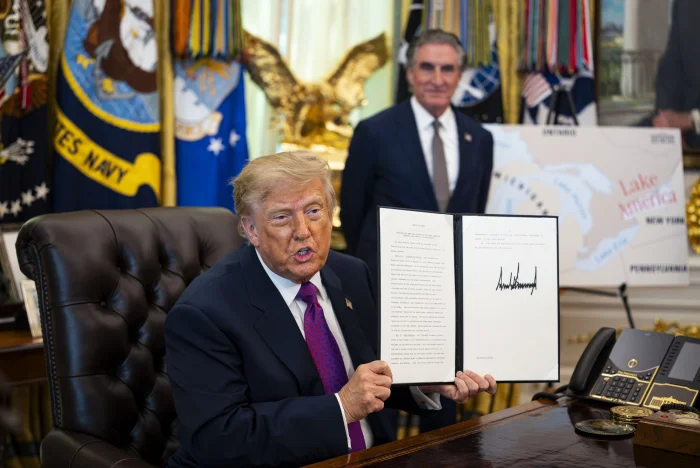
President Donald Trump speaks before signing a proclamation inside the Oval Office at The White House on Tuesday. The memorandum is set to restore the Presidential Fitness Test Award, a competitive school-based fitness program last seen under the Obama administration. Photo by Tom Brenner/UPI | License Photo

Source link

Oil hits 4-year high on Hormuz Strait, fresh U.S. military action fears

A gas station in Berlin, Germany, displays the latest per liter prices for petrol, diesel and LPG on Thursday after oil prices on global markets surged to their highest level since 2022. Photo by Filip Singer/EPA

April 30 (UPI) — Oil prices briefly topped $126 a barrel in Asian trade overnight as markets reacted to news the United States might resume its military offensive against Iran and fears the Hormuz Strait might remain closed for much longer than anticipated.

Brent crude, the global benchmark, surged to $126.31, its highest level since Russia invaded Ukraine in 2022, after a report that U.S. military commanders were pitching a campaign of “short and powerful” strikes to U.S. President Donald Trump, to force Iran back to the negotiating table.

The price retreated to around $120 by the time markets in Europe opened on Thursday and continued to fall through the morning. The Brent contract for June delivery was trading at $113.91 a barrel in mid-afternoon trade in London, while American crude for June delivery was changing hands at $104.82.

Oil prices have already elevated since the war began on Feb. 28 and began climbing further on Wednesday after Trump met with executives of U.S. oil companies the previous day about how to deal with supply disruption from the closure of the Strait of Hormuz by Iran, which has vowed it will continue until the United States’ blockade of its ports is lifted.

The group discussed “steps we could take to continue the current blockade for months if needed and minimize impact on American consumers,” a White House official said.

Around 25% of the world’s oil supply passes through the strait and the prospect of it remaining effectively closed for months has set alarm bells ringing in markets as traders’ faith in an early resolution fades and “the reality of the supply situation” sets in.

“The breakdown of talks between the U.S. and Iran, along with President Trump reportedly rejecting Iran’s proposal for a reopening of the Strait of Hormuz, has the market losing hope for any quick resumption in oil flows,” said William Patterson, ING’s Singapore-based head of commodities strategy.

Trump has said he believes the regime in Tehran will blink first, saying they were less afraid of the bombing than the blockade, with U.S. officials banking it will force Iran to shutter oil production because the oil has nowhere to go and the country lacks sufficient storage facilities.

Artemis II pilot Victor Glover (L) and mission specialist Christina Koch meet with President Trump in the Oval Office of the White House on Wednesday. Photo by Graeme Sloan/UPI | License Photo

Source link