Skyscanner recently shared insights into the best and worst times to buy flight tickets
Securing affordable flight deals can often seem impossible, but assistance might just be at hand. Skyscanner recently unveiled insights on the best and worst times to purchase international tickets, spotlighting both seasonal patterns and particular weekdays.
The travel search engine analysed historical data to reveal these trends and also addressed an ongoing debate in holiday planning: is it better to book early or to hold out for last-minute bargains?
Unfortunately, there isn’t a straightforward answer to this, as Skyscanner stressed that it largely depends on the route. Whilst quieter journeys or off-peak days may see price reductions as the departure date approaches, popular routes are likely to witness prices soar dramatically.
Irrespective of the season, Fridays and Sundays consistently emerge as the worst days to book flights due to high demand. However, statistics showed that cheaper fares are usually discovered on Tuesdays and Wednesdays, when bookings drop off.
“Based on past pricing trends, fares have dropped on Tuesday mornings after Monday deal releases,” Skyscanner wrote earlier this year, according to the Daily Record. When asked if prices decrease nearer a departure date, it added: “Sometimes, especially if seats are still available.
“But prices also tend to rise as departure nears. Last-minute deals exist, but they’re never guaranteed. You can also use the Skyscanner Savings Generator to find the best time to book flights based on your route.”
Skyscanner recommended that travellers book short-haul flights at least one to three months in advance to avoid disappointment. For long-haul journeys, it’s best to secure tickets two to six months before the trip.
Those wishing to monitor fluctuating flight prices can utilise Skyscanner’s alert system. To activate it, simply select a preferred route and click the ‘Get Price Alerts’ button located at the top left corner of the website.
To use this feature, you’ll need a Skyscanner account as alerts will be sent to the email linked with your account. Google also offers a similar alert system within its flight price tracking tool.
Google’s current advice states: “You can track flight prices for specific dates or, if your plans are flexible, any dates. To get flight alerts for a specific round trip, choose your dates and flights and select Search. Then, you can turn on price tracking.”
For more information on Skyscanner’s price-tracking tool, click the link here.
For the latest money-saving tips, shopping and consumer news, go to the new Everything Money website.
Get all the hottest shopping deals, cash saving tips and money news straight to your phone by joining our new WhatsApp Community – The Money Saving Club. Just click this link to join https://crnch.it/eutplxS1
We also treat our community members to special offers, promotions, and adverts from us and our partners. If you don’t like our community, you can check out any time you like. If you’re curious, you can read our Privacy Notice here https://crnch.it/jeQqC872
When Fernando Mendoza won the Heisman Trophy this weekend with another Latino finalist looking on from the crowd, the Cuban-American quarterback did more than just become the first Indiana Hoosier to win college football’s top prize, and only the third Latino to do so. He also subtly offered a radical statement: Latinos don’t just belong in this country, they’re essential.
At a time when questions swirl around this country‘s largest minority group that cast us in a demeaning, tokenized light — how could so many of us vote for Trump in 2024? Why don’t we assimilate faster? Why does Supreme Court justice Brett Kavanaugh think it’s OK for immigration agents to racially profile us? — the fact that two of the best college football players in the country this year were Latino quarterbacks didn’t draw the headlines they would’ve a generation ago. That’s because we now live in an era where Latinos are part of the fabric of sports in the United States like never before.
That’s the untold thesis of four great books I read this year. Each is anchored in Latino pride but treat their subjects not just as sport curios and pioneers but great athletes who were and are fundamental not just to their professions and community but society at large.
Shea Serrano writing about anything is like a really great big burrito — you know it’s going to be great and it exceeds your expectations when you finally bite into it, you swear you’re not going to gorge the thing all at once but don’t regret anything when you inevitably do. He could write about concrete and this would be true, but his latest New York Times bestseller (four in total, which probably makes him the only Mexican American author with that distinction) thankfully is instead about his favorite sport.
“Expensive Basketball” finds Serrano at his best, a mix of humblebrag, rambles and hilarity (of Rasheed Wallace, the lifelong San Antonio Spurs fan wrote the all-star forward “would collect technical fouls with the same enthusiasm and determination little kids collect Pokémon cards with.”) The proud Tejano’s mix of styles — straight essays, listicles, repeated phrases or words trotted out like incantations, copious footnotes — ensures he always keeps the reader guessing.
But his genius is in noting things no one else possibly can. Who else would’ve crowned journeyman power forward Gordon Hayward the fall guy in Kobe Bryant’s final game, the one where he scored 60 points and led the Lakers to a thrilling fourth-quarter comeback? Tied a Carlos Williams poem that a friend mistakenly texted to him to WNBA Hall of Famer Sue Bird? Reminded us that the hapless Charlotte Hornets — who haven’t made it into the playoffs in nearly a decade — were once considered so cool that two of their stars were featured in the original “Space Jam?” “Essential Basketball” is so good that you’ll swear you’ll only read a couple of Serrano’s essays and not regret the afternoon that will pass as quickly as a Nikola Jokic assist.
“Mexican American Baseball in the South Bay”
(Gustavo Arellano/Los Angeles Times)
I recommended “Mexican American Baseball in the South Bay” in my regular columna three years ago, so why am I plugging its second edition? For one, the audacity of its existence — how on earth can anyone justify turning a 450-page book on an unheralded section of Southern California into an 800-page one? But in an age when telling your story because no one else will or will do a terrible job at it is more important than ever, the contributors to this tome prove how true that is.
“Mexican American Baseball in the South Bay” is part of a long-running series about the history of Mexican American baseball in Southern California Latino communities. What’s so brilliant about this one is that it boldly asserts the history and stories of a community that too often get overlooked in Southern California Latino literature in favor of the Eastsides and Santa Anas of the region.
As series editor Richard A. Santillan noted, the reaction to the original South Bay book was so overwhelmingly positive that he and others in the Latino History Baseball Project decided to expand it. Well-written essays introduce each chapter; long captions for family and team photos function as yearbook entries. Especially valuable are newspaper clippings from La Opinión that showed the vibrancy of Southern Californians that never made it into the pages of the English-language press.
Maybe only people with ties to the South Bay will read this book cover to cover, and that’s understandable. But it’s also a challenge to all other Latino communities: if folks from Wilmington to Hermosa Beach to Compton can cover their sports history so thoroughly, why can’t the rest of us?
(University of Colorado Press)
One of the most surprising books I read this year was Jorge Iber’s “The Sanchez Family: Mexican American High School and Collegiate Wrestlers from Cheyenne, Wyoming,” a short read that addresses two topics rarely written about: Mexican American freestyle wrestlers and Mexican Americans in the Equality State. Despite its novelty, it’s the most imperfect of my four recommendations. Since it’s ostensibly an academic book, Iber loads the pages with citations and references to other academics to the point where it sometimes reads like a bibliography and one wonders why the author doesn’t focus more on his own work. And in one chapter, Iber refers to his own work in the first person — profe, you’re cool but you’re not Rickey Henderson.
“The Sanchez Family” overcomes these limitations by the force of its subject, whose protagonists descend from Guanajuato-born ancestors that arrived to Wyoming a century ago and established a multi-generational wrestling dynasty worthy of the far-more famous Guerrero clan. Iber documents how the success of multiple Sanchez men on the wrestling mat led to success in civic life and urges other scholars to examine how prep sports have long served as a springboard for Latinos to enter mainstream society — because nothing creates acceptance like winning.
“In our family, we have educators, engineers and other professions,” Iber quotes Gil Sanchez Sr. a member of the first generation of grapplers. “All because a 15-year-old boy [him]…decided to become a wrestler.”
Heard that boxing is a dying sport? The editors of “Rings of Dissent: Boxing and Performances of Rebellion” won’t have it. Rudy Mondragón, Gaye Theresa Johnson and David J. Leonard not only refuse to entertain that idea, they call such critiques “rooted in racist and classist mythology.”
(University of Illinois Press)
They then go on to offer an electric, eclectic collection of essays on the sweet science that showcases the sport as a metaphor for the struggles and triumphs of those that have practiced it for over 150 years in the United States. Unsurprisingly, California Latinos earn a starring role. Cal State Channel Islands professor José M. Alamillo digs up the case of two Mexican boxers denied entry in the United States during the 1930s, because of the racism of the times, digging up a letter to the Department of Labor that reads like a Stephen Miller rant: “California right now has a surplus of cheap boxers from Mexico, and something should be done to prevent the entry of others.”
Roberto José Andrade Franco retells the saga of Oscar De La Hoya versus Julio Cesar Chávez, landing less on the side of the former than pointing out the assimilationist façade of the Golden Boy. Mondragón talks about the political activism of Central Valley light welterweight José Carlos Ramírez both inside and outside the ring. Despite the verve and love each “Rings of Dissent” contributors have in their essays, they don’t romanticize it. No one is more clear-eyed about its beauty and sadness than Mondragón’s fellow Loyola Marymount Latino studies profe, Priscilla Leiva. She examines the role of boxing gyms in Los Angeles, focusing on three — Broadway Boxing Gym and City of Angels Boxing in South L.A, and the since-shuttered Barrio Boxing in El Sereno.
“Efforts to envision a different future for oneself, for one’s community, and for the city are not guaranteed unequivocal success,” she writes. “Rather, like the sport of boxing, dissent requires struggle.”
If those aren’t the wisest words for Latinos to embrace for the coming year, I’m not sure what is.
Felixstowe, Suffolk A proper community affair, with hundreds of participants resplendent in festive finery racing into the North Sea at 10am sharp while much of the town gathers along the promenade to watch. The event raises funds for St Elizabeth Hospice, and every year brings new tales of heroics and even romance (there’s been the odd mid-plunge proposal). The atmosphere is as heartwarming as the water is not. Afterwards warm up with a stroll around town, with its four-mile promenade and seafront gardens. 10am, £16, stelizabethhospice.org.uk
Penarth and Porthcawl
The Penarth Christmas swim. Photograph: James Richardson
The Dawnstalkers meet daily to greet the sunrise with a swim beside Penarth pier, three miles south of Cardiff city centre – and Christmas morning is no exception. Anyone can join this inclusive sea-swimming collective. A wood-fired barrel sauna will be parked on the prom from 21–29 December, offering a toasty post-dip reward. The Christmas swim at Porthcawl (25 miles west along the coast) began in 1965, when local swimming legend Arlon Owens, dressed as a clown, was pushed off the pier by another dipper dressed as Father Christmas. More than a thousand swimmers – many still in fancy dress – take the plunge, raising thousands for local charities. Penarth: 8am, free, dawnstalkers.com. Porthcawl:11.15am (enter water at 11.45am), suggested donation £10, christmasswim.org
Peter Pan Cup, the Serpentine, Hyde Park, London
Swimmers of the Serpentine Swimming Club take part in the Peter Pan Cup race. Photograph: Dominic Lipinski/PA
One of the UK’s oldest festive swims, the Serpentine Swimming Club’s Christmas Day race has been held in Hyde Park every Christmas morning since 1864. The event was later named for JM Barrie, who donated the first trophy in 1904. This short but speedy 100-yard race is open only to members, but spectators are encouraged to gather along the lakeside to cheer on the swimmers. 9am, serpentineswimmingclub.com
Weymouth, Dorset
The origins of Weymouth’s Christmas dip go back to 1948 and a bet in a pub. Photograph: Andy Cooke/We Are Weymouth
Started in 1948, when pub landlord Dill Laker and taxi driver Reggie Bugler made a boozy bet to swim the harbour after Christmas Eve drinks, Weymouth has grown into one of the UK’s biggest and best-loved festive plunges. Hundreds of swimmers splash 70 metres across the harbour, cheered on by thousands of spectators, raising funds for a local disability charity. The harbour itself is pretty, but make time to stroll the huge sandy beach too, backed by colourful beach huts. From 9.30am, £15, love-weymouth.co.uk
Hunstanton, Norfolk One of Norfolk’s largest festive events, the swim has been running for more than 60 years. Taking place just off the town’s central promenade, it’s organised by the Hunstanton and District Round Table and supports local charities. Lots of prizes and free hot soup to warm up after. 11am (register from 10am), free, hunstantonroundtable.com
Bude, Cornwall
The Bude Surf Life Saving club organises the local Christmas swim. Photograph: Simon Maycock/Alamy
This legendary swim has been organised by the Bude Surf Life Saving Club at Crooklets beach for over half a century. Thousands gather to watch as swimmers – many in Santa suits – dash into the Atlantic for a short but spirited dip. It’s all for a good cause, raising funds for the life-saving club that keeps the local beaches safe year-round. 10.45am, free (donations welcome), visitbude.info
Boxing Day
Folkestone, Kent This event brings hundreds of swimmers to Sunny Sands, cheered on by a boisterous crowd. Organised by the Folkestone, Hythe & District Lions Club, it raises funds for the Lions and other local charities. There are prizes for fancy dress and the youngest and oldest dippers. 11.30am (register from 9.30am), £10, free with sponsorship, folkestonelions.org.uk
Seaton Carew, County Durham The North Sea isn’t exactly a welcoming proposition for a swimmer at this time of year, but that doesn’t deter hundreds from joining Hartlepool Round Table’s Boxing Day Dip. A parade sets off from the Marine Hotel on the seafront at Seaton Crew, just outside Hartlepool, before the plunge. Bacon butties and beer are available back at base afterwards. 11.30am, £5, hartlepoolroundtable.co.uk
Paignton, Devon
The Lions Club’s Walk into the Sea. Photograph: Graham Hunt/Alamy
A Boxing Day classic, with hundreds of swimmers, many in fancy dress, gathering on Paignton Sands for the local Lions Club’s Walk into the Sea. There’s a fancy-dress competition at 11.45am before the mass dip at noon. A great way to shake off Christmas Day indulgence in this lively English Riviera town. 12pm, £10, englishriviera.co.uk
St Ives, Cornwall
St Ives’ harbour, lit by Christmas lights Photograph: TW/Alamy
Blow away the Christmas Day cobwebs with this relaxed dip on golden Porthminster beach. Wetsuits are allowed, fancy dress is encouraged and even dogs can join in. Porthminster Café keeps post-swim spirits high with hot chocolates and bacon butties. St Ives is particularly pretty in winter and the narrow cobbled streets make for pleasant festive wandering. 12pm, free, £1 donation suggested, no website
Ventnor, Isle of Wight Once a smugglers’ haunt, Ventnor Bay now welcomes hundreds of swimmers dressed in pyjamas, tutus and rubber rings for this swim on the Esplanade. The event raises funds for local cancer charities and for Ventnor Carnival. Post swim, mulled wine and doorstop sandwiches await brave bathers at the Spyglass Inn. 12pm, free, donation suggested, on Facebook
Fraserburgh Harbour, Aberdeenshire Few causes are closer to sea swimmers’ hearts than the RNLI (Royal National Lifeboat Association). The 17th annual 52-metre harbour swim will raise funds for Fraserburgh lifeboat station, with participants diving in from the side of a lifeboat and swimming across the icy water, cheered on by the whole town. 1pm, free, donation suggested, rnli.org
New Year’s Day
Salford Quays, Manchester
Swimmers at Salford Quays. Photograph: PA Images/Alamy
No seaside? No problem. Manchester swimmers can head to Dock 9 at MediaCity, a 2002 Commonwealth Games venue that hosts a New Year’s dip in 7C waters. This “big, bold and mighty cold” event, run by Uswim, raises lots of cash for local charities. With the Lowry theatre as a backdrop, three waves of swimmers enter the water at 15-minute intervals. A best-dressed hat competition adds to the fun. 11am, £25, uswimopenwater.com
Keswick, Lake District Cumbria’s hardiest wild swimmers take to Derwentwater in fancy dress to raise funds for the Calvert Trust, which helps people with disabilities experience the outdoors. Afterwards there will be lakeside hot chocolate and cake. 11am, free, £5 donation suggested, calvertlakes.org.uk
Bangor, County Down Swimmers plunge into Bangor’s Ballyholme Bay in fancy dress to raise funds for Cancer Focus Northern Ireland. There are prizes to be won, hot drinks and proper facilities – but no guarantee of feeling your toes afterwards. Ballyholme Yacht Club also organises a Boxing Day swim in aid of the RNLI (£5 entry) if you fancy a double whammy. 12pm, £15, cancerfocusni.org
Saundersfoot, Pembrokeshire This is one of the UK’s larger New Year’s Day swims – there were 2,535 registrations on 1 January 2025. It turns 40 in 2026, with a ruby theme promising a sea of vermilion-clad dippers and plenty of sparkle in the sea. 12.30pm, £5 (£3 under-16s), saundersfootnyds.co.uk
Lyme Regis, Dorset
Large crowds gather to watch the ‘swimming’ in Lyme Regis. Photograph: Graham Hunt/Alamy
The Rotary Club’s Lyme Lunge fills sandy Cobb beach with wigs, wings and inflatable flamingos. Fancy dress is encouraged, fundraising optional, desire to run like a loon into the sea obligatory (though just a quick paddle will suffice). Thousands of spectators flock to the beach and gardens above it to watch the mayhem. 1pm, free, donations welcome
Loony Dook, nr Edinburgh What began as a “hangover cure” for a few friends in 1986 is now a beloved slice of post-Hogmanay madness. The Loony Dook (dook is Scots for dip) sees hundreds of dressed-up swimmers parade through South Queensferry before plunging into the Firth of Forth. 1.30pm, free
Former heavyweight champion beats social-media-star-turned fighter with a sixth-round knockout in Miami.
Published On 20 Dec 202520 Dec 2025
Share
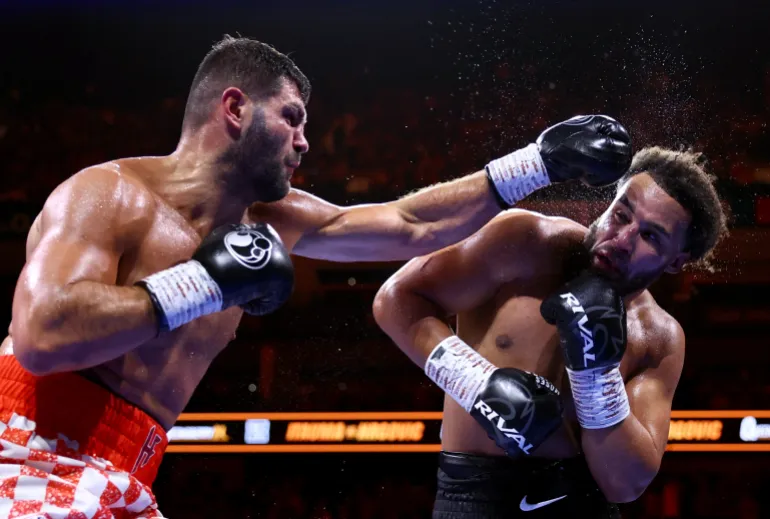
Former world heavyweight champion Anthony Joshua knocked out YouTuber-turned-boxer Jake Paul in their controversial Netflix-backed bout in Miami.
Two-time world champion Joshua made hard work of defeating his vastly less experienced opponent on Friday night, but finally made his superior size and power count in the later stages of the eight-round fight.
Recommended Stories
list of 4 itemsend of list
A mediocre contest at the Kaseya Center – with the two men reportedly splitting a mammoth purse of $184m – descended into farce at times, with Paul repeatedly dropping to the canvas and grappling at Joshua’s legs.
At one stage even referee Christopher Young appeared to be losing patience, warning the fighters in the fourth round: “The fans did not pay to see this crap.”
As Paul tired, Joshua finally began to land punches with more regularity and after knocking down the American twice in the fifth round the end came swiftly in the sixth.
Joshua backed the 28-year-old into a corner and after teeing up Paul with a crunching left, delivered the knockout blow with a right to the chin that sent his opponent crashing to the canvas.
“It wasn’t the best performance,” Joshua, 36, admitted afterwards. “But the end goal was to get Jake Paul, pin him down and hurt him.
“That was the request leading up, and that was on my mind. It took a bit longer than expected but the right hand finally found its destination.”
Joshua meanwhile praised Paul for lasting into the later rounds.
“I want to give him his props – he got up time and time again,” Joshua said. “It was difficult in there for him, but he kept on trying to find a way. It takes a real man to do that.”
Paul, meanwhile, his mouth bloodied from Joshua’s final assault, said he believed his jaw had been broken – but was satisfied with his performance.
“That was fun. I gave it my all,” Paul said. “I had a blast. I think my jaw is broken by the way. But Anthony’s one of the best to ever do it so. I’m gonna come back and get a world championship.
“I just got tired to be honest – like it was so much handling his weight. I think with better cardio I could have kept it up and kept on fighting. But he hits really hard.”
The bout was carried live to Netflix’s approximately 300 million subscribers.
Friday’s made-for-streaming contest, which came just over a year after Paul had fought a 58-year-old Mike Tyson in a much-derided Netflix fight, had triggered alarm across boxing given the disparity in size and experience between the two men.
Yet the devastating first or second round knockout by Joshua that most had predicted failed to materialise as Paul scrambled desperately to stay outside of the 2012 Olympic champion’s range.
Joshua, fighting for the first time in 15 months, always looked the more threatening fighter though, landing 48 of 146 punches thrown compared to Paul’s meagre total of 16 punches landed.
Favourite Anthony Joshua tips the scales more than 12 kilos heavier than YouTuber-turned-boxer Jake Paul at weigh-in.
Published On 19 Dec 202519 Dec 2025
Share
Former heavyweight world champion Anthony Joshua easily made weight ahead of his fight against social media boxing disruptor Jake Paul at Thursday’s official weigh-in in Miami.
Joshua, who under the rules of the fight, couldn’t weigh more than 245 pounds (111kg), tipped the scales at 243.4 pounds (110kg).
Recommended Stories
list of 4 itemsend of list
Joshua (28-4, 25 KOs), who usually fights in the heavyweight classification at about 250 pounds (11kg), was the lightest he has been since he dropped to 240 pounds (109kg) for his first heavyweight title fight against Oleksandr Usyk on September 25, 2021.
Paul (12-1, 7 KOs) weighed in at a bulky 216 pounds (98kg) – but still more than two stones, or 12.7 kilogrammes, less than the Briton, who is 13 centimetres taller at 1.98m (Six feet, six inches).
It was just the second time in his professional career that the American weighed in above his usual cruiserweight limit of 91kg, or 200 pounds.
Paul riles up the crowd at the weigh-in [Marco Bello/Reuters]
After the weigh-in, Paul, who excitedly took to the stage first and jeered up the crowd, claimed Joshua was nervous heading into the fight and said he would “shock the world” on Friday.
“I smell fear. I see something in his eyes, I truly do,” Paul said.
“The pressure is on him. I’m fighting free. I’ve already won. This is a lose-lose situation for him. I’ve got him right where I want him.”
Joshua, who remained composed throughout the weigh-in, other than when he pushed Paul’s fist away from his face and exclaimed “don’t touch me” during the promotional stare off, said his talent would prevail against the smaller, less experienced boxer.
“I’ll just outclass this kid. I’m a serious fighter. That’s the difference. I’m a serious, serious fighter,” the 2012 Olympic champion said.
The fight will take place at Miami’s Kaseya Center at 10:30pm on Friday (03:30 GMT Saturday).
The contest is an eight-round sanctioned bout with 10-ounce gloves to be used.
Joshua is returning to the ring for the first time since his knockout defeat to fellow Briton Daniel Dubois in September 2024.
In the weigh-in for the co-main event, holder Alycia Baumgardner came in at 129.2 pounds (58.6kg) while challenger Leila Beaudoin came in at 130 pounds (58.9kg) ahead of their unified junior lightweight title bout.
Baumgardner hasn’t been beaten since 2018 and is the strong favourite to retain her titles.
Alycia Baumgardner, left, and Leila Beaudoin face off during their ceremonial weigh-in ahead of their co-main event fight [Leonardo Fernandez/Getty Images via AFP]
Terence Crawford shook the boxing world on Tuesday by announcing his retirement, an unexpected decision that brings an end to one of the most dominant careers of the modern era.
At 38, the Omaha native decided to hang up his gloves at the top, undefeated and with a legacy that places him among the all-time greats.
Crawford bids farewell with a perfect record of 42 wins, 31 of them by knockout, after more than 17 years as a professional. With his unexpected retirement, Crawford leaves behind four titles in the 168-pound weight class.
“I’m retiring from competition, not because I’ve stopped fighting, but because I’ve won another kind of battle,” Crawford said in a YouTube video. “The battle where you retire on your own terms.”
Among the most decisive moments of his career was his victory over Errol Spence Jr., which established him as the undisputed welterweight champion, and the triumph that ultimately defined his legacy: his super middleweight victory over Saúl “Canelo” Álvarez.
In September, Crawford moved up a weight class to face the Mexican and defeated him by unanimous decision in Las Vegas. That fight against Álvarez not only confirmed his sporting greatness, but also led him to win the undisputed super welterweight championship, an achievement that few considered possible.
“Every boxer knows this moment will come, we just never know when,” Crawford said.
After that historic fight, speculation began about new challenges and a possible rematch, but Crawford chose a different path. In his farewell message, he made it clear that his decision was not due to a lack of physical or competitive ability, but rather to the conviction that he had pushed himself to the limit and had nothing left to prove in the ring.
“I’ve spent my whole life chasing something,” Crawford said. “Not belts, not money, not headlines. But that feeling, the feeling you get when the world doubts you, but you keep going and prove everyone wrong.”
Since his debut in 2008, he has built a career marked by versatility, tactical intelligence and an uncommon ability to adapt to any opponent and circumstance in the ring. Left-handed or right-handed as the fight demanded, his technical mastery was a constant throughout his career.
“I fought for my family. I fought for my city. I fought for the kid I used to be, the one who had nothing but a dream and a pair of gloves. And I did it my way. I gave this sport every last breath I had,” he said.
Over the years, Crawford won world titles in multiple divisions and established himself as one of the pound-for-pound greats of contemporary boxing.
His name went down in history when he became the undisputed champion in three different categories during the era of four belts, a feat that set him apart even among elite champions. With each weight class move, he faced skepticism and responded with compelling performances.
Bare-knuckle boxing bills itself as the “fastest-growing combat sport” having emerged from the shadows to host regulated and legal events in parts of the United States and many places across the world, with the first BKFC event in Britain at London’s Wembley Arena in 2022.
BKFC events in Britain, such as the one in Derby on Saturday, come under the remit of International Sport Karate and Kickboxing Association (ISKA) – a global body that regulates much of the mixed martial arts (MMA) events in Europe.
The British Boxing Board of Control (BBBC), which oversees the gloved form of the sport, is not involved.
Luke Griggs, chief executive of Headway, says the brain injury association he represents calls for all forms of boxing to be outlawed, but added that legitimising and promoting bare-knuckle fights is “irresponsible” and of “particular concern”.
“Headway has always been clear on its position on all forms of boxing – we think the risks are too great. It’s too obvious and all forms of boxing should be banned,” Griggs told BBC East Midlands Today.
“And it’s particularly concerning that bare-knuckle boxing is coming to the fore and increasing in popularity. It’s hugely dangerous and we do not believe this sort of event should be sanctioned.
“Irresponsible is a very good word. There are lots of questions that need to be asked about these fights being sanctioned, these fights being allowed to go on, to be promoted.”
Bakewell is BKFC’s figurehead in Britain and says his aim as a promoter – and the desire of those involved in the sanctioned strand of bare-knuckle fighting – want the sport to be seen at the “top end of pro combat sports”.
And he adds that events are “run accordingly” with the safety of its athletes paramount – with each fighter undergoing pre and post-fight health checks, while three doctors, two paramedics, two crewed ambulances are on-site for fight nights.
“We don’t cut any corners in terms of production or the medical care,” Bakewell said.
“We expect a lot from the fighters, but we also want to look after the fighters.”