Bowl

Letters to Sports: Back to the Rose Bowl for UCLA

p]:text-cms-story-body-color-text clearfix”>

Thank you, Ben Bolch. In your newsletter, an open letter to UCLA Chancellor Julio Frenk, you have asked all the right questions. On the surface, the proposed move to SoFi Stadium might make some sense. But in the real world, it sure doesn’t. I was at the game vs. Washington, and the sentiment was pretty strong against a move. Also, the word was that possibly 80% of season-ticket holders will not renew if they play in SoFi Stadium. Even though I have had season tickets for more than 40 years, if they do move, I will be part of that 80%. I wonder if that figure has been factored in?

Bruce Fischer
Huntington Beach

The Rose Bowl is the most storied stadium in college football. Nestled just below the San Gabriel Mountains, it is probably the most beautiful as well. It has hosted five Super Bowls (XI, XIV, XVII, XXI, XXVII), men’s and women’s World Cup finals, the Olympics and its annual namesake bowl game — “the Granddaddy of Them All.” There literally isn’t a bad seat in it. Why would UCLA even consider leaving it, especially for the glorified erector set known as SoFi Stadium?

Stephen A. Silver
San Francisco

Source link

UCLA fans at Rose Bowl conflicted over possible SoFi Stadium move

The nostalgia hit Ross Niederhaus in the grocery store as he stocked up for what might be his last Rose Bowl tailgate.

This has been nearly a lifelong tradition for the native of Linda Vista, starting in 2005 when he was 8 years old and UCLA romped over Oregon State. When he got his driver’s license in 2012, Niderhaus started throwing his own tailgates, bringing chicken-in-a-biscuit crackers because he couldn’t afford fancier fare.

He was back Saturday afternoon underneath a tent on the grass in Lot H, wearing his favorite No. 2 Eric McNeal jersey, possibly here for the last time as the Bruins contemplate whether they will remain at the place they have called home since 1982 or move to SoFi Stadium for the 2026 season.

“I wish we knew whether or not this was the last time,” Niederhaus said, “because if this was the last time for sure I could at least be saying my goodbyes to my favorite tradition. This is my favorite thing to do. My ashes are willed to be spread at the Rose Bowl.”

UCLA fan Ray Hoit sets up a tent while tailgating at the Rose Bowl before Saturday's game against Washington.

UCLA fan Ray Hoit sets up a tent while tailgating at the Rose Bowl before Saturday’s game against Washington.

(Eric Thayer / Los Angeles Times)

On the other side of the stadium, on the sprawling Brookside Golf Course, Nicholaus Iamaleava was prepping his pregame tailgate below four tents alongside his brother Matt, the siblings expecting about 60 family members to indulge in a potluck spread of burgers, hot dogs, wings, fries, hot links, sushi and fried rice.

Both brothers were hoping for more tailgates to come outside the century-old stadium. But just in case, they were preparing for the alternative.

“Today, we’re going to go in early,” said Nicholaus Iamaleava, the father of the UCLA starting quarterback by the same name. “Normally we go in right before kickoff but this time, we’re going to go in and soak it all in, man. It might be the last game, right, so we want to enjoy every bit of it and just hang out.”

Matt Iamaleava said he didn’t think moving to SoFi Stadium would solve the attendance issues plaguing the Bruins at their longtime home.

UCLA fan Nathan Nguyen sets up while tailgating outside the Rose Bowl on Saturday.

UCLA fan Nathan Nguyen sets up while tailgating outside the Rose Bowl on Saturday.

(Eric Thayer / Los Angeles Times)

“There’s nothing like playing at the Rose Bowl,” Iamaleava said. “Hopefully, it works itself out.”

Added Nicholaus Iamaleava: “We’re praying on it. That would be great.”

Nearly 6½ hours before UCLA’s kickoff against Washington, Jamie Hickcox-Baker and Dee Fitzgerald-Cardello lugged a table across the pavement in Lot K, having already unfurled a couple of folding chairs. The UCLA graduates were awaiting the arrival of a massive ice sculpture that would hold margaritas for their group of 25 friends.

“I’m very sad because I live in Altadena and so this is in my backyard and I just hate to see it leave,” Fitzgerald-Cardello said. “It’s just such a tradition. I’m very saddened by it.”

Even though she’s been making the drive from Fresno to tailgate at the Rose Bowl since 1993, Hickcox-Baker was less wistful about a possible move to SoFi Stadium.

UCLA fan Leki Manu throws a football outside the Rose Bowl before Saturday's game against Washington.

UCLA fan Leki Manu throws a football outside the Rose Bowl before Saturday’s game against Washington.

(Eric Thayer / Los Angeles Times)

“I kind of feel like we can talk tradition all we want,” Hickcox-Baker said, “but we left the Pac-12 and the Pac-12 is no longer, so if there’s no tradition in the Rose Bowl game anymore, think about how college football has evolved. I’ve been to a few games at SoFi, it’s a beautiful stadium. The last few years, because our team hasn’t been doing well, we’re stuck in that 100-degree temperature [at the Rose Bowl] and nobody’s coming to the games.”

Back in Lot H, the scene took on the feel of a state fair. The smell of burgers, brats and other grilled delicacies wafted through the air as children played football on the grass and a nearby patch of dirt. One kid kicked a football, commencing a mad scramble as a group of friends converged on the object of their delight.

“This is one of the reasons why people come now,” longtime fan John Anderson said, “is to be here with friends and be able to run around and throw a ball and stuff and if that can’t happen at SoFi, I think it will be a shame. So I don’t think they’re going to get the draw that they think they’re going to get — maybe a little bump for a couple of games and that’s it.”

UCLA fans tailgate before Saturday's game at the Rose Bowl between UCLA and Washington.

UCLA fans tailgate before Saturday’s game at the Rose Bowl between UCLA and Washington.

(Eric Thayer / Los Angeles Times)

Anderson said he missed one home UCLA football game over the last 16 years, and that was to attend a wedding. And if the Bruins move to SoFi?

“I’ll go to a game or two,” Anderson said. “It really depends on what the pricing looks like.”

Neiderhaus said he always would support the Bruins while conceding he might be in the minority.

“I’ll be there,” Niederhaus said, “but I know a lot of people that won’t — a lot of people I know who are season-ticket holders said they’re not coming back, which I think is a big issue that UCLA needs to be acknowledging throughout all of this. A lot of die-hards care about the Rose Bowl just as much as they care about Bruin football, so who knows” how attendance will go.

Source link

HBO revisits the Chicago Bears’ ‘Super Bowl Shuffle’ 40 years later

The Chicago Bears didn’t want to seem cocky.

They didn’t want to jinx themselves.

They certainly didn’t want to provide opponents with bulletin board fodder during their attempt to bring a Super Bowl championship to their home city after the 1985 season.

As a large group of players from that team — billed as the Chicago Bears Shufflin’ Crew — said in the lyrics to one of the most unlikely hit songs and music videos of the 1980s: “We’re not here to start no trouble. We’re just here to do ‘The Super Bowl Shuffle.’”

All of those thoughts weighed on the minds of the 30 or so players who recorded “The Super Bowl Shuffle” four decades ago this month, several weeks before the NFL regular season even ended.

“If we don’t go to the Super Bowl, we’re gonna be the biggest idiots ever,” former Bears linebacker and Pro Football Hall of Famer Mike Singletary says in “The Shuffle,” an NFL Films production presented by HBO Documentary Films. “We gotta win this thing, man.’”

Singletary is one of several of people who share their thoughts and memories about their participation in what has become a beloved relic during the 40-minute documentary that premieres Tuesday at 9 p.m. PST on HBO and streaming on HBO Max. Director Jeff Cameron told The Times that it’s no coincidence that “The Shuffle” is dropping during the 40th anniversary season of the Bears’ only Super Bowl title.

“Outside of some print media or some articles, no one had really chronicled the entire genesis, development and production of ‘The Super Bowl Shuffle,’ which is so intertwined with that team,“ Cameron said.

The song was the brainchild of Chicago businessman Dick Meyer, who had formed Red Label Records the previous year. With the Bears off to a strong start to the 1985 season, Meyer thought a hip-hop record featuring many of the already beloved personalities from that team might have some success in Chicago.

Many players agreed to participate after learning that part of the proceeds were going toward the Chicago Community Trust. “We’re not doin’ this because we’re greedy,” running back Walter Payton rapped during his verse, “the Bears are doin’ it to feed the needy.”

Other featured Bears players included Singletary, Gary Fencik, Willie Gault, Otis Wilson, Steve Fuller, Mike Richardson, Richard Dent, William “Refrigerator” Perry and Jim McMahon.

The vocal tracks were recorded on Nov. 21, 1985. The Bears were 11-0 at the time, coming off a 44-0 rout of the Dallas Cowboys. They continued to roll the following weekend with a 36-0 victory against the Atlanta Falcons.

But their run of perfection came to an end Dec. 2, 1985, with an ugly 38-24 loss to the Dolphins in Miami on “Monday Night Football.” It just so happened that the music video shoot for “The Super Bowl Shuffle” was scheduled for the next morning in Chicago.

Suddenly, Gault said in the documentary, “Guys don’t want to do the video.”

Two of the team’s biggest stars, Payton and McMahon, didn’t show up. They were added into the video after shooting their parts one day after practice.

“It was pretty audacious of us to talk about going to the Super Bowl, winning it, you know?” McMahon said in the documentary. “We still got games to play, and we just lost.”

Mike Singletary (left) and Gary Fencik wear their Bears uniforms and talk on the set of a video shoot

Chicago Bears players Mike Singletary (left) and Gary Fencik take part in the filming of ‘The Super Bowl Shuffle’ music video Dec. 3, 1985, at the Park West in Chicago.

(Paul Natkin / HBO / Getty Images)

But the video shoot may have had unexpected benefits for the players who participated.

“If not for ‘The Shuffle,’ they probably don’t even get together” that day, Cameron told The Times. “They probably don’t see each other until Wednesday because they have Tuesdays off after Monday night, and they’re right back in the film room or the practice field. They don’t properly get to just forget about the loss for a second, get together as a group of guys who like playing with each other and just who love each other.”

In behind-the-scenes footage provided to Cameron’s team by Meyer’s widow, Julia Meyer, the players are seen laughing and joking around as they attempt to learn a few dance moves and lip-sync their parts, all with varying degrees of success.

“We bonded in a way that we could never have bonded in any other way,” Singletary said in the documentary. “That was the fun part of working together in a totally different realm. There were guys that were backups teaching guys that were starters. We mixed in a way that we had never had a chance to do before. And it became a rallying point that brought us together, got us refocused. ‘This is what we said we were gonna do, let’s go get it done.’”

The Bears didn’t lose another game on their way to defeating the New England Patriots 46-10 in Super Bowl XX. And “The Super Bowl Shuffle” was a success in its own right, with popularity that extended well beyond Chicago.

The single spent nine weeks on the Billboard Hot 100, peaking at No. 41, and was certified gold by the Recording Industry Assn. of America (500,000 units moved). The music video, released commercially on VHS and Betamax, was certified platinum (one million units moved).

The song was even nominated for a Grammy in the category of “Best R&B Performance by a Duo or a Group with Vocals,” eventually losing to Prince and the Revolution for the song “Kiss.”

“I think it was the perfect marriage of that cast of characters from the top down … and the fact that, outside of the Miami game, of course, they just kept winning,” Cameron said. “And it wasn’t close. I think that certainly helps propel this video, along with the rise of MTV. It was a perfect storm of a pop cultural phenomenon.”

Source link

UCLA loses in blowout to Washington in possible Rose Bowl swan song

Somebody should check with SoFi Stadium to see if it rescinded its offer.

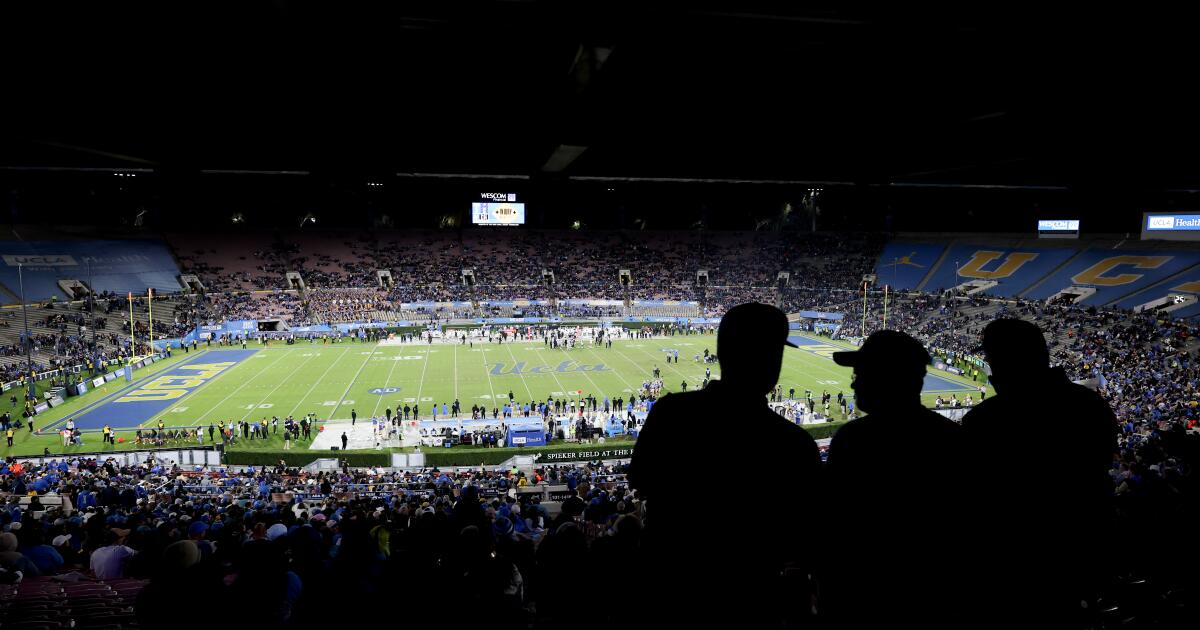
In what could have been UCLA’s last game at the Rose Bowl after 43 years of calling the place home, the Bruins unfurled the kind of showing that no one would ever want to relive or put in a scrapbook.

If this was goodbye, it was a sad sendoff.

There were lost fumbles, a laughably bad fake field goal that resulted in a touchdown for the other team and a dropped pass that probably cost UCLA its own score. And that was just in the first half.

Adding injury to insult, UCLA quarterback Nico Iamaleava took a crunching hit that sidelined him late in the third quarter, ending his gritty return from a concussion that had forced him to miss his team’s last game.

UCLA quarterback Nico Iamaleava passes in the first half against Washington on Saturday night.

UCLA quarterback Nico Iamaleava passes in the first half against Washington on Saturday night.

(Eric Thayer / Los Angeles Times)

There’s mercifully only one game left for the Bruins this season after a 48-14 loss to Washington on Saturday night led to a fast-emptying stadium, no fond farewells in store for the home fans amid an announced crowd of 38,201 that was too depleted by game’s end to boo.

The site of UCLA’s next home game remains as big of an unknown as its next head coach. School officials have said they are still contemplating plans for where the team will play in the future, though that decision could be up to a court to decide given the Bruins have nearly two decades left on a Rose Bowl lease that doesn’t expire until the summer of 2044.

It’s believed that if school officials have their way, they will move to SoFi Stadium in time for their 2026 season opener.

Wherever the Bruins play, they have a lot of improvements to make. They looked lethargic in falling behind by 34 points Saturday while making one mistake after another on the way to a fourth consecutive defeat.

By the time he entered the game, there was little backup quarterback Luke Duncan could do except make the final score slightly more palatable. He succeeded on that front, firing a 37-yard touchdown pass to Mikey Matthews late in the third quarter that helped UCLA (3-8 overall, 3-5 Big Ten) avoid a shutout.

There was another highlight for the Bruins early in the fourth quarter when Kanye Clark forced a fumble on Washington’s punt return, allowing Jamir Benjamin to pick up the ball and run 13 yards for a touchdown.

But make no mistake: This was complete domination by the Huskies (8-3, 5-3), who rolled up 426 yards of offense while holding the Bruins to 207 yards, including just 57 yards rushing.

Washington alumnus and comedian Joel McHale performed a short recorded bit that was shown on the scoreboard before the game, but the real slapstick was about to come.

The Bruins coughed up two fumbles in the first half and would have lost a third had the Huskies not been called for defensive holding on the play, nullifying the turnover.

UCLA quarterback Nico Iamaleava watches as Washington players celebrate a defensive touchdown in the first half Saturday.

UCLA quarterback Nico Iamaleava watches as Washington players celebrate a defensive touchdown in the first half Saturday.

(Eric Thayer / Los Angeles Times)

UCLA wide receiver Titus Mokiao-Atimalala dropped what could have been a touchdown pass at the Huskies’ 38-yard line with nothing but open field in front of him.

But there was no blunder quite like what happened when the Bruins lined up for a 46-yard field goal late in the second quarter. Holder Cash Peterman took the snap and flipped the ball over his shoulder as kicker Mateen Bhaghani circled behind him, the ball hitting the turf instead of Bhaghani’s hands.

Washington’s Alex McLaughlin picked up the ball and ran 59 yards for a touchdown that put the Huskies ahead, 20-0. It was the second straight game UCLA was held scoreless in the first half.

Things never got appreciably better, the Bruins left adrift without a haven in sight.

Source link

Letters: Rose Bowl or SoFi Stadium for UCLA? Split decision

p]:text-cms-story-body-color-text clearfix”>

I have to give it to Bill Plaschke when he’s right. UCLA moving to SoFi Stadium is about as smart as a typical UCLA coaching hire.

This month I was able to attend the Steelers-Chargers game at SoFi on a Sunday, followed the next Saturday by the USC-Iowa game at the Coliseum. Everything about those two places is different and only one of them feels like the college experience.

SoFi crams tailgaters in like sardines. There is no room to enjoy the experience.

The fresh air and scenery at the Rose Bowl are the best maybe in the country. People don’t show up at the Rose Bowl for a very simple reason: The program stinks. Not the venue. This proves the old adage, “the fish stinks from the head down.” Thousands of fans sat in the rain last weekend for a Trojans game because the product on the field was worth it. Simple.

Jeff Heister
Chatsworth

Who can blame UCLA for wanting to play at SoFi Stadium, the ultra-modern sports palace, not to mention great recruiting tool, a mere 15 minutes from campus? As Bill Plaschke waxes nostalgic, the rest of us slog down the 10 Freeway from Westwood, through downtown, up into the far northeast corner of L.A., to the antiquated monument that is the Rose Bowl.

Afterward, those of us sitting on the east side of the stadium, staring into the setting sun until the fourth quarter, stumble with burned-out retinas to the muddy golf course that they call a parking lot, to wait in our stack-parked cars, until everyone else is out, so we can leave, an hours-long ordeal just to get home. My only question is, what genius at UCLA signed a long-term contract to play at a place that was obsolete long before the ink dried?

Art Peck
View Park

UCLA will pay attorneys millions of dollars endeavoring to extricate the university from the ironclad Rose Bowl lease it pledged to honor. Beyond those fees, they’ll pay tens of millions more to Pasadena in order to get out of the deal.

If UCLA takes those same many millions, invests in a top-tier coach, enhances its football programs and facilities, and fills their NIL coffer, that should lead to a winning, sustainable program that brings more fans to the games. Rose Bowl revenue goes up.

Pasadena may get a one-time windfall, but over time without an anchor tenant, revenue will shrink and the stadium’s luster will fade.

Where are the sensible, honorable folks who possess the smarts and the backbone to craft a fair deal?

David Griffin
Westwood

UCLA likely leaving the historic Rose Bowl, home of a million team memories and successes, for the sterile confines of SoFi Stadium is abhorrent to any longtime Bruin fan. Terry Donahue, you have our sincerest apologies.

Jack Wolf
Westwood

Source link

Should they stay or go? UCLA greats weigh in on the Rose Bowl debate

Those who want to stay at the Rose Bowl describe the place as iconic, an ode to everything that’s great about college football. They say it oozes history and tradition. Just the sight of the glowing neon sign is enough to give them goosebumps.

Those who want to go call the place a dump. They say it’s old and decaying by the day, a shell of its former greatness. Why hold on so hard when a futuristic stadium in Inglewood could provide not only a home closer to campus but also an infusion of cash as part of a more favorable lease?

Going into what could be UCLA’s last home game ever at its century-old stadium Saturday night, some with deep ties to the school say they understand each of the dueling perspectives in the debate over a possible move to SoFi Stadium.

“The concern is, are you gonna lose part of your identity, which has been in peril lately already?” said Kris Farris, a former All-America offensive tackle with the Bruins who was among the more than half-dozen former greats and current recruits who spoke with The Times about the situation. “So it’s like you’re taking away another special part of UCLA, but of course everyone understands the upside financially and what the program needs to do in the arms race of college football right now.”

Officially, nothing has been decided. School officials have released two statements in recent weeks, both acknowledging the uncertainty of the situation. It’s believed that if UCLA decided to make a move to SoFi Stadium, the Bruins would want to do so before the 2026 season.

But the courts could have the final say. The Rose Bowl Operating Co. and the City of Pasadena have commenced a legal battle with hopes of forcing the team to stay. Having called the stadium home since moving in before the 1982 season under legendary coach Terry Donahue, UCLA committed to a lease that doesn’t expire until the summer of 2044.

“I just really feel if Terry was here, I think he’d say, ‘What’s the hurry?’ ” said Pat Donahue, one of the late coach’s brothers. “You have a lease, why don’t you underwrite what the issues are and if you feel you made a bad deal, go renegotiate. You know, I just don’t know what the hurry is and it seems to me that UCLA has a lot bigger football problems than the Rose Bowl, right? I mean, the building’s on fire and you wanna remodel the garden.”

Only one thing seems certain: UCLA will not play home games on campus, as so many have proposed over the years. A movement to build a football stadium on the spot now occupied by Drake Stadium died in 1965 amid opposition from students, political leaders and local homeowners. Not only did the University of California regents rebuff the stadium bid, they also decreed that no structure built on the Drake Stadium footprint could later be enlarged into a football stadium.

Thus the current dilemma. Does UCLA keep its word and fulfill a Rose Bowl lease in which it loses millions of dollars annually in opportunity costs because it does not take in suite or sponsorship revenue? Or do the Bruins head to SoFi Stadium for a new beginning flush with cash, if not tradition?

“In the long term, if you look at the UCLA program, SoFi makes a whole lot more sense whether you like it or not,” said former Bruins quarterback Gary Beban, who led the team to an upset of top-ranked Michigan State in the 1966 Rose Bowl and won the school’s only Heisman Trophy in 1967.

Beban played for UCLA teams that called the Coliseum home, long before the Bruins moved to the Rose Bowl. He said initially wasn’t a supporter of UCLA playing in Pasadena because of a 26.2-mile commute from campus, acknowledging the issue seemed to be largely offset by wild early success the team enjoyed while appearing in five Rose Bowl games between 1983 and 1999.

With the Bruins stuck in a decadelong funk, making that long commute has become more burdensome, leading to dwindling attendance at a stadium that’s roughly twice the distance from UCLA than SoFi Stadium.

“It’s a convenience issue for the people at the campus and over a longer period of time,” Beban said, “I think eventually SoFi just makes more sense than the Rose Bowl. … Right now, this is being looked at at a time when the program needs a lot of fresh air. Regardless of how big of a supporter you are, there are a list of things that need to be advanced and this is just one of them. Maybe it’s time to start all over in all directions and try to get going in the right direction.”

One of Beban’s teammates favors holding on more tightly to the past. Jim Colletto, co-captain of the 1966 Rose Bowl champions, said standing on that field makes one feel like he’s playing or coaching with the ghosts of legends.

Before his return to the Rose Bowl as UCLA’s offensive line coach in 2006, Colletto walked to the two-yard line, where former teammate Bob Stiles had made a goal-line stand 40 years earlier by stopping Michigan State fullback Bob Apisa on a potential game-tying two-point conversion.

“I closed my eyes,” Colletto said, “and it all came alive again.”

Which stadium do possible future UCLA players want to call home?

Kenneth Moore III, a wide receiver from St. Mary’s High in Stockton who has verbally committed to the Bruins, said he’d prefer to play at SoFi Stadium. As far as he’s concerned, the stadium that opened in 2020 is closer to campus and would create a better environment than the team has experienced at the Rose Bowl, where it’s averaging only 37,099 fans this season.

“I feel it’ll be more involvement from the fans after going to SoFi,” Moore said, “to have more packed-out stands.”

Cooper Javorsky has remained a constant presence at the Rose Bowl even after decommitting from UCLA in the wake of coach DeShaun Foster’s dismissal. The offensive lineman from San Juan Hills High who is still considering the Bruins has developed an affinity for the place based on his many weekends spent on the sideline watching games.

“I don’t think I’m really in a position to have an opinion,” Javorsky said, “but who wouldn’t think it’s cool to run out at the Rose Bowl on a Saturday?”

One widespread lament is the possible loss of unfettered tailgating on a sprawling golf course and surrounding parking lots. Farris said throwing a football on the grass and cooking food in an open space was the part of the gameday experience that his kids looked forward to most when they were younger.

“At SoFi, just having attended some professional games there, they just don’t have the tailgating experience,” Farris said. “The tailgating at the Rose Bowl is special, it’s unique. You know, it’s not a paved parking lot with a small little stall.”

Hearing that UCLA’s game against Washington on Saturday could be the team’s last one inside the stadium he once called home has motivated Farris to make the drive from Orange County. It could represent one final memory for someone who was part of the last Bruins team to play in a Rose Bowl game.

“There’s nothing like it,” Farris said of the place. “I’ve played in a lot of different stadiums and obviously the backdrop and the size and scale of the Rose Bowl, the history of the Rose Bowl, the energy coming from the fans and just the history in that building and to be able to call it your home as a program and that’s your home field and being able to dominate in that time like we were able to do as a team, I wouldn’t trade that for the world.”

Nearly everyone who weighed in the stadium debate agreed that winning would solve many of UCLA’s problems regardless of where it played, drawing more fans and revenue. But Dave Ball, a former Bruins All-America defensive end, said there was a caveat that should be attached to that sentiment.

“Yes, winning solves everything,” Ball said, “but it’s like to me, the resources are the thing, especially now, that are going to promote winning. It’s like, man, you need to have the players and to have the players you need big budgets and an environment that is like swooning over the kids and Ohio State has that, Alabama has that, a lot of the SEC schools have that, and so a great coach who starts to get the program going will instill more excitement and more money, but you do need a lot of the budget and the resources to get that top-tier coach and those top-tier athletes.

“This thing is a game of moving onto the next and what matters to everybody is, do you win football games, championships, bowl games or not?”

Source link

Shame on UCLA for trying to ditch iconic Rose Bowl for cash grab

On the drive up to the Rose Bowl’s front door, underneath the legendary glowing sign, toward the picturesque purple mountains, there stands the most impactful symbol of the school that plays there.

It is a statue of Jackie Robinson in a UCLA football uniform.

He is cradling the ball in his left hand and warding off impending tacklers with his right, a striking bronze symbol of a university’s resilience and strength. The most formidable figure in American sports history is standing where he grew up, where his team lives and where he forever will embody the epitome of the gutty Bruin.

Nobody represents the mission of UCLA more than Jackie Robinson.

UCLA fans cheer during the game against Penn State at the Rose Bowl on Oct. 4.

UCLA fans cheer during the game against Penn State at the Rose Bowl on Oct. 4.

(Gina Ferazzi/Los Angeles Times)

Nothing is more disgusting than the thought of UCLA leaving him in the dust.

The Bruins are trying to flee the Rose Bowl, did you hear? They’re trying to break a long-term lease and leave Pasadena on the next thing smokin’. Oh yeah, they’re all but gone, it’s all there in lawsuits and court filings and mounds of legal stuff that mask the real message.

UCLA values a quick buck over enduring integrity, fast cash over deep tradition and dollars over die-hards.

The Bruins want to leave the most storied stadium in America, a place where they have played for 43 years, a living monument to Bruins icons, a tailgating paradise with a postcard backdrop … for the shiny toy that is SoFi Stadium, an amazing professional football palace that has no business being the permanent home of a college football team.

This is no knock on SoFi. It’s Super Bowl cool. But it’s an NFL stadium with NFL vibes. It doesn’t work for a struggling university program that would be a third tenant viewed as a last resort.

The Bruins don’t want to move there for tradition. When it comes to college football, SoFi has none. UCLA played there once in a bowl game that drew what appeared to be a handful of fans, the quaint gathering dwarfed by the space-age surroundings.

They don’t want to go there for the increased convenience. There is none. You can’t sell me that 14 fewer miles going south on the 405 on a Saturday afternoon would be noticeably quicker than a longer trek going east on the 134. Especially if there also are events happening at the SoFi-adjacent Forum and Intuit Dome.

They don’t want to go for the game-day experience. There is none. They would be sacrificing lush Brookside tailgating for scarce parking lot tailgating, robbing UCLA fans of their one guaranteed victory every game.

Yes, SoFi has much better seats and bathrooms and amenities but, no, the Bruins want to go for one reason only, and we’ve known what that is from the moment they admitted their athletic department was in financial ruin.

UCLA offensive coordinator Jerry Neuheisel walks back to the sidelines after a timeout at the Rose Bowl.

UCLA offensive coordinator Jerry Neuheisel walks back to the sidelines after a timeout during a game against Nebraska at the Rose Bowl on Nov. 8.

(Gina Ferazzi/Los Angeles Times)

This is all about the money. UCLA long ago agreed to a lousy deal with the Rose Bowl from the outset — the school apparently sign leases like it hires football coaches — and thus the Bruins don’t receive any cut of suite or sponsorship deals, and get just a fraction of merchandise and parking. Some estimate they can make a few multiples of their current revenue by moving to SoFi, and that’s certainly a legitimate motivation, but it’s also the easy way out.

You know how else they could make more money? Win more football games! Did anybody think of that?

Since Terry Donahue retired in 1995, the UCLA football program frequently has dumped a steaming pile of garbage on Pasadena’s prettiest doorstep, and the poor decisions by the athletic department finally are catching up to it.

They’ve had losing records in seven of the last 10 years. They’ve gone through five coaches and endured countless disappointments. Not surprisingly, increasingly fewer fans want to devote their Saturdays to cheering for a team that too often finds itself plopping into a Brookside bunker.

The Bruins’ five worst attendance figures have come in the last five seasons not interrupted by COVID-19. They’ve ranked around the bottom of Big Ten attendance, and the hole just keeps getting deeper.

They’re averaging 37,099 this season entering the Saturday night’s home finale against Washington, a pace which would set the record for the lowest UCLA season attendance at the Rose Bowl.

And all this is the Rose Bowl’s fault? Not since Roy “Wrong Way” Riegels has someone in the Arroyo Seco been so misguided.

The City of Pasadena and the Rose Bowl Operating Co. have lived up to their part of the lease, which still has 19 years remaining on it. Pasadena officials say taxpayers have invested more than $150 million in stadium renovations and they’re ready to write a check on an additional $130 million for improvements.

It shows. The Terry Donahue Pavilion is magnificent. The grounds are pristine. There are plans for a cool field club beyond the south end zone.

The Rose Bowl folks have done everything they agreed to do. That UCLA still is trying to walk out the front door smacks of an entitled, oafish spouse who demands their significant other improve themselves, then leaves anyway.

I’ve been covering UCLA games at the Rose Bowl for nearly 40 years, and I can confirm there’s no better place to watch college football in this country. It’s the Augusta National of football stadiums, a place where they should hold the national championship every year, with its breathtaking skyline and deep green surroundings and that crisp fall breeze that sneaks through the Arroyo Seco like an old friend reminding you of home.

UCLA tailback Derrick Williams celebrates with a cheerleader's megaphone after defeating the USC at the Rose Bowl.

UCLA tailback Derrick Williams celebrates with a cheerleader’s megaphone after defeating the USC 13-9 at the Rose Bowl on Dec. 2, 2006.

(Stephen Dunn / Getty Images)

No, it’s not on UCLA’s campus, but there’s no more room, that ship has sailed. And, no, UCLA doesn’t make an appropriate amount of money in the deal, but the school signed the lease, and those lost dollars can appear in other ways.

By playing at the Rose Bowl, the Bruins are paid in majestic beauty, timeless tradition and a sense of family that their alumni and fans can’t get anywhere else.

I was on the sidelines in the final seconds on that first Saturday in December 2006 for quite possibly UCLA’s greatest Rose Bowl moment. You remember. How could you forget?

The John David Booty drive, the Eric McNeal interception, the stunning 13-9 UCLA victory that denied USC a spot in the national championship game while giving the Bruins their only win over the Trojans in a 13-year span.

What stays with me from that afternoon is the deafening noise that seemed to fill every corner of Pasadena before morphing into arguably the loudest Eight Clap in Bruins history.

“U-C-L-A! Fight! Fight! Fight!”

The Rose Bowl was magical that day. Shame on UCLA for not believing it still can be.

Source link

Spurned Trump turns the annual Super Bowl celebration into a culture war skirmish

It was classic Donald Trump: The president, angry and embarrassed that most Philadelphia Eagles players planned to boycott the traditional White House victory celebration for Super Bowl champs, dramatically lashed back with his own punishing spin.

Not only did Trump disinvite the entire team late Monday, but he transformed the celebration on Tuesday to dramatically inflame the culture war he ignited two years ago — casting the mostly African American players as unpatriotic and ignoring their protests both of police brutality and of Trump’s perceived divisiveness.

The president, in an early morning Twitter statement, said the White House would hold an alternative celebration of patriotism for the fans, “where we will proudly be playing the National Anthem and other wonderful music.”

“NFL, no escaping to the Locker Rooms!” Trump added, referring to the league owners’ new policy of requiring players to stand for the pregame playing of the national anthem or stay off the field. Though that policy is largely viewed as a response to the president’s pressure, Trump made plain that he was not satisfied; he’s called in the past for owners to force players to stand or be fired.

Later, at the fete on the South Lawn with military bands at the ready, Trump briefly opened the program before an audience that seemed to have fewer than the promised 1,000 Eagles fans, bolstered by a number of administration aides.

“I want to use this opportunity to explain why young Americans stand for the national anthem,” Trump said. “Maybe it’s about time that we understand. We stand to honor our military, and to honor our country and to remember the fallen heroes who never made it back home.”

The president’s reaction this week was more dramatic than his response to a similar snub last year by the 2017 National Basketball Assn. champion Golden State Warriors. That reflects not only his long-running fight with professional football players about the flag and the anthem, but also renewed tensions between Trump and the National Football League that date to the 1980s. Trump failed then both in acquiring an NFL team and in challenging the NFL commercially as a prominent owner in a new, rival sports league, the USFL, which subsequently folded.

Since the campaign, Trump has often used the NFL player protests to rally his supporters and distract from other controversies. Polls show a plurality of Americans, and large majorities of whites and Republicans, do not support the player protests.

As Trump was attacking the Eagles, a variety of other controversies swirled and vied for attention.

Former campaign chairman Paul Manafort was accused by federal prosecutors of witness tampering in his tax and money-laundering case. Trump’s press secretary and lawyer were under fire for falsely saying Trump did not dictate the misleading statement last year about a meeting that Trump’s son, son-in-law and Manafort had with a Russian lawyer promising “dirt” on rival Hillary Clinton during the 2016 campaign.

Trump himself faced new questions after his tweet Monday that he had the “absolute right to PARDON myself.” And he was being assailed for ignoring a new study estimating that about 4,600 Americans died from the hurricanes last year in Puerto Rico, not 16 or 17 as he’d said in the past.

The Eagles’ snub presented yet another controversy, but one Trump sought to turn to advantage.

“These cultural issues that stir controversy, they’re winners for the president,” said one Trump ally who speaks with the president and his top aides regularly and requested anonymity.

No Eagles players knelt in protest during the 2017 season. Torrey Smith, a former Eagles player, tweeted, “The President continues to spread the false narrative that players are anti-military.”

Many pro athletes on championship teams, especially African Americans, have been conflicted about White House visits during the Trump presidency, or simply stayed away. The Warriors had their invitation for a visit with Trump rescinded after publicly equivocating about attending.

LeBron James of the NBA’s Cleveland Cavaliers, arguably the league’s most influential player, told reporters on Tuesday that “no matter who wins” the NBA Finals now underway between the Cavs and the Warriors, “no one wants to go anyway” to the White House. Warriors star guard Stephen Curry agreed.

Trump, on Twitter, noted that he’d hosted celebrations at the White House for other professional and college teams and sports, including NASCAR, the Chicago Cubs, Houston Astros, Pittsburgh Penguins, New England Patriots, the University of Alabama and Clemson University.

Trump decided late Monday, less than 24 hours before the planned Super Bowl tribute, to instead make it “a celebration of the American flag,” as White House Press Secretary Sarah Huckabee Sanders called it in a statement Tuesday. Fewer than 10 players out of more than 70 who were eligible had been expected to attend, according to the Philadelphia Inquirer.

Sanders blamed the Eagles for botching the visit. She said 81 people from the team — including employees, coaches, managers and players — had accepted invitations to come, along with 1,000 fans. With only a small number of players expected, the team tried Friday to reschedule the event, Sanders said, to a time when Trump planned to be overseas.

The White House said that “despite sensing a lack of good faith” on the Eagles’ part, it tried to work with the team “to change the event format that could accommodate a smaller group of players.”

“Unfortunately, the Eagles offered to send only a tiny handful of representatives, while making clear that the great majority of players would not attend the event, despite planning to be in D.C. today,” she said. “In other words, the vast majority of the Eagles team decided to abandon their fans.”

In a statement, the NFL Players Assn. said it was “disappointed” with Trump’s decision to disinvite the team, adding that it led to the cancellation of several “player-led community service events for young people in the Washington, D.C., area.”

“The NFL players love their country, support our troops, give back to their communities and strive to make America a better place,” the union said.

The Eagles ownership released a statement Monday night that did not mention Trump or the canceled visit, calling it “an inspiration” to watch “the entire Eagles community come together.”

Individual players showed more frustration. The team’s star tight end, Zach Ertz, tweeted angrily after Fox News, Trump’s media ally, used file footage of Eagles players kneeling in prayer to falsely suggest they were kneeling in protest during the anthem.

“This can’t be serious,” Ertz wrote. “Praying before games with my teammates, well before the anthem, is being used for your propaganda?! Just sad, I feel like you guys should have to be better than this.”

Fox News issued a rare correction on Twitter.

Some of Pennsylvania’s Democratic lawmakers also weighed in. Sen. Bob Casey wrote on Twitter, “I’m skipping this political stunt at the White House and just invited the Eagles to Congress.”

Follow the latest news of the Trump administration on Essential Washington »

[email protected] | Twitter: @noahbierman

Special correspondents Eli Stokols and Eliza Fawcett contributed to this report.


UPDATES:

2:35 p.m.: This article was updated with details of White House celebration.

This article was originally published at 12:15 p.m.


Source link

Court denies Rose Bowl restraining order pausing UCLA move

A Los Angeles County Superior Court judge on Wednesday denied a request from the Rose Bowl Operating Co. and the City of Pasadena seeking a temporary restraining order in their attempt to keep UCLA football games at the Rose Bowl, saying those entities had not demonstrated an emergency that would necessitate such an action.

Judge James C. Chalfant said previous cases in which the New York Yankees, New York Jets and Minnesota Twins were barred from moving games did not apply to this situation because those teams were scheduled to play in a matter of days or weeks and UCLA’s next scheduled game at the Rose Bowl after its home season finale against Washington on Nov. 22 isn’t until the fall of 2026.

The judge also said there was no indication that the Rose Bowl or Pasadena would suffer imminent financial harm because a contract to construct a field-level club in one end zone had not been signed.

The legal saga is far from over. Chalfant suggested the plaintiffs’ attorneys seek discovery information regarding the school’s discussions with SoFi Stadium and file a motion for a preliminary injunction.

Nima Mohebbi, an attorney representing the Rose Bowl Operating Co. and the City of Pasadena, said he had filed a public records request in an attempt to gather information about those discussions and was pleased with the judge’s statements.

“Even though he found that there was no immediate emergency,” Mohebbi said, “he made very clear in a lot of his statements that there’s irreparable harm, that UCLA has an obligation to play at the Rose Bowl through 2044 and we’re very confident in our facts of this case. So I think all in, we feel very, very good.”

After the hearing ended, Mary Osako, vice chancellor of strategic communications, said in a statement that “the court’s ruling speaks for itself. As we have said, while we continue to evaluate the long-term arrangement or UCLA football home games, no decision has been made.”

UCLA has played its home football games at the Rose Bowl since 1982. In 2014, Janet Napolitano, president of the University of California system, signed a long-term lease amendment that did not include an opt-out clause in exchange for the stadium committing to make nearly $200 million in improvements through the issue of public bonds. When the judge asked attorneys representing UCLA if they intended to terminate the agreement, they shook their heads in denial.

But Mohebbi accused UCLA of participating in a shell game in which it had furtively explored options for moving to SoFi Stadium.

“What they really want is to have a back-room discussion where they can offer some certain amount of money and pay the city off without having to account for this publicly,” Mohebbi said. “… UCLA has not only attempted to terminate [the contract], they have indicated in no uncertain terms that they are terminating.”

After Jordan McCrary, an attorney representing UCLA, contended that his counterparts in the dispute refused to engage with the school in resolution discussions, Mohebbi said, “there’s nothing to talk about. They have an obligation — we’re not negotiating a way out of this agreement.”

McCrary disputed Mohebbi’s contention that UCLA attorneys had signaled an intention to leave the Rose Bowl through direct conversations between counsel, saying “we believe they were settlement negotiations and we don’t believe they’re admissible” in future court proceedings.

When a UCLA attorney contended during the roughly 80-minute court session that the school’s relationship with the Rose Bowl was breaking down, Chalfant said, “I don’t know why UCLA can’t just show up and play football at the Rose Bowl. You don’t need to talk to them at all.”

Chalfant said he did not agree with the UCLA attorneys’ contention that the Rose Bowl lease amounted to a personal services contract for which specific performance — essentially an order compelling the Bruins to remain tenants — was not available. The judge said specific performance could be available in a situation involving an actual breach or an anticipatory breach of the contract.

Rose Bowl officials have filed litigation intended to compel the Bruins to honor a lease that runs through the 2043 season, saying that monetary damages would not be enough to offset the loss of their anchor tenant.

They are also seeking to prevent the case from being settled through arbitration.

“I know UCLA really wants to have this out of the public sphere,” Mohebbi said, “but the reality is this is a public interest case and there are issues here that absolutely require this case to be in a public forum.

“We’re talking about two public entities. This is not the Rams, or this is not the Lakers. This is a public institution playing with public money going up against another public institution that relies on this other public institution to protect its own taxpayers from dipping into the general fund that goes to things like police services, fire services. I mean, God forbid there’s a fire like the Eaton fire this last year that we’re not going to be able to even cover the bond payments through the general reserves.”

Source link

Rose Bowl files restraining order to block UCLA move to SoFi Stadium

The City of Pasadena and the Rose Bowl Operating Co. requested a preliminary injunction and temporary restraining order Monday in Los Angeles County Superior Court seeking to prevent UCLA from leaving the Rose Bowl or terminating its stadium lease until pending litigation against the school is resolved.

The filing contends that the plaintiffs would suffer “immediate and irreparable harm if the status quo is not preserved during the pendency of this lawsuit.” A hearing has tentatively been scheduled for Wednesday morning.

Last week, the plaintiffs sued to force the Bruins to honor the terms of the lease that requires them to stay at the Rose Bowl through the end of the 2043 season.

UCLA responded in a statement that it was still evaluating options for its football home, though someone familiar with the university’s thinking on the matter later confirmed to The Times that if the Bruins decided to leave for SoFi Stadium, they would want to do so for the 2026 season.

In their Monday filing, the plaintiffs contended that: “there is no way to sugarcoat it: UCLA has confirmed its imminent departure, severely destabilizing Plaintiffs’ core operations. Those operations are structured around and contingent upon UCLA. Without confirmation that UCLA intends to honor its contractual commitments — at least during the pendency of this litigation — Plaintiffs are deprived of the ability to plan and manage the stadium’s schedule and their ongoing business operations, including cultivating and securing future business partners and opportunities, retaining personnel, and maintaining confidence among the many vendors and sponsors who rely on UCLA Football.

“Equally troubling is the precedent UCLA is setting. Stadium and arena public-private partnerships, and the financing that makes them possible, turn on enforceable, long-term contracts, with terms that typically follow the public debt incurred. UCLA’s attempt to break its contract decades early critically undermines these structures.”

Source link

L.A. restaurants to order Thanksgiving takeout from this year

For Los Angeles, it’s been a year of triumphs, trials and everything in between. From devastating wildfires to ICE raids that shook our immigrant communities, the city has weathered plenty. Still, L.A. found moments to rally (hello, Dodgers World Series win) that gave us all something to cheer for again.

Thanksgiving is a time to hold onto those small victories and give thanks for the bright spots amid the chaos. But if you won’t be brining a turkey or mashing a bowl of potatoes yourself, there are options.

Thankfully, restaurants across the city are stepping up with take-home feasts. Yes, there are the traditional roast turkeys and glazed hams, but also Caribbean jerk turkey legs, Chinese-inspired chicken ballotines, Indian biryanis, lamb Wellingtons and more.

Whether you’re hosting a big family gathering or keeping things intimate, check out these 26 spots designed to bring comfort, flavor and a little local pride to your Thanksgiving table.

Source link

Rams show flashes of Super Bowl potential in win over Saints

Don’t start planning any parades just yet. Hold off on those February plans to travel to Santa Clara.

The Rams still have a long way to go make the playoffs and try to advance to the Super Bowl at Levi’s Stadium.

Their 34-10 victory Sunday over the struggling New Orleans Saints at SoFi Stadium was no revelation or landmark win. But the Rams did something important. Something championship-caliber teams are supposed to do: They convincingly dispatched of a weaker opponent before 72,055.

Matthew Stafford passed for four touchdowns, receiver Puka Nacua returned from an ankle injury in spectacular fashion, and the defense dominated again as the Rams won their third game in a row, improved to 6-2 and showed that the Dodgers might not be the only L.A. team hoisting a championship trophy.

“We’ll see if we can continue to do some good stuff like they did,” coach Sean McVay said of the World Series champions.

The Rams’ victory put them atop the NFC West heading into next Sunday’s game against the San Francisco 49ers at Levi’s Stadium.

“I like the fact that we’re getting better,” McVay said, adding, “There’s just a good vibe.”

On most fronts, anyway.

The Rams’ first victory over an NFC opponent did not come against the defending Super Bowl-champion Philadelphia Eagles or the rival 49ers, teams the Rams lost to in part because of kicking-game disasters.

Rams coach Sean McVay watches from the sideline during the first half Sunday against the Saints.

Rams coach Sean McVay watches from the sideline during the first half Sunday against the Saints.

(Allen J. Schaben / Los Angeles Times)

And those issues remain: Joshua Karty missed a field goal and an extra point.

So McVay’s patience with the kicking game is wearing thin. And no team will win a title without a competent one.

McVay once again said he had confidence in Karty, but that was after he said “it can’t continue like this … it’s gone on for too long,” and “it’s not getting better,” among other things.

Can the Rams be a championship team without an adequate placekicking unit?

“No,” McVay said. “It’s going to cost us — it’s cost us already. It’s been a momentum killer. … The harsh truth of it is this is not sustainable.”

But if the Rams solve the kicking issue and stay healthy — Nacua said he would play against the 49ers after leaving the game in the second half because of a chest injury — and McVay can keep his team focused against division opponents and other playoff contenders, the Rams might earn their own parade.

Stafford is positioning himself to lead one.

Already a fixture on NFL career passing lists, the 17th-year pro is enjoying another sensational season.

As he did in 2021, when he passed for 41 touchdowns and led the Rams to a Super Bowl title, Stafford is playing at a level that should have him in the most-valuable-player discussion.

Rams quarterback Matthew Stafford passes in front of Saints defensive end Cameron Jordan during the first quarter Sunday.

Rams quarterback Matthew Stafford passes in front of Saints defensive end Cameron Jordan during the first quarter Sunday.

(Allen J. Schaben / Los Angeles Times)

On Sunday his two touchdown passes to Davante Adams and one each to Nacua and tight end Tyler Higbee increased Stafford’s season total to 21, with only two interceptions.

Stafford, who passed for five touchdowns in an Oct. 19 rout of the Jacksonville Jaguars, completed 24 of 32 passes for 281 yards and extended to five his streak of games without an interception.

Stafford’s wife and their daughters attended the game wearing No. 22 Dodgers jerseys, a salute to retiring pitcher Clayton Kershaw, Stafford’s high school teammate.

Now Stafford is chasing a second Super Bowl title.

“It’s not like we’ve got it all figured out,” he said, adding, “Got to keep continuing to find ways to put more points on the board.”

Nacua sat out against the Jaguars because of an ankle injury. But he said in the days leading up to the game that he was “feeling fantastic.”

Rams wide receiver Puka Nacua, left, celebrates with wide receiver Davante Adams.

Rams wide receiver Puka Nacua, left, celebrates with wide receiver Davante Adams after catching a touchdown pass in the second quarter Sunday against the Saints.

(Allen J. Schaben / Los Angeles Times)

He looked like it at the outset, making two catches for first downs to start a drive that ended with Stafford’s touchdown pass to Higbee. The veteran tight end, in an apparent salute to the Dodgers, celebrated by taking an imaginary swing and then doing their post-hit celebration.

Adams then followed his breakout three-touchdown performance against the Jaguars with the first of two more red-zone touchdowns. The 12th-year pro is tied for eighth all time with 111 touchdown catches.

Early in the second quarter, Stafford and Nacua went for the home run, connecting on a 39-yard pass that Nacua hauled in for a touchdown and a 20-3 lead.

Stafford’s short strike to Adams in the third quarter put the game out of reach, and Kyren Williams’ short touchdown run early in the fourth quarter provided the finishing touch.

Williams rushed for 114 yards and Blake Corum ran for 58 on a day when the Rams once again utilized all four tight ends in the pass and run attacks.

Meanwhile, the Rams defense made it rough on Saints rookie quarterback Tyler Shough in his first start.

Several Rams defensive players tackle Saints quarterback Tyler Shough.

Several Rams defensive players tackle Saints quarterback Tyler Shough in the second quarter of the Rams’ 34-10 win Sunday at SoFi Stadium.

(Allen J. Schaben / Los Angeles Times)

Lineman Braden Fiske got his first sack of the season, linebacker Nate Landman forced another fumble, and cornerback Emmanuel Forbes Jr. intercepted his first pass as a Ram.

“We’re growing at a great rate,” Landman said, “and we’re going to peak at the right time.”

The game against the Saints was the start of a stretch that includes two home games after the 49ers. Only two remaining nine games — a late November trip to play the Carolina Panthers and a late December trip to play the Atlanta Falcons — will require the Rams to travel farther east than Arizona.

A lot can happen between now and the start of the playoffs. But the Rams look like the Super Bowl contender they were built to be.

Source link