WE are rethinking travel plans amid uncertainty in the Middle East.
Price comparison site TravelSupermarket has found British holidaymakers are returning to reliable European favourites but also looking further afield.
Sign up for the Travel newsletter
Thank you!
We are rethinking travel plans amid uncertainty in the Middle EastCredit: Getty
In the first 25 days of March, interest surged for the Italian island of Sardinia, with searches up 236 per cent.
Chris Webber, head of holidays and deals at TravelSupermarket, said: “What’s striking about this data is the range of destinations seeing a boost.
“On the one hand, you have Majorca and Bodrum, places that Brits know and love, seeing huge jumps, which tells you a lot of people just want the certainty of a tried-and-trusted destination.
“But then you have California in the top ten, which is a sign some travellers are using this moment to think differently about where they want to go.”
IT has been our go-to since the very start of package-holiday travel and its enduring popularity is no surprise.
From family-friendly resorts such as Alcudia, Puerto Pollensa and Cala Bona, to the laidback delights of Sa Coma for couples, there is something for everyone.
Majorca has been our go-to since the very start of package-holiday travel and its enduring popularity is no surpriseCredit: Getty
The Tui Blue Levante sits in one of Cala Bona’s smartest spots and has indoor and outdoor pools, as well as direct beach access.
Seven nights’ half-board is from £442pp including flights from Gatwick on April 17, 25kg luggage and transfers.
WITH its perfect mix of affordable luxury, stunning Aegean coastline and rich history, the coastline on this Turkish delight is dotted with beautiful beaches and lively coastal spots.
A standout is the 5* Bodrum Holiday Resort, set directly on the shores of a crystal- clear bay.
Bodrum is the perfect mix of affordable luxury, stunning Aegean coastline and rich historyCredit: Getty
There is lots to keep little ones entertained, including a water park with five slides.
Seven nights’ all-inclusive is from £279pp including flights from Gatwick on April 19.
SMALLER than Wales, this tiny Balkan country on the shores of the Adriatic has so much to offer, from beautiful beaches to sleepy medieval villages and dramatic mountain scenery.
The 4* Hyatt Regency Kotor Bay Resort sits alongside the beautiful Bay of Kotor, and has stunning views over the surrounding hills and mountains from the outdoor pool.
Montenegro is on the shores of the Adriatic and has so much to offerCredit: Getty
Seven nights’ all-inclusive is from £1,110 including flights from Birmingham on May 7, 22kg luggage and transfers.
THERE are more and more travellers looking towards the Caribbean for their long-haul sunshine breaks.
So it’s no wonder this holiday favourite is increasing in popularity with its idyllic white-sand beaches and lush, green national parks.
The Dominican Republic is increasing in popularity with its idyllic white-sand beaches and lush, green national parksCredit: Getty
The 3.5* Sunscape Dominicus La Romana hotel is next to the soft sands of Playa Dominicus and has 13 restaurants, as well as plenty of activities on water and land.
Seven nights’ all-inclusive is from £1,081pp including British Airways flights from Gatwick on October 25.
The 2,700 hours of annual sunshine definitely help, combined with the fascinating history in Dubrovnik.
Croatia, known as the Land of a Thousand Islands, has crystal-clear waters and 2,700 hours of annual sunshineCredit: Getty
The 5* Hotel Croatia Cavtat is a 30-minute drive or boat ride from the famous city but also offers the chance to switch off and relax in style overlooking the waters of Cavtat Bay.
There’s a spa with indoor pool and rooftop pool to soak up the rays.
Seven nights’ B&B is from £576pp including flights from Bristol on April 12.
The Caribbean paradise of St Lucia is an-eight hour direct flight from the UKCredit: Getty
THE Caribbean paradise is an-eight hour direct flight from the UK and promises rainforest adventures, volcanic mud baths and, of course, endless beaches.
The small but perfectly formed Bay Gardens Inn is in lively Rodney Bay, a short walk from Reduit Beach.
There’s also a complimentary shuttle to sister hotel Bay Gardens Beach Resort where you can enjoy the beach and water park.
Seven nights’ room-only is from £1,004pp including flights from Gatwick on September 15.
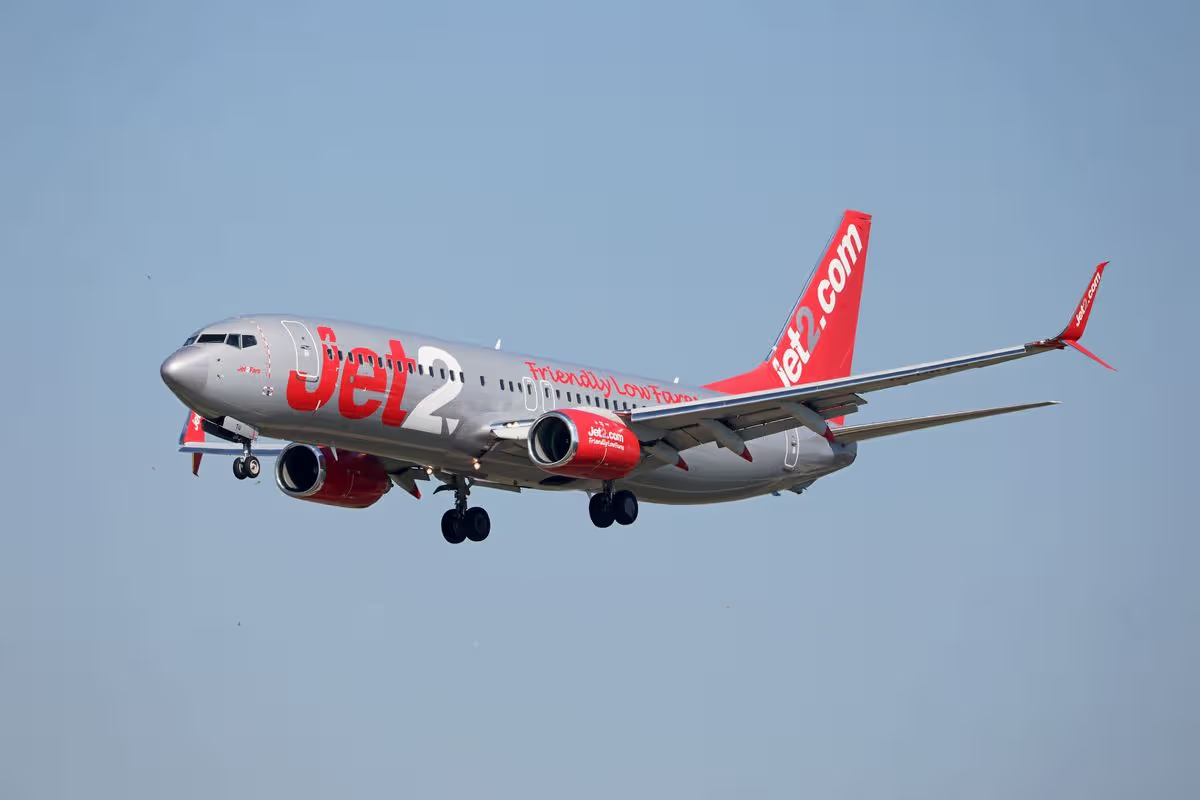
The airline and tour operator has shared advice for passengers on social media
Jet2 shared a message about bookings on social media (stock photo)(Image: Getty)
Jet2 has issued an update for passengers worried about disruption to their spring travel plans. With the Easter holidays here at last, many families have booked European getaways over the next few weeks. However, some passengers are worried about possible cancellations.
Greece faced travel disruption this week after a deadly storm hit parts of the country, and Crete was enveloped in a Saharan dust storm. Passengers have also been warned of possible jet fuel shortages caused by the Iran war.
One passenger who shared their concerns with Jet2 has been told that all flights are currently planned to go ahead as normal. Taking to X, a customer named Liz Hughes asked Jet2 for guidance ahead of an upcoming trip to Corfu later this month.
Liz wrote: “We have return flights booked Man-Corfu 13-20 Apr. Should we be worried about cancellations?” A Jet2 employee named Lily responded to the question on Friday (April 2).
Replying from the @Jet2tweets account, Lily said: “Hi Liz, all flights are planned to go ahead as normal. If anything were to change regarding your booking, we would be sure to reach out to you directly to make you aware, and discuss the options available to you. Thanks, Lily.”
Content cannot be displayed without consent
The news comes as Ryanair boss Michael O’Leary has recently said passengers could face severe disruption in early May if the Middle East conflict continues. Speaking on Sky News Michael O’Leary said: “Fuel suppliers are constantly looking at the market.
“We don’t expect any disruption until early May, but if the war continues, we do run the risk of supply disruptions in Europe in May and June, and we hope the war will finish sooner than that and the risk to supply will be eliminated.”
Oil prices have surged since February due to Iran’s block on tankers passing through a key shipping passage, the Strait of Hormuz. The Business Secretary has said there are no supply chain issues for jet fuel “at this moment.”
Peter Kyle told Times Radio: “I was looking immediately after the conflict started, where we interact in order to get resilience into our society, into our economy, we’ve been working with all these key sectors, identifying sectors where there may well be challenges down the track. We have no (fuel) supply chain issues at this moment at all.”
UK airlines are not experiencing disruption to their supply of jet fuel, according to an industry association. An Airlines UK spokesperson said: “UK airlines are currently not seeing disruption to jet fuel supply and continue to engage with fuel suppliers and Government to monitor the situation.”
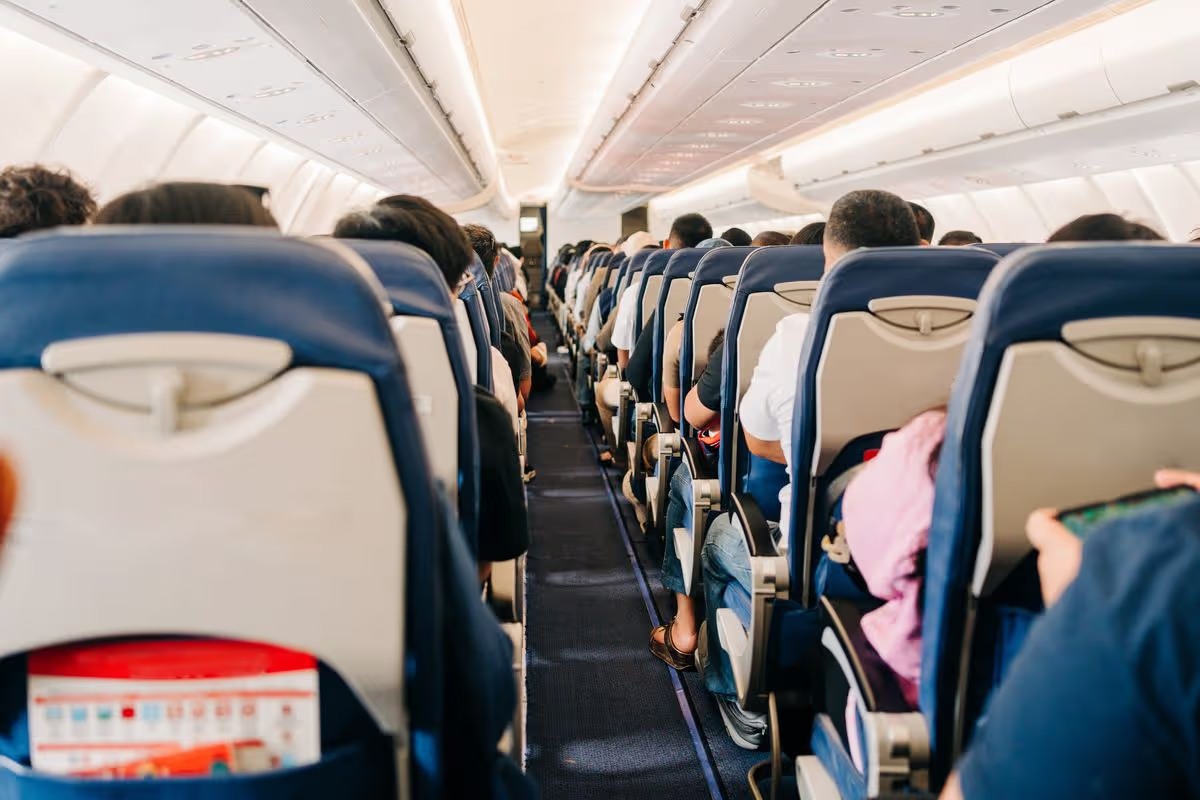
Choosing the right seat on the plane can determine a lot for your overall flight experience, and a travel expert has revealed exactly why you should avoid booking 11A
You might want to think carefully about choosing your seat on the plane(Image: Getty Images/Stock Image)
We all have a preferred window or aisle seat when flying, but one travel expert has revealed the exact seat you should always avoid.
Choosing the right seat on a plane can certainly come with its bonuses. Whether that’s more legroom, closer to the bathrooms, being the first row to be served refreshments, or a quieter spot near the back, away from babies. Yet some seats can be a disadvantage.
Window seats are popular among travellers, particularly for those wanting to enjoy the view during take-off or landing, for a little more privacy, or to take a little snooze against the cabin. One favoured window seat on planes has been 11A, due to its positioning near or over the wing, which is thought to offer less disruption from turbulence.
While it may sound appealing, 11A might not be as relaxing as it sounds. Andrea Platania, operations manager at airport transfer platform Transfeero, said that this specific seat often leaves passengers disappointed.
“Seat 11A might sound ideal because it’s by the window, but it can quickly become frustrating, especially on anything longer than a short hop,” the travel expert said. “You’re quite far from the toilets, which isn’t ideal, and getting in and out of that seat can be awkward.”
Andrea also explained that this seat can prove tricky for those who want to move around and stretch during the flight. “If you’re in 11A, you’re relying on the people next to you to move every time you want to get up. That might be fine once or twice, but over a longer journey it becomes inconvenient very quickly.”
It’s a seat that can also feel a little cut off from the rest of the cabin. “You’re not close to the aisle, so you don’t have that easy access, and you’re not in a premium position either. It ends up being a seat that looks better when you book it than it feels when you sit in it,” he outlined.
But that’s not the only seat you might want to think twice about booking. The expert said that seats 11A and 11F are among the “least rewarding seats” on a flight.
“Seats like 11A and 11F are often overlooked when people are booking, but they’re right in that middle section of the aircraft where you lose a lot of the small conveniences. They don’t seem bad on paper, but in practice, they’re some of the least rewarding seats to be in, Andrea said.
Yet one of the biggest disadvantages of these seats is during food and drink service. “On most short and mid-haul flights, cabin crew will begin service from both the front and the back of the plane, then work their way towards the centre. If you’re sitting in rows like 11, you’re effectively last in line from both directions.”
It can become even more of a drawback during busy flights. He said: “Passengers in seats like 11A and 11F are far more likely to find that popular snacks, meals, or even drinks have already run out by the time the trolley reaches them. It’s something people don’t think about when booking, but it becomes very obvious once you’re in the air.”
If that wasn’t enough to deter you from seats 11A and 11F, Andrea noted that they are inconveniently positioned on board. “You’re not particularly close to the toilets, and you’re not near the exits either, so you don’t get the benefit of convenience in either direction.
“You’re just in that middle zone where everything takes a bit longer.” So next time you book your plane seat, have a think about where you’d rather sit, whether that’s to ensure you’re one of the first to be served your meal or somewhere to ensure little disruption during your flight.
Do you have a travel story to share? Email webtravel@reachplc.com
An On the Beach travel influencer has shared recommendations for holidaymakers
People could save on their holidays with the expert’s tip (stock photo)(Image: Getty)
People booking holidays after payday could benefit from a travel expert’s destination tips. A travel influencer has shared six holiday trends he predicts for March and April, and the knowledge could benefit anyone looking for a ‘cheap city break’ in the coming weeks.
The tips were highlighted in a video shared by Rob Brooks, a travel enthusiast and influencer with the travel company On The Beach. Rob is well-known for posting budget-friendly travel advice, hotel reviews, and holiday tips for his 114k TikTok followers, where he goes by the username @Robonthebeach.
In a new video shared this week, the travel lover shared ‘six holiday trends’ he is ‘predicting for payday’. In the clip, Rob explained: “If I got paid today and I had seven days to book a holiday, this is exactly what I’d be doing.
“I’m Rob, I work in travel, and I spend my days deep in holiday data, what people are searching, what people are booking, what’s getting sneakily cheaper. And these are my payday predictions as a holiday expert, and more importantly, exactly how I’d use them.”
First, Rob predicted that city breaks will soar in popularity this year. He said: “Short trips are crazy popular in 2026, and I’m seeing loads of demand because people want a quick break without burning loads of annual leave. And when flights price dynamically, weekends get expensive really fast.
Content cannot be displayed without consent
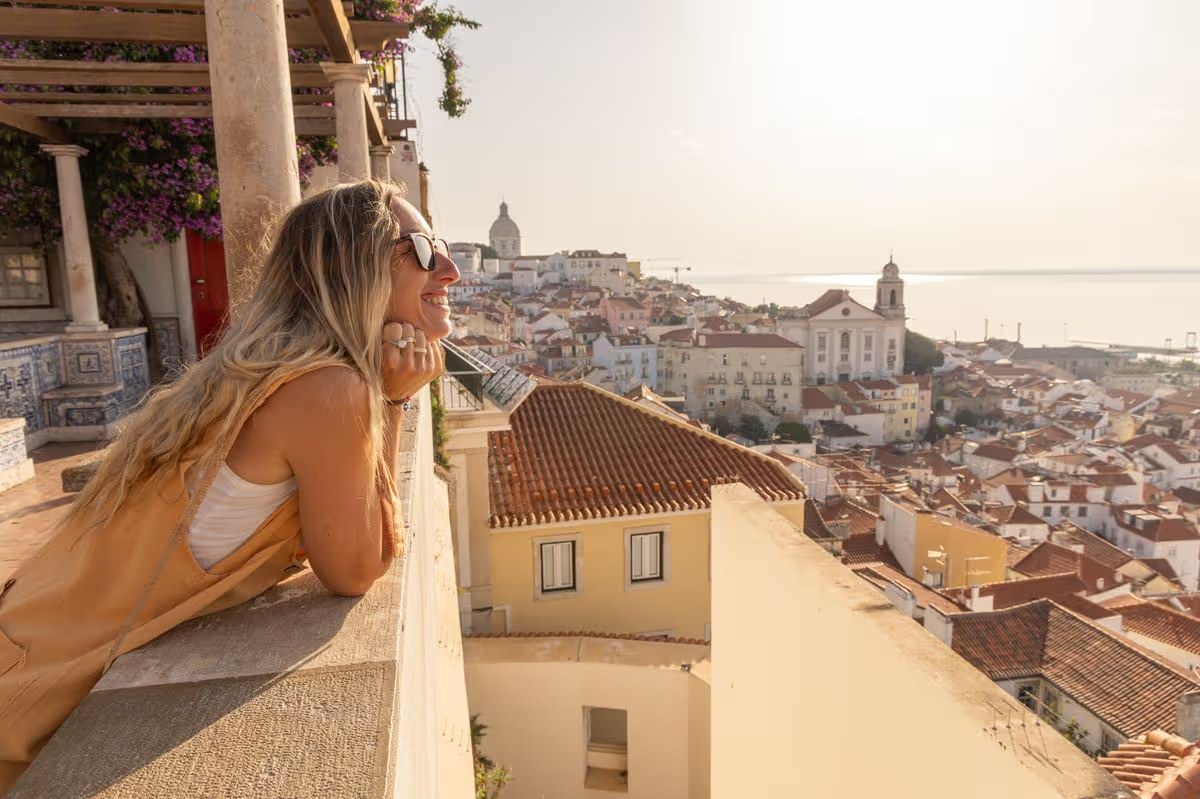
“So midweek is currently where the value sits on city breaks. And if I was booking one right now, I’d be looking at a midweek break in Prague, Lisbon or Barcelona. I’d try and line them up with a May bank holiday so you can stretch your time off without paying peak prices.”
Moving on, the travel enthusiast said Turkey ‘will see a surge of bookings.’ He said: “You’re getting five-star all-inclusive holidays for the same prices that you’d pay for three-star elsewhere. And interestingly, according to the data, the longer the transfer, the cheaper the holiday.”
As for when you want to book your trip, the holiday expert suggested May. Rob told viewers: “May is a perfect crossover for holidays, and I’m seeing some pretty nuts prices in some destinations where the weather is already properly warm.
“Airlines and hotels haven’t quite pushed up the prices yet in line with peak demand, but that demand is now starting to build. So if I was booking today I would lock in a holiday in May in somewhere like Morocco or Egypt, Tunisia or Turkey because they’re hot, reliable and still really good value before summer kicks in.”
Sharing another tip, Rob added that all-inclusive holidays are proving popular. For his next prediction, the influencer said: “Last-minute bookings will spike. There’s a real wait and see behaviour with holidaymakers right now.”
He continued: “People are watching prices then jumping in to book as soon as they drop. And when airlines and hotels need to fill seats and rooms close to departure, that’s when prices on package holidays suddenly start to dip. If I were going for pure value, I would actually wait and book about seven days before departure, possibly even later than that. It’s risky. But when it works, it really works. I should say, please, only do this if you’re prepared and in a position to take that risk.”
Concluding his video, Rob added that he thinks people will treat themselves more this payday. “There’s definitely a bit of a go on then mindset in the UK right now, and I personally think it might be tied to the cost of living creeping up again cause people know prices are only going one way, so they’re locking in the good prices now before they go up. So if I were booking this week, I’d probably stretch my budget a little bit to book a better hotel or a nicer room and lock it in before prices inevitably climb over the next few weeks.”
More than 2.5million Brits visited Portugal last year, and it could be even more popular in 2026 due to the Iran conflict
13:08, 20 Mar 2026Updated 13:08, 20 Mar 2026
Bookings to Portugal have surged since strikes on Iran began
The Foreign, Commonwealth and Development Office (FCDO) has issued updated travel guidance for those heading to Portugal. The update was released today (March 20).
Fresh information has been provided for individuals seeking to remain in Portugal beyond 90 days under exceptional circumstances. The updated guidance states: “If you’re visiting Portugal and need to extend your visa-free stay for exceptional reasons, such as a medical emergency, you must apply to AIMA using their contact form (access is only available to users in Portugal). If you’re in Portugal with a residence permit or long-stay visa, this does not count towards your 90-day visa-free limit.”
It adds: “If you’re in Portugal with a residence permit or long-stay visa, this does not count towards your 90-day visa-free limit.”
For British passport holders, visas aren’t required for short visits to EU nations or Schengen zone countries provided both conditions are met:
Your combined stay within the Schengen zone must not exceed 90 days within any 180-day period. The number of countries visited is irrelevant. The 180-day timeframe continuously ‘rolls over’, reports the Liverpool Echo.
EES
Since October 2025, the European Union has implemented the Entry/Exit System (EES), requiring travellers to provide fingerprints and photographs upon initial entry to or departure from the Schengen zone. It is scheduled to be fully operational by 10 April. However, the system has been plagued by teething problems, resulting in many travellers waiting for hours at airports. Because the system requires non-EU visitors – including Brits – to register their fingerprints and take a photo in person at the border, the additional registration time is already causing massive queues for non-European passengers at airports across the region.
It has caused such disruption that some locations have temporarily suspended its use. The European Commission has suggested that border authorities may pause the new system for up to six hours during peak travel times until September to help ease congestion.
More and more Brits are booking flights to Portugal as the conflict in the Middle East continues. Destinations like Cyprus, Turkey, Greece, Egypt, and Dubai are being viewed as increasingly risky, so travellers are opting for safer alternatives like Portugal and Spain.
Bookings to Portugal had increased by 42% over the two weeks to 13 March, according to Thomas Cook – the largest rise in any of the countries they arrange holidays to. It was followed by the Balearic Islands (40 per cent) and the Canary Islands (16 per cent).
TravelSupermarket shared data on online search interest, which it said demonstrates a “clear surge” for European and Atlantic destinations and away from the Middle East.
GREECE is the latest holiday destination seeing a drop in holiday bookings amid the Iran crisis.
In a statement released this week, On The Beach confirmed a number of popular holiday destinations including Greece had seen a drop in demand as a result of growing tensions in the Middle East.
Sign up for the Travel newsletter
Thank you!
On The Beach has reported that travellers are not booking holidays to GreeceCredit: Alamy
The announcement came as the online package holiday provider made a statement that it was suspending its profit forecast.
The group said: “Whilst the group has limited exposure to destinations in the Middle East, it has experienced a significant slowdown in demand following the onset of conflict in the region, particularly to destinations such as Turkey, Greece, Cyprus and Egypt.
“The timing of when the conflict will end and the shape of recovery in demand to these destinations are unknown.”
Despite this, the Government currently has no warning against travel to Greece.
And there are other companies, such as TUI, that have seen increased interest in Greece (along with Portugal and Spain)as “customers opt for familiar destinations”, reports The Times.
Taking to Reddit, travellers currently in Greece have shared what it is like.
One person commented: “I’m in Athens currently and it’s very crowded, also it feels perfectly safe.”
Another person said: “I live in Peloponnese, southern tip on the coast of Greece.
“We’ve been hearing a ton of military planes flying around us the last few days.
“They are definitely preparing for the worst but we are not scared at all.”
Earlier this month, the RAF Akrotiri base on Cyprus was hit by an Iranian drone.
As a result, there was a temporary closure of Paphos Airport, with flights being cancelled.
Despite this, Cyprus remains on the safe to travel list with the Foreign Office warning: “Regional escalation poses significant security risks and has led to travel disruption.”
Current guidance includes monitoring local and international media and signing up for local information alerts and resources.
Current Government advice lists Greece as safe to travel toCredit: Alamy
However, similar to Greece, Cyprus has also seen a drop in tourism.
Local businesses have expressed how people are “thinking twice” about visiting, with a number of hoteliers saying that bookings are down across March and April.
Cyprus’ foreign minister Constantinos Kombos told the BBC: “I don’t think that anyone should be in two minds, given the fact that the situation, as I have been describing right now as we speak, has been perfectly normal.
“All activity is normal. Air traffic is going back to 100 per cent what it was before the incident.
“So I don’t think this is something that should be affecting people’s decisions.
“And the security factor in terms of people feeling that everything is being done that is humanly possible to protect both citizens, residents, and visitors to Cyprus.”