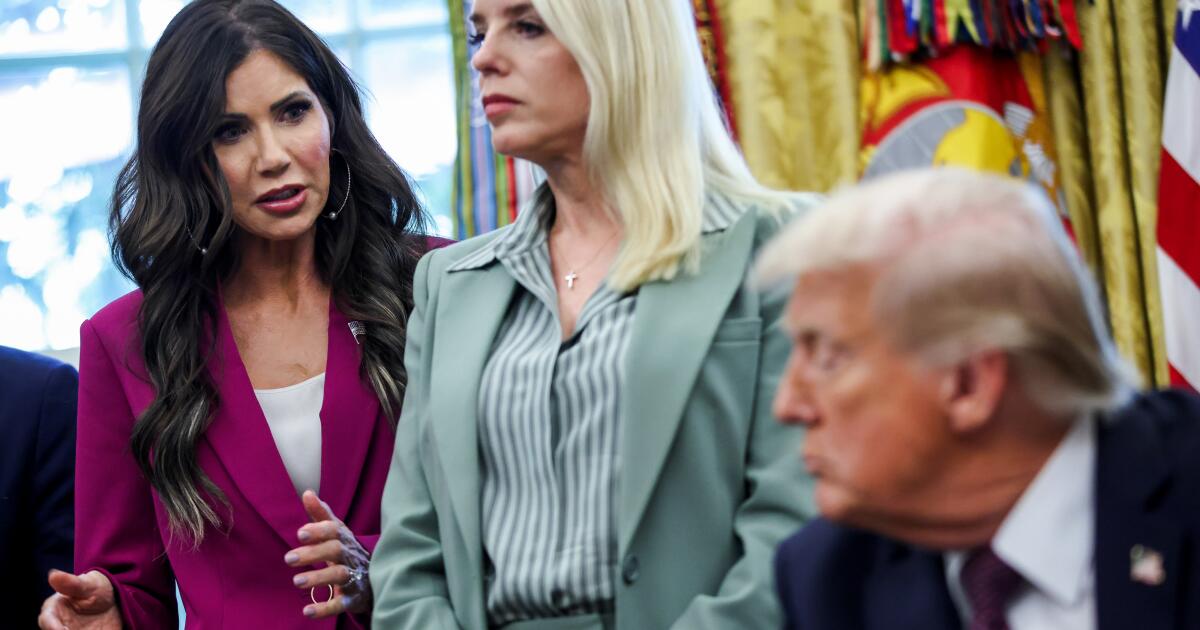
Bondi

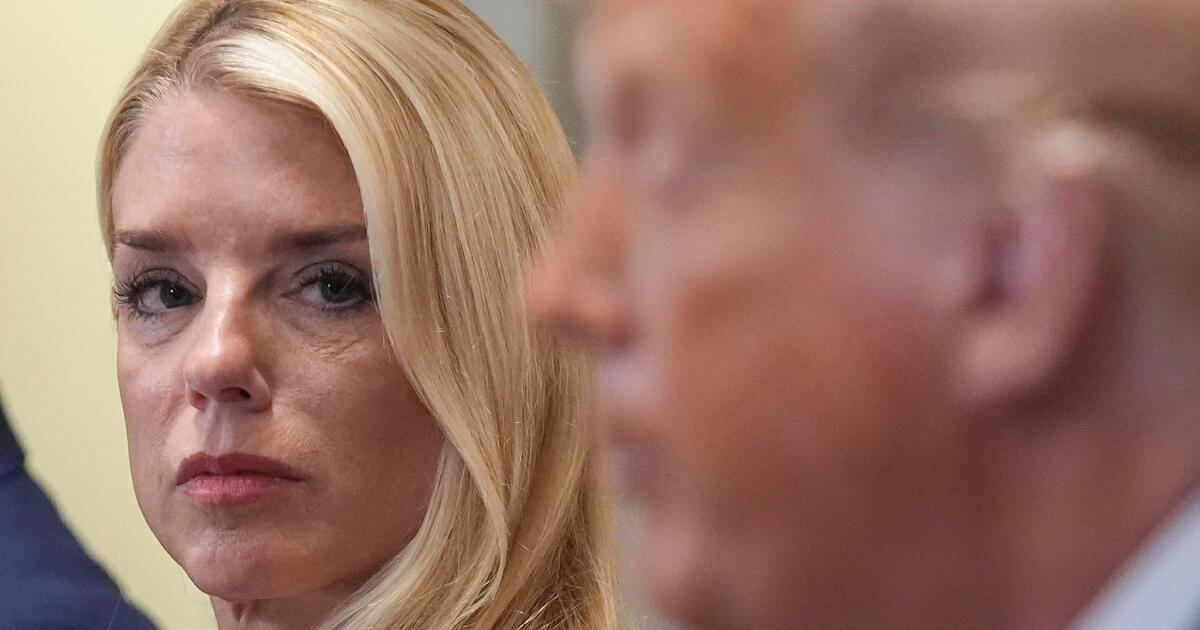
Atty. Gen. Pam Bondi subpoenaed to answer questions from Congress about the Epstein files

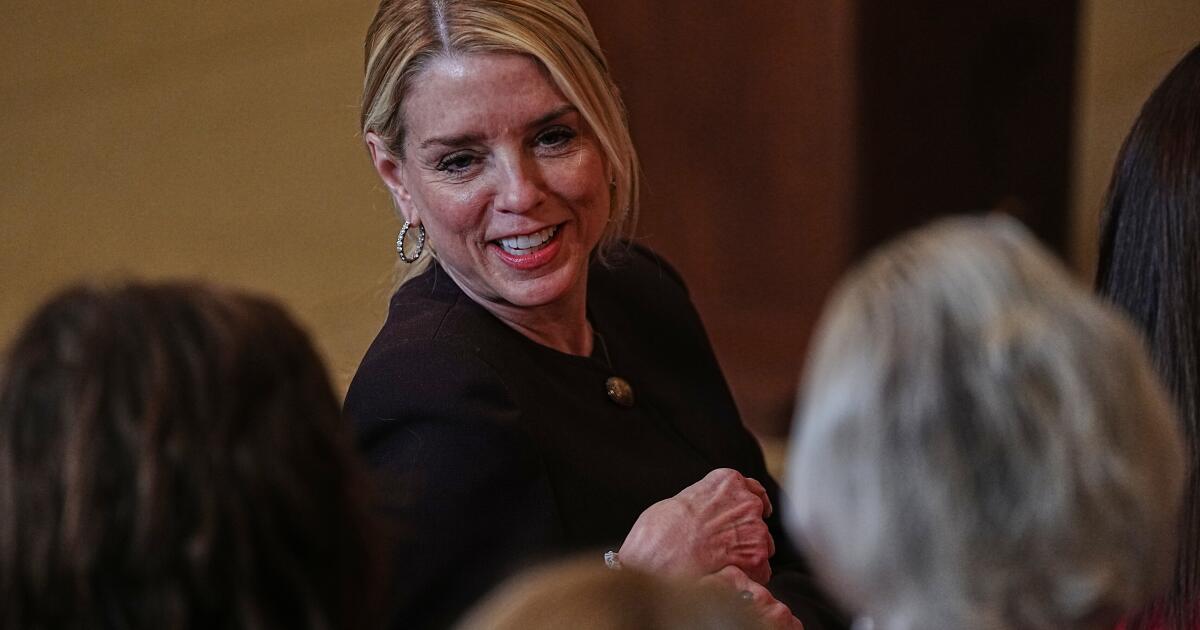
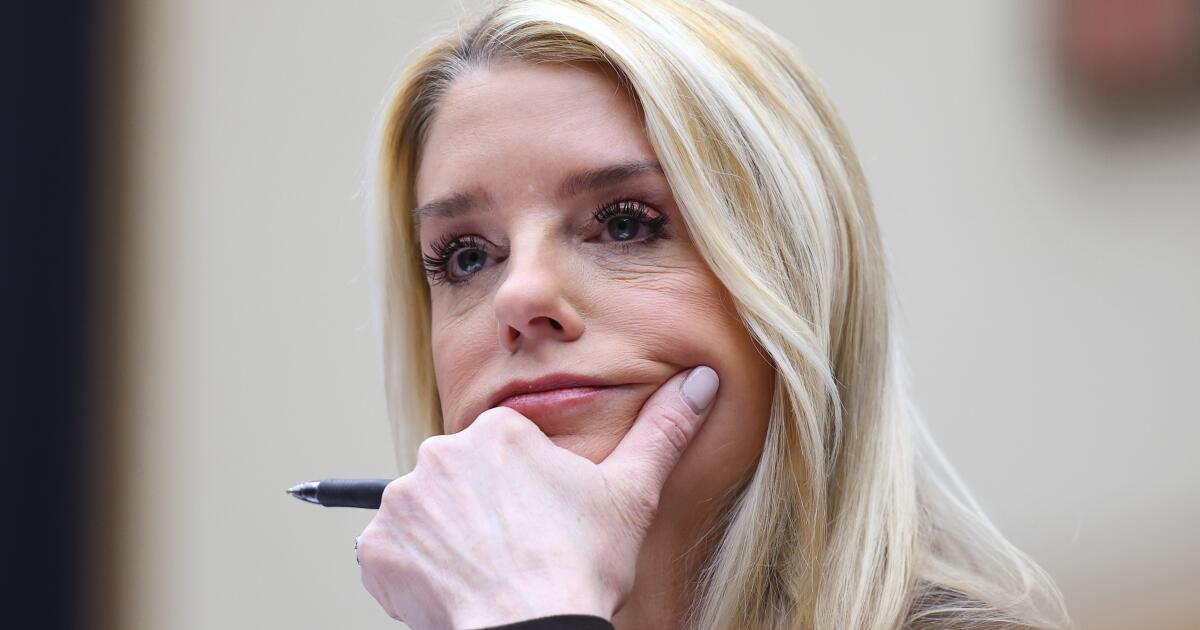
Atty. Gen. Pam Bondi was subpoenaed Tuesday to answer questions from Congress about the Justice Department’s sex trafficking investigation of Jeffrey Epstein and the agency’s handling of millions of files related to the disgraced financier.

Bondi was ordered to appear for a deposition on April 14 by the Committee on Oversight and Government Reform after a vote earlier this month that five Republicans supported.

The Justice Department’s failure to fend off the subpoena from the Republican-led committee underscores widespread discontent among President Trump’s own base over Bondi’s management of the review and release of a trove of documents from the criminal investigation into Epstein.

“The Committee has questions regarding the Department of Justice’s handling of the investigation into Jeffrey Epstein and his associates and its compliance with the Epstein Files Transparency Act,” Rep. James Comer, the Republican chairman, said in a letter to Bondi.

“As Attorney General, you are directly responsible for overseeing the Department’s collection, review, and determinations regarding the release of files pursuant to the Epstein Files Transparency Act, and the Committee therefore believes that you possess valuable insight into these efforts,” he wrote.

The department on Tuesday called the subpoena “completely unnecessary.” Bondi and Deputy Atty. Gen. Todd Blanche were expected to provide a private briefing Wednesday to members of the committee.

“Lawmakers have been invited to view the unredacted files for themselves at the Department of Justice, and the Attorney General has always made herself available to speak directly with members of Congress,” the department said in a statement. The agency said it looks forward to “continuing to provide policymakers with the facts.”

The Trump administration has faced constant political headaches since the rollout of the files began in December, with critics accusing the department of hiding certain documents and over-redacting files. In other cases, victims have slammed the department for sloppy redactions that revealed their sensitive information.

The Justice Department has fiercely defended its handling of the Epstein files, saying it worked as quickly and diligently as possible to review and release millions of documents required under the law. The department has denied any accusations that it used redactions to protect certain people or improperly withheld certain materials. And it has said it immediately worked to fix any redaction errors raised by victims.

Richer writes for the Associated Press.

Source link

Column: Trump’s recklessness endangers the nation

President Trump was uncommonly lucky in his first term, neither inheriting nor provoking a crisis of the sort that tests U.S. presidents, until COVID struck in his final 10 months. (He failed that test, contributing to his 2020 reelection defeat.) Trump 1.0 was bequeathed a growing economy from President Obama, and the incoming president assembled a roster of capable advisors who often acted to prevent him from doing nutty things at home and abroad.

Trump 2.0 made sure that no such human guardrails populated his second Cabinet, only genuflecting enablers. Unrestrained, he has presided over one crisis on top of another, all of his own making. Tariff mayhem and high prices. Armed agents and troops in American cities. Repeated violations of court orders. Demolition at federal agencies and the White House.

And now Trump has taken the nation to war against Iran in league with Israel’s Benjamin Netanyahu. Depending on the moment and the audience, a contradictory Trump is either claiming the war is “very complete” or that much remains to be done to “decimate” Iran. On Wednesday he blithely told Axios, “Any time I want it to end, it will end,” even as U.S. officials planned further actions.

In any case, Trump’s war of choice and the killing of the supreme leader of Iran’s terroristic theocracy now has spawned another potential crisis, counterterrorism experts warn: the risks of retaliatory terrorist threats at home. And that is a threat, whether from homegrown extremists or sleeper cells of the sort that came alive for 9/11, that is likely greater because of the initial self-induced crisis of Trump’s second term: his whacking of the federal government.

Trump authorized Elon Musk’s destruction of the bureaucracy in the name of “government efficiency” and continues to exact retribution against any federal employee who had anything to do with investigating and prosecuting him during his interregnum. Longtime agents and operatives have been eliminated at the FBI, Justice Department, Department of Homeland Security, CIA and elsewhere. Especially at the FBI, counterterrorism experts with centuries of collective experience are gone and many who remain have been diverted to Trump’s top priority: mass deportations.

Consequently, the president who promised to “Make America Safe Again” has arguably made Americans less safe.

I raised this scary prospect just over a year ago as Trump’s teardown of the purported Deep State was underway. And now a Mideast war that Trump promised never to start has further incentivized Iran and its jihadi proxies to hit back, just as he’s diminished the nation’s early-warning systems.

Enough intelligence remains, however, that even in the days before Trump ordered the first strikes against Tehran, government analysts were picking up “worrisome signs” of Iranian plotting against U.S. targets, the New York Times reported. After the U.S.-Israel onslaught and death of Ayatollah Ali Khamenei on Feb. 28, the government intercepted a possible Iranian “operational trigger” to “sleeper assets” outside Iran, according to ABC News.

Counterterrorism expert Colin P. Clarke, executive director of the Soufan Center, which focuses on global security and transnational terrorism, wrote this week in the Atlantic that U.S. agencies’ record of disrupting Iranian-backed plots in America was in jeopardy given the recent changes in funding, personnel and priorities. “Because of this,” he concluded, “the U.S. homeland is arguably more vulnerable than it has been in a long time.”

In a follow-up exchange of emails, Clarke told me, “Many of this administration’s moves have been myopic — shifting counterterrorism resources to immigration, firing FBI agents working counterintelligence, etc. A week before the U.S. went to war with Iran, the FBI Director Kash Patel was off gallivanting in Milan at the Olympics [where he struggled to chug a Michelob Ultra, a firing offense in its own right] when he should have been preparing for the potential for an Iranian response on U.S. soil.”

Patel’s preposterous partying with the U.S. men’s hockey team while war-planning was underway in Washington was widely, justifiably mocked. But it stands as a metaphor for the entire Trump administration’s cavalier attitude toward homeland security. Its abusive focus on both migrants and citizens protesting on the migrants’ behalf is a distraction from actual threats to the country.

Patel, like his boss at the Justice Department, Atty. Gen. Pam Bondi, has made plain in words and actions that the president’s political enemies are the real public enemies No. 1. One of Bondi’s first acts was creation of a “weaponization working group” to identify, fire or prosecute those in her department who’d investigated and prosecuted Trump, many of whom also had experience in domestic and transnational terrorism. The association representing FBI agents called her purges “dangerous distractions” from the work “to make America safe again.”

Days after starting the Iran war, when homeland security should have been on red alert, Trump fired his secretary of Homeland Security, Kristi Noem. Her costly cosplaying as the homeland’s heroine on horseback in anti-migrant videos, along with her penchant for luxury jets allegedly to transport deportees, was too much even for him.

Yet all three “national security” officials — Noem, Bondi and Patel — simply reflect Trump’s own warped approach and blasé attitude toward the homefront.

When Time magazine last week asked the commander in chief whether Americans should be worried about potential terrorist strikes at home, he replied, “I guess.”

“We plan for it,” he added. “But yeah, you know, we expect some things. Like I said, some people will die. When you go to war, some people will die.”

The administration is planning for it all right. An extraordinary number of senior Trump officials have taken up residence in houses on military bases, including Bondi, Noem, the secretaries of State and Defense, Marco Rubio and Pete Hegseth, and White House consigliere Stephen Miller.

The rest of us just have to keep our fingers crossed. I guess.

Bluesky: @jackiecalmes
Threads: @jkcalmes
X: @jackiekcalmes

Source link

House panel subpoenas Bondi to testify on handling of Epstein files

March 4 (UPI) — The House Oversight Committee voted Wednesday to subpoena U.S. Attorney General Pam Bondi to testify on the Justice Department’s handling of the Jeffrey Epstein files.

Five Republicans joined the Democrats on the committee voting in favor of the subpoena by a 24-19 count.

The vote was forced by Rep. Nancy Mace, R-S.C., during a full committee business meeting that was not related to the Epstein investigation. Republicans joining Mace in voting for the subpoena were Reps. Lauren Boebert, R-Colo., Tim Burchett, R-Tenn., Scott Perry, R-Pa., and Michael Cloud, R-Texas.

“AG Bondi claims the DOJ has released all of the Epstein Files,” Mace posted on social media. “The record is clear: they have not.”

Potential dates for Bondi’s testimony have not been announced.

While some Republicans joined Democrats in voting for a subpoena of Bondi, they did not do the same on a subpoena for Homeland Security Secretary Kristi Noem. A motion to subpoena Noem for her handling of immigration enforcement failed.

Commerce Secretary Howard Lutnick agreed on Tuesday to testify before the House Oversight Committee about his relationship with Epstein. Lutnick’s relationship with the sexual abuser and trafficker came under further scrutiny after a photo of him with Epstein was posted on the Justice Department’s Epstein files database.

Lutnick previously downplayed his ties to Epstein.

Source link

Bondi claims win in ICE mask ban fight; court ruled on different case

U.S. Atty. Gen. Pam Bondi declared a triumph against California on Friday, touting an appellate court ruling that she said blocked a state ban on immigration agents and other law enforcement officers wearing masks.

“The 9th Circuit has now issued a FULL stay blocking California’s ban on masks for federal law enforcement agents,” Bondi posted on the social media site X, calling the Feb. 19 decision a “key victory.”

Bondi, however, appeared confused about which case the court was ruling on this week.

A federal judge in Los Angeles blocked California’s first-in-the-nation mask ban 10 days earlier, on Feb. 9.

At the time, U.S. District Judge Christina A. Snyder said she was “constrained” to block the law because it included only local and federal officers, while exempting state law enforcement.

The state did not appeal that decision.

Instead, on Wednesday, the law’s author Sen. Scott Wiener (D-San Francisco) introduced a new mask bill without the problematic carve-out for state officers.

With the initial legal challenge already decided and the new bill still pending in the legislature, the 9th Circuit Court of Appeals has no reason to revisit the mask ban.

The ruling that Bondi appeared to reference involves a separate California law requiring law enforcement officers to display identification while on duty.

Snyder had previously ruled the “No Vigilantes Act” could take effect because it did not exempt state police, a decision the Justice Department appealed to the 9th Circuit.

The appellate court is set to review the matter early next month. Until then, the court issued an injunction that pauses the state law from taking effect.

Issuing a temporary administrative injunction is a common procedural move, allowing judges to freeze things in the status quo until the court has a chance to weigh the law and come to a decision.

Thursday’s order set a hearing in the Richard H. Chambers U.S. Court of Appeals in Pasadena for March 3, indicating the case is far from over.

Bill Essayli, who leads the U.S. attorney’s office in Los Angeles, also celebrated with a post on X, calling Thursday’s order “another key win for the Justice Department.” He too suggested the injunction somehow involved the mask case.

A spokesperson for the U.S. Justice Department did not immediately respond to a request for comment.

The law requiring officers to show ID is less controversial than the mask ban. But it may still face an uphill battle in the appellate court. A three-judge panel is set to hear the case, comprising two judges nominated to the bench by President Trump and one by President Obama. One of the Trump appointees, Judge Mark Bennett of Hawaii, has previously signaled skepticism over the administration’s immigration enforcement policies.

At issue in the ID case is whether California’s law interferes with or controls the operations of the federal government, actions prohibited by the supremacy clause of the U.S. Constitution. Snyder ruled that the identification law was more akin to speed limits on the highway, which apply equally to everyone, a decision the appellate court could reject.

A ruling is not expected before mid-March, and would not directly affect the push by state lawmakers to pass a revised mask ban.

Recent polls show more than 60% of Americans want U.S. Immigration and Customs Enforcement officers and other federal agents unmasked. More than a dozen states are pursuing laws similar to California’s.

In Washington, congressional Democrats have made a mask ban for ICE a key issue in the ongoing partial government shutdown, vowing not to fund the Department of Homeland Security until one is enacted.

Legal experts have said the issue likely will not be resolved until it reaches the Supreme Court.

Source link