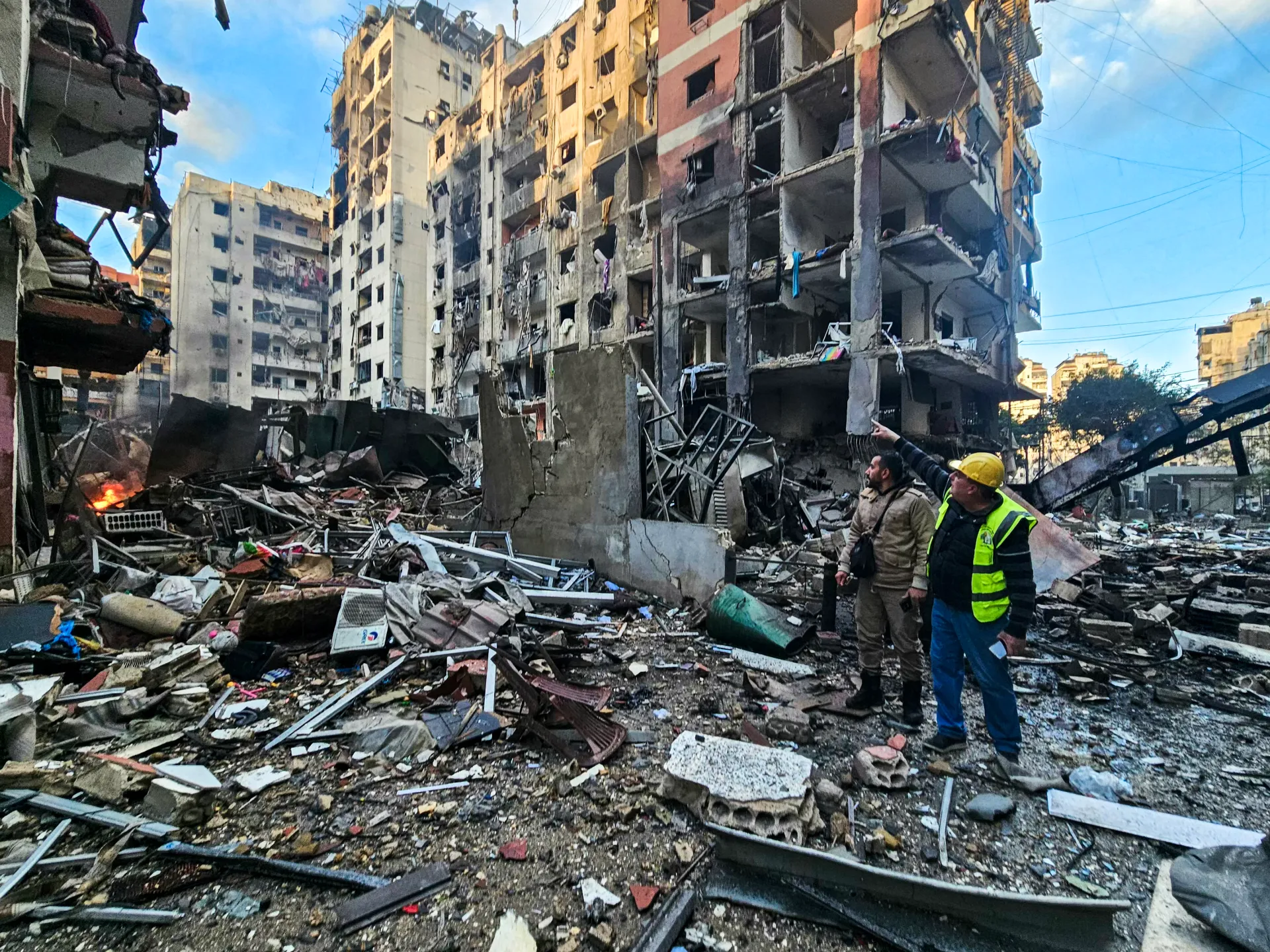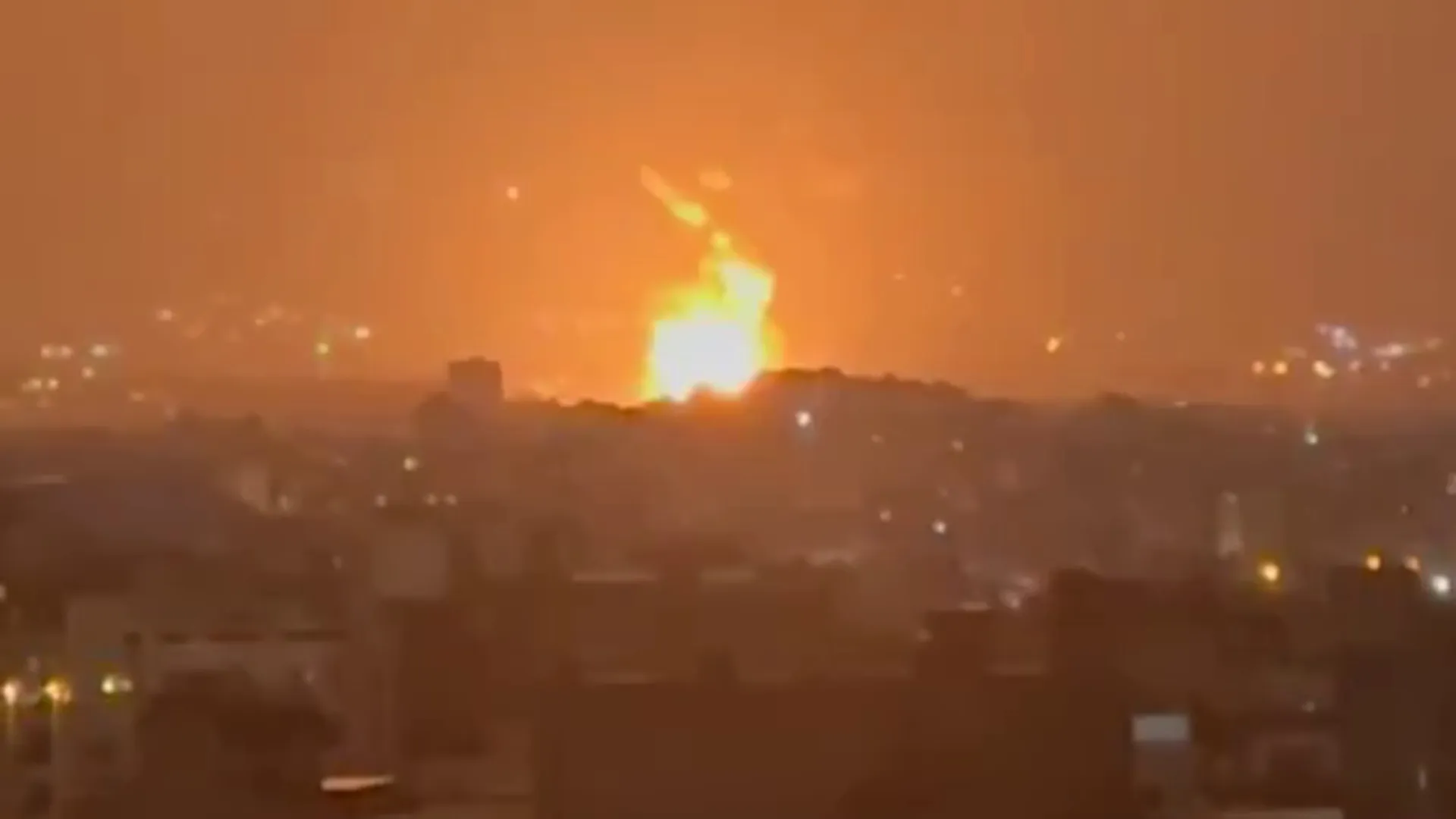
bombing

3 Pakistani national police killed, 12 others hurt, in suicide bombing

Federal Constabulary troops stand guard Monday outside the regional headquarters of the force in Peshawar, Khyber Pakhtunkhwa province, following a deadly attack by militants. Photo by Bilawal Arbab/EPA

Nov. 24 (UPI) — At least three officers of Pakistan’s Federal Constabulary were killed Monday and 12 people, including civilians, were injured in a suicide bombing at the force’s regional headquarters in Peshawar in the northwest of the country.

Two loud explosions were heard coming from the compound at about 8:10 a.m. local time, with an official saying five security officials and seven civilians had been injured.

Calling it a “foiled terrorist plot,” authorities said two armed attackers were shot dead before they were able to enter the building.

“Initially, three militants tried to attack the headquarters. One terrorist blew himself up at the gate, while two others tried to enter the premises but were gunned down by FC personnel,” Peshawar Capital City Police Officer Mian Saeed Ahmad told reporters.

Ahmad said authorities were already on high alert due to the security situation in Khyber Pakhtunkhwa, the province where Peshawar is located, which borders Afghanistan, and where the Pakistan Taliban, also known as Tehrik-i Taliban Pakistan, has carried out a series of deadly attacks.

A TTP splinter group called Jamatul Ahrar said it carried out the attack.

“The perpetrators of this incident should be identified as soon as possible and brought to justice,” said Pakistani Prime Minister Shehbaz Sharif.

The Federal Constabulary is a national paramilitary police force responsible for internal security as well as tackling organized crime and drug production and trafficking.

Monday’s attack came two weeks after a suicide bomber killed 12 people and injured 36 after detonating a car bomb outside a court building in Islamabad, which Pakistan Defense Minister Khawaja Asim blamed on the TTP and its backers in Afghanistan.

The government said the Taliban regime in Kabul backs the TTP, which has been waging a campaign of violence against Shiite Muslims in Pakistan and launching attacks against Pakistan’s military and government in a bid to replace the secular state with an Islamic one.

Tensions escalated in early October when Pakistan mounted airstrikes on TTP targets in Kabul and three other cities. The Taliban responded by launching deadly attacks along its border with Pakistan in which 23 soldiers were killed and at least 29 were injured.

Pakistan carried out retaliatory strikes that officials said killed 200 Taliban-backed Afghan militants and claimed Pakistani forces had destroyed Afghan terrorist training camps.

In September, six soldiers were killed in an attack on an FC compound in Khyber Pakhtunkhwa’s Bannu district, 100 miles southwest of Peshawar. Five militants that authorities said belonged to the TTP were killed in the ensuing firefight.

The TTP is proscribed by the United States and Britain, among others, as a foreign terror organization.

Source link

‘Utter pandemonium’: Witnesses recall chaos after Islamabad suicide bombing | Armed Groups News

Islamabad, Pakistan – At about 12:30pm (07:30 GMT) on Tuesday afternoon, Khalid Khan, a 25-year-old lawyer, was waiting for his lunch with his friend, Fawad Khan, at the cafeteria of Islamabad’s District Judicial Complex.

Suddenly, a loud boom shook the cafeteria and the entire judicial complex.

Recommended Stories

list of 4 itemsend of list

“I first thought that the roof will collapse on me,” Khalid told Al Jazeera outside the complex, two hours later.

The complex had been hit by a suicide attack. According to official figures, at least 12 people were killed and more than 30 were injured, several of them critically, when the bomber blew himself up at the entrance of the court complex.

Prime Minister Shehbaz Sharif blamed “India-backed proxies” operating from Afghanistan for carrying out the attack.

India, where a car explosion on Monday evening killed at least 13 people, said that it “unequivocally” rejects the “baseless and unfounded allegations being made by an obviously delirious Pakistani leadership”.

Interactive_Islamabad_bomb_blast_Nov11_2025

In a statement issued on Tuesday evening, Randhir Jaiswal, the spokesperson for India’s Ministry of External Affairs, said Islamabad was attempting to “deflect the attention of its own public from the ongoing military-inspired constitutional subversion and power-grab unfolding within the country”, appearing to refer to the 27th constitutional amendment being debated in Pakistan’s National Assembly.

“The international community is well aware of the reality, and will not be misled by Pakistan’s desperate diversionary ploys,” Jaiswal added.

The constitutional amendment has sparked criticism from activists, sitting judges and opposition parties for granting lifelong immunity from criminal prosecution for the country’s senior-most military officers, and for setting up a parallel Federal Constitutional Court, which many fear could undermine the Supreme Court.

But on Tuesday, it was the District Judicial Complex in Islamabad that was shaken, as the impact blast there reverberated across South Asia.

The sound of the explosion was heard in nearby residential areas and office buildings. Soon after, videos of the incident went viral on social media, showing flames and plumes of smoke rising from a charred vehicle near a security barrier at the compound’s entrance.

In other clips, lawyers were seen rushing out to help those on the road as security personnel surrounded the premises.

Witnesses said that at the time of the blast, nearly 2,000 people were inside the complex, including judges, lawyers, litigants and court staff.

They described an explosion so powerful that windows in several courtrooms were shattered, and body parts were strewn across the site, including the head of the suicide bomber.

With different gates for entry and exit, and the main gate closed immediately after the blast, police initially instructed people to stay inside before allowing them to leave about 25 minutes later.

Muhammad Shehzad Butt, a 52-year-old lawyer, was among them. He said he had been heading towards the cafeteria when the explosion occurred.

“It was utter pandemonium, and in the panic, most of the people were trying to exit the complex, causing havoc at the gate, while many others tried to get back inside the building,” he told Al Jazeera outside the complex.

Lawyers outside the District Judicial Complex.
Fawad Khan (left) and Khalid Khan (right) outside the court building after the suicide attack [Abid Hussain/Al Jazeera]

After the attack, authorities cordoned off the area, placing barriers to keep the media from entering or approaching the site where the suicide bomber detonated the explosives.

A large number of journalists gathered outside the compound, hoping to capture visuals, but officials initially denied them access.

By then, most litigants had left, though some lawyers lingered nearby, speaking with reporters and YouTube vloggers recording their accounts.

Butt, the lawyer, said that when he arrived at court in the morning, security checks appeared routine but thorough. However, he heard from colleagues that there was an additional layer of screening that day.

This was corroborated by Khalid, the lawyer from Quetta who has worked in Islamabad for the past five years.

“This morning, when Fawad and I reached the court premises, we had to wait slightly longer as there was extra checking at the entrance. There was no concern, but we just felt that maybe some VIP might be visiting the court or some delegation,” he said.

Despite the dozen people killed, including one lawyer, both Khalid and Fawad, who is originally from Swat, said they felt no fear about returning to work the next day.

“We have seen enough of this [violence],” Khalid said. “These things don’t scare us.”

Source link

Pakistan says ‘India proxies’ behind Islamabad bombing: What we know so far | Armed Groups News

Islamabad, Pakistan – Prime Minister Shehbaz Sharif has blamed India for the “suicide attack” that struck outside the district and sessions court building in Islamabad on Tuesday afternoon.

Interior Minister Mohsin Naqvi said at least 12 people were killed and hospital authorities confirmed more than 30 wounded, including at least five in critical condition.

Recommended Stories

list of 4 itemsend of list

The blast occurred as Islamabad hosted several international conferences and while sports events were also under way nearby. The Sri Lankan cricket team, which was attacked in March 2009 by gunmen in Pakistan, was playing a one-day international match in Rawalpindi, about 10km (6 miles) from the court.

The suicide attack marked a dramatic escalation of violence at a time when the military was focused on rescuing hundreds of cadets held by fighters in a separate incident at Cadet College in South Waziristan, in Khyber Pakhtunkhwa province, near the Afghan border.

The assault on the college in Wana, the district capital, occurred a day earlier when an explosives-laden car rammed the campus entrance. Security forces say at least 300 cadets have been rescued so far and that operations to free the remainder are ongoing.

On Tuesday, another bomb in Dera Ismail Khan, Khyber Pakhtunkhwa, injured at least 14 security personnel.

Sharif blamed India for both the Islamabad and Wana incidents without offering evidence. “Both attacks are the worst examples of Indian state terrorism in the region. It is time for the world to condemn such nefarious conspiracies of India,” he said.

A day earlier, a car explosion in New Delhi killed at least 13 people. India’s Home Minister Amit Shah said on X that India would “hunt down each and every culprit behind this incident”.

Here is what we know so far about the Islamabad blast.

Where did the blast happen?

The suicide bomber struck after 12:30pm (07:30 GMT) at the entrance of the District Judicial Complex on Srinagar Highway, one of Islamabad’s main arteries.

Opened three years ago, the complex handles thousands of litigants and draws large numbers of lawyers daily. The complex has several gates, with a side entrance used primarily by judges and a main gate for litigants.

Key political and civic institutions – the Parliament, Supreme Court, and offices of the president and prime minister – are about 15km (9 miles) away.

Interactive_Islamabad_bomb_blast_Nov11_2025

Has anyone claimed responsibility?

The Jamaa-ul-Ahrar, a breakaway faction of the Tehreek-e-Taliban Pakistan (TTP) armed group, claimed responsibility for the attack.

The TTP, an ideological ally of the Afghan Taliban, itself denied any role in the Islamabad attack.

Pakistan has suffered a series of attacks from the TTP in recent years that have led to the deaths of hundreds of security officials and civilians. Pakistan has repeatedly accused the Afghan Taliban of sheltering the TTP, a charge Kabul denies. The TTP are at the centre of recent tensions between Pakistan and Afghanistan, including a series of deadly cross-border clashes.

Pakistan’s capital, however, has largely stayed peaceful in recent years. The last major attack in Islamabad was in December 2022, when a car rammed a police post and a police officer died. The TTP had claimed responsibility for that attack.

What did witnesses see?

As Islamabad’s main district court, the judicial complex sees thousands of litigants visiting the court premises for their various cases. Thousands of lawyers also come to the complex for their daily duties.

Raja Aleem Abbasi, a member of the Islamabad Bar Council, was taking a break in the main courtyard when the blast shook the compound.

“It was a deafening blast, and complete chaos and panic set in. As we regained composure, I saw the head of the suicide bomber, which had flown from outside, rolling just in front of me, merely a few feet away,” a shaken Abbasi told Al Jazeera.

Abbasi, 60, said hundreds tried to flee, but the main entrance was blocked. “Soon, the entrance used for the judges was open for the public, allowing us to escape,” he added.

He estimated about 2,000 people were on the premises when the device detonated.

Mushahid Dawar, another lawyer, said he had left the compound on his motorcycle minutes before the blast but returned when he heard it.

“I had left for the office from the court when I heard the blast, and instinctively I turned back. However, as I saw so many bodies strewn on the road, I just could not bear the sight and decided to leave,” Dawar told Al Jazeera.

What is the wider context?

The attacks coincide with a fraught period in Pakistan-Afghanistan ties. The two neighbours were locked in a week of clashes last month before Qatar and Türkiye mediated a ceasefire in Doha on October 19.

Interactive_Wana_CadetCollege_attack_Nov11_2025
(Al Jazeera)

Follow-up talks in Istanbul have, however, failed to resolve differences, and negotiations collapsed again over the weekend following the third round of talks.

Pakistan long enjoyed close ties with the Afghan Taliban and many Pakistanis welcomed the militants’ return to power in August 2021.

But relations have soured, largely over Pakistan’s accusations that Kabul has provided sanctuary to the TTP, an armed group that emerged in 2007 and has waged a sustained campaign against Islamabad.

Besides the TTP, Pakistan also accuses Afghanistan of sheltering the Balochistan Liberation Army (BLA) and the ISIL affiliate in Khorasan Province (ISKP). The Taliban government denies responsibility for Pakistan’s internal security concerns.

Regional powers including China, Iran and Russia have urged the Taliban to act against the TTP. That message was reiterated at the Moscow Format consultations in early October, attended by Amir Khan Muttaqi, the Taliban’s foreign minister.

Shortly after the blast, Pakistan’s Defence Minister Khawaja Asif wrote on X that the country was “in a state of war”.

“Anyone who thinks that the Pakistan Army is fighting this war in the Afghan-Pakistan border region and the remote areas of Balochistan should take today’s suicide attack at the Islamabad district courts as a wake-up call: this is a war for all of Pakistan, in which the Pakistan Army is giving daily sacrifices and making the people feel secure,” he wrote.

Why is India being blamed?

The year 2025 has seen shifting regional alignments. Relations between Pakistan and the Afghan Taliban, once close, now stand at a breaking point, despite the current year seeing several attempts to patch up the relationship.

Pakistan appointed an ambassador to Kabul and engaged in multiple diplomatic dialogues, but relations have deteriorated.

India, which long treated the Taliban as a Pakistani proxy and shunned contact, has, on the other hand, strengthened its diplomatic and strategic ties in recent years, as witnessed by a visit by Afghanistan’s foreign minister to India last year.

Islamabad has historically accused New Delhi of stoking unrest in Balochistan and has more recently alleged Indian support for the TTP, charges India rejects.

What do experts say?

Analysts warn that if tensions between Pakistan and Afghanistan remain unresolved, instability is likely to spill across borders and provoke further attacks inside Pakistan’s cities.

Ihsanullah Tipu Mehsud, a security analyst in Islamabad, said the TTP has the capability to strike major cities but has largely concentrated its operations in Khyber Pakhtunkhwa.

“The Pakistani Taliban believe that if they continue attacking security personnel in Khyber Pakhtunkhwa, they can weaken the control of administration and that will allow them opportunity to capture parts of the province, where they can make their bases,” Mehsud told Al Jazeera.

Referring to the recent Pakistan-Afghanistan clashes and the failed talks, Mehsud warned of a possible surge of violence in major cities. “If there is a war to take place against Afghanistan, Pakistan must be ready for the blowback, and to suffer losses,” he said. “There can be attacks against its key installations and symbols.”

Source link

54 injured in bombing at Jakarta high school mosque

Police bomb squad officers inspect the site of an explosion inside a school mosque in Jakarta, Indonesia, Friday. At least 54 people were injured in an explosion at a mosque inside a school compound during Friday prayers, according to the police. Photo by Mast Irham/EPA

Nov. 7 (UPI) — Explosions at a mosque on a high school campus in Jakarta, Indonesia, have injured at least 54 people, most of them students.

The injured have been taken to hospitals and have injuries that range from minor to serious, said Jakarta City Police Chief Asep Edi Suhaeri, the Independent reported.

Police have identified the alleged attacker as a 17-year-old student, who was also injured.

The explosions happened at 12:15 p.m. WID during Friday prayers.

Indonesia Police General Listyo Sigit Prabowo said an investigation is underway, “including how the suspect assembled and carried out the attack.”

One student told the Indonesian government-owned news agency Antara that a student brought in a homemade bomb. The boy had often been bullied by students, the BBC reported.

Other students told Indonesian news outlets that the boy had been a “loner” who often drew violent pictures. They said they saw him lying on the ground after the explosion happened.

Antara’s images appear to show objects that looked like guns, but Indonesian politician Lodewijk Freidrich Paulus said the photos depicted “a toy gun, not a real gun.”

On one of the alleged “toy guns,” it said, “14 words. For Agartha,” and, “Brenton Tarrant. Welcome to Hell,” the BBC reported.

Tarrant is the attacker in the 2019 shooting at a New Zealand mosque that killed 51 people.

Paulus also told the public not to assume that the blast was a terrorist act because detectives were still investigating.

Source link