A 13-year-old girl on Snapchat captured the moment Israel began its assault on Beirut. In the video posted on her mother’s social media, she is seen running with her father to hide from the blast. On the first day of the US-Iran ceasefire, Israel said it bombed Lebanon 100 times in just 10 minutes, killing hundreds.
Tehran says it will respond ‘in kind’ to any attacks on its infrastructure, warns Trump threats an ‘incitement to war crimes’.
At least 34 people have been killed, including six children, as the United States and Israel carried out massive attacks across Iran, targeting a top university as well as residential areas, after US President Donald Trump set a Tuesday deadline for Tehran to fully reopen the Strait of Hormuz or face strikes on its power plants and bridges.
The Fars news agency reported on Monday that an air attack killed 23 people, including four girls and two boys aged below 10 years, in Tehran province’s Baharestan County.
Recommended Stories
list of 3 itemsend of list
At least five people were killed in an attack on a residential building in the city of Qom, according to the political and security deputy of the governor, Morteza Heydari. Six others were killed in Bandar-e Lengeh, in southern Iran, authorities said.
At least a dozen cities were hit across Iran, including Bandar Abbas, Ahvaz, Mahshahr, Shiraz, Isfahan and Karaj.
US-Israeli strikes also hit Sharif University in Tehran, one of Iran’s leading scientific universities, often compared with the US’s Massachusetts Institute of Technology (MIT). Al Jazeera’s Tohid Asadi, reporting from Tehran, said the facility was severely hit, with extensive damage reported in the compound’s mosque and laboratories.
“The Sharif area has witnessed other attacks, including one on a gas facility,” Asadi said, adding that other civil facilities, including roads, power plants and bridges were also targeted across Iran.
“Iran’s Ministry of Science and Technology told us that at least 30 universities have been hit” since the beginning of the war on February 28, he said.
Iran vows retaliatory attacks
The attacks follow Trump’s expletive-laden threat on Truth Social, demanding that Iran reopen the Strait of Hormuz or face “hell”. Iran has warned of retaliatory attacks, saying it will respond “in kind” to any attacks on its infrastructure, with senior officials condemning the president’s remarks as an “incitement to war crimes”. The strait, through which some 20 percent of global oil and gas passes, has been under effective blockade by Iran in response to the war.
Ministry of Foreign Affairs spokesman Esmaeil Baghaei said Iranians were unfazed by Trump’s threats and that they would not be forced into any unfavourable deal. He said Trump’s statements were “an indication of a criminal mindset” and amounted to an “incitement to war crimes and crimes against humanity”.
Baghaei also warned that Iran would respond to any attacks on its infrastructure by launching similar attacks in the region.
Ali Akbar Velayati, an adviser to Iran’s Supreme Leader Mojtaba Khamenei, said a single misstep by either country could severely disrupt global energy flows and international trade.
Velayati added that while the US has learned certain lessons from Iran’s history, it “has yet to understand the geography of power”.
Meanwhile, Israel also faced several missile attacks, with alarms going off in parts of the country. According to the official Israeli radio station, four volleys of Iranian missiles were launched in the early morning hours on Tuesday.
Rescue workers pulled two bodies from the rubble of a building struck in Haifa, while two residents remained missing.
Ambulance and civil defence services reported several injuries, some serious, in more than 20 locations, including Tel Aviv, Petah Tikva and Ramat Gan.
The Ynet News outlet said a 34-year-old woman was “seriously injured” by interceptor missiles in Petah Tikva.
The Channel 2 broadcaster published images of smoke rising over Gush Dan and Bnei Brak, as well as a video of minor damage to a building in Tel Aviv.
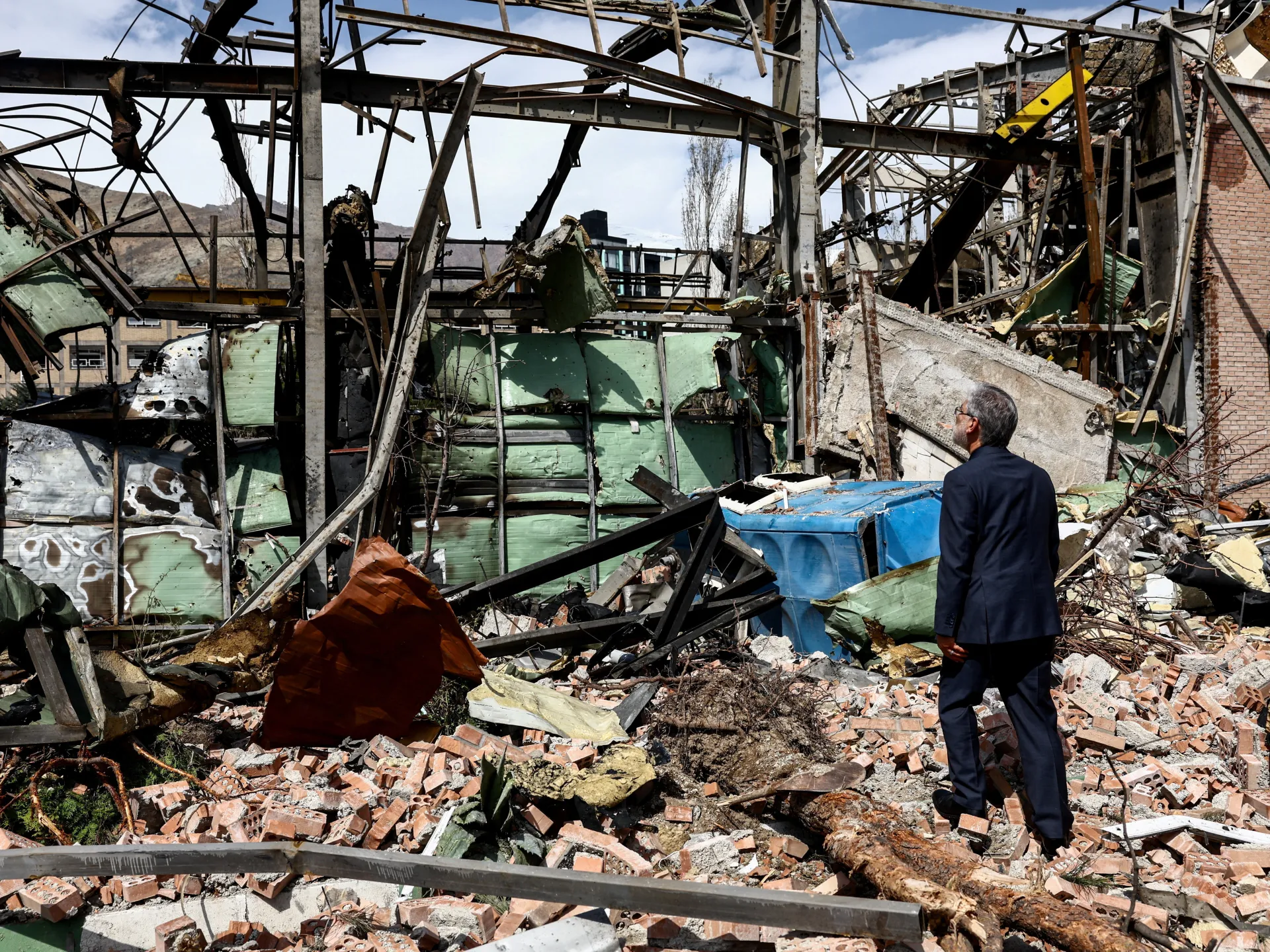
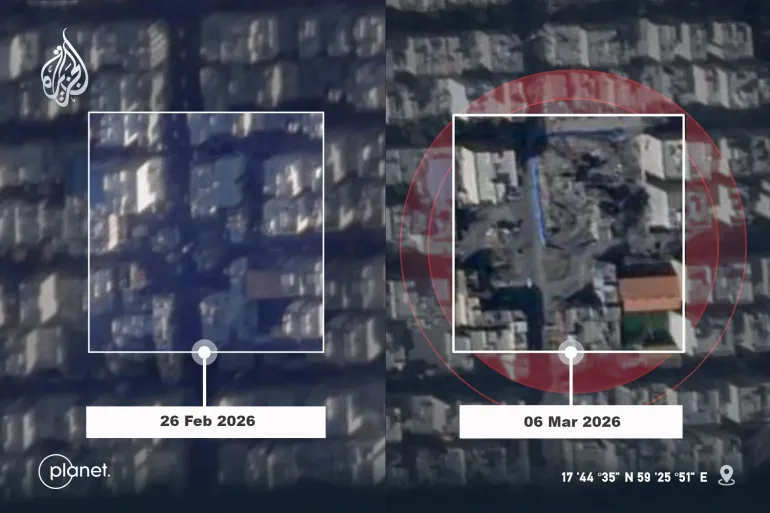
In the densely populated neighbourhoods of southern Tehran, the 11th Criminal Investigation Base once stood as a mundane symbol of local law enforcement. Its detectives investigated economic crimes, fraud and petty thefts.
The building housed no ballistic missiles, no uranium centrifuges and no military command centres. Today, it is a crater. In the opening wave of the United States-Israel war on Iran, warplanes wiped the local police station off the map.
Satellite imagery provided by Planet Labs shows the destruction of the 11th Criminal Investigation Base in southern Tehran on February 26 and March 6, 2026. [Al Jazeera/Planet]
It was not an isolated incident. An investigation by Al Jazeera’s Digital Investigations unit has verified that at least 75 internal security sites were destroyed or damaged in bombardments by Israel and the US from February 28 to March 10. The targeted facilities included local police stations, criminal investigation headquarters, public security offices and checkpoints operated by the Basij paramilitary force.
Al Jazeera mapped the strikes using open-source data, cross-referencing field reports with satellite imagery to confirm the destruction. However, conducting independent verification has grown increasingly difficult. On March 6, commercial satellite providers Planet Labs and Vantor restricted imagery over the Middle East, later expanding the blackout to impose a 14-day delay on all images of Iran.
While the companies said the blackout prevents hostile actors from endangering civilians, independent journalist Ken Klippenstein recently revealed a leaked US Space Force directive dictating how commercial satellite firms describe damage. The leak exposed a deliberate US effort to control the flow of information and obscure the reality of the battlefield.
Targeting population centres
The spatial distribution of the 75 verified strikes revealed a clear and deliberate strategy. Warplanes bypassed isolated military installations to hit the infrastructure Tehran uses to police its citizens.
An Al Jazeera map details the geographic distribution of the 75 internal security sites targeted by US-Israeli strikes, showing a heavy concentration in Tehran and western provinces. [Al Jazeera]
The capital alone absorbed 31 strikes, more than 40 percent of the total targets. Sanandaj, the capital of Kurdistan province, suffered eight strikes. The remaining targets were clustered tightly in major western and central cities, including Isfahan, Kermanshah and Hamedan. Meanwhile, Iran’s sprawling eastern and southeastern provinces remained largely untouched by this campaign.
By overlaying the strike coordinates with demographic maps, the investigation shows a near-perfect alignment with urban density. More than 70 percent of Iran’s population lives in these targeted western urban areas.
A population density map of Iran demonstrates how the strike locations closely align with the country’s most heavily populated urban centres. [Al Jazeera]
The strikes systematically targeted the Law Enforcement Command, known as FARAJA, and the Basij network. FARAJA, elevated in 2021 by late Supreme Leader Ali Khamenei to operate alongside the military, is currently led by Ahmad-Reza Radan. It manages daily urban law enforcement and riot control. The Basij, an immense volunteer paramilitary force deeply embedded in Iranian neighbourhoods, acts as the state’s ultimate tool for social control.
Engineering state collapse
The pattern of the US-Israeli air strikes points to an objective far removed from dismantling nuclear facilities or degrading military infrastructure. It reveals a calculated attempt to engineer the collapse of the Iranian state.
On February 28, US President Donald Trump launched the war and in a video address urged Iranians to take over their government once the bombs stopped falling. Israeli Prime Minister Benjamin Netanyahu echoed this sentiment in Farsi, calling on millions of Iranians to take to the streets and describing the military strategy as breaking the Iranian government’s bones.
The military planning, however, preceded events on the ground that Trump and Netanyahu pointed to for justification for their war. Israeli Defence Minister Israel Katz revealed in early March that Israel had been planning to strike Iran in mid-2026, long before January’s deadly government crackdown across Iran against economic protests.
Satellite imagery captures extensive damage to the Beheshti Basij headquarters in Tehran’s District 8 after the initial wave of strikes. [Al Jazeera/Planet]
This approach aligns with a broader Israeli doctrine. Daniel Levy, a former Israeli government adviser, previously told Al Jazeera that Israel has no interest in a smooth political transition in Tehran. What Israel wants is the collapse of the government and the state, Levy said, adding that if the repercussions spread to Iraq, the Gulf and the entire region, that is better from Israel’s point of view.
A failing strategy
Still, a month into the war, the US-Israeli strategy to spark an internal revolution through the systematic destruction of Iran’s internal security apparatus appears to be failing.
Iranians are living under daily bombardments. As missiles destroy civilian infrastructure and oil refineries burn, daily survival has eclipsed any coordinated political uprising. The United Nations special rapporteur on human rights in Iran has warned that civilians are facing a simultaneous military and human rights crisis.
Rather than collapsing, Iran’s internal security apparatus has adapted. During Ramadan, FARAJA deployed 24-hour patrols across Tehran, and riot police shut down public gatherings before the Persian New Year holiday. After the March 17 assassination of Basij commander Gholamreza Soleimani, Israeli forces released footage of strikes on mobile Basij checkpoints, indicating that Iranian security forces are still controlling the streets.
The US attempt to dismantle state security from the air mirrors its disastrous 2003 de-Baathification policy in neighbouring Iraq, which barred members of the former ruling Baath Party from holding government jobs, dismantled local policing and birthed a devastating sectarian war. Unlike in Iraq, Washington today has no troops on the ground in Iran to fill a security void it is trying to create.
Beneath the rubble of the 11th Criminal Investigation Base and dozens of stations like it, the US and Israel are aiming to bury the Iranian state and spark a popular revolt. Instead, they have trapped millions of civilians in a burning country.
The anti-nuclear artists collective whose work is on display at Pitzer College in Claremont never predicted a nuclear proliferation crisis would break out in the Middle East during their exhibit, or how grimly topical their work would quickly become as a result.
“Atomic Dragons,” wrapping April 4 with a closing-day symposium of nuclear experts, is the work of SWANS, which stands for Slow War Against the Nuclear State. The group is made up of artists, activists and academics with ties to the nuclear industry, including children and spouses of nuclear industrial complex workers — putting a new spin on the “nuclear family.”
The show examines the environmental and human cost of the atomic era through an artistic lens, tracing present day nuclear risk back to its Cold War roots.
The SWANS’ warning call has always been clear, but ”Atomic Dragons” took on a whole new meaning when the United States and Israel launched a joint assault on Iran over its illicit stockpile of nuclear materials Feb. 28, three weeks after the show opened.
“We’re at the start of what will be an exceedingly dangerous period in terms of the Iranian nuclear program,” nuclear policy expert Scott Sagan, who co-directs Stanford’s Center for International Security and Cooperation, said. “We’re likely to have a major, major conflict over this.”
In a time of acute nuclear anxiety, SWANS is an outlet through which the artists process the fear and gravity of our atomic reality.
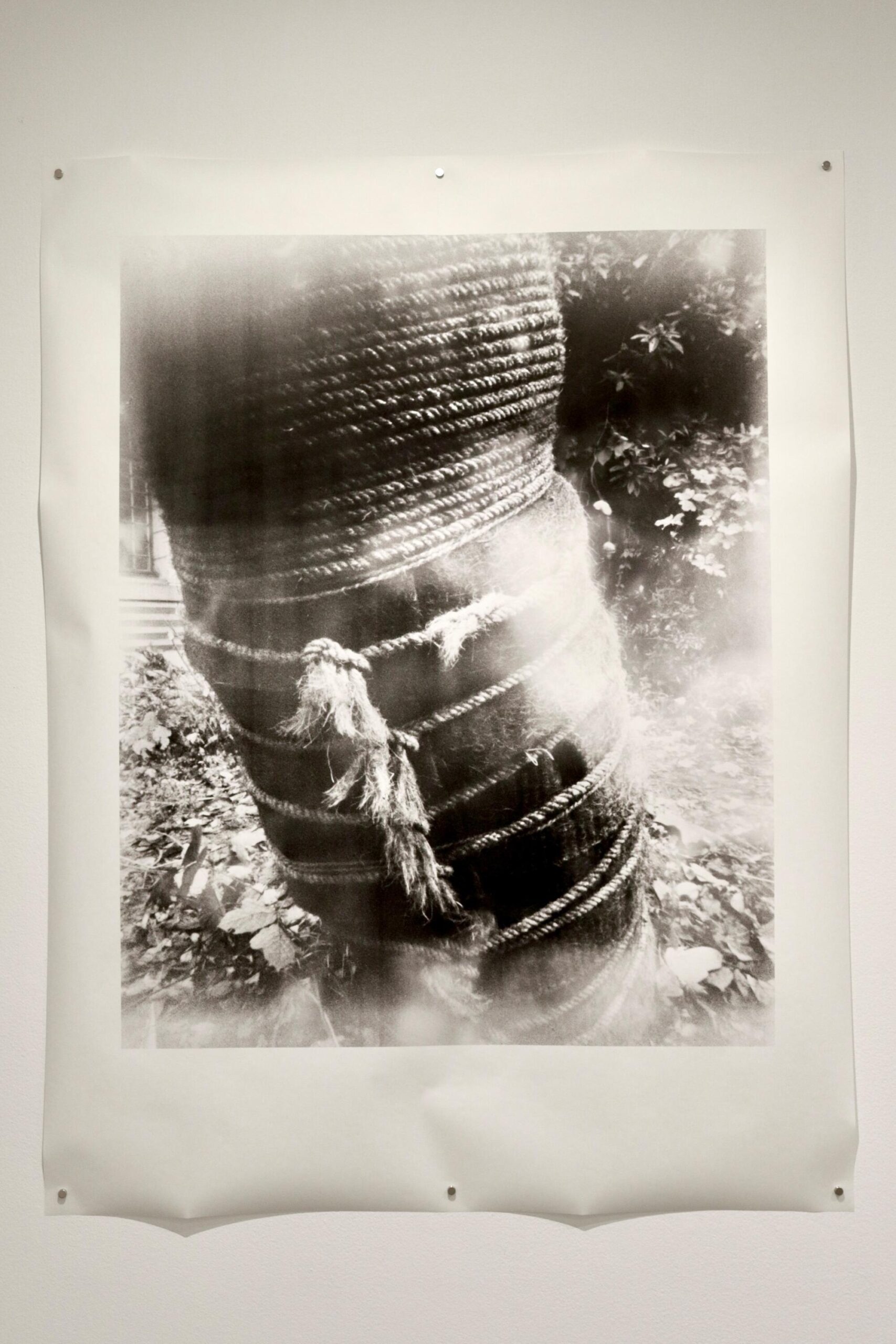
Fiona Amundsen, “Yoshino Cherry Tree, Sanyo Buntokuden, Hiroshima (lovingly held),” 2025, from the series, “The Trees are Leaking Light,” 2024-25, 4 x 5 inch negative processed using seaweed, gathered from the ocean current of the Fukushima wastewater release, inkjet washi photograph.
(Chloe Shrager)
“My maybe-naive hope is that the artworks help to provide an avenue into that understanding of the severity of what it means to play with the nuclear,” said Fiona Amundsen, whose arresting film photography of three trees in Hiroshima that survived the 1945 nuclear bomb was developed using contaminated seaweed growing in the Fukushima wastewater release line.
The resulting images are dotted with delicate white flares: trace amounts of radioactive tritium that transferred to the film from the nuclear effluent during the chemical processing, bearing physical witness to the usually invisible effects of radiation.
Amundsen’s work is in keeping with the rest of the show, which fills two halls at the liberal arts school with visual and multimedia works that probe the persistence of radioactive materials. Artifacts from the birth of the nuclear age are also featured, including items recovered from postwar Hiroshima and a letter from the father of the nuclear bomb, Robert J. Oppenheimer.
The artworks are as likely to unsettle as they are to move.
elin o’Hara slavick, selection from “There Have Been 528 Atmospheric Nuclear Tests to Date,” 2022, photo-chemical drawings on outdated and fogged silver gelatin paper.
(Chloe Shrager)
Slavick said she found the abandoned silver-gelatin paper, which was fogged despite being stored in closed boxes, in the basement of the university near a door labeled “Radiation Science,” which led her to believe radiation exposure from Caltech’s Manhattan Project past distorted the photographic paper.
SWANS seems to double as a support group for families impacted by the nuclear industry. Many members believe they’ve lost loved ones to radiation, or were themselves likely impacted by early-life exposure as children of Manhattan Project engineers. The tension between the anti-nuclear artwork and its artists’ familial ties to the production of the very technology they reject is an enticing dance of its own.
Judith Dancoff, “The Milk Pathway (still),” 2023, video, briefcase, antique milk bottles, and tempera.
(Chloe Shrager)
Writer Judith Dancoff links her hyperthyroidism and long-term reproductive issues from a pituitary gland tumor to childhood radiation exposure during a summer spent at the Oak Ridge uranium enrichment site in Tennessee where her father worked as a student of Oppenheimer. Her father died young of cancer, and the story is woven into her featured SWANS work.
One of the largest pieces on display at “Atomic Dragons” is Nancy Buchanan’s interactive full-wall exhibit of documents her father brought home from his government work as a Manhattan Project physicist, alongside material from the FBI file on his mysterious death, on display for viewers to read under looming red letters spelling out “SECURITY.”
Nancy Buchanan, “Security,” 1987, installation with file folders, photos, map pins, and documents.
(Chloe Shrager)
The current crisis in Iran has sent memories bubbling to the surface for the collective, and chills down the spines of viewers.
Many have expressed fears of an Orwellian-style forever war, or worse, the use of the atomic weapon invented “to end all wars” in a twisted attempt to do so, poisoning the region as a byproduct. But nuclear policy expert Sagan said the likelihood of the conflict escalating to involve nuclear weapons is “exceedingly low,” even if Iran has the capability to build them.
Iran possesses enough 60% highly-enriched uranium to build about 10 nuclear weapons if further enriched to 90% weapons grade, he said. This could take a matter of weeks to complete depending on the state of Iran’s enrichment centrifuges, which Trump claimed to have “obliterated” during air strikes in June.
Iran could also craft a primitive nuclear device out of minimally enriched materials for an offensive attack (“60% could actually create an explosion, it just wouldn’t be a very efficient one,” according to Sagan), but George Perkovich, senior fellow for the Carnegie Endowment for International Peace’s Nuclear Policy Program and author of “How to Assess Nuclear Threats in the 21st Century,” points out that “you have to build more than one for it to be useful,” especially under the wrath of a nuclear-armed West’s expected response.
What is more likely, and probably more dangerous, experts say, is the now-heightened long-term risk of global proliferation. “This war is going to suggest to some countries that if they want to secure their sovereignty, they need nuclear weapons,” Sagan said.
elin o’Hara slavick, selection from “There Have Been 528 Atmospheric Nuclear Tests to Date,” 2022, photo-chemical drawings on outdated and fogged silver gelatin paper.
(Chloe Shrager)
Since 1968, the world nuclear order has rested on the delicate architecture of the Nuclear Non-Proliferation Treaty, enforcing the international norm that countries without nuclear weapons won’t try to get them, and countries with nuclear weapons won’t help arm their allies. Now, experts say the rulebook has been thrown out.
“What this does is it breaks the old system that was based on the non-proliferation treaty,” said Perkovich, who has worked on nuclear issues for 44 years. “It’s now ‘might makes right,’ everybody’s on their own, friends versus enemies. I think the terms now change, and we’re not bargaining.”
Though the timing of the military operation in Iran with the “Atomic Dragons” exhibit could not be described as kismet as much as brutally ironic, slavick said the “sick and sad thing” is that “it’s always topical when you’re an American.”
“We do this. We wage wars. We are the leading nuclear country,” she said, speaking to the heart of the SWANS message: In a world where nuclear materials exist, it is not a matter of if humans will be harmed, but when.
There is a historic relationship between visual art and nuclear war, said Jim Walsh, a senior research associate at the MIT Security Studies Program on nuclear weapons risk issues in Iran and North Korea, who is also a speaker at the exhibit’s closing symposium. As the world enters a “more disruptive period” after the post-Cold War cooling of nuclear tensions, he expects to soon see “a flowering of artistic projects,” as nuclear risk reaches a local peak. “It’s a super powerful thing involving life and death, the planet, the entire environment, love and hate,” he said.
“Atomic Dragons,” which also features work created decades ago, highlights questions that are as relevant today as they were at the dawn of the nuclear era: Can we make the world safe enough so we can once again dream? Is the strength of a country found in its military rather than its culture? Is fear our gross national product?
Symposium: Art, Science, and the Nuclear Legacy
A talk by nuclear expert panelists Jim Walsh and David Richardson, as well as a viewing of the “Atomic Dragons” art exhibit and a conversation with the artists. Coffee and a light lunch will be served.
When: Saturday, April 4, 11 a.m. – 4 p.m. Where: George C. S. Benson Auditorium, Pitzer College Tickets:Free RSVP Info: Details on event website