Car bomb hijacking victim 'incredibly brave', says police chief
Chief Constable Jon Boutcher says his officers suspect the bombing was carried out by the dissident republican group known as the New IRA.
Source link
Chief Constable Jon Boutcher says his officers suspect the bombing was carried out by the dissident republican group known as the New IRA.
Source link
Published On 26 Apr 202626 Apr 2026
A highway bomb attack in southwestern Colombia has killed 19 people and injured at least 38, the latest spate of violence ahead of next month’s presidential election.
Buses and vans were left mangled in the blast Saturday on the Pan-American Highway, in the restive southwestern Cauca department.
Several cars were flipped over by the force of the explosion and a large crater was blown out of the roadway.
The department’s governor on Saturday evening provided a death toll of 14, with more than 38 injured, but the National Institute of Legal Medicine and Forensic Sciences said Sunday morning it had begun the examination of 19 bodies.
Military chief Hugo Lopez told a news conference on Saturday that the bomb had exploded after assailants stopped traffic by blocking the road with a bus and another vehicle.
The attack comes just over one month ahead of national elections, in which voters will pick a successor to President Gustavo Petro.
Petro blamed the bombing on Ivan Mordisco, the South American country’s most-wanted criminal, whom the president has compared to late cocaine kingpin Pablo Escobar.
The violence came after a bomb attack on Friday on a military base in Cali, Colombia’s third-largest city, injured two people and set off a string of attacks in the Valle del Cauca and Cauca departments.
According to Lopez, 26 attacks have been recorded in the two departments over the past two days.
Authorities have boosted military and police presence in the areas, Defence Minister Pedro Sanchez said.
Security is one of the central issues of the May 31 presidential election. Political violence was brought into sharp focus last June, when young conservative presidential frontrunner Miguel Uribe Turbay was shot in broad daylight while campaigning in the capital Bogota and later died from his wounds.
Leftist Senator Ivan Cepeda, an architect of Petro’s controversial policy of negotiating with armed groups, is ahead in polls.
He is trailed by right-wing candidates Abelardo de la Espriella and Paloma Valencia, both of whom have pledged to take a hard line against rebel groups.
All three have reported receiving death threats and are campaigning under heavy security.
The TWZ Newsletter
Weekly insights and analysis on the latest developments in military technology, strategy, and foreign policy.
Videos and other imagery bearing witness to the awesome destructive power of nuclear detonations remain some of the most enduring legacies of the Cold War. But of the more than 2,000 nuclear weapons tests that have been carried out since 1945, only very, very few have involved a live weapon dropped from a fighter-bomber.
A nuclear strike performed by the Su-7
At least one such test took place in the Soviet Union, however. On his X account, Sam Wise, an aviation analyst at Janes, brought our attention to footage that purportedly shows that test, or at least portions of it.
It’s a shame about the poor condition of the footage because this is some extremely rare and compelling footage of a nuclear armed Su-7. Special mention to the extraordinary lean forward when the brakes are applied!https://t.co/tlrOnnAAdN
— Sam Wise Aviation (@samwiseaviation) April 21, 2026
The test in question was especially notable in that it involved a free-fall tactical nuclear bomb that was delivered by a crewed fighter-bomber, specifically a Su-7 Fitter attack jet, in an end-to-end test.
Of those 2,000-plus nuclear tests, only a small fraction involved bombs dropped from aircraft of any kind — roughly 200 to 250 according to records compiled by the Comprehensive Nuclear-Test-Ban Treaty Organization. Those tests almost always involved bombers, aircraft with multiple engines, several crew members, and, often, dedicated to delivering nuclear weapons.

The vast majority of nuclear tests were conducted underground, at sea, or on land. In the latter case, the devices were typically detonated from an elevated position, either atop a tower or suspended from a balloon. This better replicated the conditions of a typical nuclear detonation, with the weapon engineered to explode in an air burst above the ground, for maximum effect.

One reason for the relative scarcity of air-dropped nuclear bomb tests was the Partial Test Ban Treaty of 1963, which pushed testing underground.
At the same time, dropping a live nuclear weapon from a crewed aircraft brings additional risks for relatively little benefit.
At the beginning of the nuclear age, air-dropped tests were useful to prove that bombs could be delivered, but they were inefficient in terms of scientific measurement and riskier to conduct from a safety point of view. Dropping a nuclear device from an aircraft adds variables (altitude, speed, trajectory) that complicate measurements. If something goes wrong, you risk losing a plane, or worse, an accidental detonation or contamination spread.

Based on the available information, it appears that the U.S. military never tested a live tactical nuclear bomb dropped by a tactical combat jet, despite the very many platforms, both Air Force and Navy, that were cleared to carry them operationally.
It should be noted that the U.S. Air Force did detonate one tactical nuclear weapon after launch from a fighter. However, this involved an air-to-air rocket, the nuclear-tipped Genie, which was fired on this occasion from an F-89 interceptor, in 1957’s Operation Plumbbob John.
Project Genie : Air-to-air rocket nuclear testing
France does appear to have conducted a live test of an air-dropped tactical nuclear bomb, with an AN52 dropped from a Jaguar attack jet in August 1972, to help prove that weapon for service.
Returning to the Soviet Union, on August 27, 1962, pilot Lt. Col. A. I. Shein took off in a single-seat Su-7B, with a live 244N nuclear bomb carried on the centerline station below the fuselage. He then headed for the Semipalatinsk test site on the Soviet steppe. Also known as “The Polygon,” the Semipalatinsk range was the main test site for Soviet nuclear weapons. It is in the Abai region, in what is now Kazakhstan.

Shein put the jet into a climb at an angle of around 45 degrees. This was an ‘over-the-shoulder’ toss maneuver, typical for fighter-bombers of this era. This involved the attacking aircraft pulling upward before releasing its bomb to compensate for the weapon’s gravity drop in flight. The result would put the weapon on the target, without the aircraft having to pass over it. Instead, the jet would complete a half roll and (hopefully) avoid the blast effects so it could escape. The launch maneuver sequence, as shown in the video, is apparently simulated, or at the least, heavily edited.

Shein later recalled:
“I take off, the excitement subsides, I enter the combat course, and make an approach. Everything is normal, I make an approach for a combat release, bring the aircraft into a nose-up attitude, and monitor the G-forces. After four seconds, I hear a signal, then a second, a short third, and I press the ‘release’ trigger. The green light goes out, indicating the release has been completed. The bomb’s release is felt by the shaking of the aircraft. I continue the nose-up attitude. For control, I note the release angle; it is almost constant and equal to 44–50 degrees. After passing the top point, I then descend at a 50-60 degree angle, perform a half-roll, increase engine speed and, consequently, aircraft speed, descend to the lowest possible altitude, and try to get as far and as quickly as possible from the target.”
This method required a bomb computer to calculate the release point. For the U.S. Air Force, this was the Low Altitude Bombing System, or LABS, while the Su-7 was fitted with the equivalent PBK-1 device, a separate box that was added to the left side of the instrument panel. In this context, PBK denoted Pritsel dliya Bombometaniya s Kabrirovaniya, or toss-bombing sight.
A video shows a U.S. Air Force B-47 bomber flying the LABS maneuver:
Boeing B-47 Stratojet (Low Altitude Bombing System) LABS Maneuver
After release from the Su-7, the bomb exploded at an altitude of around 800 feet, at the coordinates of 50.4°N and 77.8°E. The detonation had a yield of 11 kilotons.


As for the Su-7, this was the Soviet Union’s first-generation supersonic attack jet. It was rapidly equipping fighter-bomber regiments, and nuclear strike would become one of its most important duties.
The streamlined 244N was the first mass-produced Soviet tactical nuclear bomb specifically intended for carriage by supersonic jets.
A photo showing the earlier, non-streamlined RDS-4 tactical free-fall bomb:
RDS-4 “Tatyana” was a Soviet atomic bomb that was first tested with a yield of 27 kilotons at Semipalatinsk Test Site, on August 23, 1953. The Soviet Union’s first mass-produced tactical nuclear weapon. pic.twitter.com/c7xdODw0tZ
— NUKES (@atomicarchive) August 24, 2023
At this point, it should be noted that there is a possibility that the video shows not the 244N, but an IAB-500, a so-called ‘imitation bomb’ that replicated the shape, dimensions, weight and flight characteristics of the nuclear device. Filled with a mixture of liquid petroleum and white phosphorus, it also produced a large fireball that subsequently turned into a mushroom cloud.
With that in mind, the video could at least show portions of an IAB-500 test, although the location and the original voiceover point squarely to the 1962 Semipalatinsk test. The apparent installation of a camera pod below the Su-7’s wing, to record the detonation, also suggests a nuclear test rather than training.
Regardless, the 244N was successfully tested and was put into operational service in several variants, including with different yields up to a maximum of 30 kilotons. Most of these bombs were deployed by Soviet units stationed close to what would have been the front line in the event of a confrontation with NATO: in East Germany, Hungary, and Poland.
Starting in 1967, Western intelligence began to note training activities involving nuclear weapons at Soviet airbases in East Germany, including Su-7s taking part in LABS-type maneuvers.
In one of its reports from 1967, the U.S. Military Liaison Mission (USMLM) noted that its staff identified Su-7s from Grossenhain Air Base performing at least four LABS practice delivery runs on October 7 of that year.
“The aircraft passed over the airfield at approximately 2,000 feet, pulled up into vertical climb to 3,500 feet, pitched over, flew inverted for several seconds, then rolled over again departing to the west.”
Two days later, the USMLM reported “A very active program of local navigational, touch-and-go landings, LABS maneuvers, and possible range activity flown by Grossenhain-based Fitter and [two-seat Su-7] Moujik” aircraft.
Air-dropped tactical nuclear weapons still play a significant role in Russia’s military strategy, as evidenced by recent moves to station tactical devices in Belarus. Many Russian combat aircraft have variants capable of carrying nuclear bombs, and most Russian air-launched missiles weighing over around 1,000 pounds have the option of a nuclear warhead.
Russia really wants West to see they’re doing a tac nuke exercise. After several exercise videos they put the head of the 12 GUMO in front of a Belarusian Su-25 (possibly at Lida air base) loaded with what is said to be “training nuclear ammunition.” https://t.co/h9rHp2qvGv pic.twitter.com/sTzAqSNd9f
— Hans Kristensen (also on Bluesky) (@nukestrat) June 13, 2024
Starting in the 1960s, the 244N was superseded by a modernized development of the same weapon, the 10-kiloton RN-24, as well as the one-kiloton RN-28. These were carried, among others, by the MiG-21 and Su-7.
These bombs were followed in the 1980s followed by the RN-40 and RN-41, carried by the MiG-23, MiG-27, MiG-29, Su-17, Su-24, and Su-27.
To this day, the IAB-500 also remains in use to train combat jet pilots in nuclear bomb delivery. Alongside it, although much less known, and barely ever seen, are tactical nuclear bombs, the descendants of the 244N that was proven in a unique test back in 1962.
Contact the author: thomas@thewarzone.com
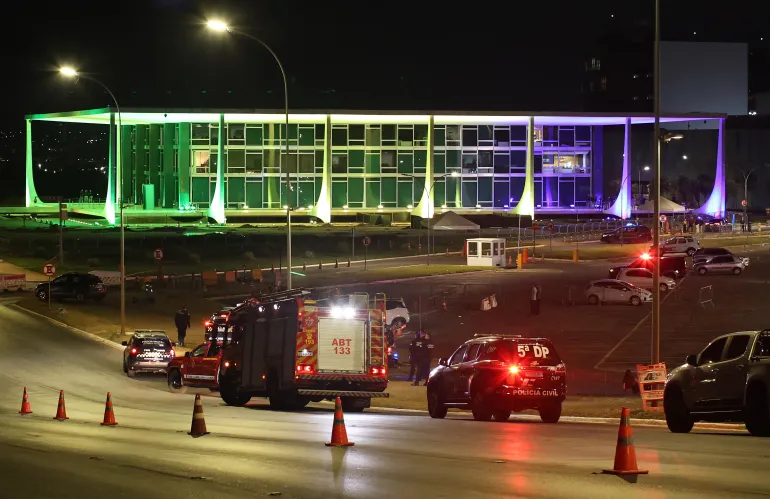
April 26 (UPI) — Police in Northern Ireland said Sunday morning that the New IRA is believed to have been involved in a car bombing near a police station in Belfast.
Detectives are treating a car bombing outside a police station in the Dunmurry area of outer Belfast as an attempted murder, and said called it a miracle that nobody was injured, The Guardian and the Belfast Telegraph reported.
A delivery car was hijacked late Saturday night in West Belfast, an explosive device was placed in the car’s boot and the delivery driver was told to drive to the police station and abandon it there, police said.
Bobby Singleton, deputy chief constable of the Police Service of Northern Ireland, told reporters that the attack was nearly identical to an attack earlier this year.
“As a consequence of that, our early working hypothesis is that this may well be the work of the New IRA, who claimed responsibility for the attack in Lurgen,” Singleton said.
“Thanks to the swift actions of police, no one has been injured, which is nothing short of miraculous,” he said.
The attempt on a Lurgen police station in March was unsuccessful because the device did not detonate, but the method — hijacking a car and forcing the driver to abandon the bomb on wheels somewhere — was nearly the same, Singleton said.

United States President Donald Trump has claimed that a new nuclear deal being negotiated with Iran will be “far better” than the 2015 Joint Comprehensive Plan of Action (JCPOA), which the US withdrew from in 2018 during his first term.
On Tuesday, Trump extended the two-week ceasefire with Iran a day before it was set to expire, with hopes for a second round of talks in Islamabad, Pakistan.
Key among the US demands is that Iran stop all enrichment of uranium.
Iran has always insisted its nuclear programme is for civilian use only, such as for power generation, which requires uranium enrichment of between 3 percent and 5 percent. To build nuclear weapons, uranium needs to be enriched to 90 percent.
In this explainer, we visualise what uranium is, how it is enriched and how long it could take Iran to make a nuclear weapon.
Uranium is a dense metal used as a fuel in nuclear reactors and weapons. It is naturally radioactive and usually found in low concentrations in rocks, soil and even seawater. About 90 percent of the world’s uranium is produced in just five countries: Kazakhstan, Canada, Namibia, Australia and Uzbekistan. Reserves of uranium have also been found in other countries.
Uranium is extracted either by digging it out of the ground or, more commonly, through a chemical process that dissolves uranium from within the rock.

Before it can be used as nuclear fuel, uranium is processed through several different forms, including:

Natural uranium exists in three forms, called isotopes. They are the same element, with the same number of protons but different numbers of neutrons.
Most naturally occurring uranium (99.3 percent) is U-238 – the heaviest and least radioactive – while about 0.7 percent is U-235 and trace amounts (0.005 percent) are U-234.
To generate energy, scientists separate the lighter, more radioactive U-235 from the slightly heavier U-238 in a process called uranium enrichment. U-235 can sustain a nuclear chain reaction while U-238 cannot.
To enrich uranium, it must first be converted into a gas, known as uranium hexafluoride (UF₆). This gas is fed into a series of fast-spinning cylinders called centrifuges. These cylinders spin at extremely high speeds (often more than 1,000 revolutions per second). The spinning force pushes the heavier U-238 to the outer walls, while the lighter U-235 stays in the centre and is collected.
A single centrifuge provides only a tiny amount of separation. To reach higher concentrations – or “enrichment” – the process is repeated through a series of centrifuges, called a cascade, until the desired concentration of U-235 is achieved.

The higher the U‑235 percentage, the more highly enriched the uranium is.
Small amounts (3-5 percent) are enough to fuel nuclear power reactors, while weapons require much higher enrichment levels (about 90 percent).
The International Atomic Energy Agency (IAEA) considers anything below 20 percent to be low-enriched uranium (LEU), while anything above 20 percent is considered highly-enriched uranium (HEU).
Low enriched – less than 20 percent
Highly enriched – More than 20 percent
Depleted uranium, which contains less than 0.3 percent U‑235, is the leftover product after enrichment. It can be used for radiation shielding or as projectiles in armour‑piercing weapons.
The effort it takes to enrich uranium is not linear, meaning it is much more difficult to go from 0.7 percent natural uranium to 20 percent LEU than it is to go from 20 percent to 90 percent HEU. Once uranium reaches 60 percent enrichment, it becomes much quicker to reach 90 percent weapons grade.
The effort it takes to enrich uranium is measured in separative work units (SWU).
According to the IAEA, Iran is believed to have about 440kg (970lbs) of uranium enriched to 60 percent – enough to theoretically build 10 or 11 low-technology atomic bombs if refined to 90 percent.

Ted Postol, professor emeritus of science, technology and international security at the Massachusetts Institute of Technology (MIT), told Al Jazeera that before the US attack on Iran’s nuclear facility at Fordow, the country had at least 10 cascades of 174 IR-6 centrifuges in operation – meaning 1,740 IR-6 centrifuges.
The IR-6 is one of Iran’s most advanced centrifuge models. The country also has tens of thousands of older centrifuges.
Little is known about the conditions of these centrifuges or the stocks of uranium hexafluoride, which are still believed to be buried underground.
Postol has calculated that Iran’s cascade of centrifuges could produce 900 to 1,000 SWUs annually.
“Getting from natural uranium to 60 percent enrichment, which Iran has already achieved, takes roughly five years, and about 5,000 SWUs using Iran’s cascades.”
“If I want to go from 60 to 90 percent, I only need 500 SWUs. So, instead of five years, [by] starting with the 60 percent here, this might take me four or five weeks. Because I am already very enriched,” Postol said.
Using an analogy of a clock, Postol explained: “Let’s say it takes seven minutes to get 33 percent enrichment, and then eight minutes to get to 50 percent enrichment. It only takes me one minute to get to total [90 percent] enrichment.”

Postol said Iran’s stockpile is held underground, meaning a military strike would not necessarily eliminate the nuclear threat.
A single centrifuge cascade capable of enriching weapons-grade uranium could take up “no more floor space than a studio apartment, making it easily hidden in a small laboratory”, he said, estimating the area at 60sq metres (600sq feet).
“A single Prius Compact Hybrid car can produce enough electric power to run four or more of these cascades at a time,” Postol added, meaning “Iran can covertly convert its 60 percent uranium into weapons-grade uranium metal”.
“What they have done is put themselves in a position where anybody who thinks about attacking them with nuclear weapons has to know that they could be sitting in those tunnels after such an attack, refining [and] enriching the final step they need to build atomic weapons and converting it to metal, and building a nuclear weapon, and that they have the means to deliver it,” Postol said.
“They would have all of the technical equipment they need to build the atomic weapons. And they have the missiles, which are also in the tunnels and can be manufactured in addition to what they already have. And the atomic weapon would not need to be tested, because uranium weapons do not need to be tested before they’re used.”
The Treaty on the Non-Proliferation of Nuclear Weapons (NPT), established in 1968, is a landmark international agreement aimed at preventing the spread of nuclear weapons and promoting peaceful uses of nuclear energy. Iran is a signatory to this pact.
The treaty supports the right of all signatories to access nuclear technology and enrich uranium for peaceful purposes, including energy, medical or industrial purposes, with precise safeguards to ensure it is not diverted to make weapons.
Under the NPT, nuclear-weapon states agree not to transfer nuclear weapons or assist non-nuclear-weapon states in developing them. Non-nuclear-weapon states also agree not to seek or acquire nuclear weapons.
Despite this, most nuclear powers are currently modernising their arsenals rather than dismantling them.
Most of the countries are signatories, except five: India, Pakistan, Israel, South Sudan and North Korea.

In 2015, under the Obama administration, Iran struck a deal with six world powers — China, France, Germany, Russia, the United Kingdom and the US — plus the European Union, known as the JCPOA.
Under the pact, Tehran agreed to scale down its nuclear programme, capping enrichment to 3.67 percent, in exchange for relief from sanctions.
“The Iranians agreed to it, and they were following the treaty. There was no problem with the treaty at all, absolutely no problem,” Postol said.
“They were allowed to have 6,000 centrifuges, which, if they had natural uranium, they could probably build a bomb within a year if they were secretly using these centrifuges, but that was all under inspection. They were just simply going to enrich to 3.67 percent, which is for a power reactor. They’re allowed to do that by the Non-Proliferation Treaty.”
But in 2018, Trump pulled out of the deal, calling it “one-sided” and reimposing sanctions on Iran. Iran responded by eventually resuming enrichment at Fordow.
After the US killed Iran’s General Qassem Soleimani in January 2020, Tehran stated it would no longer follow the set uranium enrichment limits.
Former President Joe Biden made attempts to revive the deal, but it never came to fruition due to disagreements over whether sanctions should be lifted first or Iran should rejoin the JCPOA first.
Trump has repeatedly said Iran should not have the ability to produce nuclear weapons. It has been one of Washington’s red lines during talks with Iranian officials over the past year, and was also the central justification that Washington used when it bombed Iranian nuclear facilities during the 12-day US-Israel war on Iran last year.
In the current negotiations, Iran has said it is willing to “downblend” its 60 percent enriched uranium to about 20 percent – the threshold for low-enriched uranium. The process of downblending involves mixing stocks with depleted uranium to achieve a lower percentage of enriched U-235 overall.
“From the point of view of showing goodwill, I think it’s good, it shows that the Iranians are thinking of ways to address what the Americans claim are their concerns,” Postol said.

Nine countries possessed roughly 12,187 nuclear warheads as of early 2026, according to the Federation of American Scientists. Approximately two-thirds are owned by two nations – Russia (4,400) and the US (3,700), excluding their retired nuclear arsenals.
Some 9,745 of the total existing nuclear weapons are military stockpiles for missiles, submarines and aircraft. The rest have been retired. Of the military stockpile, 3,912 are currently deployed on missiles or at bomber bases, according to the Federation of American Scientists. Of these, some 2,100 are on US, Russian, British and French warheads, ready for use at short notice.
While Russia and the US have dismantled thousands of warheads, several countries are thought to be increasing their stockpiles, notably China.
The only country to have voluntarily relinquished nuclear weapons is South Africa. In 1989, the government halted its nuclear weapons programme and began dismantling its six nuclear weapons the following year.
Israel is believed to possess nuclear weapons, with a stockpile of at least 90. It has consistently neither confirmed nor denied this, and despite numerous treaties, it faces little international pressure for transparency.

Russia’s FSB accused the woman, found with a bomb in her backpack, of taking part in a plot hatched by Ukraine.
Published On 20 Apr 202620 Apr 2026
Russian authorities say they have thwarted a Ukraine-linked bomb plot against security services and arrested a German woman found with a makeshift bomb in her backpack.
Russia’s FSB security agency said the unnamed woman was detained on Monday in the southern city of Pyatigorsk.
list of 3 itemsend of list
In a statement cited by Russia’s state-run TASS news agency, the FSB said it had “prevented a terrorist attack planned by the Kyiv regime against a law enforcement facility in the Stavropol region, involving a German citizen born in 1969”.
It said the woman had been recruited by a citizen from a Central Asian country, who was working on orders from Ukraine. That man was found and arrested near the targeted site.
According to the FSB, the device contained an explosive charge equivalent to 1.5kg (3 pounds) of TNT and was intended to be detonated remotely. The agency said the blast was ultimately prevented by electronic jamming.
Video of the purported arrest published by Russia’s state RIA Novosti news agency showed armed Russian security agents approach the woman as she was face down in a car park.
Another video showed masked plainclothes agents pulling a man into a station, followed by a controlled explosion of the backpack.
Russia has arrested dozens of people throughout the four-year war, mostly its own citizens, on allegations of working for Ukraine to carry out sabotage attacks.
Russia has previously accused Ukraine of working with Islamic fundamentalists to carry out attacks inside Russia, without providing evidence.
Officials initially alleged that the perpetrators of a 2024 massacre at a concert hall on the outskirts of Moscow that killed 150 people were ISIL (ISIS) members in coordination with Ukraine.
ISIL claimed responsibility for that attack, making no reference of any Ukrainian involvement, for which no evidence was presented by Moscow and which Kyiv denies.
The fate of an Iranian woman caught in a US-Israeli bomb attack is unknown, after video emerged of the moments she filmed the bombardment on her phone.
Published On 21 Mar 202621 Mar 2026
Share
Umar Muhammad Mustapha had just stepped out of the mosque when he heard someone say an explosion had gone off in the Maiduguri Monday Market area on the evening of March 16. He panicked and asked when. “Just a moment ago,” someone replied, “while we were praying.”
Immediately, Umar began dialling his nephew’s number as he rushed toward the scene without first returning home. “The phone kept ringing, but he did not answer. A few moments later, it prompted ‘switched off’,” he recalled.
That was when the panic deepened.
“I began dialling those whose shops were close to ours.”
Umar sells gabgab at the market. His nephew, Muhammad Ibrahim, makes the local incense while he sells it. The 27-year-old has been with Umar since he was nine.
As he moved through the city that Monday evening, his thoughts raced ahead of him. “I began to imagine the condition in which I would meet him,” Umar said. “Is he alright? Is he alive? Is he dead? Is he injured? And how bad his injuries might be.”
They both work at the market, but that day, Umar stayed at home.
That night, at around 7 p.m., three explosions simultaneously rocked parts of Maiduguri, the Borno State capital in northeastern Nigeria, including the Monday Market, the Post Office area along Ahmadu Bello Way, and the entrance of the University of Maiduguri Teaching Hospital (UMTH).
As he hailed a tricycle to rush to the market, Umar was restless. “I felt as though the keke was not going fast enough and kept urging the driver to go faster,” he said.
Before he reached the market, Umar’s phone rang, and Muhammad’s name was displayed. But when he answered, a different voice spoke. “Come to the emergency ward of General [State Specialist Hospital],” the person said.
In that moment, uncertainty gave way to reality. “An explosion occurred; he was affected,” the person continued. “He was brought to the hospital. You are the last person he talked to, so we are reaching out.”

The blasts at the market and the Post Office were especially devastating. The two locations sit minutes apart. Traders had closed for the day and were heading home when the first explosion tore through the Elkanemi junction, near the market.

In the immediate aftermath of the first blast, many people scattered and ran towards the Post Office area. Muhammad was among them. At the time Umar was trying to reach him, he had already escaped the market blast. In the confusion, he could not hear his phone. As he ran towards the Post Office area, another explosion went off.
It caught him, and he sustained injuries to his chest and legs.
When HumAngle visited the hospital on Tuesday, March 17, Muhammad could not speak, only nodding when spoken to. Umar said he was scheduled for surgery later in the evening.

Other survivors also carry similar stories.
Mohammed Babagana Bukar had just bought a pair of shoes for Eid al-Fitr, which is in a few days, with money he earned as a porter at the market. When the blast happened, the 15-year-old said, “We panicked and began running towards the Post Office when another one went off, close to where the flyover is being constructed.”
He was brought to the hospital by a stranger. “He carried me as I could not walk.”
Fantami Modu didn’t escape the first blast that rocked the market; he was injured.
“It affected my leg,” the 40-year-old said. “We were brought to the hospital by the police.” Fantami sells clothing materials and earns about ₦7,000 daily. It is what he uses to feed his family.
Get our in-depth, creative coverage of conflict and development delivered to you every weekend.
Subscribe now to our newsletter!
Now, he cannot work. Beside him, his brother, Babagana, said they are contributing to support the household until he recovers.
According to the Borno State Police Command, 23 people were killed, and 108 were injured in the multiple bomb blasts. No terror group has claimed responsibility for the attacks, but the Nigerian Army said they were “carried out by suspected Boko Haram terrorist suicide bombers”.
“Preliminary information further indicates that the terrorists may have deployed multiple suicide bombers into Maiduguri with the intention of carrying out coordinated suicide bombings at crowded locations,” Lieutenant Colonel Sani Uba, Media Information Officer of the Joint Task Force North East Operation Hadin Kai, said in a statement.
At the State Specialist Hospital, where victims were first rushed to, HumAngle counted 13 survivors on admission. The hospital is less than two kilometres from the scenes. Of these 13, 11 were males and two females, with varying degrees of injuries to the arm, leg, and chest.
Nurses at the hospital said at least 40 people were brought to the emergency ward that night, with many later referred to the UMTH. Only 14 survivors were eventually admitted, but one died on arrival.

UMTH was also targeted that night. An explosion that went off at the hospital’s entrance. Although no civilian casualties were recorded, sources said that a suspected suicide bomber, who tried to enter the hospital on a bicycle before he was stopped by security operatives, died in the incident.
For some residents, the events revived familiar anxieties.
“We had just broken our fast and were waiting for a tricycle to return home when we heard the explosion close to the Monday Market,” Sulaiman Muhammad, a resident, recounted. “Less than 20 minutes after, we heard another one from the Post Office area. In panic, we scattered.”
He did not go to the scene. “It is dangerous,” he said. “I remember in one explosion like this inside the market at the peak of the [Boko Haram] insurgency, another explosion went off immediately people gathered to help victims.”

Now, those memories are resurfacing. “People are in panic,” he said. “We had begun to experience relative calm until the past few days.”
Sulaiman has sold shoes at the market for more than 20 years. He believes the attacks will affect business. “As you can see, no one is out [to sell],” he said.
These incidents are part of a broader pattern of escalating violence.
The explosions came barely 24 hours after terrorists attacked a military base in Kofa, a community close to Ajilari on the outskirts of Maiduguri, on March 16. Joint security operatives repelled the attack, leaving many terrorists dead.
However, before then, there had been attacks by terror groups across Borno State, including assaults on rural military bases and resettled communities like Ngoshe and Dalwa. Also, on Dec. 25, 2025, a suicide bomber detonated at a mosque in the Gamboru Market area of Maiduguri. Five people were killed, and 35 others were injured.
Taken together, these incidents point to what observers describe as a violent resurgence. HumAngle has reported that the terror groups operating in the region have undergone several technological shifts that have aided their expanded attacks and operations, including the use of artificial intelligence and drones.
For Umar, the incident has narrowed into something smaller, more personal.
Muhammad, he said, loves to read.
“He would read verses from the Qur’an after his morning prayer. And after breakfast, he would head to the market. And by evening, he would return home. He would read in the evening too, before going to bed.”
When asked what he hopes for, Umar paused.
“I would have hoped for more security or for more vigilance,” he said. “But what would an empty hope solve? Authorities know what to do. They would act properly if they intend to.”
WASHINGTON — President Trump’s sweeping act of clemency for rioters who stormed the U.S. Capitol also should apply to a man charged with planting pipe bombs near the national headquarters of the Democratic and Republican parties on the eve of the Jan. 6, 2021, riot, the suspect’s attorneys argue in a bid to get his case dismissed.
In a court filing Monday, defense attorneys assert that Trump’s blanket pardons extend to the charges against Brian J. Cole Jr. because his alleged conduct on Jan. 5, 2021, is “inextricably tethered” to what happened at the Capitol the next day. They’re asking U.S. District Judge Amir Ali to throw out the case before trial.
Justice Department prosecutors didn’t immediately respond in writing to the defense’s request. In a previous court filing, prosecutors said Cole, under questioning by FBI agents, denied that his actions were related to the Jan. 6 proceedings at the Capitol.
On his first day back in the White House last year, Trump pardoned, commuted prison sentences and ordered the dismissal of all 1,500-plus people charged in the attack by a mob of his supporters.
Nearly a year later, Cole was arrested on charges that he placed two pipe bombs outside both the Republican and the Democratic national committees’ headquarters in Washington the night before the riot. The devices didn’t detonate before law enforcement officers discovered them Jan. 6.
Cole’s attorneys said the Justice Department’s framing of the case has explicitly linked Cole’s alleged conduct on Jan. 5 to the events of Jan. 6, when rioters disrupted the joint session of Congress for certifying Joe Biden’s electoral victory over Trump.
“That is not happenstance sequencing in time. It is the government’s theory of Mr. Cole’s alleged motive and context,” defense lawyers wrote. “According to the government, the timing was chosen because of what was scheduled to occur at the Capitol on January 6.”
They also argued that prosecutors’ theory of a possible motive places Cole’s alleged conduct “in the same political controversy that animated the January 6 crowd.”
In court filings, prosecutors have said that Cole confessed to investigators after his Dec. 4 arrest. He told FBI agents that he felt “bewildered” by conspiracy theories related to the 2020 presidential election and “something just snapped” after “watching everything, just everything getting worse,” prosecutors said.
Cole has remained jailed since his arrest. His attorneys have appealed Ali’s refusal to order Cole’s pretrial release from custody. The judge hasn’t set a trial date yet.
Cole, 30, of Woodbridge, Virginia, has been diagnosed with autism and obsessive-compulsive disorder. His attorneys say he has no criminal record.
Authorities said they used phone records and other evidence to identify him as a suspect in a crime that confounded the FBI for more than four years.
Kunzelman writes for the Associated Press.
WASHINGTON — Days after he was named Iran’s next supreme leader, and over a week since U.S. and Israeli bombing wiped out much of his family, Mojtaba Khamenei issued his first statement on Thursday demanding vengeance against the alliance over the war it unleashed.
He called on Iranian forces to continue thwarting vital shipping traffic through the Strait of Hormuz. He vowed to open new fronts against the United States and Israel. And he warned that Gulf states hosting U.S. bases would remain targets of Iranian attack.
Yet, what concerned the White House most was what the new supreme leader didn’t say.
Khamenei made no mention of a strategic endeavor that had brought the Islamic Republic to war: Its nuclear program, suspected for decades of harboring military dimensions.
The omission was not lost on officials in the Trump administration, who told The Times they are largely in the dark over the new supreme leader’s stance on whether Iran should break out to build a nuclear weapon.
Khamenei’s deep alliance with the Islamic Revolutionary Guard Corps, which has advocated for weaponization in the past, has raised concern that the new leader will depart from his father’s long-standing position against building a bomb.
U.S. intelligence assessments long held that the late ayatollah, Ali Khamenei, had adopted a strategy of remaining at the threshold of developing a nuclear weapon while avoiding the costs and risks of actually building one. In 2003, as the United States invaded Iraq over false claims that Saddam Hussein possessed weapons of mass destruction, Khamenei issued a religious edict — a fatwa — declaring nuclear weapons to be forbidden under Islam.
That doctrine is now in doubt, with the new supreme leader wounded and stewing underground over the U.S. assault that has devastated Iran’s military and killed his father, his mother and his sister, among other family members.
Concern among U.S. officials comes as Trump has expressed interest in ending the war “very soon,” even though a stockpile of uranium — a key ingredient in the construction of nuclear weapons — remains buried but accessible to Iranian authorities.
Defense officials are skeptical that the nuclear program can be fully dismantled without sending in a substantial U.S. ground force, an escalation that Trump has sought to avoid. But ending the war with Iran’s nuclear infrastructure partially intact could have devastating repercussions. The U.S.-Israeli campaign could force the new Iranian leader to conclude that regime survival requires a nuclear deterrent, one official said.
“Even if President Trump declares victory tomorrow, and points to the damage done to Iran’s conventional military, the fact of the matter is you have a more hardline regime in place with the key ingredients for a nuclear weapon,” said Eric Brewer, deputy vice president of the nuclear materials security program at the Nuclear Threat Initiative, who noted that Tehran still has a stockpile of 60% enriched uranium — close to weapons grade — and advanced centrifuges to take it over the finish line.
“What’s the plan for day after,” Brewer added, “as Iran starts to build back, and potentially seeks nuclear weapons?”
Patrick Clawson, director of the Iran program at the Washington Institute for Near East Policy, said that Mojtaba Khamenei’s position on the nuclear program has been a stubborn mystery. Reports spreading on social media that he opposed the Joint Comprehensive Plan of Action, a nuclear deal brokered among world powers and Iran during the Obama administration, are unsubstantiated, he said.
“While Mojtaba often advised his father on domestic issues, there is much less information about his position on foreign affairs, other than opposition to Israel,” Clawson said. “I have never seen any indications he took a position about the JCPOA.”
President Trump has outlined the destruction of Iran’s nuclear capabilities as a major goal. But in closed door briefings to Congress, defense officials have been less emphatic, according to Democratic lawmakers.
On Tuesday, shortly after Khamenei was named to succeed his father, Defense Secretary Pete Hegseth warned him to disavow continued nuclear work in an exchange with reporters.
“He would be wise to heed the words of our president, which is to not pursue nuclear weapons,” Hegseth said, “and come out and state as such.”